Problem 26 · 2018 Math Kangaroo
Stretch
Counting & Probability
careful-counting
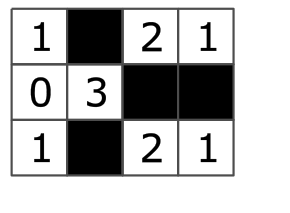
Diana draws a rectangle made of squares on grid paper and colours some squares black. In every white square she writes the number of black squares next to it (sharing an edge). The diagram shows an example. She now does the same with a rectangle made of 2018 squares. What is the biggest possible sum of all the numbers in the white squares?
Show answer
Answer: D — 3025
Show hints
Hint 1 of 2
The total written down is just the number of shared edges that have a black square on one side and a white square on the other.
Still stuck? Show hint 2 →
Hint 2 of 2
Since \(2018 = 2\times 1009\), the rectangle is either \(1\times 2018\) or \(2\times 1009\); compare which shape allows more black–white edges.
Show solution
Approach: the sum equals the count of black–white shared edges; maximise that
- Each number in a white square counts its black neighbours, so adding them all gives exactly the number of edges that separate a black square from a white square.
- Because \(2018 = 2\times 1009\), the rectangle is \(1\times 2018\) or \(2\times 1009\); colouring whole columns black/white alternately so that no two same-colour columns touch makes nearly every internal edge a black–white edge.
- For the \(2\times 1009\) strip this alternating pattern gives \(3\times 1009 - 2 = 3025\) such edges (the \(1\times 2018\) strip gives only \(2017\)), so the largest total is 3025.
Mark:
· log in to save