Problem 22 · 2017 Math Kangaroo
Stretch
Geometry & Measurement
area-decomposition
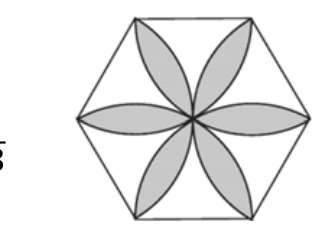
The diagram shows a regular hexagon with side length 1. The grey flower is outlined by circular arcs of radius 1 whose centres lie at the vertices of the hexagon. How big is the area of the grey flower?
Show answer
Answer: E — \(2\pi - 3\sqrt{3}\)
Show hints
Hint 1 of 2
Each petal is built from two circular arcs of radius 1; relate it to a 60-degree sector of a unit circle.
Still stuck? Show hint 2 →
Hint 2 of 2
Subtract the straight triangular pieces from the arc sectors to isolate the petal area, then multiply by the number of petals.
Show solution
Approach: decompose the flower into arc-sectors minus triangles
- Each petal is the overlap of two unit circles centred at adjacent vertices; that lens is two \(60^\circ\) sectors minus the equilateral triangle counted twice, i.e. \(2\cdot\frac{\pi}{6} - 2\cdot\frac{\sqrt{3}}{4} = \frac{\pi}{3} - \frac{\sqrt{3}}{2}\).
- The flower is made of six such petals, so its area is \(6\left(\frac{\pi}{3} - \frac{\sqrt{3}}{2}\right)\).
- That simplifies to \(2\pi - 3\sqrt{3}\), which is answer E.
Mark:
· log in to save