Problem 11 · 2015 Math Kangaroo
Medium
Spatial & Visual Reasoning
cube-viewsspatial-reasoning
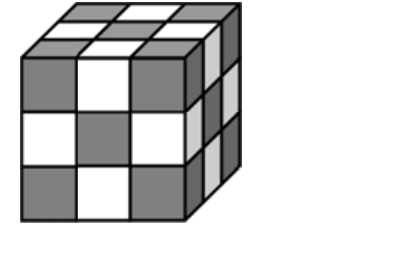
Jack makes a cube from 27 small cubes. The small cubes are either grey or white as shown in the diagram. Two small cubes with the same colour are not allowed to be placed next to each other. How many small, white cubes has Jack used?
Show answer
Answer: C — 13
Show hints
Hint 1 of 2
No two cubes of the same colour may touch, so the colours alternate like the dark-and-light squares on a checkerboard.
Still stuck? Show hint 2 →
Hint 2 of 2
The big cube is built from 27 little cubes; the corners are grey, so count up the grey cubes and the rest are white.
Show solution
Approach: colour the 27 little cubes like a checkerboard
- Since same-coloured cubes can't touch, the colours flip back and forth like a checkerboard going up, across and back.
- Start the corner as grey: then the grey cubes are the 8 corners and the 6 little cubes sitting in the middle of each face — that is 8 + 6 = 14 grey cubes.
- All 27 cubes minus the 14 grey ones leaves the white cubes: 27 − 14 = 13.
- Jack used 13 white cubes.
Mark:
· log in to save