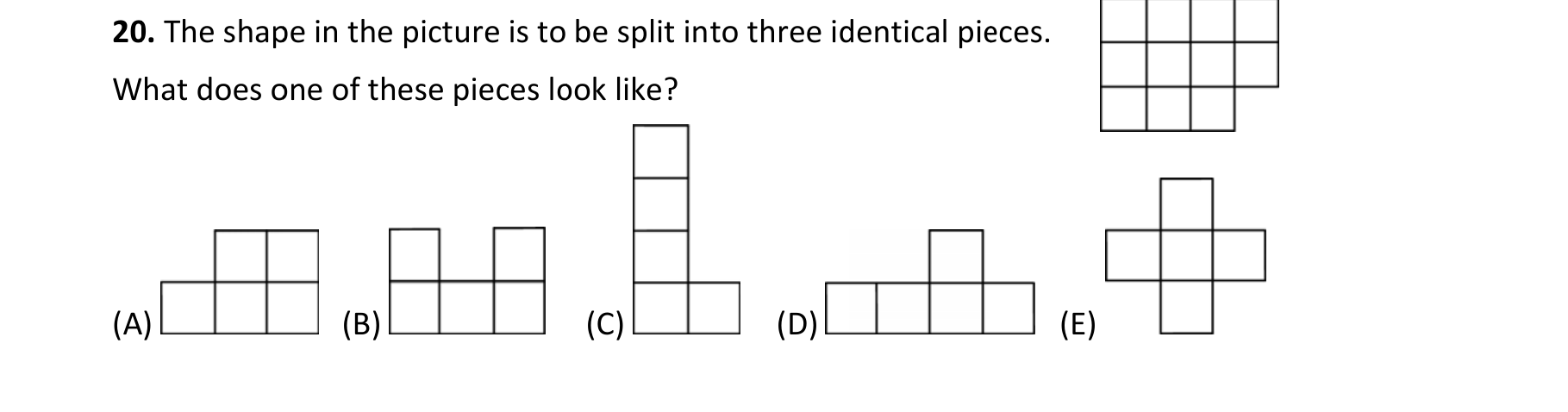
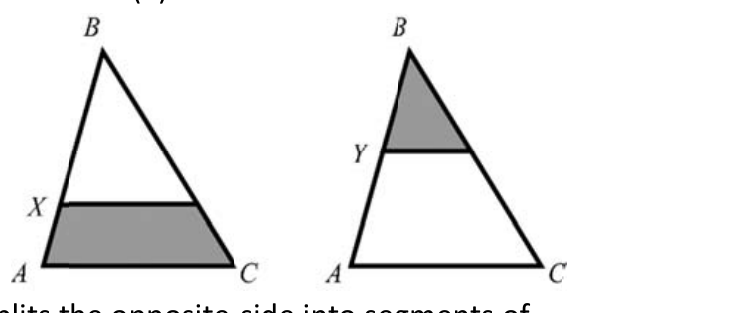
For each shape, ask whether the grey part and the white part are the same size.
Still stuck? Show hint 2 →
Hint 2 of 2
An altitude of a triangle splits it into two pieces of equal area; check which figure is cut into two matching halves.
Show solution
Approach: compare grey area to whole in each picture
In the triangle the line goes straight down from the top vertex, cutting it into two pieces of equal area, and exactly one of them is grey.
The circle is in thirds (grey = one third), the four-square figure has three of four shaded, and the square-with-X and the pentagon-star are not split into two equal grey/white halves.
Only the triangle has exactly one half coloured grey, so the answer is B.
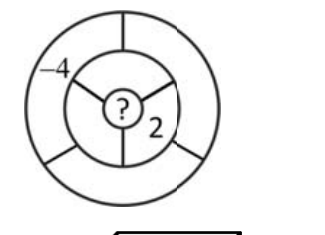
Start with the number in the first cloud and follow the arrows. The arrows say, in order, −0, then +1, then ×5. Which number is hidden behind the question mark?
Show answer
Answer: E — 15
Show hints
Hint 1 of 2
Start with the number in the first cloud and do what each arrow says, one arrow at a time.
Still stuck? Show hint 2 →
Hint 2 of 2
Taking away 0 keeps the number the same; then add 1, then make 5 copies of it.
Show solution
Approach: follow the operation chain left to right
Begin with 2. The first arrow says −0, so it stays 2.
Andrea was born sometime in the year 1997 and her sister Charlotte sometime in the year 2001. What is known for certain about the age difference of the two sisters? It is…
Show answer
Answer: E — not less than 3 years
Show hints
Hint 1 of 2
Push the two birth dates to their extremes to find the smallest and largest possible gap.
Still stuck? Show hint 2 →
Hint 2 of 2
Born in 1997 vs 2001 means the gap is bigger than 3 years but can fall short of 4.
Show solution
Approach: bound the age gap from both extremes
The earliest Andrea could be born is start of 1997; the latest Charlotte is end of 2001, giving an age gap just under 5 years.
The latest Andrea is end of 1997 and the earliest Charlotte is start of 2001, giving an age gap just over 3 years.
So the gap is always more than 3 years; nothing stronger is guaranteed, so it is not less than 3 years (E).
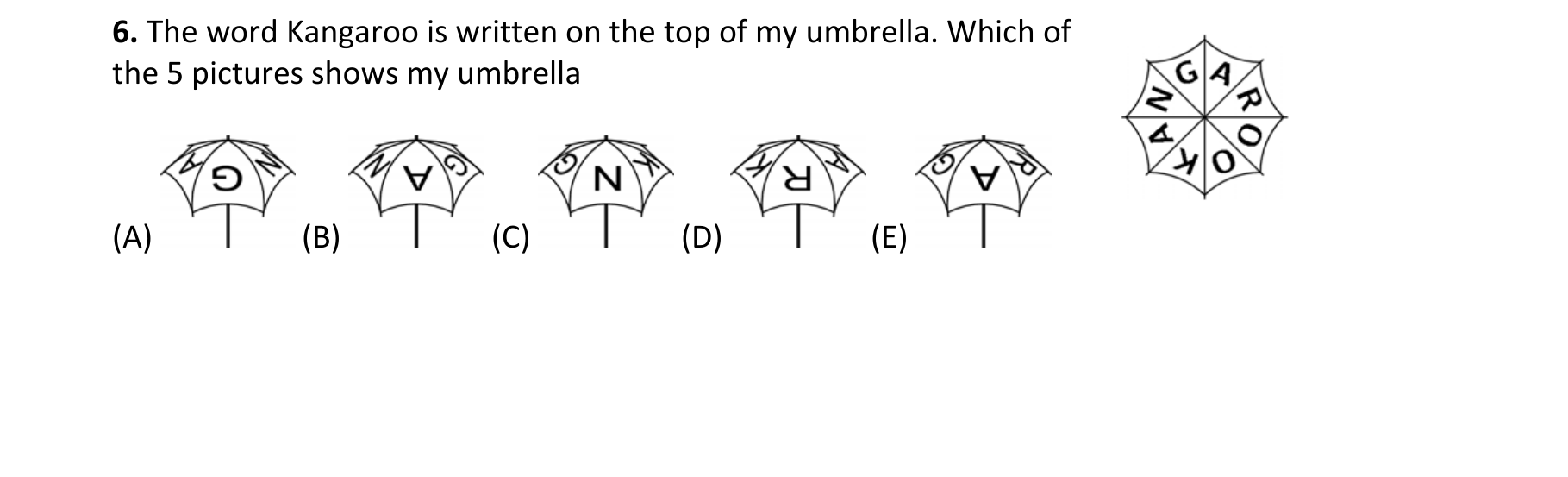
On the real umbrella the eight letters of KANGAROO appear in one fixed cyclic order around the rim.
Still stuck? Show hint 2 →
Hint 2 of 2
Pick the front letter of each pictured umbrella and read the neighbours left and right; the order around the rim must always match KANGAROO (just rotated).
Show solution
Approach: check the cyclic order of letters around each umbrella
Around the rim the letters always follow the same circular sequence K-A-N-G-A-R-O-O (the umbrella can only be turned, not rearranged).
Four of the pictures show that exact cyclic order, just rotated to a different front panel.
Picture C has the letters in an order that cannot be obtained by turning the umbrella, so it is the one that does not show the umbrella.
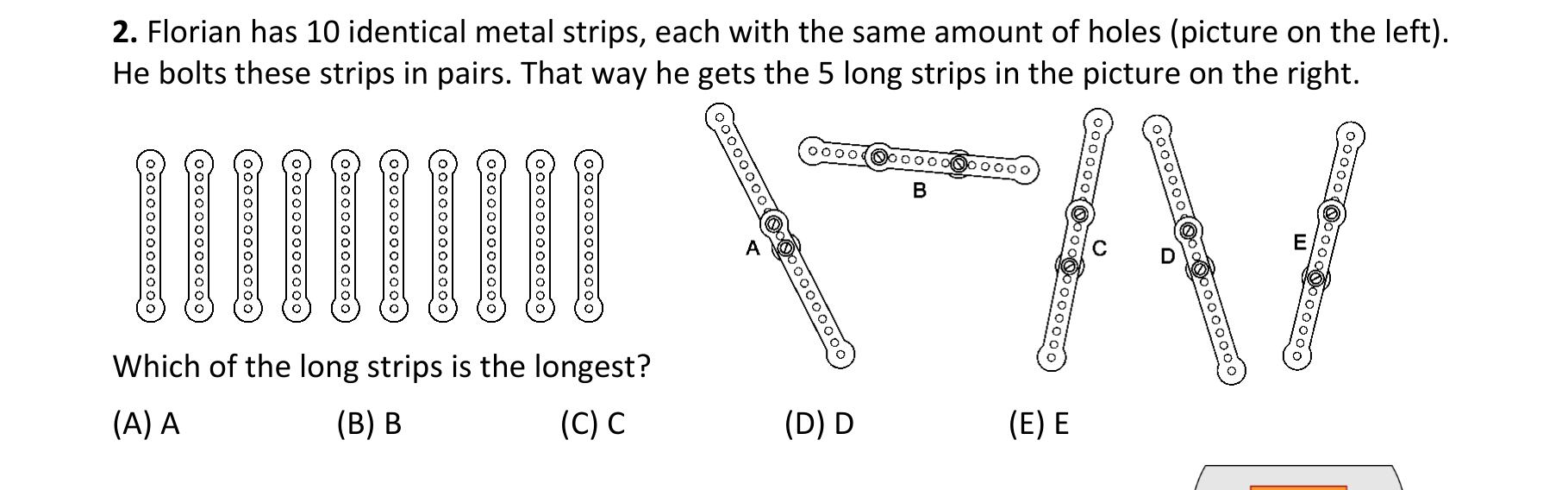
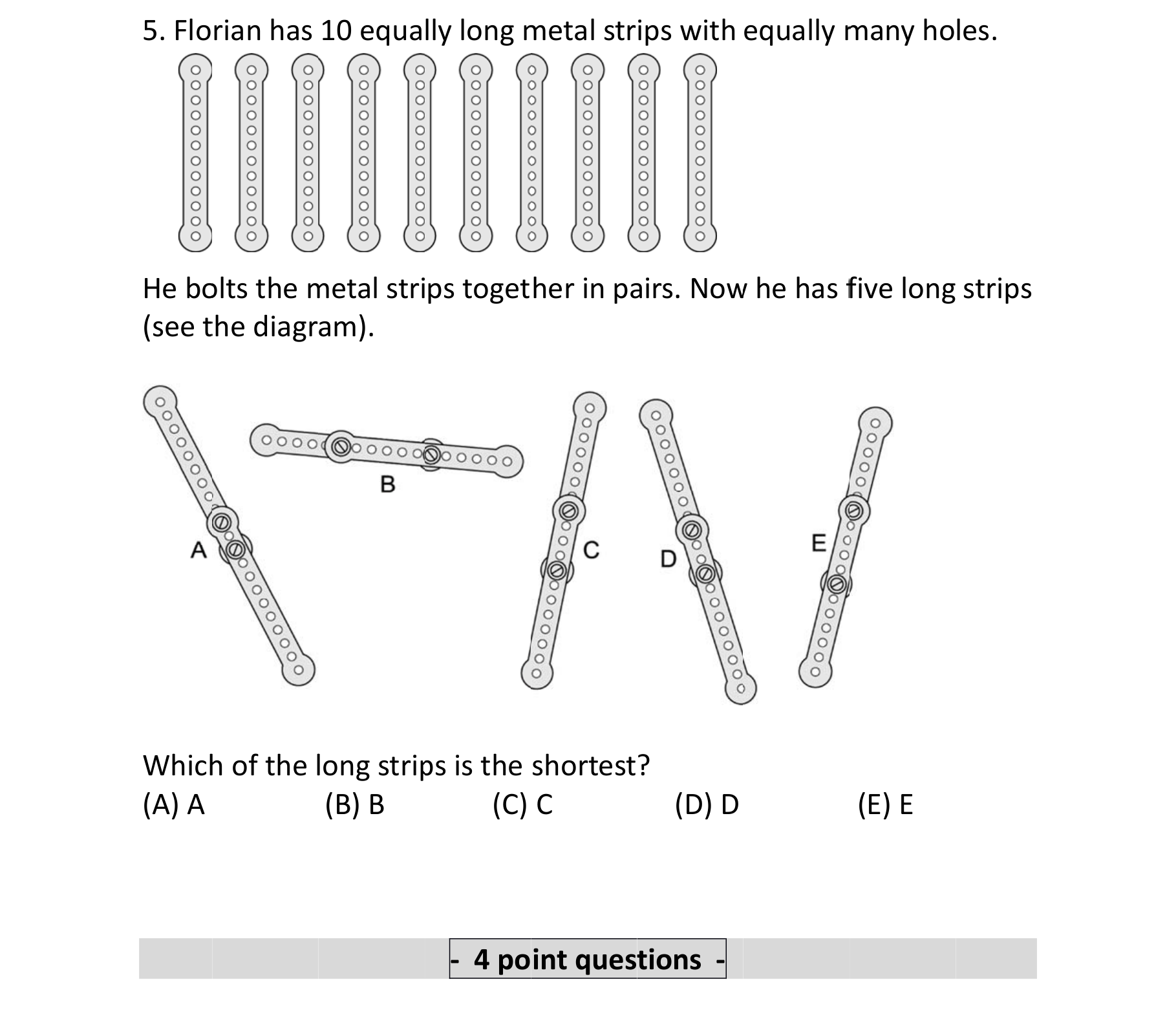
Florian has 10 identical metal strips, each with the same number of holes. He bolts them together in pairs to make the 5 long strips in the picture. Which of the long strips is the longest?
Show answer
Answer: A
Show hints
Hint 1 of 2
Each long strip is two short strips laid end to end, sharing a few holes where they overlap.
Still stuck? Show hint 2 →
Hint 2 of 2
The fewer holes the two short strips share, the further the long strip stretches.
Show solution
Approach: compare how much each pair of strips overlaps
Every long strip is two equal short strips bolted so they share some holes in the overlap.
Picture sharing only 1 hole versus sharing many: the less the strips overlap, the longer they reach.
Strip A is the one whose two pieces overlap the least, so it stretches the furthest.
After mum had hung the t-shirts on the washing line for drying, her son hung a single sock between each two t-shirts. Now there are 29 pieces of clothing on the line. How many of them are t-shirts?
Show answer
Answer: E — 15
Show hints
Hint 1 of 2
A sock goes in every gap between two t-shirts, so socks number one fewer than t-shirts.
Still stuck? Show hint 2 →
Hint 2 of 2
If there are T t-shirts, the line holds T + (T−1) pieces; set that equal to 29.
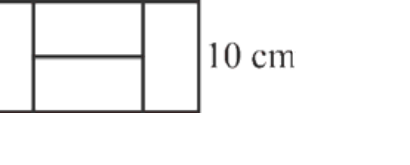
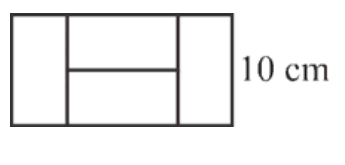
A rectangle is made of 4 equally sized small rectangles. The shorter side of the big rectangle is 10 cm long. How long is the longer side of the big rectangle?
Show answer
Answer: B — 20 cm
Show hints
Hint 1 of 2
Look at how the four equal small rectangles are arranged along the short and long sides.
Still stuck? Show hint 2 →
Hint 2 of 2
Two small rectangles stack to make the 10 cm short side; that fixes one small rectangle, then build the long side.
Show solution
Approach: use the arrangement of the four equal pieces
The short side of the big rectangle is split into two equal small rectangles, so each small rectangle is 10 by 5.
The long side is made of two small-rectangle long edges placed end to end.
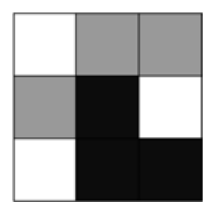
Sam paints the 9 small squares in the shape either white, grey or black. What is the minimum number he must paint over so that no two squares sharing a side have the same colour?
Show answer
Answer: A — 2
Show hints
Hint 1 of 2
Find every pair of side-touching squares that currently share a colour; those are the trouble spots.
Still stuck? Show hint 2 →
Hint 2 of 2
Try to fix several clashes at once by changing a single well-chosen square, and count the fewest squares you must repaint.
Show solution
Approach: spot the colour clashes and repaint the fewest squares to break them all
Scan the grid for neighbours that share a colour: the two grey squares touch, and the black squares touch.
Changing two carefully chosen squares is enough to separate every same-colour pair, while one change still leaves a clash somewhere.
Mr Bauer has 10 ducks. 5 of these ducks lay an egg every day. The other 5 lay an egg every second day. How many eggs will the 10 ducks have laid after 10 days?
Show answer
Answer: A — 75
Show hints
Hint 1 of 2
Work out the two groups of ducks separately, then add their egg counts.
Still stuck? Show hint 2 →
Hint 2 of 2
An every-second-day duck lays once every two days, so in 10 days it lays only 5 eggs.
Show solution
Approach: count each group's eggs over 10 days and add
The 5 everyday ducks each lay 10 eggs in 10 days: 5 × 10 = 50 eggs.
The other 5 ducks lay every second day, so 5 eggs each in 10 days: 5 × 5 = 25 eggs.
Anna, Beate and Cindy buy a bag of 30 biscuits together. They get 10 biscuits each. But Anna has paid 80 cents, Beate 50 cents and Cindy 20 cents. How many more biscuits should Anna have got, if they had shared them in proportion with the amount they had each paid?
Show answer
Answer: E — 6
Show hints
Hint 1 of 2
Split the 30 biscuits in the same ratio as the money paid: 80 : 50 : 20.
Still stuck? Show hint 2 →
Hint 2 of 2
Simplify 80 : 50 : 20 to 8 : 5 : 2 and find Anna's fair share, then subtract the 10 she got.
Show solution
Approach: share in proportion to money paid
The payments 80 : 50 : 20 simplify to 8 : 5 : 2, which is 15 equal parts.
30 biscuits over 15 parts means 2 biscuits per part.
Anna's fair share = 8 × 2 = 16 biscuits.
She already received 10, so she should have got 16 − 10 = 6 more.
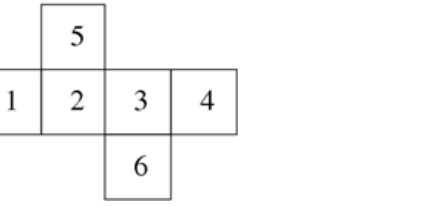
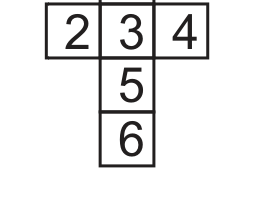
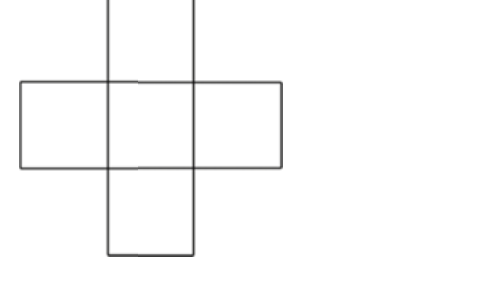
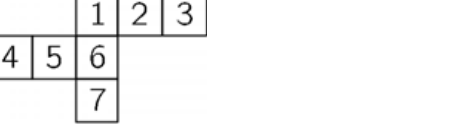
The diagram shows the net of a cube whose faces are numbered. Sascha adds the numbers that are on opposite faces of the cube. Which three results does he get?
Show answer
Answer: A — 4, 6, 11
Show hints
Hint 1 of 2
Fold the net into a cube in your head and see which faces end up opposite each other.
Still stuck? Show hint 2 →
Hint 2 of 2
On a band of four faces in a row, opposite faces skip one; then pair the two faces sticking out.
Show solution
Approach: identify the three pairs of opposite faces
Faces 1, 2, 3, 4 form a band around the cube, so 1 is opposite 3 and 2 is opposite 4.
The remaining faces 5 and 6 are top and bottom, so 5 is opposite 6.
The three opposite-face sums are 1+3 = 4, 2+4 = 6, and 5+6 = 11.
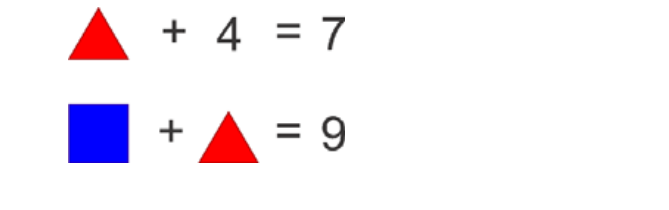
The two shapes below each stand for a number. The red triangle plus 4 equals 7, and the blue square plus the red triangle equals 9. Which number is hidden behind the square?
Show answer
Answer: E — 6
Show hints
Hint 1 of 2
The first picture-sum tells you the triangle's number all by itself.
Still stuck? Show hint 2 →
Hint 2 of 2
Once you know the triangle, use the second picture-sum to find the square.
Show solution
Approach: find the triangle first, then use it to find the square
Triangle and 4 make 7, so the triangle must be 3 (because 3 + 4 = 7).
The square and the triangle make 9, so the square and 3 make 9.
The number that goes with 3 to make 9 is 6 (since 6 + 3 = 9).
Florian has 10 equally long metal strips with equally many holes. He bolts the metal strips together in pairs. Now he has five long strips (see the diagram). Which of the long strips is the shortest?
Show answer
Answer: B
Show hints
Hint 1 of 2
Each long strip is two of the equal short strips bolted together, but they overlap by some holes.
Still stuck? Show hint 2 →
Hint 2 of 2
The strip that overlaps the most (shares the most holes) ends up the shortest.
Show solution
Approach: more overlap means a shorter combined strip
All the short strips are the same length, so the total length of a pair depends only on how much the two pieces overlap.
The more holes the two pieces share, the shorter the finished strip.
Strip B has the biggest overlap, so it is the shortest: choice B.
Which of the following fractions is smaller than 2?
Show answer
Answer: E — \(\frac{23}{12}\)
Show hints
Hint 1 of 3
Notice that a fraction equals exactly 2 when the top is double the bottom.
Still stuck? Show hint 2 →
Hint 2 of 3
So "smaller than 2" just means the top number is less than two times the bottom number.
Still stuck? Show hint 3 →
Hint 3 of 3
Go down the list and compare each top with double its bottom.
Show solution
Approach: compare each numerator to twice its denominator
A fraction is smaller than 2 exactly when its top number is less than double its bottom number (because doubling the bottom is what makes the fraction equal 2).
Compare each one: 19 vs 16, 20 vs 18, 21 vs 20, 22 vs 22, 23 vs 24 — in the first four the top is as big or bigger, so those are 2 or more.
Only \(\frac{23}{12}\) has its top smaller than the doubled bottom (23 < 24), so the answer is E.
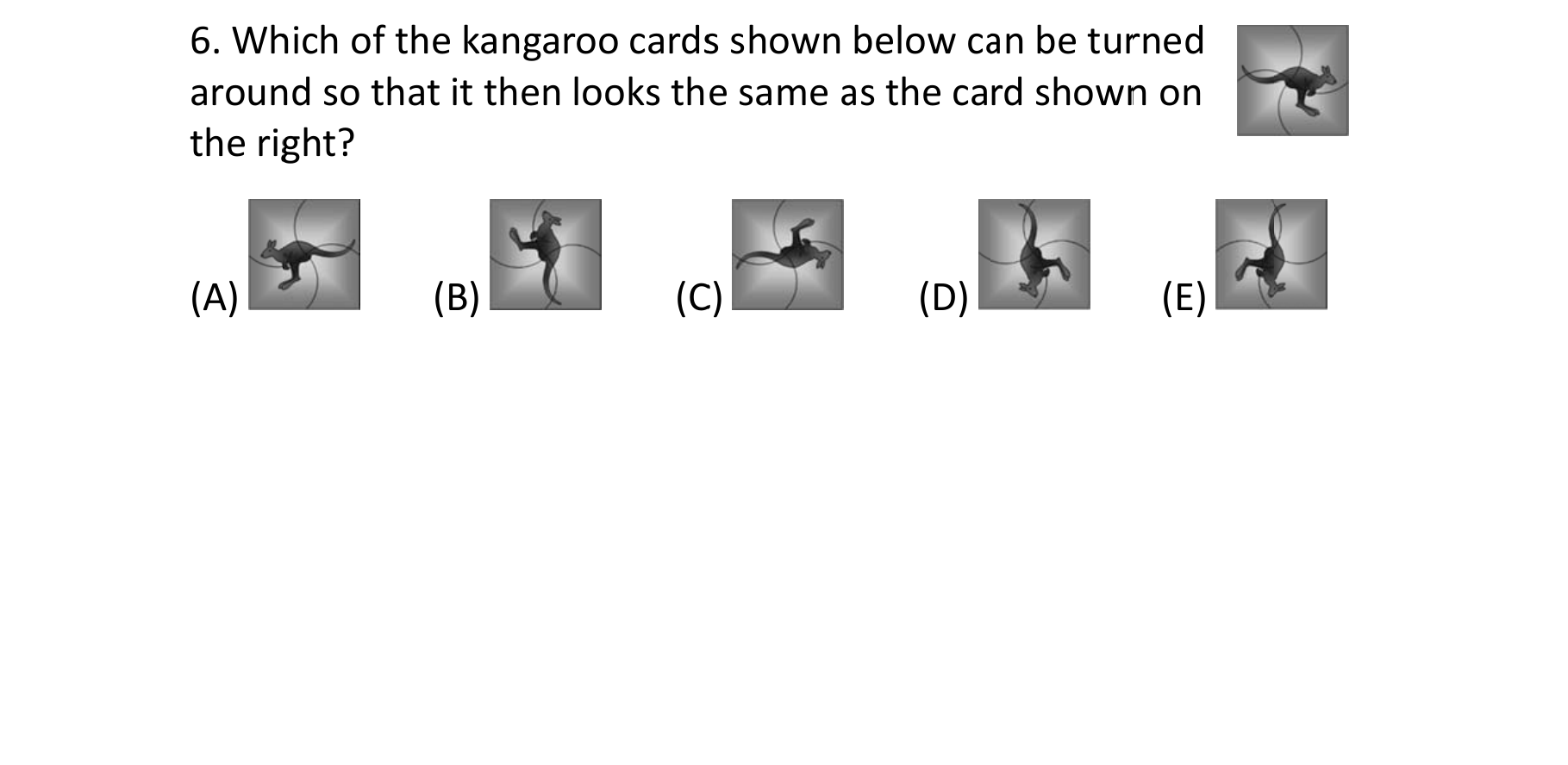
Which of the kangaroo cards shown below can be turned around so that it then looks the same as the card shown on the right? (The five cards and the reference card are shown in the figure.)
Show answer
Answer: E
Show hints
Hint 1 of 2
You may only turn (rotate) a card, not flip it over like a mirror.
Still stuck? Show hint 2 →
Hint 2 of 2
Find the option that becomes exactly the reference kangaroo after some rotation.
Show solution
Approach: test each card for a matching rotation
The card on the right shows the kangaroo in one pose; turning a card keeps it the same shape (no mirror flip).
Rotate each option in your mind and compare it to the reference.
Only card E matches the reference after a turn, so the answer is E.
The drive from A-village to B-town via C-house takes 130 minutes. The drive from A-village to C-house takes 35 minutes. How many minutes does a drive from C-house to B-town take?
Show answer
Answer: A — 95
Show hints
Hint 1 of 2
The whole trip splits into the first leg plus the part you want.
Still stuck? Show hint 2 →
Hint 2 of 2
Subtract the A-to-C time from the total A-to-B time.
Show solution
Approach: subtract the known leg from the total
The full drive A to B via C takes 130 minutes.
The first leg A to C takes 35 minutes.
So the remaining leg C to B takes 130 - 35 = 95 minutes.
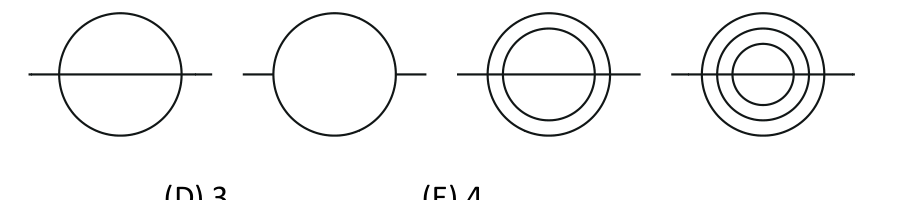
A shape is traceable in one stroke (without retracing) exactly when it is connected and has at most two vertices where an odd number of edges meet.
The circle with a line passing all the way through, and the two- and three-ring targets, each have only the two free line tips as odd vertices, so all three are traceable.
The shape whose line stops on each side of the circle (two separate stubs) has four odd points and fails, leaving 3 drawable shapes (D).
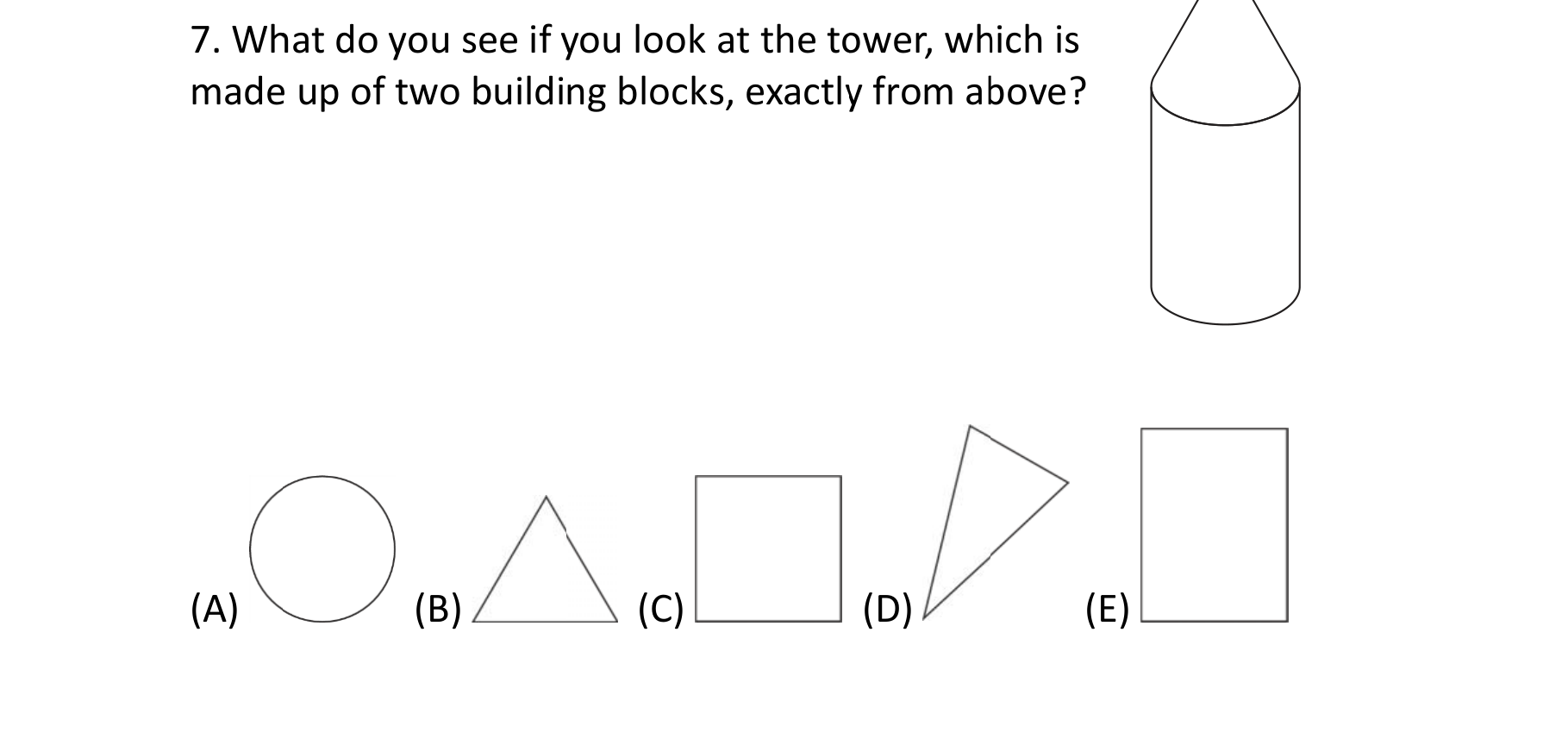
What do you see if you look at the tower, which is made up of two building blocks, exactly from above? (The tower and the five answer pictures are shown in the figure.)
Show answer
Answer: A
Show hints
Hint 1 of 2
Looking straight down, you only see the outline of the widest part of the tower.
Still stuck? Show hint 2 →
Hint 2 of 2
Both round blocks in the tower look round when you peek at them from straight above.
Show solution
Approach: find the shape of the top-down outline
Pretend you are a bird flying right over the tower and looking straight down.
Both round blocks make a round outline, so from above you see a circle.
There are 33 teenagers in a class. Their favourite subjects are either computing, PE or both. Three of them like both subjects. There are twice as many teenagers who only like computing as teenagers who like PE only. How many of them like computing?
Show answer
Answer: E — 23
Show hints
Hint 1 of 2
Split the class into computing-only, PE-only, and both, and write the total.
Still stuck? Show hint 2 →
Hint 2 of 2
Let PE-only be p; then computing-only is 2p, and 3 + p + 2p = 33.
Show solution
Approach: set up parts of a Venn split
Let PE-only = p, so computing-only = 2p, and both = 3.
3 + p + 2p = 33 gives 3p = 30, so p = 10.
Computing-only = 20; those who like computing = 20 + 3 (the 'both') = 23.
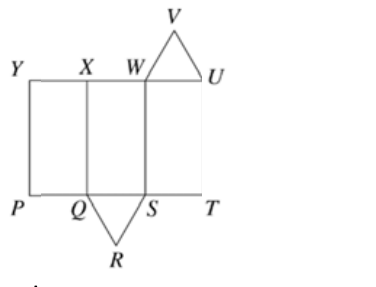
The diagram shows the net of a three-sided prism. Which line of the diagram forms an edge of the prism together with line UV when the net is folded up?
Show answer
Answer: C — XY
Show hints
Hint 1 of 2
Fold the net into the prism and watch where the endpoints of UV land.
Still stuck? Show hint 2 →
Hint 2 of 2
When folded, the edge along UV meets another edge of the net; find which labelled segment touches it.
Show solution
Approach: fold the net and see which edge meets UV
The net of the triangular prism wraps the rectangular faces around the two triangular ends.
When it is folded up, segment UV is brought together with the segment that shares its endpoints after folding.
A quadrilateral is called convex if all its internal angles are less than 180°. The number of right angles in a convex quadrilateral is n. Which of the following lists is a complete listing of all possible values of n?
Show answer
Answer: B — 0, 1, 2, 4
Show hints
Hint 1 of 2
Could a convex quadrilateral have exactly three right angles?
Still stuck? Show hint 2 →
Hint 2 of 2
The four interior angles must add to 360°.
Show solution
Approach: use that the four angles sum to 360°
0, 1 and 2 right angles are all possible (e.g. a general quadrilateral, a kite, a right trapezoid).
If three angles were 90°, the fourth would also be 360−270 = 90°, giving four — so exactly three is impossible.
Four right angles is a rectangle, which works, so the complete list is 0, 1, 2, 4 (B).
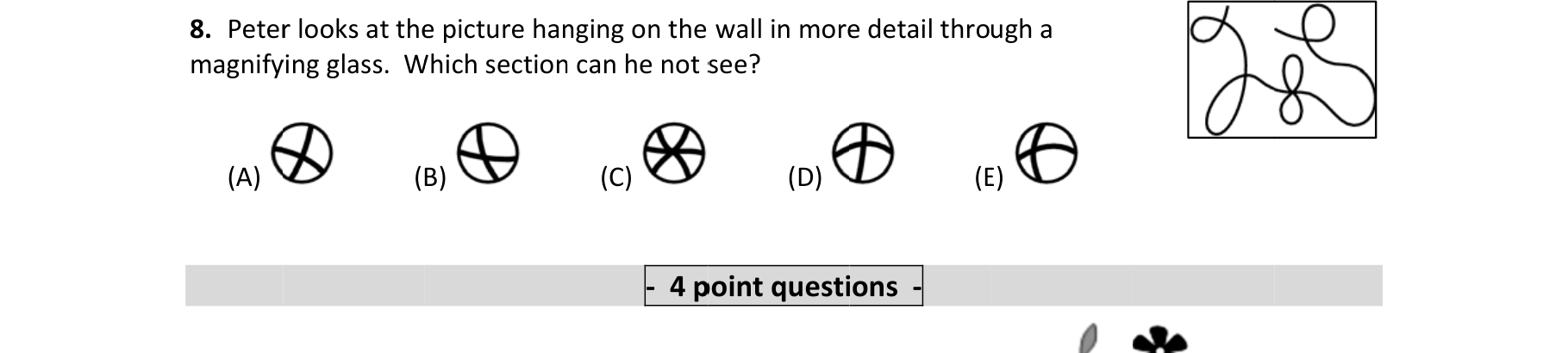
A magnified circular patch must match a piece of the squiggly drawing exactly in how the lines cross it.
Still stuck? Show hint 2 →
Hint 2 of 2
Compare the line pattern inside each circle with what actually appears in the picture; one pattern never occurs.
Show solution
Approach: match each magnified circle to a region of the picture
Through the magnifying glass Peter sees a round window onto part of the drawing, so the lines inside the circle must reproduce a real crossing in the picture.
Four of the circles match a place where the curves cross or pass through as shown.
The pattern of lines in circle E does not occur anywhere in the picture, so that is the section he cannot see.
Imagine slitting the glass along one slant line and rolling it flat.
Still stuck? Show hint 2 →
Hint 2 of 2
The top and bottom rims become circular arcs of different radii.
Show solution
Approach: unroll the lateral surface of the frustum
Cutting the side of the truncated cone along a slant line and flattening it gives a piece of a sector centred at the apex of the full cone (the cone you get by extending the glass to a point).
The top and bottom rims flatten into two concentric circular arcs (the wider bottom rim becomes the longer outer arc), joined by two straight slant edges — an annular sector.
That is the shape with two arcs and the apex shown by dashed lines (E).
Each plant in John's garden has exactly 5 leaves or exactly 2 leaves and a flower. In total the plants have 6 flowers and 32 leaves. How many plants are growing in the garden?
Show answer
Answer: A — 10
Show hints
Hint 1 of 2
Only the 2-leaf plants carry flowers, so the number of flowers tells you how many of those there are.
Still stuck? Show hint 2 →
Hint 2 of 2
Subtract the leaves on the flowering plants from 32 to see how many leaves are left for the 5-leaf plants.
Show solution
Approach: use the flowers to fix one kind of plant, then account for the leaves
Each flower belongs to a 2-leaf plant, and there are 6 flowers, so there are 6 plants with 2 leaves, giving 6 × 2 = 12 leaves.
That leaves 32 − 12 = 20 leaves for the 5-leaf plants, which is 20 ÷ 5 = 4 plants.
Luis has got 7 apples and 2 bananas. He gives 2 apples to his friend Jacob, who gives him bananas in return. Afterwards Luis has got the same amount of apples as bananas. How many bananas did Luis get from Jacob?
Show answer
Answer: B — 3
Show hints
Hint 1 of 2
First update the apple count after Luis gives 2 away.
Still stuck? Show hint 2 →
Hint 2 of 2
Set the new banana count equal to the apple count and read off how many bananas he received.
Show solution
Approach: track apples and bananas, then make them equal
Luis gives away 2 of his 7 apples, leaving 5 apples.
Afterwards he has as many bananas as apples, so he must have 5 bananas.
He started with 2 bananas, so he received 5 − 2 = 3 bananas from Jacob.
Herr Waxi buys 100 candles. Each day he burns down one candle. From the left overs of seven burned down candles, he can always make a new candle. After how many days does he have to buy new candles?
Show answer
Answer: D — 116
Show hints
Hint 1 of 2
Every candle burned leaves a stub, and 7 stubs become a fresh candle — keep recycling.
Still stuck? Show hint 2 →
Hint 2 of 2
Count how many candles in total he can burn, recycling stubs, then that many days pass before he needs more.
Show solution
Approach: recycle stubs until none remain
100 candles burn to 100 stubs → 14 new candles (2 stubs left).
Those 14 burn → 14 + 2 = 16 stubs → 2 new candles (2 left).
Those 2 burn → 2 + 2 = 4 stubs (not enough for another).
Total burned = 100 + 14 + 2 = 116, so he must buy new candles after 116 days.
One corner of a square piece of paper is folded into the middle of the square. That way an irregular pentagon is created. The numerical values of the areas of the pentagon and the square are consecutive whole numbers. What is the area of the square?
Show answer
Answer: C — 8
Show hints
Hint 1 of 2
Folding one corner to the centre removes a triangle, so the pentagon area is the square area minus that triangle.
Still stuck? Show hint 2 →
Hint 2 of 2
Write the square area as A; the removed triangle is A/8, so the pentagon is 7A/8, and the two areas are consecutive whole numbers.
Show solution
Approach: express the removed triangle as a fraction of the square
Folding a corner into the centre covers a triangle equal to one eighth of the square.
So the pentagon has area A - A/8 = 7A/8, where A is the square area.
Square and pentagon are consecutive whole numbers, so their difference A/8 = 1, giving A = 8.
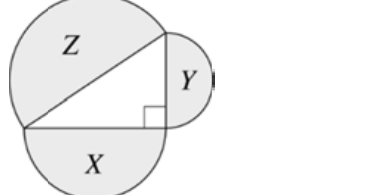
The diameters of three semi-circles form the sides of a right-angled triangle. Their areas are X cm², Y cm² and Z cm² as pictured. Which of the following expressions is definitely correct?
Show answer
Answer: C — X + Y = Z
Show hints
Hint 1 of 2
A semicircle's area depends on the square of its diameter.
Still stuck? Show hint 2 →
Hint 2 of 2
The diameters are the triangle's sides, which satisfy the Pythagorean relation.
Show solution
Approach: semicircle areas track the squares of the sides
Each semicircle area is πd²/8, proportional to the square of its diameter (a side of the right triangle).
For a right triangle, leg² + leg² = hypotenuse², so the two smaller semicircle areas add to the largest.
Andrea has 4 equally long strips of paper. When she glues two together with an overlap of 10 cm, she gets a strip 50 cm long. With the other two she wants to make a 56 cm long strip. How long must the overlap be?
Show answer
Answer: A — 4 cm
Show hints
Hint 1 of 2
Two strips glued together lose exactly one overlap from their combined length.
Still stuck? Show hint 2 →
Hint 2 of 2
First find the length of one strip from the 50 cm result, then use it for the 56 cm strip.
Show solution
Approach: find one strip length, then solve for the new overlap
Two strips glued with a 10 cm overlap measure 50 cm, so the two full strips total 50 + 10 = 60 cm, meaning each strip is 30 cm.
The other two strips also total 60 cm; gluing them to make 56 cm loses 60 − 56 = 4 cm to overlap.
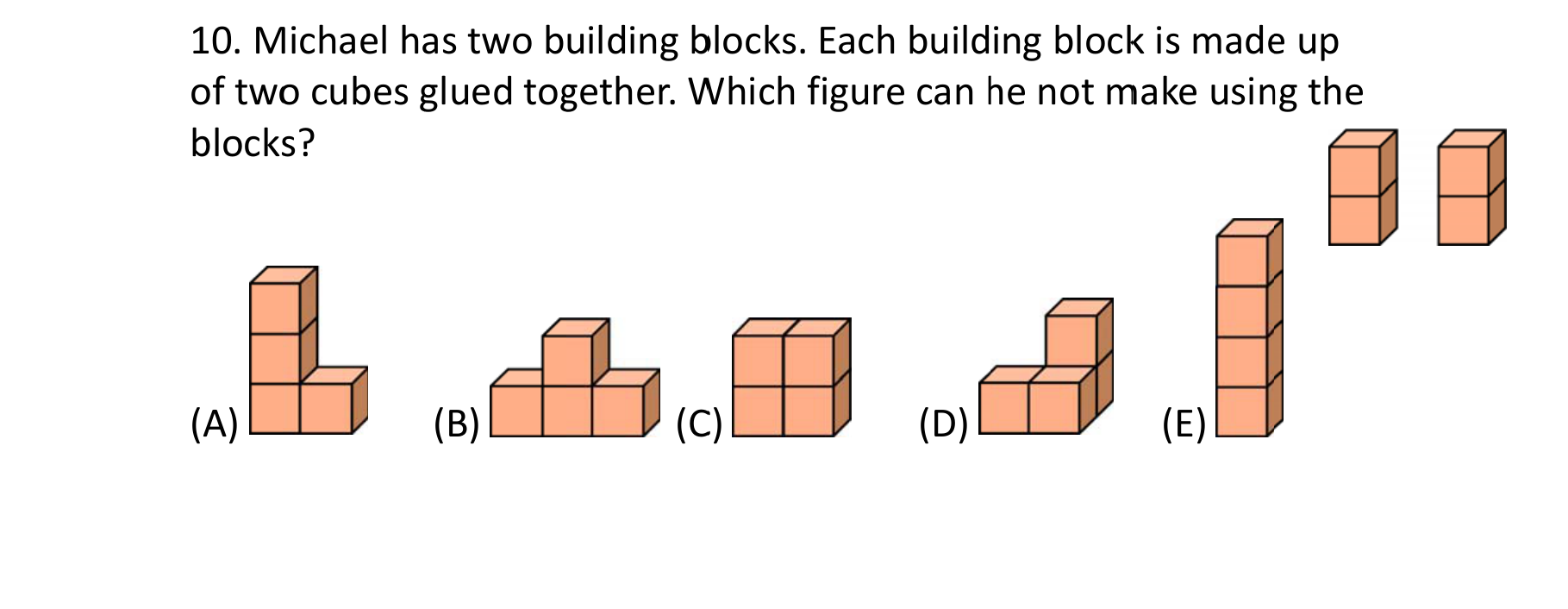
Michael has two building blocks. Each building block is made up of two cubes glued together. Which figure can he not make using the blocks? (The five answer figures are shown in the figure.)
Show answer
Answer: B
Show hints
Hint 1 of 2
Each block is two cubes glued in a straight line (a 1x2 domino shape).
Still stuck? Show hint 2 →
Hint 2 of 2
A figure can be made only if it splits into two such straight 1x2 pieces.
Show solution
Approach: check if each shape splits into two straight two-cube blocks
Michael has two straight pieces, each made of two cubes in a row.
Try to cut each figure into two such straight two-cube pieces.
Four of the figures can be split this way, but figure B cannot be cut into two straight two-cube blocks, so the answer is B.
A pentagon is called convex if all its internal angles are less than 180°. The number of right angles in a convex pentagon is n. Which of the following lists is a complete listing of all possible values of n?
Show answer
Answer: C — 0, 1, 2, 3
Show hints
Hint 1 of 2
The five interior angles of a pentagon add to 540°, and each must stay below 180°.
Still stuck? Show hint 2 →
Hint 2 of 2
How many 90° angles can you use while the remaining angles each stay under 180°?
Show solution
Approach: use the angle-sum bound
A convex pentagon's angles sum to 540°, each < 180°.
0, 1, 2, or 3 right angles all leave the rest achievable (e.g. 3 right angles leave 270° over two angles, each < 180°).
4 right angles would force the 5th to be 540 − 360 = 180°, not allowed.
The side lengths of a triangle are 6, 10 and 11. An equilateral triangle has the same perimeter as this triangle. How long is one side of the equilateral triangle?
Show answer
Answer: D — 9
Show hints
Hint 1 of 2
First find the perimeter of the given triangle.
Still stuck? Show hint 2 →
Hint 2 of 2
An equilateral triangle with the same perimeter has each side equal to that perimeter divided by 3.
Show solution
Approach: match perimeters then divide by 3
The triangle's perimeter is 6 + 10 + 11 = 27.
An equilateral triangle with the same perimeter also has perimeter 27.
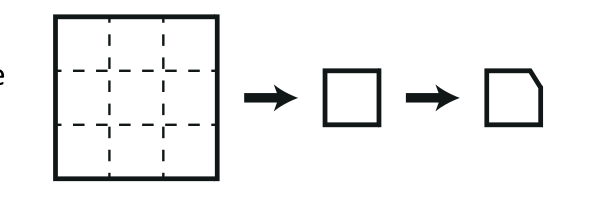
A square bit of paper is folded along the dashed lines in some order and direction. One of the corners of the resulting small square is cut off. The piece of paper is then unfolded. How many holes are on the inner area of the piece of paper?
Show answer
Answer: B — 1
Show hints
Hint 1 of 2
The folds stack the 3×3 grid into one small square, so the single cut copies onto a matching point in every cell.
Still stuck? Show hint 2 →
Hint 2 of 2
A copied cut only becomes a hole when it lands strictly inside the unfolded sheet, not on its outer edge.
Show solution
Approach: track the cut through the folded layers
Folding along the dashed thirds stacks all nine cells of the 3×3 grid into the small square, so cutting one corner of the stack puts a matching cut at the same corner of every cell.
When unfolded, those copied cuts that land on the sheet's outer border only notch the edge, while a cut at an interior grid point makes a real hole.
Exactly one of the copies falls on an interior point of the sheet, leaving a single hole, so the answer is 1 (B).
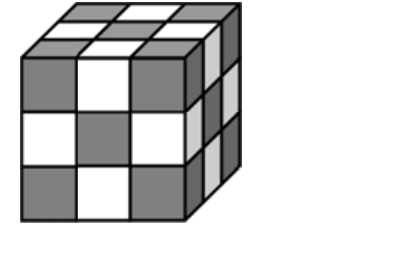
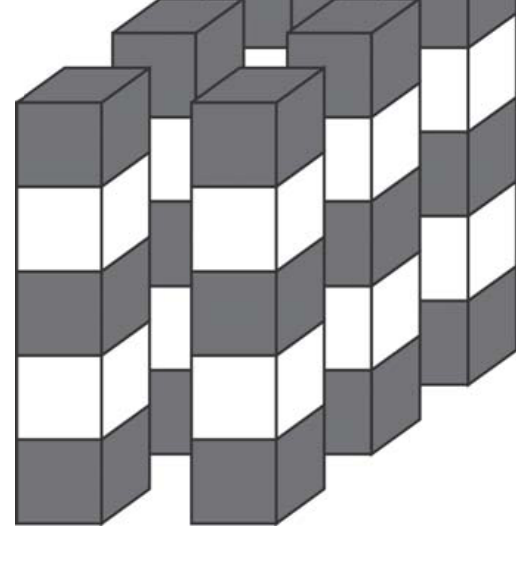
Jack makes a cube from 27 small cubes. The small cubes are either grey or white as shown in the diagram. Two small cubes with the same colour are not allowed to be placed next to each other. How many small, white cubes has Jack used?
Show answer
Answer: C — 13
Show hints
Hint 1 of 2
No two cubes of the same colour may touch, so the colours alternate like the dark-and-light squares on a checkerboard.
Still stuck? Show hint 2 →
Hint 2 of 2
The big cube is built from 27 little cubes; the corners are grey, so count up the grey cubes and the rest are white.
Show solution
Approach: colour the 27 little cubes like a checkerboard
Since same-coloured cubes can't touch, the colours flip back and forth like a checkerboard going up, across and back.
Start the corner as grey: then the grey cubes are the 8 corners and the 6 little cubes sitting in the middle of each face — that is 8 + 6 = 14 grey cubes.
All 27 cubes minus the 14 grey ones leaves the white cubes: 27 − 14 = 13.
A cyclist covers a distance of 5 m in one second. The wheels of his bike each have a circumference of 125 cm. How many complete turns does each wheel make in 5 seconds?
Show answer
Answer: D — 20
Show hints
Hint 1 of 2
First find how far the bike travels in 5 seconds, then how far one wheel turn moves it.
Still stuck? Show hint 2 →
Hint 2 of 2
One full turn moves the bike one circumference; divide the distance by the circumference (watch the units).
Show solution
Approach: distance over circumference
In 5 seconds the bike covers 5 * 5 = 25 m = 2500 cm.
Each full wheel turn moves it forward one circumference, 125 cm.
Each day Maria writes down the date and then adds together the individual digits. For instance, today on the 23rd March she writes 23. 03. and calculates 2 + 3 + 0 + 3 = 8. What is the largest total she can make in this way in the course of a year?
Show answer
Answer: E — 20
Show hints
Hint 1 of 2
Maximise the day part and the month part of the digit sum separately.
Still stuck? Show hint 2 →
Hint 2 of 2
The month with the biggest digit sum is September (0 + 9), and you want the day with the biggest digit sum that still exists in that month.
Show solution
Approach: maximise the day-digits and month-digits separately
For the month, 09 gives the largest digit sum 0 + 9 = 9 (months 10, 11, 12 give only 1, 2, 3).
For the day, 29 gives 2 + 9 = 11, the biggest possible (31 gives only 4), and the 29th exists in September.
So the largest total is 29.09 → 2 + 9 + 0 + 9 = 20.
10 runners start in a running race. At the finish, there are 3 more runners behind Thomas than there are in front of him. In which position did Thomas finish?
Show answer
Answer: C — 4
Show hints
Hint 1 of 2
Besides Thomas there are 9 other runners, split into a front group and a back group.
Still stuck? Show hint 2 →
Hint 2 of 2
The back group is 3 bigger than the front group; try sharing the 9 runners so the back has 3 more.
Show solution
Approach: share the other 9 runners into front and back groups
Take Thomas out for a moment: the other 9 runners are split into the ones in front and the ones behind.
The back group must be 3 bigger than the front group, so split 9 into 3 in front and 6 behind (6 is 3 more than 3).
With 3 runners in front of him, Thomas is the next one, so he is in 4th place.
Every one of these six building blocks consists of 5 little cubes. The little cubes are either white or grey. Cubes of equal colour don’t touch each other. How many little white cubes are there in total?
Show answer
Answer: C — 12
Show hints
Hint 1 of 2
In each block of 5 cubes the colours alternate, so they go grey-white-grey-white-grey.
Still stuck? Show hint 2 →
Hint 2 of 2
Count the white cubes in one block, then multiply by the number of blocks.
Show solution
Approach: count white per block, then scale to all blocks
Because same-colour cubes never touch, each block of 5 alternates colour, giving 3 of one colour and 2 of the other.
Each block ends up with 2 white cubes.
With 6 blocks that is 6 x 2 = 12 white cubes, choice C.
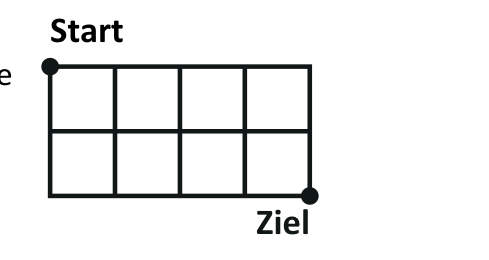
The side lengths of each of the small squares in the diagram are 1. How long is the shortest path from “Start” to “Ziel”, if you are only allowed to move along the sides and the diagonals of the squares?
Show answer
Answer: C — \(2+2\sqrt{2}\)
Show hints
Hint 1 of 2
You may step along square sides (length 1) or square diagonals (length √2); mix them to go down and across.
Still stuck? Show hint 2 →
Hint 2 of 2
Two diagonal steps drop you down a row and across, then walk straight; compare 2√2 + 2 with the others.
Show solution
Approach: combine diagonals and straight edges
From Start, two diagonal moves (each √2) carry you down one row and two columns across: 2√2.
Then walk straight along the bottom edge the remaining distance: 2 unit sides = 2.
Logic & Word Problemssum-constraintcareful-counting
All the boys in a class are born on different days of the week and all the girls are born in different months. If one new girl or boy joins this class, this is definitely no longer true. How many teenagers are in this class?
Show answer
Answer: B — 19
Show hints
Hint 1 of 2
There are only 7 days in a week and 12 months in a year.
Still stuck? Show hint 2 →
Hint 2 of 2
If adding any one new person must break the all-different rule, the class already uses every day and every month.
Show solution
Approach: fill every day and every month exactly
Boys are on different days of the week, so at most 7 boys.
Girls are in different months, so at most 12 girls.
For any new boy OR girl to be forced to repeat, there must already be 7 boys and 12 girls.
The x-axis and the graphs of \(f(x) = 2 - x^2\) and \(g(x) = x^2 - 1\) split the coordinate plane into
Show answer
Answer: D — 10 regions
Show hints
Hint 1 of 2
First locate where the two parabolas meet each other and where each meets the x-axis.
Still stuck? Show hint 2 →
Hint 2 of 2
Each new curve added to the plane can cut existing regions into more pieces.
Show solution
Approach: count regions made by the three curves
The three curves meet in six distinct points: the down-parabola y = 2−x² hits the x-axis at \(x=\pm\sqrt2\), the up-parabola y = x²−1 hits it at \(x=\pm1\), and the two parabolas meet at \(x=\pm\sqrt{3/2}\).
Sketching all three through those crossings and counting every separate piece of the plane (the bounded slivers between the curves plus the unbounded outer regions) gives 10 regions (D).
A rectangle is formed from 4 equally sized smaller rectangles. The shorter side is 10 cm long. How long is the longer side?
Show answer
Answer: C — 20 cm
Show hints
Hint 1 of 2
Two of the small rectangles stand upright and span the full 10 cm height; the other two lie flat, stacked in the middle.
Still stuck? Show hint 2 →
Hint 2 of 2
An upright rectangle's long side is 10 cm; a stacked rectangle's short side is half of 10. Use that to find both side lengths of a small rectangle.
Show solution
Approach: find the small rectangle's sides, then add up the long side of the big one
Each small rectangle is the same. The two upright ones have long side equal to the full height, 10 cm; the two stacked in the middle split that height, so each has short side 10 ÷ 2 = 5 cm.
So a small rectangle is 5 cm by 10 cm.
Along the long side of the big rectangle: upright (5) + stacked length (10) + upright (5) = 20 cm.
Joseph has got a toy car, a teddy bear, a ball and a ship. He wants to put them in a new order on the shelf. The ship must be next to the car, and the teddy bear should also be next to the car. In how many different orders can he put the toys on the shelf?
Show answer
Answer: B — 4
Show hints
Hint 1 of 2
The car must touch both the ship and the teddy, so the car sits between them.
Still stuck? Show hint 2 →
Hint 2 of 2
Treat ship-car-teddy as one block and place the ball at either end.
Show solution
Approach: form the forced block, then place the remaining toy
The ship and the teddy both must be next to the car, so the car is in the middle of a block: ship–car–teddy.
That block can be ordered 2 ways (ship–car–teddy or teddy–car–ship).
The ball goes at the left end or the right end of the block: 2 choices.
Each inhabitant of a distant planet has at least two ears. Three inhabitants called Imi, Dimi and Trimi meet in a trendy crater. Imi says: “I can see 8 ears.” Dimi then replies: “I can see 7 ears.” Finally Trimi says: “Strange, I can only see 5 ears.” None of them can see their own ears. How many ears does Trimi have?
Show answer
Answer: C — 5
Show hints
Hint 1 of 2
Add up what all three claim they can see; every ear gets counted by the two who don't own it.
Still stuck? Show hint 2 →
Hint 2 of 2
Sum of the three counts = 2 × (total ears); subtract the count that excludes Trimi to get Trimi's ears.
Show solution
Approach: add the three counts and halve
Each ear is seen by exactly the two others, so 8 + 7 + 5 = 2 × (total ears).
Total ears = 20 / 2 = 10.
Imi (sees 8) has 10 − 8 = 2; Dimi (sees 7) has 3; Trimi (sees 5) has 10 − 5 = 5.
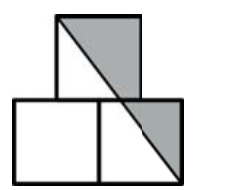
The diagram consists of three squares each of side length 1. The midpoint of the topmost square is exactly above the common side of the two other squares. What is the area of the section coloured grey?
Show answer
Answer: C — 1
Show hints
Hint 1 of 2
Use the side-1 squares as units and locate the grey triangle's base and height.
Still stuck? Show hint 2 →
Hint 2 of 2
The midpoint of the top square sits above the shared side; use that to get the triangle's dimensions, then area = base times height over 2.
Show solution
Approach: compute the grey triangle's area on the unit grid
Two unit squares sit side by side, with the third unit square centred above their common side.
The grey region is the triangle cut off by the diagonal across the stacked squares.
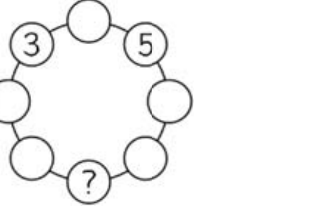
Ella wants to write a number into each circle in the diagram on the right, in such a way that each number is equal to the sum of its two direct neighbours. Which number does Ella need to write into the circle marked with “?”?
Show answer
Answer: E — This question has no solution.
Show hints
Hint 1 of 2
‘Each number equals the sum of its two neighbours’ rearranges to ‘next = this − previous’, which repeats with period 6.
Still stuck? Show hint 2 →
Hint 2 of 2
Follow that pattern around the 8-circle ring and see whether the two given numbers, 3 and 5, can both fit.
Show solution
Approach: chase the neighbour-sum rule around the ring
Writing each circle as the sum of its neighbours rearranges to ‘next neighbour = this − previous’, a rule that repeats every 6 steps.
On a ring of 8 circles this period-6 repetition forces two of the circles (here the ones holding 3 and 5) to carry equal values.
Since 3 ≠ 5, no consistent filling exists, so the answer is ‘no solution’ (E).
In Field Street there are 9 houses in a row. At least one person lives in each house. Each pair of neighbouring houses has at most 6 inhabitants. What is the maximum number of people living in Field Street?
Show answer
Answer: D — 29
Show hints
Hint 1 of 2
To pack in as many people as possible, alternate crowded and nearly-empty houses.
Still stuck? Show hint 2 →
Hint 2 of 2
Try 5, 1, 5, 1, … : each neighbouring pair then totals exactly 6, the most allowed.
Show solution
Approach: alternate large and small to push every adjacent pair to the limit
Each neighbouring pair may hold at most 6 people, and every house needs at least 1.
Alternating 5 and 1 keeps every pair at 5 + 1 = 6, the maximum, and uses the minimum (1) in the small houses.
With 9 houses this is 5, 1, 5, 1, 5, 1, 5, 1, 5 = five 5's and four 1's = 25 + 4 = 29 people.
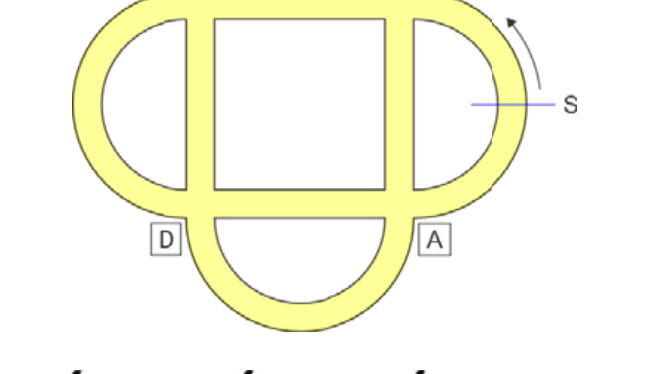
Peter rides his bike along a cycle path in a park. He starts at point S and rides in the direction of the arrow. At the first crossing he turns right, then at the next left, and then again to the right and then again to left. Which crossing does he not reach?
Show answer
Answer: D — D
Show hints
Hint 1 of 2
Put your finger on S, point it the way the arrow points, and ride along.
Still stuck? Show hint 2 →
Hint 2 of 2
At each crossing make the next turn in the list (right, then left, then right, then left) and see which labelled crossing your finger never lands on.
Show solution
Approach: trace the route obeying the turn sequence
Start at S facing the arrow and ride to the first crossing, then turn as told: right, then left, then right, then left.
Tracing this with your finger, Peter rolls through the other crossings but his turns steer him away from one of them.
11 flags are placed alongside a straight race course. The first flag is at the start, the last one at the finish. The distance between two flags is always 8 meters. How long is the race course?
Show answer
Answer: D — 80 meters
Show hints
Hint 1 of 2
The flags are like fence posts: 11 flags do not make 11 gaps.
Still stuck? Show hint 2 →
Hint 2 of 2
Count the gaps between the flags, then multiply by 8 meters.
Show solution
Approach: count the gaps (one fewer than the flags)
With 11 flags in a row there are 11 - 1 = 10 gaps between them.
Each gap is 8 meters, so the course is 10 x 8 = 80 meters.
A cuboid shaped container has a square base with side length 10 cm. It is filled up to a height h with water. Now a metal cube with side length 2 cm is put inside. It sinks to the bottom of the container. The water now reaches to the top corner of the metal cube. Determine h!
Show answer
Answer: A — 1.92 cm
Show hints
Hint 1 of 2
The cube sinks fully; the water surface ends level with the cube's top, i.e. at height 2 cm.
Still stuck? Show hint 2 →
Hint 2 of 2
Volume of water is fixed: it equals the 10×10×2 block minus the 2×2×2 cube.
Show solution
Approach: conserve the water volume
The water rises to the cube's top, so the final level is 2 cm.
Up to height 2, the container holds 10 × 10 × 2 = 200 cm³, but the cube occupies 2³ = 8 cm³.
Water volume = 200 − 8 = 192 cm³, and originally that filled 10 × 10 × h = 100h.
Each ? in the equation \(2\,?\,0\,?\,1\,?\,5\,?\,2\,?\,0\,?\,1\,?\,5\,?\,2\,?\,0\,?\,1\,?\,5 = 0\) should be replaced by either “+” or “−” so that the equation is correct. What is the smallest number of ? that can be replaced by “+”?
Show answer
Answer: B — 2
Show hints
Hint 1 of 2
With every sign a minus, the signed total is some negative value; switching a sign to plus before a number raises the total by twice that number.
Still stuck? Show hint 2 →
Hint 2 of 2
You need the total to reach 0, so use the fewest plus signs whose doubled values close the gap (favour the big numbers).
Show solution
Approach: balance the signed sum to zero
The numbers used are 2, 0, 1, 5 repeated three times; the 0s do not matter.
Switching a sign from − to + before a number raises the total by twice that number, so the plus signs must supply exactly the gap up to 0.
Using the large numbers first, two plus signs can close the gap while one plus sign cannot.
We know the following about five positive whole numbers a, b, c, d, e. All the numbers are different, b = c : e, d = a + b and a = e − d. Which of the numbers a, b, c, d, e is the largest?
Show answer
Answer: C — c
Show hints
Hint 1 of 2
Express everything in terms of the smaller quantities, then see which is built up the most.
Still stuck? Show hint 2 →
Hint 2 of 2
c is a product, while the others are sums or differences.
Show solution
Approach: rewrite each in terms of a and b
From a = e−d and d = a+b, we get e = 2a+b, so e and d are modest sums.
b = c÷e means c = b·e, a product of two positive whole numbers larger than 1.
A product of such factors beats the sums, so c is the largest (C).
Lucy and her mother were both born in January. Today, on 23rd March 2015, Lucy adds together her year of birth, that of her mother, her age, and that of her mother. Which answer does she get?
Show answer
Answer: C — 4030
Show hints
Hint 1 of 2
Both birthdays are in January, so by 23 March each has already had her birthday this year.
Still stuck? Show hint 2 →
Hint 2 of 2
For anyone, year of birth + current age equals the current year once the birthday has passed.
Show solution
Approach: year of birth plus current age equals the present year
Since both were born in January, by 23 March 2015 each has already turned a year older this year.
So Lucy's birth year + Lucy's age = 2015, and likewise her mother's birth year + her mother's age = 2015.
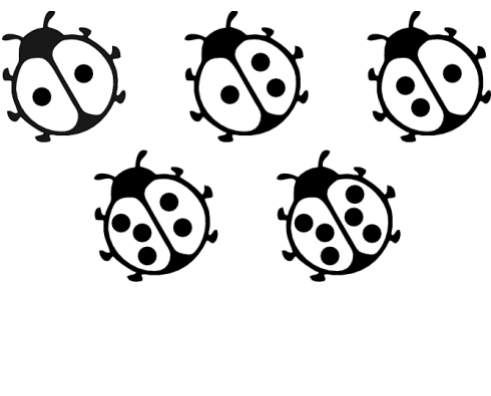
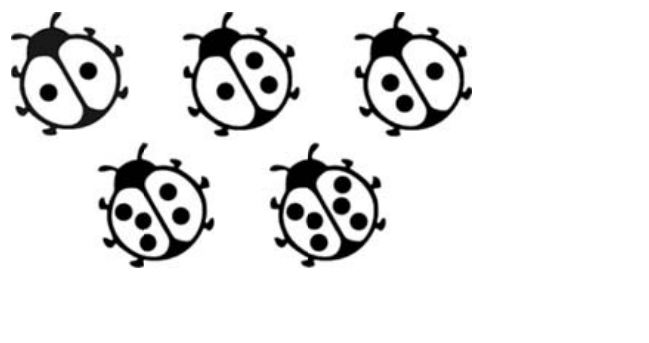
Two of the 5 ladybirds in the picture are always friends with each other if the difference between their number of dots is exactly 1. Today every ladybird has sent an SMS to each of their friends. How many SMS messages were sent?
Show answer
Answer: C — 6
Show hints
Hint 1 of 2
First count the spots on each ladybird, then pair up those that differ by exactly one spot.
Still stuck? Show hint 2 →
Hint 2 of 2
Each friendship means two messages, since each friend texts the other.
Show solution
Approach: find friend pairs, then count messages both ways
The ladybirds carry 2, 3, 3, 5 and 6 spots.
Friends differ by exactly 1 spot: the 2-spot is friends with each 3-spot, and the 5-spot is friends with the 6-spot — 3 friendships in all.
In each friendship both friends send a message, so each pair accounts for 2 messages.
Some pirates are climbing onto a ship one after the other using a rope. Their leader is exactly in the middle. He is the eighth pirate to climb onto the ship. How many pirates board the ship?
Show answer
Answer: B — 15
Show hints
Hint 1 of 2
The leader is the 8th to climb and is exactly in the middle of the line.
Still stuck? Show hint 2 →
Hint 2 of 2
If 7 pirates are ahead of him, the same number must be behind him.
Show solution
Approach: balance the pirates on each side of the middle one
The leader is the 8th to climb, so 7 pirates went before him.
Being exactly in the middle, 7 pirates must also come after him.
The square ABCD has area 80. The points E, F, G and H are on the sides of the square and AE = BF = CG = DH. How big is the area of the grey part, if AE = 3 × EB?
Show answer
Answer: B — 25
Show hints
Hint 1 of 3
AE = 3·EB places E (and likewise F, G, H) three-quarters of the way along each side.
Still stuck? Show hint 2 →
Hint 2 of 3
Put the square on coordinates with side s where s² = 80, then read the grey region's corners.
Still stuck? Show hint 3 →
Hint 3 of 3
Use the shoelace area on the grey polygon's vertices — the side length squared (80) cancels into a clean number.
Show solution
Approach: place coordinates, then find the grey area by proportion
Let the square have side s with s² = 80; since AE = 3·EB, each of E, F, G, H sits 3/4 of the way along its side (so AE = 3s/4, EB = s/4).
By the equal spacing the figure is symmetric under a quarter-turn, so the grey region is a fixed fraction of the whole square.
Working out that fraction with coordinates gives 5/16 of the square, and 5/16 × 80 = 25.
The geometric mean of n numbers is defined as the nth root of the product of all n numbers, that is n√x1 · x2 · … · xn. We have six numbers. The geometric mean of three of them is 3, the geometric mean of the other three is 12. How big is the geometric mean of all six numbers?
Show answer
Answer: B — 6
Show hints
Hint 1 of 2
A geometric mean of 3 numbers tells you their product.
Still stuck? Show hint 2 →
Hint 2 of 2
Multiply the two products, then take the sixth root.
Show solution
Approach: combine the two products under one sixth root
Geometric mean 3 of three numbers means their product is 3³ = 27; geometric mean 12 means the other product is 12³ = 1728.
All six multiply to 27×1728 = 46656 = 6⁶.
The geometric mean of all six is the sixth root, 6 (B).
There are 10 balls, numbered 0 to 9 in a basket. John and George play a game. Each person is allowed to take three balls from the basket and calculate the total of the numbers on the balls. What is the biggest possible difference between the John and George's totals?
Show answer
Answer: E — 21
Show hints
Hint 1 of 2
To make the gap as large as possible, one player grabs the biggest numbers and the other the smallest.
Still stuck? Show hint 2 →
Hint 2 of 2
They draw from the same basket, so the two sets of three balls cannot overlap.
Show solution
Approach: maximise one total and minimise the other
One player can take the three largest balls: 9 + 8 + 7 = 24.
The other is then left to take the three smallest: 0 + 1 + 2 = 3.
If the whole number age of a father is multiplied by the whole number age of his son, one obtains 2015. Both are born in the 20th century. How big is the age gap between father and son?
Show answer
Answer: D — 34
Show hints
Hint 1 of 2
Factor 2015 into a product of two whole numbers, both ages of people born in the 1900s.
Still stuck? Show hint 2 →
Hint 2 of 2
2015 = 5 × 13 × 31; find the factor pair that gives believable father/son ages.
Show solution
Approach: match a factor pair to plausible ages
2015 = 5 × 13 × 31.
The factor pair fitting a father and son both born in the 20th century is 65 × 31.
A bush has 10 twigs. Each twig has exactly 5 leaves, or exactly 2 leaves and a flower. Which of the following numbers could be the total number of leaves on the bush?
Show answer
Answer: E — None of the numbers from (A) to (D).
Show hints
Hint 1 of 2
Each of the 10 twigs adds either 5 leaves or 2 leaves.
Still stuck? Show hint 2 →
Hint 2 of 2
Write the total as \(5a + 2b\) with \(a + b = 10\) and check which listed number is reachable.
Show solution
Approach: reachable totals from 5s and 2s on 10 twigs
Each twig gives 5 leaves or 2 leaves, so with 10 twigs the total is \(5a + 2b\) where \(a + b = 10\).
Then the total is \(2 \cdot 10 + 3a = 20 + 3a\), so it is 20 more than a multiple of 3.
The reachable totals run 20, 23, 26, …, 50; none of 45, 39, 37, 31 fits this pattern.
The diagram shows three concentric circles and two perpendicular, common diameters of the three circles. The three grey sections are of equal area, the small circle has radius 1. What is the product of the radii of the three circles?
Show answer
Answer: A — √6
Show hints
Hint 1 of 2
Write each shaded region's area in terms of the three radii and set them equal.
Still stuck? Show hint 2 →
Hint 2 of 2
Work outward from the small circle of radius 1.
Show solution
Approach: set the three equal-area conditions and solve for the radii
The three grey pieces (a quarter of the inner disk, and quarter-annulus bands of the middle and outer rings) have equal areas.
Equal areas force the radii to satisfy r₁² = r₂²−r₁² = r₃²−r₂²; with r₁ = 1 this gives r₂² = 2 and r₃² = 3.
Each of the 9 sides of the triangles in the picture will be coloured blue, green or red. Three of the sides are already coloured (blue and red are shown). Which colour can side x have, if the sides of each triangle must be coloured in three different colours?
Show answer
Answer: C — only red
Show hints
Hint 1 of 2
Each triangle uses all three colours once, so within one triangle two known sides force the third.
Still stuck? Show hint 2 →
Hint 2 of 2
Start from the triangle whose two coloured sides are already given and work along the strip toward side x.
Show solution
Approach: fill in forced colours triangle by triangle along the strip
Every triangle shows each of blue, green, red exactly once, so once two of its three sides are coloured the third is forced.
Beginning at the triangle that already has two coloured sides and moving along the row of triangles, each shared edge passes a forced colour to the next triangle.
Carrying this through to side x leaves only one possibility: x must be red.
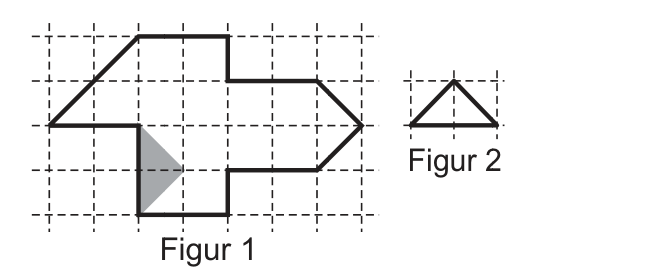
Luca wants to cut the shape in figure 1 into equally sized small triangles (like those in figure 2). One of these triangles is already drawn on figure 1. How many of these triangles will he get?
Show answer
Answer: D — 15
Show hints
Hint 1 of 2
Notice that one little triangle is exactly half of a small grid square.
Still stuck? Show hint 2 →
Hint 2 of 2
If you know how much room the big shape covers in grid squares, two triangles fit in each square.
Show solution
Approach: fit the half-square triangles into the shape
Each little triangle is half of a small grid square, so two of them fill one square.
The big shape covers seven-and-a-half squares of room, and two triangles fit in every square.
Doubling seven-and-a-half gives 15 little triangles.
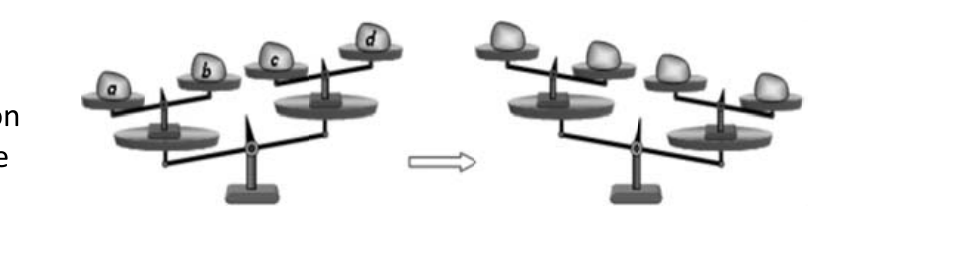
Four objects a, b, c, d are placed on a double balance as shown. Then two of the objects are exchanged, which results in the change of position of the balance as shown. Which two objects were exchanged?
Show answer
Answer: D — a and d
Show hints
Hint 1 of 2
Track which pan tips in each balance before and after the swap.
Still stuck? Show hint 2 →
Hint 2 of 2
Test swaps of two objects and see which single exchange flips the balances to the shown new state.
Show solution
Approach: test each possible exchange against the new tilt
The two balances pin down the relative weights of a, b, c, d before the swap.
After exchanging two objects, the balance tilts change to the pictured arrangement.
Only swapping a and d reproduces the new positions.
The 10 participants of a test achieve on average 6 points. Exactly 6 of the participants passed the test. The average of the participants that passed the test was 8 points. What is the average of the participants that did not pass the test?
Show answer
Answer: C — 3
Show hints
Hint 1 of 2
Turn each average into a total number of points.
Still stuck? Show hint 2 →
Hint 2 of 2
Total points minus the passers' points gives the failers' points; divide by how many failed.
Show solution
Approach: use totals, not averages, then divide
All 10 participants total 10 * 6 = 60 points.
The 6 who passed total 6 * 8 = 48 points.
The 4 who failed total 60 - 48 = 12 points, so their average is 12 / 4 = 3.
In the past 20 years the population of Arnberg has increased by 40%. In the same time span the population of Berghausen has increased by 60%. In total the population of the two villages has increased by 54%. What was the ratio of the populations 20 years ago?
Show answer
Answer: C — 3 : 7
Show hints
Hint 1 of 2
The combined 54% growth is a weighted average of 40% and 60%.
Still stuck? Show hint 2 →
Hint 2 of 2
Let the old populations be a and b and set up the weighted-average equation.
Show solution
Approach: weighted average of the two growth rates
With old populations a and b: (1.4a + 1.6b)/(a+b) = 1.54.
So 1.4a + 1.6b = 1.54a + 1.54b, giving 0.06b = 0.14a, i.e. a:b = 6:14 = 3:7.
3 green apples, 5 yellow apples, 7 green pears and 2 yellow pears are in a sack. Without looking, Sebastian takes either an apple or a pear out of the sack. How many pieces of fruit must he take out of the sack to be sure of having at least one apple and one pear of the same colour?
Show answer
Answer: E — 13
Show hints
Hint 1 of 2
Think of the unluckiest case: how many fruit could he pull out and still NOT have an apple and a pear of the same colour?
Still stuck? Show hint 2 →
Hint 2 of 2
He could keep drawing green pears and yellow apples forever without ever matching a colour across the two fruit types.
Show solution
Approach: find the largest unlucky collection with no same-colour apple+pear, then add one
He wins when he holds an apple and a pear of the same colour: green-with-green or yellow-with-yellow.
The biggest collection that still avoids this takes all 7 green pears and all 5 yellow apples — green pears with no green apple, yellow apples with no yellow pear — that's 12 fruit and still no match.
Any 13th fruit must be a green apple or a yellow pear, which completes a same-colour pair, so he needs to take 13.
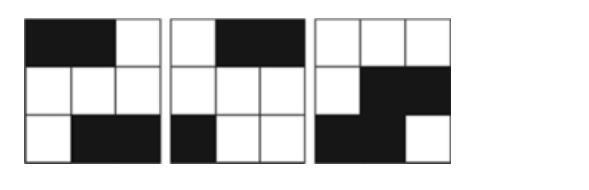
Some of the small squares on each of the square transparencies have been coloured black. If you slide the three transparencies on top of each other, without lifting them from the table, a new pattern can be seen. What is the maximum number of black squares which could be seen in the new pattern?
Show answer
Answer: D — 8
Show hints
Hint 1 of 2
Stacking the see-through sheets makes a square black wherever any sheet is black there.
Still stuck? Show hint 2 →
Hint 2 of 2
Slide them so the black cells overlap as little as possible, then count the covered squares.
Show solution
Approach: overlay the transparencies and count the black cells
Each sheet is transparent, so a cell looks black if it is black on at least one of the stacked sheets.
Lining the three sheets up so their black cells barely overlap covers as many squares as possible.
Together the black cells can cover 8 of the 9 squares, leaving just one clear.
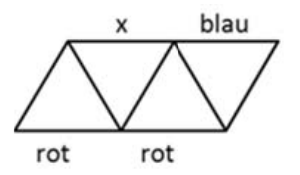
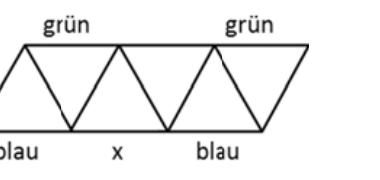
Each side of each triangle in the diagram is painted either blue (blau), green (grün) or red. Four of the sides are already painted, as shown. Which colour can the line marked x have, if each triangle must have all sides in different colours?
Show answer
Answer: A — only green
Show hints
Hint 1 of 2
Each triangle uses all three colours exactly once, and neighbouring triangles share a side.
Still stuck? Show hint 2 →
Hint 2 of 2
Start from the known blue sides and force each shared side in turn along the strip until you reach x.
Show solution
Approach: propagate the all-different constraint along the strip
Each triangle must use blue, green and red once.
Starting from the two given blue sides and using the shared edges, each triangle's remaining colours are forced one after another.
Following the chain to the side marked x leaves only green possible.
Bibi rolls a die which has the numbers 1, 2, 3, 4, 5, 6 on its faces. At the same time Tina rolls a die which has the numbers 2, 2, 2, 5, 5, 5 on its faces. Tina wins if she rolls a number higher than Bibi. What is the probability that Tina wins?
Show answer
Answer: C — 512
Show hints
Hint 1 of 2
Tina's die only ever shows 2 or 5; split into those two cases.
Still stuck? Show hint 2 →
Hint 2 of 2
Count Bibi's faces that each Tina value beats, over 36 equally likely pairs.
Show solution
Approach: case on Tina's roll, count favourable pairs out of 36
There are 6×6 = 36 equally likely (Bibi, Tina) pairs.
Tina rolls 2 (3 faces) and wins only against Bibi's 1: 3×1 = 3 wins.
Tina rolls 5 (3 faces) and wins against Bibi's 1,2,3,4: 3×4 = 12 wins.
Total 15 wins, so the probability is 15/36 = 5/12 (C).
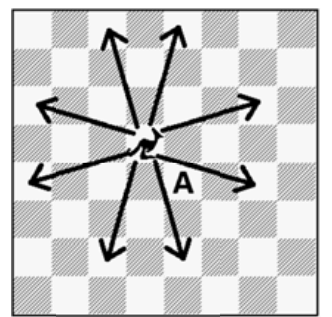
For the game of chess a new piece, the Kangaroo, has been invented. With each jump the kangaroo jumps either 3 squares vertically and 1 horizontally, or 3 horizontally and 1 vertically, as pictured. What is the smallest number of jumps the kangaroo must make to move from its current position to position A?
Show answer
Answer: B — 3
Show hints
Hint 1 of 2
Square A is only a short step away, but every jump is long (3 one way, 1 the other), so you must overshoot and come back.
Still stuck? Show hint 2 →
Hint 2 of 2
Check that one or two jumps can never land exactly on A, then find a route that works.
Show solution
Approach: rule out the short jump counts, then exhibit a 3-jump path
Square A sits just one square diagonally from the start, while each jump moves a total of 4 squares (3 + 1), so a single jump lands far away.
Two jumps can be checked to never end exactly on A's square.
Three well-chosen jumps (overshooting and stepping back) do land on A, so the smallest number of jumps is 3.
The numbers 1, 2, 3, 4 and 9 are written into the squares on the following figure. The sum of the three numbers in the horizontal row should be the same as the sum of the three numbers in the vertical column. Which number is written in the middle?
Show answer
Answer: E — 9
Show hints
Hint 1 of 2
The middle square sits in both the row and the column, so it gets used in both totals.
Still stuck? Show hint 2 →
Hint 2 of 2
The other four numbers must split into two equal-sized pairs, one pair for the row's ends and one for the column's ends.
Show solution
Approach: the middle is shared, so the other four split into two equal pairs
The number in the middle is part of both the row total and the column total, so the other four numbers fill the two ends of the row and the two ends of the column.
Those four numbers must make two pairs that add up to the same amount; from 1, 2, 3, 4 the pairs 1 + 4 = 5 and 2 + 3 = 5 match perfectly, leaving 9 for the middle.
Then each line totals 9 + 5 = 14, the same both ways, so it works.
The middle number is 9.
A quick check for older kidsAll five numbers add to 19. The row and column together use the middle twice, giving 19 + middle, and that must split into two equal halves — so 19 + middle is even, which forces the middle to be odd, and 9 is the choice that balances.
Eva added the lengths of three sides of a rectangle and obtained 44 cm. Ulli also added the lengths of three sides of the same rectangle and obtained 40 cm. What is the perimeter of the rectangle?
Show answer
Answer: B — 56 cm
Show hints
Hint 1 of 2
Each person added three sides, so together their sums use the sides a known number of times.
Still stuck? Show hint 2 →
Hint 2 of 2
Adding the two results counts the length three times and the width three times: 3 times (length + width).
Show solution
Approach: add the two three-side sums
One person summed two lengths and a width, the other two widths and a length.
Adding their results, 44 + 40 = 84, counts three lengths and three widths: 3(L + W) = 84.
There are 2015 marbles in a pipe. They are numbered 1 to 2015. Marbles whose digits add up to the same number have the same colour, and marbles whose digits have a different sum have a different colour. How many different colours do the marbles in the pipe have?
Show answer
Answer: C — 28
Show hints
Hint 1 of 2
The colour of a marble depends only on its digit sum.
Still stuck? Show hint 2 →
Hint 2 of 2
Find the smallest and largest digit sum occurring among 1 to 2015 — then count the values in between.
Show solution
Approach: count the distinct digit sums from 1 to 2015
Colours correspond exactly to the different digit sums that appear.
The smallest digit sum is 1 (e.g. 1, 1000) and the largest is 28 (from 1999).
Every value from 1 to 28 is achievable, so there are 28 colours (C).
Sarah bought three books. For the first book she paid half of her money plus 1 Euro more. For the second book she paid again half of her left-over money plus 2 Euros more. For the third book she paid again half of her left-over money plus 3 Euros more. After which she had spent all of her money. How much money did she have to begin with?
Show answer
Answer: C — 34 €
Show hints
Hint 1 of 2
Work backwards from the end, when she has spent everything.
Still stuck? Show hint 2 →
Hint 2 of 2
Just before the last book she had some amount L; she paid half of it plus 3 and was left with nothing, so half of L equals 3.
Show solution
Approach: rewind the spending step by step, starting from when she has nothing left
Work backwards from the end. At the third book she paid half her money plus 3 € and was left with nothing, so that half must have been the 3 €, meaning she had 6 € before book three.
Before book two she paid half plus 2 € and was left with that 6 €; so after taking the extra 2 € back the 6 € is the other half, making 8 € the half, so she had 16 € before book two.
Before book one she paid half plus 1 € and was left with that 16 €; adding the 1 € back, 17 € is one half, so she started with 34 €.
Forward checkStart 34: pay 17+1=18, left 16; pay 8+2=10, left 6; pay 3+3=6, left 0. ✓
Which value of the variable n is a counterexample to the statement “If n is a prime number, then exactly one of the two numbers n − 2 and n + 2 is a prime number.”?
Show answer
Answer: E — 37
Show hints
Hint 1 of 2
You want a prime n for which the rule fails: both n−2 and n+2 prime, or neither.
Still stuck? Show hint 2 →
Hint 2 of 2
Check each option: 37 is prime but 35 and 39 are both composite, so neither n−2 nor n+2 is prime.
Show solution
Approach: find the prime that breaks the claim
The statement fails if, for a prime n, the count of primes among n−2, n+2 is 0 or 2.
For 37 (prime): 35 = 5·7 and 39 = 3·13 are both composite → neither is prime.
The teacher asks five of her students how many of them had studied the previous day. Azra says: “Nobody.” Berti says: “Only one.” Christa says: “Exactly two.” Doris says: “Exactly three.” Emina says: “Exactly four.” The teacher knows that students always lie if they haven’t studied and are always truthful when they have studied. How many of those students had studied the previous day?
Show answer
Answer: B — 1
Show hints
Hint 1 of 2
The five claims 0, 1, 2, 3, 4 are all different, so at most one of them is true.
Still stuck? Show hint 2 →
Hint 2 of 2
A student tells the truth exactly when they studied, so the number who studied equals the number of true statements.
Show solution
Approach: find the count that makes exactly the truth-tellers truthful
Students who studied tell the truth; the others lie. So the number who studied equals the number of true statements.
The five statements give five different counts, so at most one is true, meaning at most one student studied.
If exactly one studied, that student truthfully said 'Only one' and the other four lie - which is consistent.
On a standard die the sum of the numbers on opposite faces is always 7. Two identical standard dice are shown in the figure. How many dots could there be on the non-visible right-hand face (marked with “?”)?
Show answer
Answer: A — only 5
Show hints
Hint 1 of 2
The two dice are identical, so they have the same handedness: the cyclic order of the 1-2-3 corner is the same on both.
Still stuck? Show hint 2 →
Hint 2 of 2
Read the top and front pips of the right die, then use that fixed handedness to read off the third (right-hand) face.
Show solution
Approach: use the matching handedness of two identical dice
From the left die you can read the way its 1, 2 and 3 faces turn around their shared corner; the right die, being identical, turns the same way.
On the right die the top and front faces are shown, so its handedness fixes the remaining (right-hand) face to a single value.
Nina wants to make a cube from the paper net. You can see there are 7 squares instead of 6. Which square(s) can she remove from the net, so that the other 6 squares remain connected and from the newly formed net a cube can be made?
Show answer
Answer: D — only 3 or 7
Show hints
Hint 1 of 2
A cube net needs the remaining 6 squares to stay connected AND to fold up without two squares landing on the same face.
Still stuck? Show hint 2 →
Hint 2 of 2
Test each candidate removal: most leave a shape that overlaps when folded; only certain end squares work.
Show solution
Approach: test which removals leave a connected, foldable 6-square net
Removing a square must keep the other six joined and able to fold into a cube with no doubled-up face.
Taking out an interior square breaks the net or makes two squares fold onto the same face, so those fail.
Removing square 3 works, and removing square 7 works, while no other single removal does — so the answer is only 3 or 7.
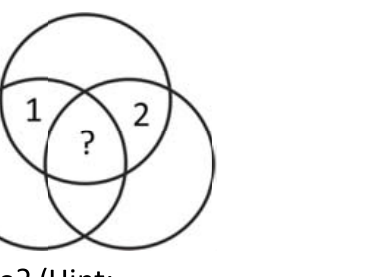
In the diagram we can see seven sections which are bordered by three circles. One number is written into each section. It is known that each number is equal to the sum of all the numbers in the adjacent zones. (Two zones are called adjacent if they have more than one corner point in common.) Which number is written into the inner area?
Show answer
Answer: A — 0
Show hints
Hint 1 of 2
Give each of the seven regions a letter and write 'region = sum of its adjacent regions'.
Still stuck? Show hint 2 →
Hint 2 of 2
With two outer regions fixed at 1 and 2, solving the linear system pins the centre to 0.
Show solution
Approach: solve the linear system of region sums
Label the seven regions; each equals the sum of the regions sharing an arc with it.
Two outer regions are 1 and 2; this fixes all the others by the equations.
Solving, the inner (all-three) region comes out to 0.
In a group of kangaroos the two lightest ones weigh 25 % of the total weight of the whole group. The three heaviest ones weigh 60 % of the total weight. How many kangaroos are in this group?
Show answer
Answer: A — 6
Show hints
Hint 1 of 2
The 2 lightest take 25% and the 3 heaviest take 60%, so the rest share the remaining percent.
Still stuck? Show hint 2 →
Hint 2 of 2
Find the leftover percentage and how many average-weight kangaroos it represents to total the group.
Show solution
Approach: account for every percent of the weight
The 2 lightest are 25% and the 3 heaviest are 60%, leaving 15% for the kangaroos in between.
A lightest one averages 12.5% and a heaviest one averages 20%, so each middle kangaroo must weigh between 12.5% and 20%.
Only one middle kangaroo fits the leftover 15% (two would average 7.5% each, too light), giving 2 + 1 + 3 = 6 kangaroos.
A train has 12 carriages. In each carriage there is the same number of compartments. Mike is sitting in the 18th compartment behind the engine, this is in the 3rd carriage. Joanna is sitting in the 50th compartment behind the engine, this is in the 7th carriage. How many compartments are in one carriage?
Show answer
Answer: B — 8
Show hints
Hint 1 of 3
Every carriage holds the same number of compartments, so try the answer choices one at a time.
Still stuck? Show hint 2 →
Hint 2 of 3
If each carriage has 8 compartments, carriages 1 and 2 use compartments 1–16, so carriage 3 holds 17–24.
Still stuck? Show hint 3 →
Hint 3 of 3
Check that the same guess also lands compartment 50 inside carriage 7.
Show solution
Approach: test the answer choices: find how many compartments fit before each carriage
Try 8 compartments per carriage. Then carriages 1 and 2 fill compartments 1 through 16, so carriage 3 holds compartments 17 through 24 — and Mike's seat 18 lands there. ✓
With 8 each, carriages 1–6 fill compartments 1 through 48, so carriage 7 holds 49 through 56 — and Joanna's seat 50 lands there. ✓
Both facts work only with 8, so there are 8 compartments in one carriage.
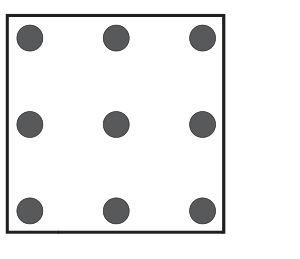
In this square there are 9 dots. The distance between the points is always the same. You can draw a square by joining 4 points. How many different sizes can such squares have?
Show answer
Answer: D — 3
Show hints
Hint 1 of 2
Squares can sit straight on the dots, but they can also be tilted like a diamond.
Still stuck? Show hint 2 →
Hint 2 of 2
Hunt for a tiny straight square, a big straight square, and one slanted square.
Show solution
Approach: find every square size, straight ones and the tilted one
On the 3-by-3 dots you can make a tiny straight square (1 step on each side) and a big straight square (2 steps on each side).
You can also make a slanted square shaped like a diamond, joining the four middle dots of the edges.
Five positive whole numbers, which are not necessarily all different, are written on five cards. Peter calculates the sum of each pair of cards. He obtains only three different results, namely 57, 70 and 83. What is the biggest number that is written on one of the cards?
Show answer
Answer: C — 48
Show hints
Hint 1 of 2
With only three distinct pairwise sums, the five numbers take very few distinct values.
Still stuck? Show hint 2 →
Hint 2 of 2
The smallest sum is the two smallest cards and the largest sum the two largest; use 57, 70, 83 to pin them.
Show solution
Approach: deduce the card values from the three pair-sums
Only three sums (57, 70, 83) appear, so the cards take just a couple of distinct values plus an odd one out.
The biggest sum 83 pairs the two largest cards; combined with 57 and 70 this forces a largest card of 48.
Indeed 35 + 48 = 83, while repeated smaller values give 57 and 70.
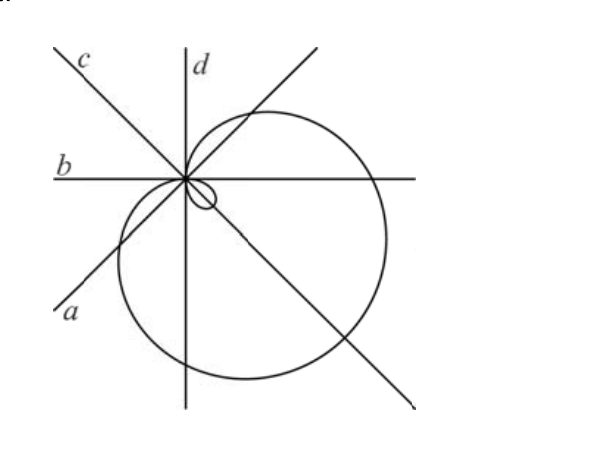
The curve in the diagram is defined by the equation (x2 + y2 − 2x)2 = 2(x2 + y2). Which of the lines a, b, c, d is the y-axis?
Show answer
Answer: A — a
Show hints
Hint 1 of 2
Rewrite the curve in polar form to see its single axis of symmetry.
Still stuck? Show hint 2 →
Hint 2 of 2
The y-axis must be perpendicular to that axis of symmetry, then match it to the drawn lines.
Show solution
Approach: find the curve's symmetry axis and locate the perpendicular line
Substituting \(x^2+y^2=r^2\) and \(x=r\cos\theta\), the equation becomes \(r = 2\cos\theta \pm \sqrt2\); since it depends only on \(\cos\theta\), the limaçon is symmetric about its own x-axis, with the small inner loop opening toward the positive-x side.
The y-axis passes through the curve's origin (its self-crossing node) and is perpendicular to that symmetry axis.
Matching the perpendicular-through-the-node line to the drawing identifies it as a (A).
In how many ways can the three kangaroos be placed in three different squares of the row of 7 squares so that no kangaroo has an immediate neighbour?
Show answer
Answer: D — 10
Show hints
Hint 1 of 3
The kangaroos look the same, so you are really just choosing which 3 of the 7 squares are filled, with no two filled squares touching.
Still stuck? Show hint 2 →
Hint 2 of 3
Put the 4 empty squares in a row and notice the 5 gaps around them (one before, three between, one after).
Still stuck? Show hint 3 →
Hint 3 of 3
Dropping a kangaroo into a gap automatically keeps them apart, so just count ways to pick 3 of those 5 gaps.
Show solution
Approach: place the empty squares first, then drop kangaroos into the gaps so they can't touch
Since the kangaroos are identical, we just choose 3 of the 7 squares to fill, with no two chosen squares next to each other.
Line up the 4 empty squares: _ ▢ _ ▢ _ ▢ _ ▢ _. The 5 underscores are the safe spots, and any kangaroo placed in a gap is automatically separated from the others.
Choosing 3 of these 5 gaps, leaving 2 empty, the gap-pairs left out are 12,13,14,15,23,24,25,34,35,45 — that's 10 ways.
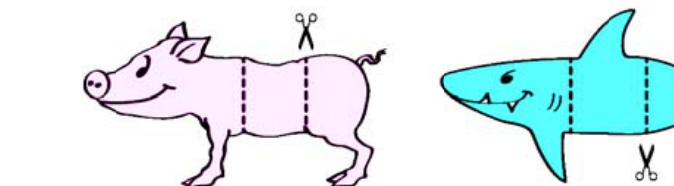
Thomas drew a pig and a shark. He cuts each animal into three pieces. Then he takes one of the two heads, one of the two middle sections and one of the two tails and lays them together to make another animal. How many different animals can he make in this way?
Show answer
Answer: E — 8
Show hints
Hint 1 of 2
A new animal needs a head, a middle and a tail, and there are two choices for each part.
Still stuck? Show hint 2 →
Hint 2 of 2
Multiply the number of choices for the three parts.
Show solution
Approach: multiply the choices for each of the three parts
There are 2 heads to choose from, 2 middle sections, and 2 tails.
Each new animal is one choice for each part, so 2 × 2 × 2 = 8 animals can be built.
Petra has three different dictionaries and two different novels on her bookshelf. In how many different ways can she arrange the books, if all the dictionaries should stay together and likewise the novels as well?
Show answer
Answer: B — 24
Show hints
Hint 1 of 2
Treat the dictionaries as one block and the novels as another, then arrange the two blocks.
Still stuck? Show hint 2 →
Hint 2 of 2
Multiply: arrange the 2 blocks, then arrange within the 3-dictionary block and within the 2-novel block.
Show solution
Approach: block (glue) the groups, then count
The 3 dictionaries form one block, the 2 novels another: 2! ways to order the two blocks.
Inside: 3! ways for the dictionaries, 2! ways for the novels.
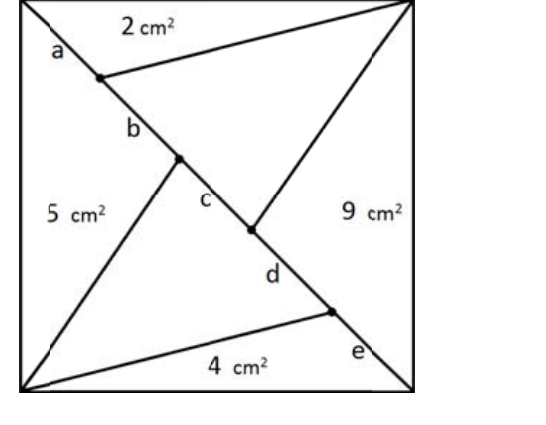
A square with area 30 is split into two by its diagonal and then split into triangles as shown in the diagram. Some of the areas of the triangles are given in the diagram. Which of the line segments a, b, c, d, e of the diagonal is the longest?
Show answer
Answer: D — d
Show hints
Hint 1 of 2
Triangles on the diagonal share the same height, so a segment's length is proportional to its triangle's area.
Still stuck? Show hint 2 →
Hint 2 of 2
Read each segment a, b, c, d, e from the area sitting on it and pick the biggest.
Show solution
Approach: segment length is proportional to the triangle's area
The triangles standing on the diagonal share one height, so each base segment is proportional to that triangle's area.
The square area 30 is split into the marked pieces (5, 9, 4, 2 and the rest), letting each segment be read off its area.
Comparing all five, segment d carries the largest area and so is the longest.
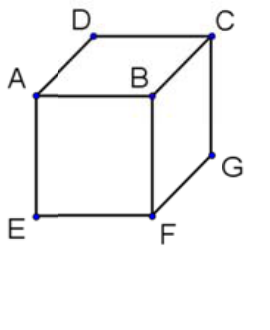
Maria writes a number on each face of the cube. Then, for each corner point of the cube, she adds the numbers on the faces which meet at that corner. (For corner B she adds the numbers on faces BCDA, BAEF and BFGC.) In this way she gets a total of 14 for corner C, 16 for corner D, and 24 for corner E. Which total does she get for corner F?
Show answer
Answer: C — 22
Show hints
Hint 1 of 2
Two corners at opposite ends of a space diagonal use all six faces between them, so their corner-sums add up to the same total every time.
Still stuck? Show hint 2 →
Hint 2 of 2
Pair the given corner with the unknown one along a space diagonal, and pair the other two the same way.
Show solution
Approach: use that opposite corners of the cube share the same total of all six faces
A corner's number is the sum of its three meeting faces. Two corners on opposite ends of a space diagonal together touch all six faces exactly once, so each such pair has the same sum S (the total of all six faces).
Corners C and E are opposite, and corners D and F are opposite, so C + E = D + F.
Anna, Berta, Charlie, David and Elisa baked biscuits at the weekend. Anna baked 24, Berta 25, Charlie 26, David 27 and Elisa 28 biscuits. By the end of the weekend one of the children had twice as many, one 3 times, one 4 times, one 5 times and one 6 times as many biscuits as on Saturday. Who baked the most biscuits on Saturday?
Show answer
Answer: C — Charlie
Show hints
Hint 1 of 2
Each child's weekend total is their Saturday pile shared into 2, 3, 4, 5 or 6 equal groups (each size used once).
Still stuck? Show hint 2 →
Hint 2 of 2
Find which totals can be shared evenly by 5 and by 3 first, since only one each can.
Show solution
Approach: see how each total splits evenly, then share it out to find Saturday
Each total (24, 25, 26, 27, 28) is a Saturday pile copied 2, 3, 4, 5 or 6 times, with each copy-number used once.
Only 25 shares evenly into 5 groups (25 ÷ 5 = 5) and only 27 shares evenly into 3 groups (27 ÷ 3 = 9).
That leaves 26 as 2 copies (26 ÷ 2 = 13), 28 as 4 copies (28 ÷ 4 = 7), and 24 as 6 copies (24 ÷ 6 = 4).
Saturday piles: Anna 4, Berta 5, Charlie 13, David 9, Elisa 7 — Charlie's 13 is the biggest, so the answer is Charlie.
Lines parallel to the base AC of triangle ABC are drawn through X and Y. In each case, the areas of the grey parts are equal in size. The ratio BX : XA = 4 : 1 is known. What is the ratio BY : YA?
Show answer
Answer: D — 3 : 2
Show hints
Hint 1 of 2
A line parallel to the base cuts off a small similar triangle whose area scales as the square of the height ratio.
Still stuck? Show hint 2 →
Hint 2 of 2
Set the two grey areas equal: (BY/BA)² matches 1 − (BX/BA)², with BX/BA = 4/5.
Show solution
Approach: use area scales as the square of the side ratio
BX : XA = 4 : 1 means BX/BA = 4/5, so the trapezoid below X is 1 − (4/5)² = 9/25 of the triangle.
On the right, the grey triangle above Y is (BY/BA)² of the triangle.
Setting (BY/BA)² = 9/25 gives BY/BA = 3/5, so BY : YA = 3 : 2.
Riki wants to write one number in each of the seven sections of the diagram pictured. Two zones are adjacent if they share a part of their outline. The number in each zone should be the sum of all numbers of its adjacent zones. Riki has already placed numbers in two zones. Which number does she need to write in the zone marked “?”?
Show answer
Answer: C — 6
Show hints
Hint 1 of 2
Each zone equals the sum of its neighbours; write that relation for every zone.
Still stuck? Show hint 2 →
Hint 2 of 2
Use the two given numbers and the diagram's adjacencies to solve for the zone marked with a question mark.
Show solution
Approach: solve the adjacency-sum equations
Label the seven zones; each value equals the sum of the values in the zones touching it.
Using the placed numbers and the adjacency relations from the figure gives a small system of equations.
In a right-angled triangle the angle bisector of an acute angle splits the opposite side into segments of length 1 and 2 respectively. How long is this angle bisector?
Show answer
Answer: C — \(\sqrt{4}\)
Show hints
Hint 1 of 3
By the angle-bisector theorem, the two segments (1 and 2) are in the ratio of the two sides meeting at that acute vertex.
Still stuck? Show hint 2 →
Hint 2 of 3
Put the right angle at the origin and the foot of the bisector on a leg, then read off the bisector's length as a distance.
Still stuck? Show hint 3 →
Hint 3 of 3
The ratio of sides is 2 : 1, which fixes the triangle; the bisector then comes out a clean length.
Show solution
Approach: use the angle-bisector ratio, then place coordinates
The bisector of the acute angle at B meets the opposite leg AC (length 1 + 2 = 3) at D, with AD : DC = BA : BC.
Put the right angle at C = (0,0), A = (3,0), B = (0,√3); then BA = 2√3 and BC = √3, a 2 : 1 ratio, so D is at distance 1 from C: D = (1,0).
The bisector is BD = distance from (0,√3) to (1,0) = √(1 + 3) = 2.
Florian has seven pieces of wire of lengths 1 cm, 2 cm, 3 cm, 4 cm, 5 cm, 6 cm and 7 cm. He uses some of those pieces to form a wire model of a cube with side length 1. He does not want any overlapping wire parts. What is the smallest number of wire pieces that he can use?
Show answer
Answer: D — 4
Show hints
Hint 1 of 2
A cube frame has 12 edges of length 1; the wires can bend at the corners.
Still stuck? Show hint 2 →
Hint 2 of 2
Think of tracing all 12 edges with as few continuous strokes as possible without overlap - an Euler-path count.
Show solution
Approach: cover all 12 edges with the fewest continuous wires
The cube wireframe has 12 edges meeting at 8 corners where 3 edges meet.
Every corner has odd degree, so a single continuous wire cannot cover all edges without overlap.
The minimum number of continuous strokes covering all 12 edges is 4.
A two-digit number with the digits x, y, can be written in the form \(\overline{xy}\). Let a, b, c be different digits. In how many ways can the digits a, b, c be chosen, so that \(\overline{ab} < \overline{bc} < \overline{ca}\)?
Show answer
Answer: A — 84
Show hints
Hint 1 of 2
All three of ab, bc, ca are genuine two-digit numbers, so a, b, c are each from 1 to 9 and distinct.
Still stuck? Show hint 2 →
Hint 2 of 2
Count ordered distinct triples (a, b, c) from 1–9 satisfying ab < bc < ca.
Show solution
Approach: count valid distinct digit triples
Since ab, bc, ca are two-digit numbers, a, b, c are in {1, ..., 9} and all different.
Among the 9·8·7 = 504 ordered distinct triples, count those with 10a+b < 10b+c < 10c+a.
In the trapezium PQRS the sides PQ and SR are parallel. Also \(\angle RSP = 120^\circ\) and \(RS = SP = \tfrac{1}{3}PQ\). What is the size of angle \(\angle PQR\)?
Show answer
Answer: D — 30°
Show hints
Hint 1 of 2
Drop the equal sides RS = SP = (1/3)PQ into the trapezium and use that PQ is parallel to SR.
Still stuck? Show hint 2 →
Hint 2 of 2
The isosceles pieces and the 120 degree angle let you chase angles down to angle PQR.
Show solution
Approach: angle-chase using the equal sides and parallels
RS = SP makes triangle RSP isosceles, and angle RSP = 120 gives base angles of 30 degrees.
Since RS = SP = PQ/3, the equal lengths split the figure into congruent isosceles triangles with 30 degree base angles.
Chasing these angles across to the corner Q gives angle PQR = 30 degrees.
How many different triangles ABC whose side lengths are whole numbers are there, if ∠ABC = 90° and AB = 20? (Hint: two triangles are called different if they are not congruent.)
Show answer
Answer: D — 4
Show hints
Hint 1 of 2
With the right angle at B, AB and BC are the legs; you need integer BC and hypotenuse AC.
Still stuck? Show hint 2 →
Hint 2 of 2
Use AC² − BC² = 400 and factor it as a difference of squares.
Show solution
Approach: solve AC² − BC² = 20² by factoring
The right angle is at B, so 20² + BC² = AC², i.e. (AC−BC)(AC+BC) = 400.
Both factors must be even; the pairs (2,200),(4,100),(8,50),(10,40) give positive integer legs (the pair (20,20) gives a zero leg).
On a straight line there are five points. Alex measures all the distances between every possible pair of points. He obtains in ascending order 2, 5, 6, 8, 9, k, 15, 17, 20 and 22. What is the value of k?
Show answer
Answer: E — 14
Show hints
Hint 1 of 2
Five points give 10 pairwise distances; the largest is the whole span and the smallest are the outer gaps.
Still stuck? Show hint 2 →
Hint 2 of 2
Fix the endpoints at 0 and 22, fit the inner points to match the distances, then read off the missing one.
Show solution
Approach: reconstruct the point positions from the distances
Put the endpoints at 0 and 22, so the span 22 is the largest distance.
The two smallest gaps, 2 and 5, sit at the ends, which places points at 2 and 17; matching the rest forces the last point to 8, giving coordinates 0, 2, 8, 17, 22.
Their ten pairwise distances are 2, 5, 6, 8, 9, 14, 15, 17, 20, 22; the one missing from the given list is 14, so k = 14.
In the rectangle ABCD pictured, M1 is the midpoint of DC, M2 the midpoint of AM1, M3 the midpoint of BM2 and M4 the midpoint of CM3. Determine the ratio of the area of the quadrilateral M1M2M3M4 to the area of the rectangle ABCD.
Show answer
Answer: C — 732
Show hints
Hint 1 of 2
Put the rectangle on coordinates with side lengths 1 and build the midpoints step by step.
Still stuck? Show hint 2 →
Hint 2 of 2
Use the shoelace formula on the four midpoint coordinates.
Show solution
Approach: coordinates plus the shoelace area formula
Take A(0,0), B(1,0), C(1,1), D(0,1); then M₁(½,1), M₂(¼,½), M₃(⅝,¼), M₄(13/16,⅝).
The shoelace formula on M₁M₂M₃M₄ gives area 7/32.
Since the rectangle has area 1, the ratio is 7/32 (C).
The ant Tanti starts an adventure at a vertex of a cube with side length 1. She wants to walk along each edge of the cube at least once and return to the starting point at the end. What is the minimum possible length of her walk?
Show answer
Answer: D — 16
Show hints
Hint 1 of 2
The ant must traverse all 12 edges and return; every cube vertex has 3 edges (an odd number).
Still stuck? Show hint 2 →
Hint 2 of 2
To close the walk, some edges must be repeated — pair up the 8 odd vertices to add as few repeats as possible.
Show solution
Approach: route-inspection on the cube graph
A cube has 12 edges; each of its 8 vertices has degree 3 (odd).
A closed walk covering every edge needs all even degrees, so the 8 odd vertices must be fixed by repeating edges.
Pairing them needs 4 extra unit edges, so minimum walk = 12 + 4 = 16.
I have noted down six digits of Erich’s seven-digit phone number in the correct order. I don’t know which digit I have missed out and where I have missed it out. What is the maximum number of tries that I have to make to be sure that I have used the correct phone number? (Note: the first digit could also be 0!)
Show answer
Answer: C — 64
Show hints
Hint 1 of 2
You know 6 digits in order with one digit deleted somewhere; rebuild the candidates by inserting one unknown digit.
Still stuck? Show hint 2 →
Hint 2 of 2
Count insertions of a digit (0-9) into the 8 gaps, then remove the duplicates that arise next to matching digits.
Show solution
Approach: count insertions of one digit into the known string
Insert one missing digit into one of the 8 positions (including before the first digit).
Each position allows 10 digits, giving 8 * 10 = 80 raw candidates.
Inserting a digit equal to an adjacent known digit repeats an earlier candidate; removing those duplicates leaves 64.
On a board there are blue and red rectangles. Exactly 7 of the rectangles are squares. There are 3 more red rectangles than blue squares. There are also two more red squares than blue rectangles. How many blue rectangles are there on the board?
Show answer
Answer: B — 3
Show hints
Hint 1 of 2
Treat squares as a special kind of rectangle and name four counts: blue squares, blue non-square rectangles, red squares, red non-square rectangles.
Still stuck? Show hint 2 →
Hint 2 of 2
Translate each sentence into an equation, then require every count to be a non-negative whole number.
Show solution
Approach: set up four counts and solve with non-negativity
Let TB be the total blue rectangles (squares included) and use: blue squares + red squares = 7; red rectangles = blue squares + 3; red squares = TB + 2.
These give blue squares = 5−TB, blue non-square rectangles = 2·TB−5, red non-square rectangles = 6−2·TB.
All must be ≥ 0, which forces TB = 3, so there are 3 blue rectangles (B).
Ten different numbers are written down. Each number which is equal to the product of the other nine numbers can then be underlined. What is the maximum amount of numbers that can be underlined?
Show answer
Answer: B — 2
Show hints
Hint 1 of 2
If a number equals the product of the other nine, that product is special; can many numbers be like that at once?
Still stuck? Show hint 2 →
Hint 2 of 2
Examine how two such numbers could coexist (think about signs and magnitudes) — you can get at most 2.
Show solution
Approach: bound how many can equal the others' product
Suppose a number equals the product of the other nine; multiplying all ten then gives that number squared.
Analysing the constraints, at most two of the ten numbers can satisfy this at once.
Maria divides 2015 by 1. Then she divides 2015 by 2, and then in order by 3, 4 and so on up to and including 1000. For each division she writes down the remainder. What is the biggest remainder she has noted down?
Show answer
Answer: C — 671
Show hints
Hint 1 of 2
The remainder is always less than the divisor, so big remainders need a divisor a bit above a half (or third) of 2015.
Still stuck? Show hint 2 →
Hint 2 of 2
With the divisor capped at 1000, try n just above 2015/3 so the quotient is 2 and the remainder 2015 - 2n is large.
Show solution
Approach: maximise the remainder under the divisor cap of 1000
The remainder of 2015 divided by n is at most n - 1, and n only runs up to 1000.
For n between 672 and 1007 the quotient is 2, so the remainder is 2015 - 2n, which is largest when n is smallest in that range.
At n = 672 the remainder is 2015 - 1344 = 671, and nothing under the cap beats it.
Logic & Word Problemswork-backwardcareful-counting
The 96 members of a counting club are standing in a circle counting. They start with 1, 2, 3, etc., each person in the circle saying the next number in turn. If a member of the club says an even number, he steps out of the circle. The remaining members continue, starting the second round with 97. They continue in this way until only one member of the club is left. Which number did this person say in round one?
Show answer
Answer: D — 65
Show hints
Hint 1 of 2
Saying an even number = being eliminated, so this is the every-second-person Josephus elimination.
Still stuck? Show hint 2 →
Hint 2 of 2
Use the 2·L+1 rule after writing 96 as a power of two plus a remainder.
Show solution
Approach: Josephus elimination with step 2
Saying an even number removes that person, so persons are knocked out two-at-a-time in the classic every-second elimination.
Writing 96 = 64 + 32, the survivor's position is 2·32 + 1 = 65.
In round one the person in position 65 says the number 65 (D).
Several points are marked on a straight line. Then all possible connecting lines between each two points are drawn. One such point lies within exactly 80 of those connecting lines, and another one lies within exactly 90 of those. How many points were marked on the straight line?
Show answer
Answer: B — 22
Show hints
Hint 1 of 2
A marked point with L points to its left and R to its right lies inside exactly L×R of the segments.
Still stuck? Show hint 2 →
Hint 2 of 2
Find one N giving both L×R = 80 and L×R = 90 at two points; N = 22 works (5×16 and 6×15).
Show solution
Approach: count segments through a point as L×R
A point with L points left and R right is interior to L×R segments.
We need L×R = 80 and (elsewhere) = 90 for the same total N.
With N = 22: a point at position 6 gives 5×16 = 80, at position 7 gives 6×15 = 90.
Each positive whole number is coloured in according to the following three rules: (i) Each number is either red or green. (ii) The sum of two different red numbers is a red number. (iii) The sum of two different green numbers is a green number. How many ways are there to do this?
Show answer
Answer: D — 6
Show hints
Hint 1 of 2
The two rules force strong closure: sums of like-coloured numbers keep their colour.
Still stuck? Show hint 2 →
Hint 2 of 2
Colour 1, 2, 3, ... and chase the forced consequences to count how many consistent colourings of all positive integers exist.
Show solution
Approach: count the colourings closed under the two sum-rules
Reds are closed under adding two distinct reds, and greens under adding two distinct greens.
Fixing the colours of the smallest numbers forces almost everything else, leaving only a few consistent patterns.
Carefully enumerating them gives exactly 6 valid colourings.
Independently from each other, Bill and Bob substitute the letters in the word KANGAROO with numbers, so that the resulting numbers are multiples of 11. They both substitute different letters with different digits and same letters with the same digits (K ≠ 0). Bill obtains the biggest possible number and Bob the smallest possible. In both cases one letter is substituted with the same digit. Which digit is that?
Show answer
Answer: D — 5
Show hints
Hint 1 of 2
For divisibility by 11 use the alternating digit sum; in KANGAROO the repeated A and O sit in opposite positions and cancel.
Still stuck? Show hint 2 →
Hint 2 of 2
Build the largest number greedily from the front and the smallest greedily from the front, then see which letter lands on the same digit both times.
Show solution
Approach: alternating-digit-sum test for divisibility by 11, then optimise
Labelling the positions of K A N G A R O O, the alternating sum reduces to \(K+N-G-R\) (the two A's and two O's cancel), so divisibility by 11 means \(K+N-G-R\equiv 0 \pmod{11}\).
Pushing the largest digits to the front gives Bill's maximum 98758066 (K=9, A=8, N=7, G=5, R=0, O=6), and pushing the smallest gives Bob's minimum 10250933 (K=1, A=0, N=2, G=5, R=9, O=3).
Comparing the two, the letter G takes the digit 5 in both, so the shared digit is 5 (D).