Problem 30 · 2014 Math Kangaroo
Stretch
Spatial & Visual Reasoning
tiling-tessellation
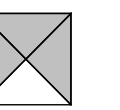
A \(5\times 5\) square is covered with \(1\times 1\) tiles. The design on each tile is made up of three dark triangles and one light triangle (see diagram). The triangles of neighbouring tiles always have the same colour where they join along an edge. The border of the large square is made of dark and light triangles. What is the smallest number of dark triangles that could be among them?
Show answer
Answer: B — 5
Show hints
Hint 1 of 2
Neighbouring tiles must match colour along each shared edge, which constrains how the dark and light triangles line up.
Still stuck? Show hint 2 →
Hint 2 of 2
Focus on the border triangles and arrange the tiles to use as few dark ones there as the matching rule allows.
Show solution
Approach: minimise dark triangles under the edge-matching rule
- Every tile has three dark and one light triangle, and triangles meeting along a shared edge must be the same colour.
- This matching rule links the colours of adjacent tiles' edge triangles, limiting how the single light triangle of each tile can be aimed outward.
- Arranging the tiles so the most light triangles fall on the border leaves the fewest dark ones there.
- The smallest possible number of dark border triangles is 5.
Mark:
· log in to save