Arno lays out the word KANGAROO with 8 letter cards, but some cards are turned the wrong way (see picture). The letter K can be set right by turning its card twice, and the letter A by turning its card once. How many turns in all does Arno need so that KANGAROO reads correctly?
Show answer
Answer: C — 6
Show hints
Hint 1 of 2
Go letter by letter and decide whether each card is already the right way up.
Still stuck? Show hint 2 →
Hint 2 of 2
Count the cost: a letter that is upside-down or mirrored needs one or two turns to fix; add those up across the whole word.
Show solution
Approach: check each card and add up the turns it needs
Read the laid-out word against KANGAROO and find every card that is rotated or flipped.
Each wrong card needs either one turn or two turns to come right, exactly as the example shows for K and A.
Adding the turns needed across all the wrong cards gives a total of 6.
The Mathematical Kangaroo takes place each year on the third Thursday of March. What is the latest possible date on which the competition could take place?
Show answer
Answer: D — 21 March
Show hints
Hint 1 of 2
The third Thursday is latest when the first Thursday falls as late in March as possible.
Still stuck? Show hint 2 →
Hint 2 of 2
The first Thursday is latest when March 1st is a Friday; then count two weeks forward.
Show solution
Approach: push the first Thursday as late as possible
The third Thursday is latest when the very first Thursday of March is as late as it can be.
If March 1st is a Friday, the first Thursday is the 7th.
Adding two more weeks gives the third Thursday on the 7th + 14 = 21st.
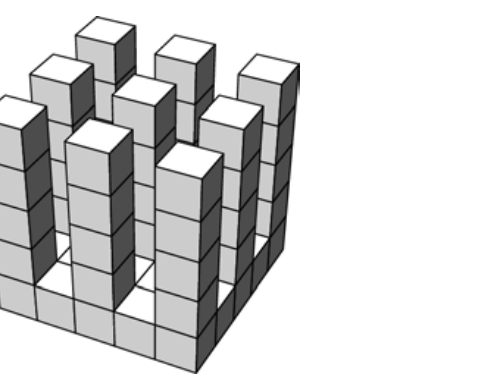
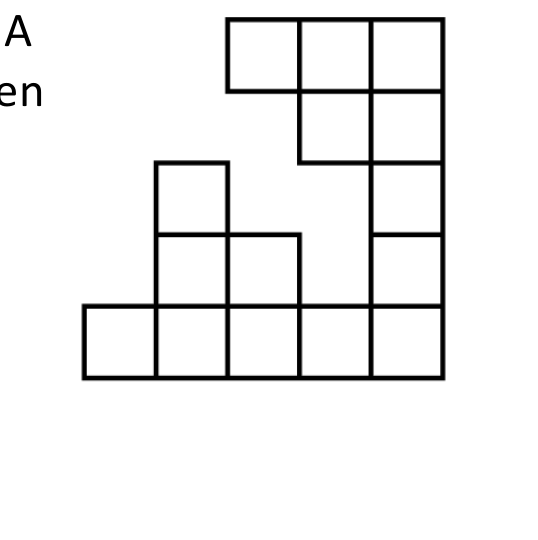
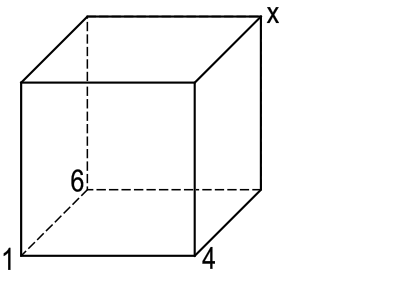
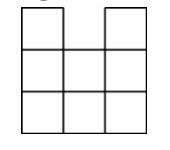
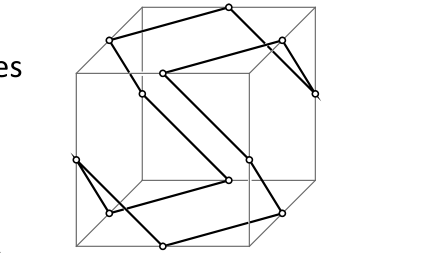
If one removes some 1×1×1 cubes from a 5×5×5 cube, you obtain the solid shown. It consists of several equally high pillars built on a common base. How many little cubes have been removed?
Show answer
Answer: C — 64
Show hints
Hint 1 of 2
Build it in two parts: a solid base layer, then the equal pillars standing on it.
Still stuck? Show hint 2 →
Hint 2 of 2
Count how many of the 125 unit cubes are LEFT, then subtract from 125.
Show solution
Approach: count what remains, then subtract
The full cube has 5×5×5 = 125 unit cubes.
One complete bottom layer stays in place: that is 5×5 = 25 cubes.
On top sit 9 equal pillars (a 3×3 arrangement), each rising the remaining 4 levels: 9×4 = 36 cubes.
So 25 + 36 = 61 cubes remain, and 125 − 61 = 64 were removed.
A cake weighs 900 g. Paul cuts it into 4 pieces. The biggest piece weighs exactly as much as the other three pieces together. How much does the biggest piece weigh?
Show answer
Answer: D — 450 g
Show hints
Hint 1 of 2
The biggest piece equals all the other pieces put together, so it is one of two equal halves of the cake.
Still stuck? Show hint 2 →
Hint 2 of 2
Half of the whole cake is the biggest piece.
Show solution
Approach: the biggest piece is half the cake
If the biggest piece weighs as much as the other three together, then those two parts are equal halves of the cake.
Marie wants to put the digit 3 somewhere into the number 2014. Where must she put the 3 so that the new number (with all 5 digits) is as small as possible?
Show answer
Answer: D — between 1 and 4
Show hints
Hint 1 of 3
A number is smaller when its first (left-most) digits are smaller.
Still stuck? Show hint 2 →
Hint 2 of 3
Putting the big digit 3 near the front pushes the number up, so push the 3 as far right as you can.
Still stuck? Show hint 3 →
Hint 3 of 3
Write out each new number and read them like words to see which comes first.
Show solution
Approach: keep the small left-hand digits and push the 3 to the right
Try the 3 in each gap: 32014, 23014, 20314, 20134, 20143.
Reading them like a race, the one that stays smallest the longest at the front is 20134.
The container ship MSC Fabiola carries 12500 identically long containers. When put next to each other in a row they make a 75 km long line. Roughly, how long is one container?
Show answer
Answer: A — 6 m
Show hints
Hint 1 of 2
Put the whole line and the number of containers into the same units first.
Still stuck? Show hint 2 →
Hint 2 of 2
Divide the total length by how many containers make it up.
Show solution
Approach: convert to one unit, then divide
The line is 75 km = 75000 m long and is made of 12500 containers.
Today is Carmen, Gerda and Sabine's birthday. The sum of their ages is now 44. How big will the sum of their ages be the next time it is a two-digit number with two equal digits?
Show answer
Answer: C — 77
Show hints
Hint 1 of 2
Every year that passes, the total of three ages goes up by 3.
Still stuck? Show hint 2 →
Hint 2 of 2
Which numbers with two equal digits can you actually reach by adding multiples of 3 to 44?
Show solution
Approach: step the total up by 3 each year and land on a repdigit
Each birthday all three get one year older, so the sum rises by 3 each year.
Starting from 44, the reachable totals are 44, 47, 50, 53, … (everything 44 + 3k).
Check the two-equal-digit numbers: 55 and 66 are not of the form 44 + 3k, but 77 = 44 + 33 is.
So the next time the sum is a two-digit repdigit it equals 77.
Whenever Koko the koala bear is awake, he always eats 50 grams of leaves in one hour. Yesterday Koko slept for 20 hours. How many grams of leaves did he eat yesterday?
Show answer
Answer: D — 200 grams
Show hints
Hint 1 of 3
Koko only eats when he is awake, so first work out how many hours he was awake.
Still stuck? Show hint 2 →
Hint 2 of 3
A whole day is 24 hours; take away the hours he slept.
Still stuck? Show hint 3 →
Hint 3 of 3
For each awake hour add another 50 grams of leaves.
Show solution
Approach: find the awake hours, then add 50 grams for each one
A day is 24 hours and Koko slept 20 of them, so he was awake 24 − 20 = 4 hours.
Each awake hour he eats 50 grams, so count by fifties for the 4 hours: 50, 100, 150, 200.
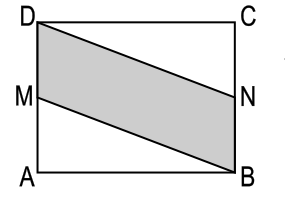
The area of rectangle ABCD in the diagram is 10. M and N are the midpoints of the sides AD and BC respectively. What is the area of the quadrilateral MBND?
Show answer
Answer: B — 5
Show hints
Hint 1 of 2
M and N are midpoints, so segment MN splits the rectangle into two equal halves.
Still stuck? Show hint 2 →
Hint 2 of 2
Compare the quadrilateral MBND with the half of the rectangle that contains it.
Show solution
Approach: use the midpoint line to halve the area
Because M and N are the midpoints of the two opposite sides, the segment MN cuts the rectangle into two equal pieces, each of area 5.
The quadrilateral MBND is built symmetrically about MN, and a quick shear/area argument shows it covers exactly half of the whole rectangle.
In three differently sized baskets there are 48 balls in total. Together the smallest and the biggest basket hold twice as many balls as the middle one. The smallest basket holds half as many balls as the middle one. How many balls are there in the biggest basket?
Show answer
Answer: C — 24
Show hints
Hint 1 of 2
Let the middle basket be your unit and write the others in terms of it.
Still stuck? Show hint 2 →
Hint 2 of 2
Three quantities add to 48 — turn the words into one equation in the middle amount.
Show solution
Approach: express all baskets through the middle one
Let the middle basket hold m balls. The smallest holds m/2.
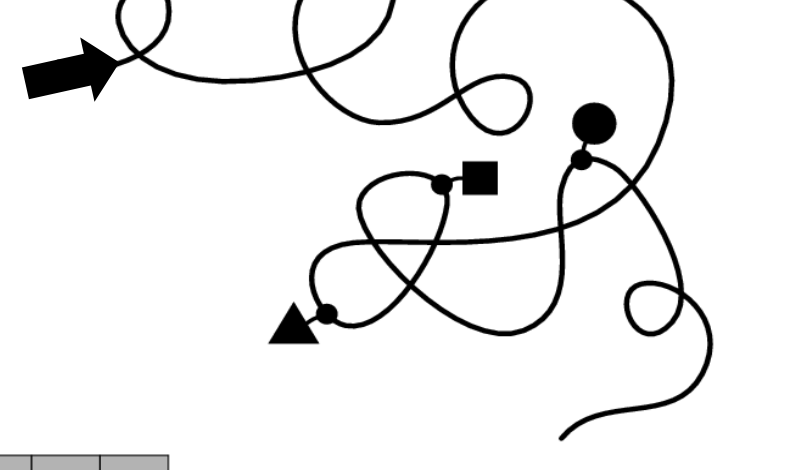
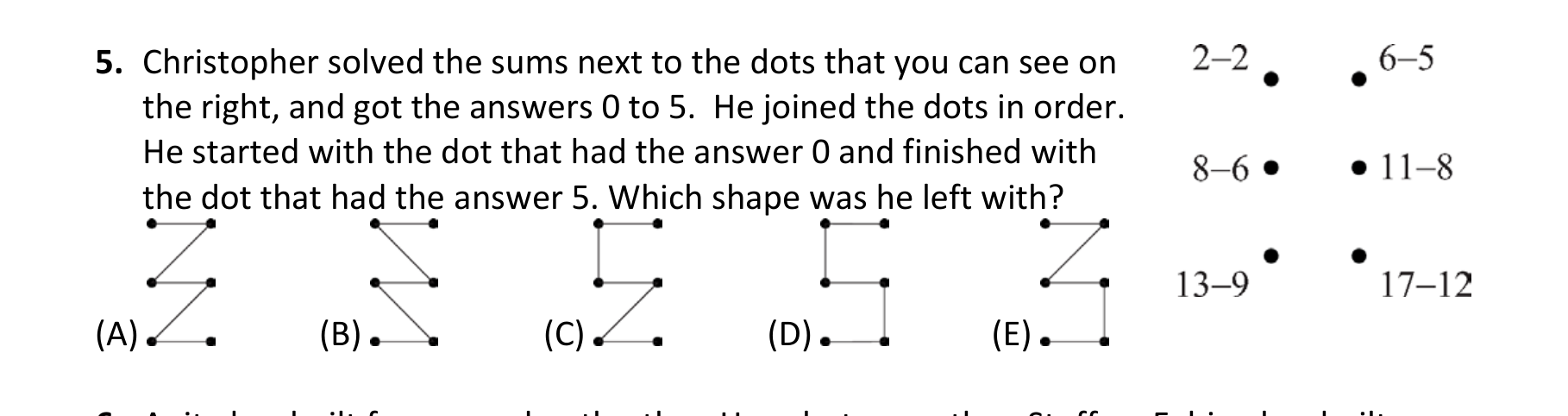
Christopher worked out the sums written next to the dots and got the answers 0, 1, 2, 3, 4 and 5. He joined the dots in order, starting at the dot with answer 0 and finishing at the dot with answer 5. Which shape was he left with? (Choose the matching picture.)
Show answer
Answer: A
Show hints
Hint 1 of 3
First work out the little sum next to each dot and write its answer on the dot.
Still stuck? Show hint 2 →
Hint 2 of 3
Now you have dots labelled 0, 1, 2, 3, 4 and 5.
Still stuck? Show hint 3 →
Hint 3 of 3
Draw a line from 0 to 1 to 2 and on to 5, then see which picture your line looks like.
Show solution
Approach: label each dot with its answer, then join them in order
Work out each sum and write the answer on its dot, so the dots are now numbered 0, 1, 2, 3, 4 and 5.
Start your pencil at the 0 dot and draw to the 1 dot, then the 2, and so on up to the 5.
The line zig-zags from side to side and makes a clear shape.
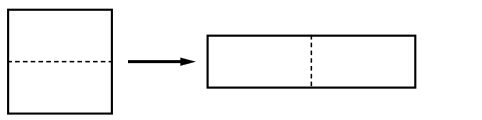
A square with perimeter 48 cm is cut into two equal pieces with one straight cut. The pieces are put together to make a rectangle, as shown in the picture. What is the perimeter of that rectangle?
Show answer
Answer: D — 60 cm
Show hints
Hint 1 of 2
Find the side of the square first from its perimeter.
Still stuck? Show hint 2 →
Hint 2 of 2
Cutting the square in half and laying the pieces side by side makes a rectangle that is twice as long and half as tall.
Show solution
Approach: find the square's side, then the new rectangle's sides
The square has perimeter 48 cm, so each side is 48 ÷ 4 = 12 cm.
The picture shows it cut into two 12 cm by 6 cm halves laid end to end, giving a 24 cm by 6 cm rectangle.
Anita has built fewer sandcastles than Hans but more than Stefan. Fabian has built more sandcastles than Anita and more than Hans. Bruno has built more sandcastles than Hans but fewer than Fabian. Who has built the most sandcastles?
Show answer
Answer: E — Fabian
Show hints
Hint 1 of 3
Picture the children standing in a line, tallest pile of sandcastles at the top.
Still stuck? Show hint 2 →
Hint 2 of 3
Each sentence tells you who stands above whom, so place them one at a time.
Still stuck? Show hint 3 →
Hint 3 of 3
Look for the one child who never has anybody above them.
Show solution
Approach: stand the children in order, most sandcastles at the top
Hans is above Anita, and Anita is above Stefan, so far Hans, then Anita, then Stefan.
Fabian is above both Anita and Hans, so Fabian goes near the top.
Bruno is above Hans but below Fabian, so the full line is Fabian, Bruno, Hans, Anita, Stefan.
Nobody is above Fabian, so the most sandcastles belong to Fabian.
The side lengths of the large regular hexagon are twice those of the small regular hexagon. What is the area of the large hexagon if the small hexagon has an area of 4 cm²?
Show answer
Answer: A — 16 cm²
Show hints
Hint 1 of 2
Doubling every length does not double the area.
Still stuck? Show hint 2 →
Hint 2 of 2
Area scales by the square of the scale factor.
Show solution
Approach: area scales as the square of the side ratio
The large hexagon has sides twice as long, so its area is 2² = 4 times the small one.
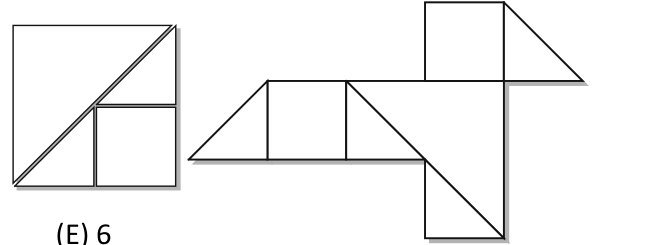
Wanda has lots of pages of square paper, each with an area of 4. She cuts each page into right-angled triangles and squares (see the left-hand diagram). She takes a few of these pieces and forms the shape in the right-hand diagram. What is the area of this shape?
Show answer
Answer: E — 6
Show hints
Hint 1 of 2
Each whole page has area 4, so work out the area of each small piece she cuts.
Still stuck? Show hint 2 →
Hint 2 of 2
Add up the areas of the pieces that make the right-hand shape, regardless of how they are turned.
Show solution
Approach: count the area contributed by each cut piece
Each page is a square of area 4, i.e. side 2; the cuts make a big right triangle of area 2, a unit square of area 1, and a small right triangle of area 1.
The dog shape is built from these pieces, so just add the areas of the pieces used: it is made up of unit squares and triangles of area 1 plus a couple of the area-2 triangles.
Adding the areas of all the assembled pieces totals an area of 6.
Katrin has 38 matches. She uses all of them to make a triangle and a square that share no matches. Each side of the triangle is made of 6 matches. How many matches are in one side of the square?
Show answer
Answer: B — 5
Show hints
Hint 1 of 2
Work out how many matches the triangle uses, then see what is left for the square.
Still stuck? Show hint 2 →
Hint 2 of 2
Whatever the square gets, split it evenly across its four equal sides.
Show solution
Approach: subtract the triangle's matches, then divide the rest by 4
The triangle has three sides of 6 matches, so it uses 3 × 6 = 18 matches.
That leaves 38 − 18 = 20 matches for the square.
The square's four equal sides share these, so each side has 20 ÷ 4 = 5 matches.
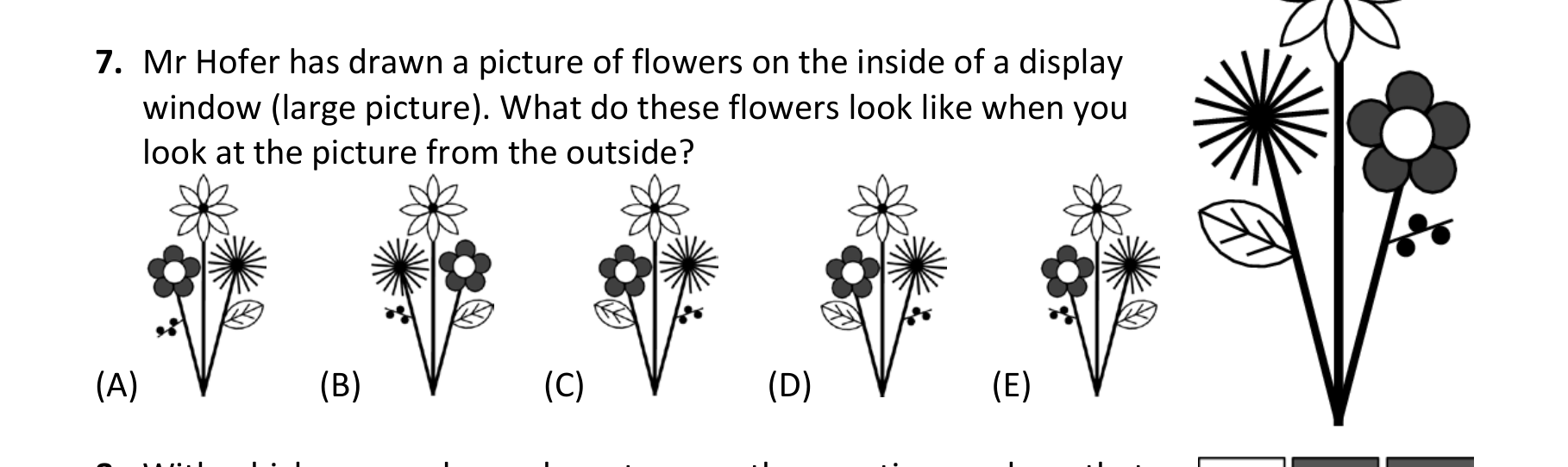
Mr Hofer drew a picture of flowers on the inside of a shop window (the large picture). What do these flowers look like when you walk outside and look at the picture through the glass? (Choose the matching picture.)
Show answer
Answer: E
Show hints
Hint 1 of 3
Looking through the glass from the other side is just like looking in a mirror.
Still stuck? Show hint 2 →
Hint 2 of 3
A mirror swaps left and right, but keeps top and bottom the same.
Still stuck? Show hint 3 →
Hint 3 of 3
Hold the picture up to a mirror in your mind: what is on the left jumps to the right.
Show solution
Approach: flip the picture left-to-right like a mirror
Seeing the drawing from outside the glass is the same as seeing it in a mirror.
A mirror keeps each flower the right way up but swaps the left side with the right side.
So flowers on the left of the drawing should now be on the right.
A bucket is filled halfway with water. A cleaning liquid adds another 2 litres of liquid to the bucket. Now the bucket is three-quarters full. How many litres in total can the bucket hold?
Show answer
Answer: B — 8 litres
Show hints
Hint 1 of 2
How much of the bucket did the 2 litres fill up?
Still stuck? Show hint 2 →
Hint 2 of 2
Going from half full to three-quarters full is one quarter of the bucket.
Show solution
Approach: match the added amount to the fraction it fills
The level rose from 1/2 to 3/4, an increase of 1/4 of the bucket.
That 1/4 equals 2 litres, so the whole bucket holds 4 × 2 = 8 litres.
Grey and white pearls are threaded on a string (see picture). Monika wants 5 grey pearls, but she can only pull pearls off from an end of the string, so she has to pull off some white pearls too. What is the smallest number of white pearls she has to pull off to get 5 grey pearls?
Show answer
Answer: B — 3
Show hints
Hint 1 of 2
She can only take pearls from one of the two ends, so compare the two ends.
Still stuck? Show hint 2 →
Hint 2 of 2
Pick the end where the fifth grey pearl is reached after passing the fewest white pearls, and count just those whites.
Show solution
Approach: scan inward from the better end and count the white pearls passed
Pearls come off only from an end, so check each end and stop once 5 grey pearls have come off.
Reading in from the end that reaches the fifth grey pearl soonest, only a few white pearls sit among those first five greys.
Counting just those white pearls gives a minimum of 3.
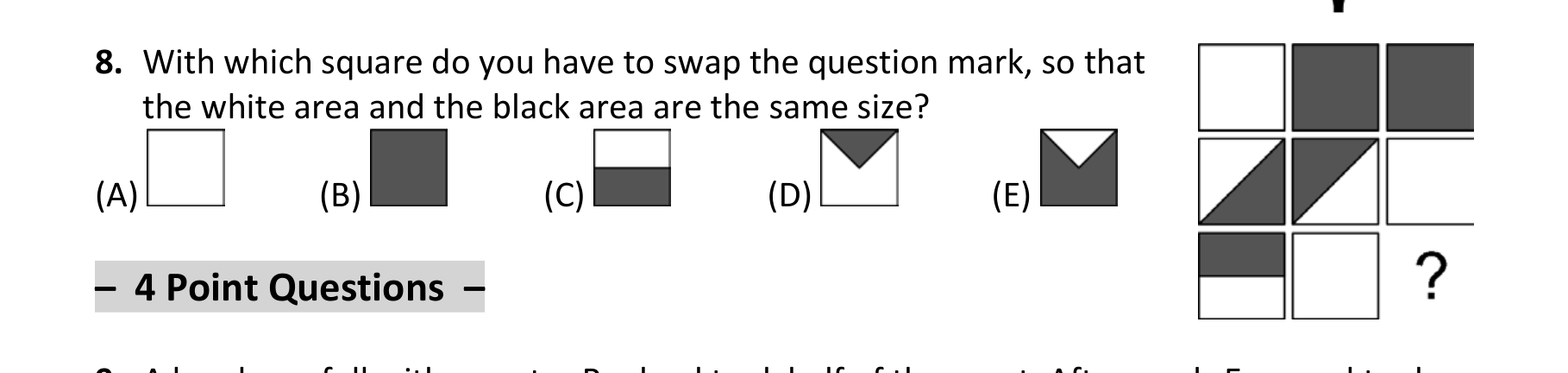
With which square do you have to swap the question-mark square so that the white area and the black area become the same size? (Choose the matching picture.)
Show answer
Answer: B
Show hints
Hint 1 of 3
Count how many small black parts and how many small white parts the picture has right now.
Still stuck? Show hint 2 →
Hint 2 of 3
If there is more black than white, the new square must add some white to even them out (or the other way round).
Still stuck? Show hint 3 →
Hint 3 of 3
Pick the square that swaps in just the right amount to make black and white match.
Show solution
Approach: count the black and white parts and find the square that balances them
Count up all the black little pieces and all the white little pieces as the picture stands.
One colour is ahead, so the question-mark square needs to be replaced by one that gives back exactly that difference in the other colour.
Try each choice and see which one makes the black total equal the white total.
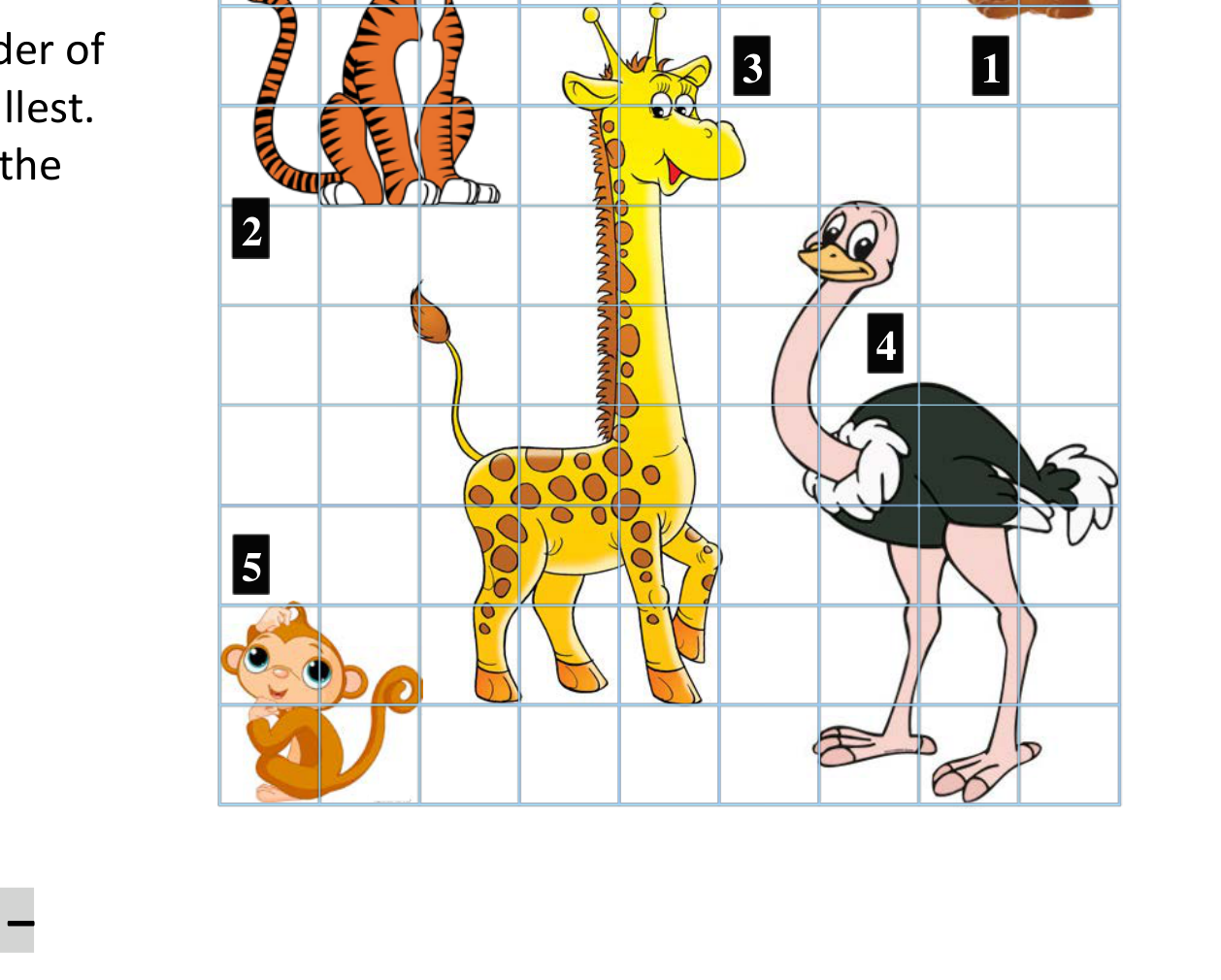
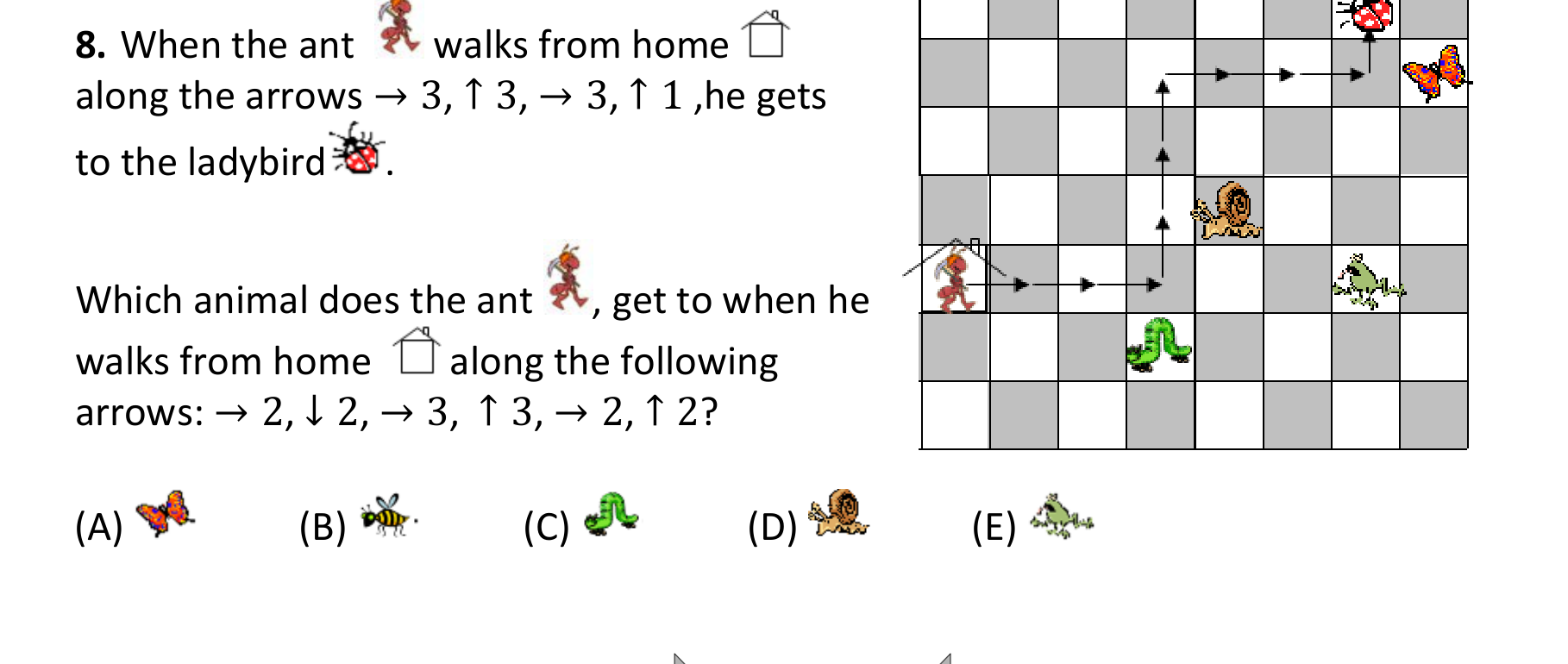
When the ant walks from home along the arrows right 3, up 3, right 3, up 1, he gets to the ladybird. Which animal does the ant get to when he walks from home along these arrows: right 2, down 2, right 3, up 3, right 2, up 2?
Show answer
Answer: A
Show hints
Hint 1 of 3
An arrow with a number tells you how many squares to step that way, like a board game move.
Still stuck? Show hint 2 →
Hint 2 of 3
Start your finger on the home square and make each move one square at a time, counting as you go.
Still stuck? Show hint 3 →
Hint 3 of 3
When all the moves are done, look at the square your finger has landed on.
Show solution
Approach: hop square by square through every arrow, then read the animal on the landing square
Put your finger on the home square; each arrow says which way to go and how many squares to hop.
Hop right 2, then down 2, then right 3, then up 3, then right 2, then up 2, counting each square.
Your finger lands on the square in the top-right where the butterfly is sitting.
Tom draws a square on the coordinate plane. One diagonal sits on the x-axis, with endpoints \((-1,0)\) and \((5,0)\). Which of the following points is also a corner of the square?
Show answer
Answer: B — \((2,3)\)
Show hints
Hint 1 of 2
The two diagonals of a square cross at its centre and have equal length.
Still stuck? Show hint 2 →
Hint 2 of 2
Find the centre, then go the same distance perpendicular to the given diagonal.
Show solution
Approach: use the equal, perpendicular diagonals of a square
The given diagonal runs from (−1,0) to (5,0); its centre is (2,0) and its half-length is 3.
The other diagonal is vertical through (2,0) with the same half-length, giving corners (2,3) and (2,−3).
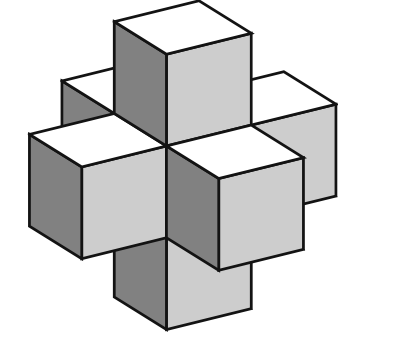
George builds the sculpture shown from seven cubes, each of edge length 1. How many more of these cubes must he add to the sculpture to build a large cube of edge length 3?
Show answer
Answer: E — 20
Show hints
Hint 1 of 2
How many unit cubes does a 3×3×3 cube contain?
Still stuck? Show hint 2 →
Hint 2 of 2
Subtract the seven cubes he already has from the full count.
Show solution
Approach: count and subtract
A cube of edge 3 is made of 3 × 3 × 3 = 27 unit cubes.
Handsome Fritz has a secret e-mail address that is known by only four of his friends. Today he received eight e-mails at this address. Which of the following statements is definitely correct?
Show answer
Answer: D — Fritz received at least two e-mails from one of his friends.
Show hints
Hint 1 of 2
Spread 8 e-mails among only 4 senders — can they all stay at one each?
Still stuck? Show hint 2 →
Hint 2 of 2
This is the pigeonhole principle in disguise.
Show solution
Approach: pigeonhole on senders
Eight e-mails come from just four friends.
If every friend sent at most one, that is at most 4 e-mails — too few.
So at least one friend must have sent two or more.
The statement guaranteed true is (D): at least two e-mails come from one friend.
The little witch takes part in a broomstick flying competition of 5 rounds. The times at which she crossed the starting line are shown in the table. Which round was her fastest?
Time
Start
09:55
after round 1
10:26
after round 2
10:54
after round 3
11:28
after round 4
12:03
after round 5
12:32
Show answer
Answer: B — the second
Show hints
Hint 1 of 2
A round's time is the gap between two crossing times, not the clock time itself.
Still stuck? Show hint 2 →
Hint 2 of 2
Subtract each crossing time from the previous one and look for the smallest gap.
Show solution
Approach: find each round's length as a time gap and pick the smallest
Round 1 lasted 09:55 to 10:26 = 31 min; Round 2: 10:26 to 10:54 = 28 min; Round 3: 10:54 to 11:28 = 34 min; Round 4: 11:28 to 12:03 = 35 min; Round 5: 12:03 to 12:32 = 29 min.
The shortest gap is 28 minutes.
That is Round 2, so the fastest round was the second.
A bowl was full of sweets. Raphael took half of them out. Afterwards Emanuel took out half of the remaining sweets. Now there are only 12 sweets left in the bowl. How many sweets were in the bowl to begin with?
Show answer
Answer: E — 48
Show hints
Hint 1 of 3
Start at the end with the 12 sweets that are left and walk backwards.
Still stuck? Show hint 2 →
Hint 2 of 3
Each boy took half, so the 12 left is half of what was there just before him.
Still stuck? Show hint 3 →
Hint 3 of 3
Going back one step means doubling, so double, then double again.
Show solution
Approach: walk backwards, doubling at each step
The 12 left over is half of what was in the bowl before Emanuel reached in, so before Emanuel there were 12 + 12 = 24.
Those 24 are half of what was there before Raphael, so the bowl started with 24 + 24 = 48.
In Kangaroo City there are m men, f women and k children, with m : f = 2 : 3 and f : k = 8 : 1. In what ratio is the number of adults (men and women) to the number of children?
Show answer
Answer: E — 40 : 3
Show hints
Hint 1 of 2
Scale the two ratios so the women count matches in both.
Still stuck? Show hint 2 →
Hint 2 of 2
Make f the same number, then read off adults vs children.
Show solution
Approach: line up the shared term (women)
m : f = 2 : 3 and f : k = 8 : 1. Scale the first so f = 24: m : f = 16 : 24.
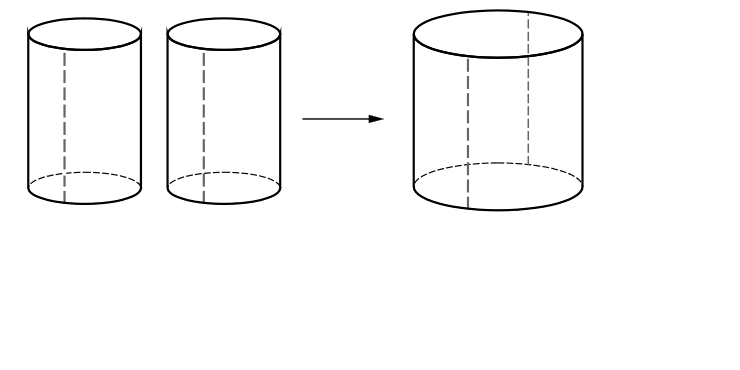
The curved surfaces of two identical cylinders are cut open along the vertical dotted line, as shown, and then stuck together to create the curved surface of one big cylinder. What can be said about the volume of the resulting cylinder compared to the volume of one of the small cylinders?
Show answer
Answer: D — It is 4 times as big.
Show hints
Hint 1 of 2
The two lateral surfaces are joined side by side, so what doubles — the height or the circumference?
Still stuck? Show hint 2 →
Hint 2 of 2
Same height, double circumference means double the radius. How does radius affect volume?
Show solution
Approach: track how radius scales the volume
Joining two equal lateral surfaces edge to edge keeps the height the same but doubles the circumference, so the new radius is twice the old: R = 2r.
Volume ∝ radius², so the big cylinder's volume is (2)² = 4 times one small cylinder's.
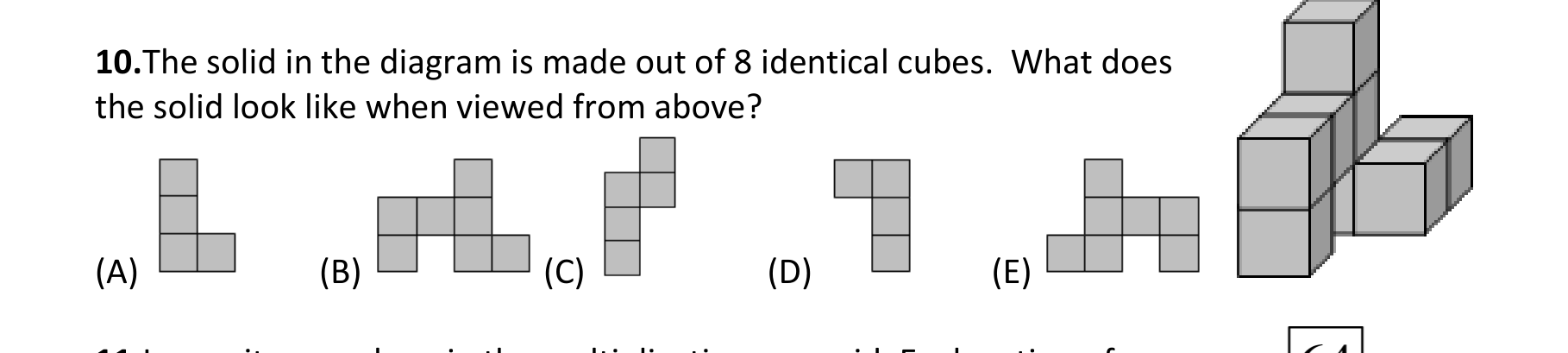
The solid in the diagram is built from 8 identical cubes. What does the solid look like when you look straight down at it from above? (Choose the matching picture.)
Show answer
Answer: C
Show hints
Hint 1 of 3
Imagine you are a bird flying right over the top, looking straight down.
Still stuck? Show hint 2 →
Hint 2 of 3
From up there you cannot tell how tall a stack is, only which floor squares are covered.
Still stuck? Show hint 3 →
Hint 3 of 3
Shade in every square that has at least one cube under it and match that shape.
Show solution
Approach: draw the shape of the floor squares the cubes cover
Looking from above, tall and short stacks look the same; all that matters is which floor squares are filled.
Mark each square that has a cube sitting on it, ignoring how high the pile goes.
The circumference of the large wheel of a bicycle measures 4·2 m, and that of the small wheel 0·9 m. To begin with, the valves on both wheels are at the lowest point; then the bicycle moves off. After a few metres both valves are again at the lowest point at the same time. After how many metres does this happen for the first time?
Show answer
Answer: C — 12·6 m
Show hints
Hint 1 of 2
Both valves return to the bottom after a whole number of turns of each wheel.
Still stuck? Show hint 2 →
Hint 2 of 2
Find the least common multiple of the two circumferences.
Show solution
Approach: least common multiple of the wheel circumferences
The distance must be a whole-number multiple of both 4.2 m and 0.9 m.
Work in tenths of a metre: lcm(42, 9) = 126, so 12.6 m.
Gray and white pearls are threaded onto a string (see picture). Tony pulls pearls off from the ends of the string. After pulling off the fifth gray pearl he stops. At most, how many white pearls could he have pulled off?
Show answer
Answer: D — 7
Show hints
Hint 1 of 2
He can pull from either end, so choose the ends that hand over white pearls cheaply.
Still stuck? Show hint 2 →
Hint 2 of 2
Count how many white pearls can be removed before the fifth gray pearl is forced off.
Show solution
Approach: pull from whichever end yields the most white pearls
Tony stops the instant the fifth gray pearl comes off, so he removes exactly 5 gray pearls in total, sharing them between the two ends.
He should pull from whichever end currently hands over white pearls before its next gray pearl.
Taking the first three gray pearls from one end and the next two from the other end sweeps up the most white pearls along the way.
Counting the white pearls collected before that fifth gray pearl gives at most 7.
In the year 2014 all digits are different and the last digit is bigger than the sum of the other three digits. How many years ago was this last the case?
Show answer
Answer: C — 305
Show hints
Hint 1 of 2
Read 2014's two conditions, then walk backwards year by year.
Still stuck? Show hint 2 →
Hint 2 of 2
You need all four digits different AND the last digit larger than the sum of the first three.
Show solution
Approach: step backward to the previous year meeting both rules
2014 works: digits 2,0,1,4 are all different and 4 > 2+0+1.
Going back, you must find a year with four different digits whose last digit beats the sum of the other three — hard once the leading digits grow.
The most recent earlier such year is 1709 (digits all different, 9 > 1+7+0 = 8).
In a holiday camp, 7 children eat ice cream every day and 9 children eat ice cream every other day. The rest never eat ice cream. Yesterday 13 children ate ice cream. How many children will eat ice cream today?
Show answer
Answer: D — 10
Show hints
Hint 1 of 2
The 7 daily eaters had ice cream yesterday and will have it again today.
Still stuck? Show hint 2 →
Hint 2 of 2
Figure out how many of the every-other-day group ate yesterday; the rest of that group are the ones who eat today.
Show solution
Approach: split the 13 into daily eaters and every-other-day eaters
The 7 daily children ate yesterday, so 13 − 7 = 6 of the every-other-day children also ate yesterday.
Those 6 skip today, so the other 9 − 6 = 3 every-other-day children eat today.
Today's total is the 7 daily children plus those 3, which is 10.
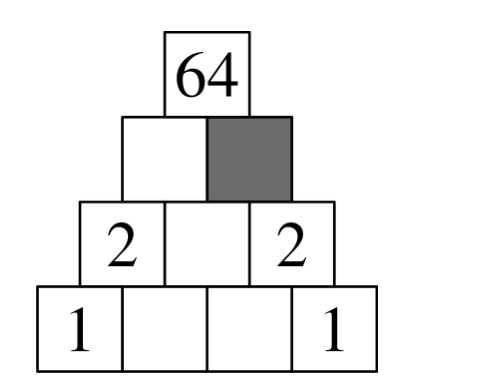
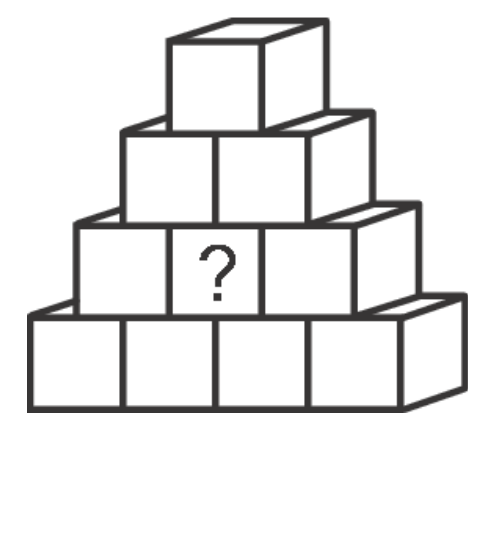
Leo writes numbers in the multiplication pyramid. In a multiplication pyramid, you multiply two numbers that are next to each other to get the number directly above them (in the middle). Which number must Leo write in the grey field?
Show answer
Answer: E — 8
Show hints
Hint 1 of 3
Each block is found by multiplying the two blocks right under it.
Still stuck? Show hint 2 →
Hint 2 of 3
Start at the bottom row, which you know, and build one row up at a time.
Still stuck? Show hint 3 →
Hint 3 of 3
Keep multiplying neighbouring blocks until you reach the grey one.
Show solution
Approach: build the pyramid upward, multiplying each pair of neighbours
Start with the bottom row 1, 2, 2, 1.
Multiply each neighbouring pair to get the next row up: 1×2 = 2, 2×2 = 4, 2×1 = 2, so that row is 2, 4, 2.
Multiply neighbours again: 2×4 = 8 and 4×2 = 8, so the grey block is 8.
How many numbers, which are only allowed to contain the digits 1, 2 or 3, are bigger than 10 and smaller than 32? The digits can be used more than once in the numbers.
Show answer
Answer: D — 7
Show hints
Hint 1 of 3
Bigger than 10 and smaller than 32 means the number has two digits and starts with 1, 2, or 3.
Still stuck? Show hint 2 →
Hint 2 of 3
Be neat: write all the numbers that start with 1, then all that start with 2, then those that start with 3.
Still stuck? Show hint 3 →
Hint 3 of 3
Remember each digit can only be 1, 2, or 3, and don't forget to stop before 32.
Show solution
Approach: list the two-digit numbers in order, using only the digits 1, 2, 3
We want two-digit numbers made only from 1, 2, 3 that are bigger than 10 and smaller than 32.
Starting with 1: 11, 12, 13. Starting with 2: 21, 22, 23. Starting with 3 (but under 32): just 31.
A grandmother, her daughter and her granddaughter each have their birthday in February. Together they are 100 years old, and each person’s age is a power of 2. In which year was the granddaughter born?
Show answer
Answer: C — 2010
Show hints
Hint 1 of 2
Three ages, each a power of 2, add to 100.
Still stuck? Show hint 2 →
Hint 2 of 2
Try the largest powers of 2 first and see what is left.
Show solution
Approach: find three powers of 2 summing to 100
Powers of 2 available: 1, 2, 4, 8, 16, 32, 64.
64 + 32 + 4 = 100, so the ages are 64, 32 and 4 (grandmother, mother, granddaughter).
Max has a one-hour piano lesson twice a week; Hanna has a one-hour lesson only every second week. The piano lessons run over a certain number of weeks. How many weeks is this, if during this time Max has 15 more hours of lessons than Hanna?
Show answer
Answer: E — 10 weeks
Show hints
Hint 1 of 2
Work out how many extra hours Max gets over Hanna in a single week.
Still stuck? Show hint 2 →
Hint 2 of 2
Divide the 15-hour gap by the weekly gap to get the number of weeks.
Show solution
Approach: find the weekly difference, then divide
Max has 2 hours each week; Hanna has 1 hour every two weeks, i.e. 0.5 hours per week on average.
So Max gains 2 − 0.5 = 1.5 extra hours every week.
To build a 15-hour lead takes 15 ÷ 1.5 = 10 weeks.
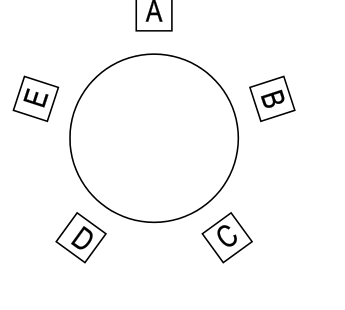
The kangaroos A, B, C, D and E sit in this order, clockwise, around a round table (see picture). After a bell rings, all but one kangaroo swap seats with a neighbour. Afterwards they sit, clockwise, in the order A, E, B, D, C. Which kangaroo did not change places?
Show answer
Answer: B — B
Show hints
Hint 1 of 2
Everyone who moved swapped with a next-door neighbour, so the movers come in pairs.
Still stuck? Show hint 2 →
Hint 2 of 2
Fix the seats and find the one kangaroo whose new neighbours match its old ones — that is the one that stayed put.
Show solution
Approach: anchor one seat and check the rest are neighbour swaps
Before, clockwise: A, B, C, D, E; afterwards, clockwise: A, E, B, D, C.
Suppose B stays in its seat. Reading the after-order clockwise starting at B gives B, D, C, A, E around the circle.
Comparing seat by seat with the before arrangement, C and D have simply swapped (they were neighbours) and A and E have swapped (also neighbours), while B never moved.
Every change is a neighbour swap, so the kangaroo that did not move is B.
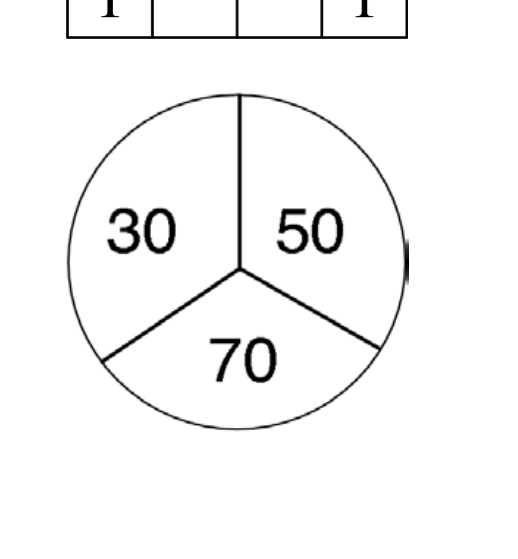
Katja throws darts at the target shown on the right. If she does not hit the target she gets no points. She throws twice and adds her points. What can her total not be?
Show answer
Answer: D — 90
Show hints
Hint 1 of 3
Each single throw can only score one of the numbers on the target (or 0 for a miss).
Still stuck? Show hint 2 →
Hint 2 of 3
Try adding two of those numbers together in every way you can.
Still stuck? Show hint 3 →
Hint 3 of 3
Check each answer choice to find the one total you can never build.
Show solution
Approach: add the two throws in every way and find the missing total
One throw scores 0, 30, 50 or 70, and the total is two throws added.
The rabbit family Hoppel eat cabbages and carrots. Each day they eat either 10 carrots or 2 cabbages. In the whole of last week they ate 6 cabbages. How many carrots did the rabbit family eat last week?
Show answer
Answer: D — 40
Show hints
Hint 1 of 3
A week has 7 days, and each day is either a carrot day or a cabbage day.
Still stuck? Show hint 2 →
Hint 2 of 3
On a cabbage day they eat 2 cabbages, so group the 6 cabbages into 2s to count the cabbage days.
Still stuck? Show hint 3 →
Hint 3 of 3
The days left over in the week are carrot days, with 10 carrots on each.
Show solution
Approach: split the 7 days into cabbage days and carrot days, then count the carrots
There are 7 days in the week, and each day is a cabbage day or a carrot day.
Cabbage days have 2 cabbages each, and 6 cabbages make 3 groups of 2, so 3 days were cabbage days.
That leaves 7 − 3 = 4 carrot days.
Each carrot day has 10 carrots, so 4 days give 4 × 10 = 40 carrots.
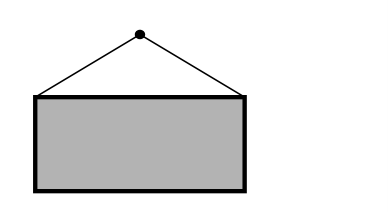
Paul hangs rectangular pictures on a wall. For each picture he hammers a nail into the wall 2·5 m above the floor and ties a 2 m long string to the two upper corners of the picture (see diagram). Which picture size (width in cm × height in cm) has its lower edge nearest to the floor?
Show answer
Answer: C — 120 × 90
Show hints
Hint 1 of 2
The 2 m string and the picture's width form an isosceles triangle hanging from the nail.
Still stuck? Show hint 2 →
Hint 2 of 2
Find how far the top edge drops below the nail, then subtract the picture's height.
Show solution
Approach: drop of the top edge below the nail, then subtract height
Each half of the 2 m string is 1 m and spans half the width w/2 horizontally.
The top edge sits √(1 − (w/2)²) below the nail (in metres), and the nail is 2.5 m up.
Lower edge height = 2.5 − √(1 − (w/2)²) − height; testing the options, 120 × 90 gives the smallest (0.8 m).
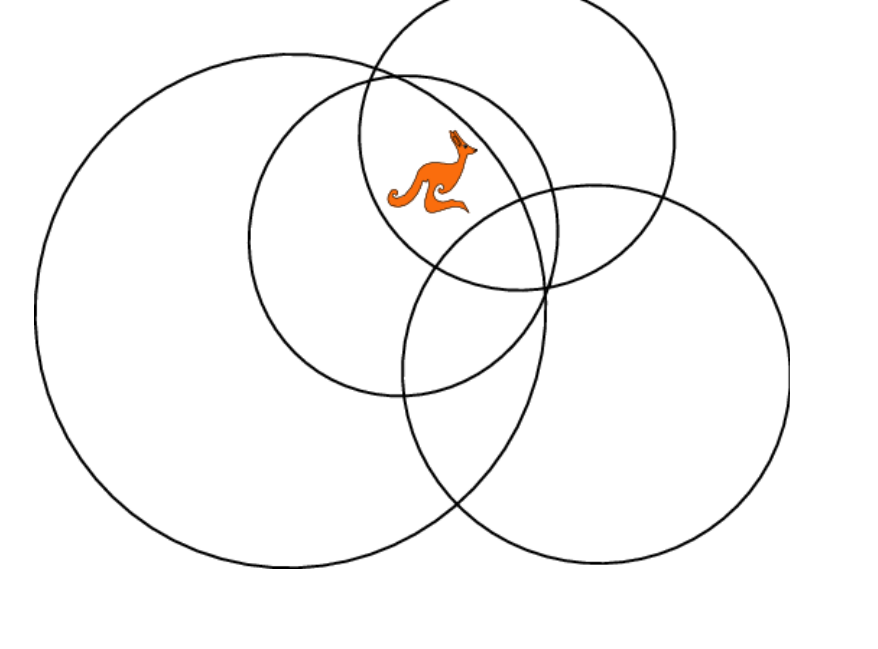
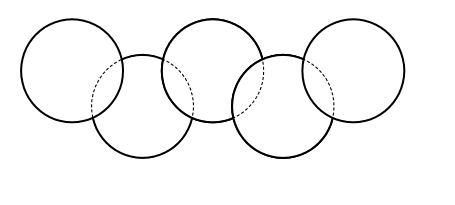
Five circles, each with an area of \(1\text{ cm}^2\), overlap to form the figure in the diagram. The regions where two circles overlap each have an area of 18\(\text{ cm}^2\). What is the area completely covered by the figure in the diagram?
Show answer
Answer: B — 92\(\text{ cm}^2\)
Show hints
Hint 1 of 2
If you just add the five circle areas, the overlap regions get counted twice.
Still stuck? Show hint 2 →
Hint 2 of 2
Use inclusion–exclusion: total area = sum of circles − sum of the doubly-covered overlaps.
Show solution
Approach: inclusion–exclusion on overlapping areas
Adding the five circles gives 5 × 1 = 5 cm², but every overlap region is then counted twice.
There are four overlaps, each of area 1/8 cm², so subtract 4 × 1/8 = 1/2 cm².
The winning team of a football match gets 3 points and the losing team 0 points. In the case of a draw both teams get one point each. Four teams A, B, C and D play a tournament in which each team plays each other team exactly once. At the end of the tournament team A has 7 points, and teams B and C have 4 points each. How many points does team D have?
Show answer
Answer: B — 1
Show hints
Hint 1 of 2
Six games are played; figure out the total number of points handed out, depending on draws.
Still stuck? Show hint 2 →
Hint 2 of 2
A's 7 points pin down how A's three games went.
Show solution
Approach: reconstruct results from the point totals
Each of the 6 games gives out 3 points (a win) or 2 points (a draw).
A has 7 = 3+3+1, so A won twice and drew once (A played 3 games).
B and C each have 4 points; working through the remaining games consistently forces D to total just 1 point.
Each piece is a square with some sides pushed in (a dent) or pushed out (a bulge).
Still stuck? Show hint 2 →
Hint 2 of 2
When two pieces sit side by side, a bulge on one must drop into a matching dent on its neighbour; find the piece whose curves have no partner.
Show solution
Approach: match each piece's curved edges so bulges fill dents
To build a square with straight outer sides, every outward bulge on one piece must fit a matching inward dent on a neighbour, so the curved edges have to pair up.
Four of the pieces have curves that pair off neatly and tile a 2-by-2 square.
Piece B's curves cannot be matched by the others, so it is the piece left over.
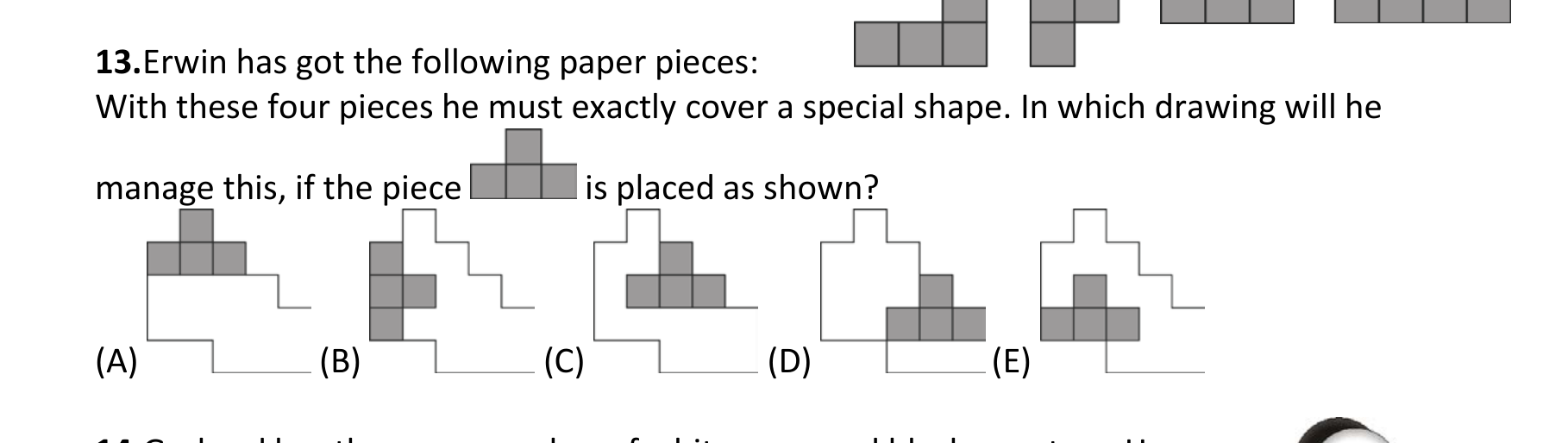
Erwin has the four paper pieces shown. He has to cover a special shape exactly with these four pieces. In which drawing can he do this, when the one piece is placed as shown? (Choose the matching picture.)
Show answer
Answer: C
Show hints
Hint 1 of 3
The piece that is already placed covers part of the shape, so look at the empty gap that is left.
Still stuck? Show hint 2 →
Hint 2 of 3
Ask whether the other three pieces can fill that gap with no holes and no sticking out.
Still stuck? Show hint 3 →
Hint 3 of 3
Try each drawing and keep the only one that the pieces fit perfectly.
Show solution
Approach: see which outline the leftover three pieces fill exactly
Once the shown piece is set down, the empty space that remains has a fixed shape.
Imagine sliding the other three pieces in like a little jigsaw, covering every square with no gaps and no overlaps.
Only one of the drawings lets all four pieces fit exactly.
In a shared apartment where six girls live there are 2 bathrooms. Each morning from 7:00 the girls use the bathrooms before breakfast, each spending 9, 11, 13, 18, 22 and 23 minutes respectively, always alone in one of the two bathrooms. What is the earliest time that all six girls can have breakfast together?
Show answer
Answer: B — 7:49
Show hints
Hint 1 of 2
Two bathrooms run in parallel; minimise the longer of the two totals.
Still stuck? Show hint 2 →
Hint 2 of 2
Split the six times into two groups whose sums are as close as possible.
Show solution
Approach: balance the two bathrooms (minimise the larger total)
The six times total 9+11+13+18+22+23 = 96 minutes, shared by two bathrooms running in parallel, so we want to split them into two groups whose larger sum is as small as possible.
A perfect 48/48 split is impossible, but 23+13+11 = 47 and 22+18+9 = 49 is the closest, so one bathroom needs 49 minutes.
Everyone is finished after 49 minutes, i.e. at 7:49.
A grandmother, her daughter and her granddaughter find that the sum of their ages is 100. Each age is a power of two (that is, several twos multiplied together). How old is the granddaughter?
Show answer
Answer: C — 4
Show hints
Hint 1 of 2
Each age is a power of two: 1, 2, 4, 8, 16, 32, 64, ...
Still stuck? Show hint 2 →
Hint 2 of 2
Find three powers of two that add to 100; the smallest one is the granddaughter.
Show solution
Approach: write 100 as a sum of three powers of two
The grandmother must be the oldest power of two under 100, so try 64; that leaves 36 for the other two ages.
Two powers of two adding to 36 can only be 32 + 4, so the ages are 64, 32 and 4.
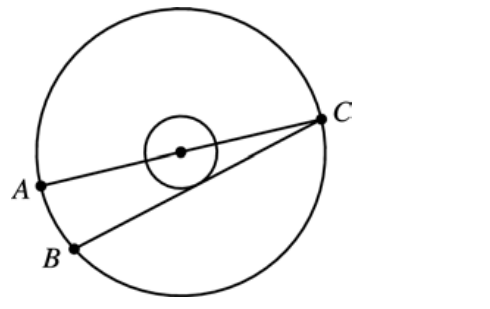
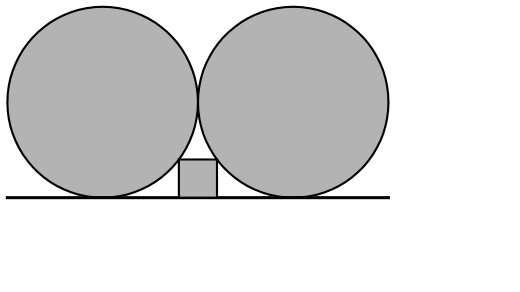
The ratio of the radii of two concentric circles is 1 : 3. The line AC is a diameter of the bigger circle. A chord BC of the big circle touches the small circle (see diagram). The line AB has length 12. How big is the radius of the big circle?
Show answer
Answer: B — 18
Show hints
Hint 1 of 2
Because AC is a diameter, the angle at B is a right angle.
Still stuck? Show hint 2 →
Hint 2 of 2
The centre is the midpoint of AC; how far is a midpoint of the hypotenuse from one leg?
Show solution
Approach: use the right angle at B and a midline distance
AC is a diameter, so by Thales the angle at B is 90°; thus AB ⊥ BC.
Chord BC is tangent to the small circle, so the centre O lies a distance r = R/3 from line BC.
O is the midpoint of AC, and its distance to line BC is half of AB (a midline), i.e. 12/2 = 6.
Gerhard has the same number of white, grey and black counters. He has thrown some of these round pieces together onto a pile. All the pieces he used can be seen in the picture. He has, however, got 5 counters left that will not stay on the pile. How many black counters did he have to begin with?
Show answer
Answer: B — 6
Show hints
Hint 1 of 3
He began with the same number of white, grey and black, so think of them in equal groups.
Still stuck? Show hint 2 →
Hint 2 of 3
Count the counters on the pile, colour by colour, from the picture.
Still stuck? Show hint 3 →
Hint 3 of 3
The 5 left over are the extras that did not fit, so add them back to find each starting group.
Show solution
Approach: count the pile by colour, then add back the leftovers to make equal groups
Count how many white, grey and black counters are actually on the pile in the picture.
He started with the same number of each colour, and 5 counters were left over that did not stay on.
Sharing everything back into three equal colour groups, each group had 6 counters.
Each of the digits 2, 3, 4 and 5 will be placed in a square. Then there will be two numbers, which will be added together. What is the biggest number that they could make?
Show answer
Answer: D — 95
Show hints
Hint 1 of 3
Each number has a tens box and a ones box, and the tens box is worth a lot more.
Still stuck? Show hint 2 →
Hint 2 of 3
To make the total big, the biggest digits should sit in the front (tens) boxes.
Still stuck? Show hint 3 →
Hint 3 of 3
Put the two largest digits in the two front boxes and the two smallest in the back boxes.
Show solution
Approach: put the largest digits in the front (tens) places where they are worth the most
Two two-digit numbers are built from 2, 3, 4, 5, and the front digit of each counts for tens.
To make the sum largest, give the front boxes the two biggest digits, 5 and 4.
The other digits, 2 and 3, go in the back boxes.
That gives 52 + 43 = 95 (53 + 42 also makes 95), the biggest possible total.
Five congruent rectangles are positioned inside a square of side length 24, as shown in the diagram. What is the area of one of these rectangles?
Show answer
Answer: E — \(32\text{ cm}^2\)
Show hints
Hint 1 of 2
Call the rectangle's long side L and short side W, then read off the side of the square along two directions.
Still stuck? Show hint 2 →
Hint 2 of 2
The staircase forces a relation between L and W; solve it together with the side length 24.
Show solution
Approach: set up length equations from the staircase
Let the rectangle be L by W. Reading across one direction of the staircase and down the other gives equations that link L and W to the square's side 24.
Solving them yields a long side that is twice the short side, with L = 8 and W = 4.
A restaurant has 16 tables, each with 3, 4, or 6 chairs. The tables with 3 or 4 chairs seat 36 guests in total. The restaurant seats 72 guests altogether. How many tables have three chairs?
Show answer
Answer: A — 4
Show hints
Hint 1 of 2
First find how many seats the 6-chair tables provide, then how many such tables there are.
Still stuck? Show hint 2 →
Hint 2 of 2
Once you know the number of 3-or-4-chair tables and their 36 seats, set up two simple equations for the 3s and 4s.
Show solution
Approach: peel off the 6-chair tables, then nudge 4-chair tables down to 3
The 3- and 4-chair tables seat 36 guests, so the 6-chair tables seat 72 − 36 = 36, which is 36 ÷ 6 = 6 tables of six.
That leaves 16 − 6 = 10 tables with 3 or 4 chairs, and they seat 36 guests in total.
Pretend all 10 had 4 chairs: that would be 40 seats, which is 4 too many.
Each time you change a 4-chair table into a 3-chair table you lose one seat, so you need 4 of those changes.
There are 4 tables with three chairs.
The same idea with a quick equationIf t tables have 3 chairs, then 3t + 4(10 − t) = 36, so 40 − t = 36 and t = 4.
Hubert the rabbit loves cabbages and carrots. In one day he eats either 9 carrots, or 2 cabbages, or one cabbage and 4 carrots. In one week Hubert ate 30 carrots. How many cabbages did he eat during this week?
Show answer
Answer: B — 7
Show hints
Hint 1 of 3
There are 7 days in a week, so Hubert eats one of his three menus on each of the 7 days.
Still stuck? Show hint 2 →
Hint 2 of 3
Only two of the menus give carrots: the 9-carrot day and the 1-cabbage-and-4-carrots day.
Still stuck? Show hint 3 →
Hint 3 of 3
Try a few of each carrot-day until the carrots add up to 30, then count cabbages on every day.
Show solution
Approach: find which days give the 30 carrots, then count cabbages
Only two kinds of day give carrots: a 9-carrot day, or a day of 1 cabbage and 4 carrots.
Two 9-carrot days give 18 carrots, and three of the ‘1 cabbage + 4 carrots’ days give 12 more — that is 18 + 12 = 30 carrots, using 5 days.
Those three mixed days give 3 cabbages, and the 2 days left over are 2-cabbage days, giving 2 × 2 = 4 more.
Ingrid has 4 red, 3 blue, 2 green and 1 yellow cube. She uses them to build the object shown. Cubes with the same colour don't touch each other. Which colour is the cube with the question mark?
Show answer
Answer: A — red
Show hints
Hint 1 of 3
There are 10 cubes and 10 colour-tiles: 4 red, 3 blue, 2 green, 1 yellow.
Still stuck? Show hint 2 →
Hint 2 of 3
The rule says two cubes of the same colour may never sit next to each other.
Still stuck? Show hint 3 →
Hint 3 of 3
Red is the most common colour, so the reds have to be spread far apart all over the pile.
Show solution
Approach: there are exactly enough cubes for each colour, so the spread-out rule forces the marked cube's colour
The pile has 10 cubes, and the colours come in just the right amounts: 4 red, 3 blue, 2 green, 1 yellow.
No two cubes of the same colour may touch, so the 4 reds must be pushed far apart from one another.
Filling the pile while keeping every colour from touching its twin leaves only one colour that can go in the marked spot.
The tail of the biggest crocodile in a zoo is one third of the crocodile’s total length. The head is 93 cm long and makes up one quarter of the length of the crocodile not counting its tail. How long is the crocodile?
Show answer
Answer: A — 558 cm
Show hints
Hint 1 of 2
Tail is 1/3 of the whole, so the rest (head + body) is 2/3 of the whole.
Still stuck? Show hint 2 →
Hint 2 of 2
The head is 1/4 of that 'rest', and the head is 93 cm.
Show solution
Approach: chain the two fractions back to the total
Without the tail the crocodile is 2/3 of the total length.
The head is 1/4 of that part: 93 = (1/4)(2/3 L) = L/6, so L = 558.
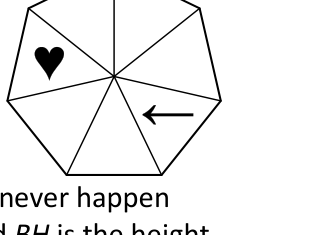
In the figure, the heart and the arrow are arranged as pictured. At the same moment the heart and the arrow begin to move. The arrow moves around the figure 3 spaces clockwise and the heart 4 spaces anticlockwise, and then they stop. This process repeats over and over again. After how many repetitions does the arrow find itself for the first time in the same triangle as the heart?
Show answer
Answer: E — That will never happen
Show hints
Hint 1 of 2
After r repetitions the arrow has moved 3r spaces one way and the heart 4r spaces the other way, around 7 triangles.
Still stuck? Show hint 2 →
Hint 2 of 2
Look at the gap between them modulo 7: each repetition changes it by a fixed amount that never makes it zero.
Show solution
Approach: track the gap between them around the ring of 7 triangles
The figure is a ring of 7 triangles. In one repetition the arrow moves 3 spaces one way and the heart 4 spaces the other way.
So in each repetition the arrow gains \(3+4 = 7\) spaces on the heart, which is a whole lap around the 7 triangles.
Gaining exactly 7 spaces each time returns them to the same relative positions, so the gap between them never changes.
Since they do not start in the same triangle, they can never meet.
The points A, B, C, D, E, F lie on a straight line in this order. These distances are known: AF = 35, AC = 12, BD = 11, CE = 12, and DF = 16. How long is BE?
Show answer
Answer: D — 16
Show hints
Hint 1 of 2
Put A at 0 and F at 35, then place the other points using the given distances.
Still stuck? Show hint 2 →
Hint 2 of 2
Once every point has a position on the line, BE is just the difference of E's and B's positions.
Show solution
Approach: give each point a coordinate on the line, then subtract
Set A = 0, so F = 35. Then C = 12 (from AC = 12).
DF = 16 puts D at 35 − 16 = 19, and BD = 11 puts B at 19 − 11 = 8.
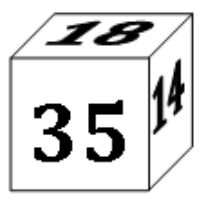
If you add the numbers on opposite faces of this special die, you get the same total three times. The numbers on the hidden faces are prime numbers. Which number is on the face opposite to 14?
Show answer
Answer: E — 23
Show hints
Hint 1 of 2
Opposite faces all add to the same total; the three hidden faces are primes.
Still stuck? Show hint 2 →
Hint 2 of 2
Use the three visible numbers 18, 35, 14 and make each opposite a prime with one common sum.
Show solution
Approach: find the common opposite-sum that makes all hidden faces prime
Let every opposite pair add to S. Then the hidden faces are S−18, S−35 and S−14.
S = 37 works: hidden faces 19, 2 and 23 are all prime.
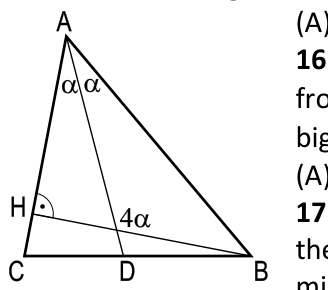
In triangle ABC (see sketch) AD is the angle bisector of the angle at A, and BH is the height from side AC. The obtuse angle between BH and AD is four times the size of angle \(\angle DAB\). How big is the angle \(\angle CAB\)?
Show answer
Answer: C — \(60°\)
Show hints
Hint 1 of 2
Let angle DAB = α, so angle CAB = 2α; the height BH is perpendicular to AC.
Still stuck? Show hint 2 →
Hint 2 of 2
Find the angle between AD and the perpendicular BH in terms of α, then set its obtuse value equal to 4α.
Show solution
Approach: express the angle between the bisector and the height
Let ∠DAB = α, so ∠CAB = 2α and AD makes angle α with AC.
BH is perpendicular to AC, so the acute angle between AD and BH is 90° − α, and the obtuse one is 90° + α.
The vertices of a die are numbered 1 to 8 so that the sum of the four numbers on the vertices of each face is the same. The numbers 1, 4 and 6 are already indicated in the picture. Which number is in position x?
Show answer
Answer: A — 2
Show hints
Hint 1 of 2
Every face uses 4 of the 8 corner numbers and they must all add to the same total.
Still stuck? Show hint 2 →
Hint 2 of 2
Total of 1…8 is 36; use that to find each face's required sum, then fill in around the given 1, 4, 6.
Show solution
Approach: fix the common face sum, then deduce the corners
The eight corner labels add to 1+…+8 = 36; pairing opposite faces shows each face must sum to 18.
Placing the given 1, 4 and 6 and forcing every face to total 18 determines all remaining corners uniquely.
Lea plays with her marbles, placing them in small groups on the table. In groups of three, two marbles are left over. In groups of five, again two are left over. How many more marbles does Lea need so that she can place them in groups of three and in groups of five with none left over?
Show answer
Answer: E — 13
Show hints
Hint 1 of 2
Leaving 2 over for both groups of three and groups of five means leaving 2 over for groups of fifteen.
Still stuck? Show hint 2 →
Hint 2 of 2
She wants a multiple of 15; find the next multiple of 15 above her current count and see how many more marbles that needs.
Show solution
Approach: use that 2 left over mod 3 and mod 5 means 2 left over mod 15
Leaving 2 over in groups of three and in groups of five means leaving 2 over in groups of fifteen.
So her smallest possible count is 2; to split evenly into both 3s and 5s she needs a multiple of 15.
The next multiple of 15 after 2 is 15, which is 15 − 2 = 13 more marbles.
On the Kangaroo planet each kangoo-year has 20 kangoo-months. Each kangoo-month has 6 kangoo-weeks. How many kangoo-weeks are in a quarter of a kangoo-year?
Show answer
Answer: B — 30
Show hints
Hint 1 of 3
First find how many kangoo-weeks fill a whole kangoo-year.
Still stuck? Show hint 2 →
Hint 2 of 3
Every one of the 20 months holds 6 weeks, so count by sixes (or multiply).
Still stuck? Show hint 3 →
Hint 3 of 3
A quarter means splitting that whole year into 4 equal parts and taking one.
Show solution
Approach: find the weeks in a whole year, then split into four equal parts
A year has 20 months and each month has 6 weeks, so a year is 20 × 6 = 120 kangoo-weeks.
A quarter is one of four equal pieces, so share 120 into 4 parts: 120 ÷ 4 = 30.
Anna walks a distance of 8 km at a speed of 4 km/h. Then she runs for a while at 8 km/h. For how many minutes must she run so that her overall average speed is 5 km/h?
Show answer
Answer: E — 40 min
Show hints
Hint 1 of 2
Average speed is total distance over total time, not the average of the speeds.
Still stuck? Show hint 2 →
Hint 2 of 2
Write the running distance as an unknown and set the overall average to 5 km/h.
Show solution
Approach: set total distance / total time = 5
Walking 8 km at 4 km/h takes 2 h. Let the run be d km at 8 km/h, taking d/8 h.
Require (8 + d)/(2 + d/8) = 5; solving gives d = 16/3 km.
Six boys live together in an apartment that has two bathrooms. Each morning from 7:00 they use both bathrooms before breakfast, each boy being alone in one of the two bathrooms for 8, 10, 12, 17, 21, and 22 minutes respectively. What is the earliest time that all six boys can have breakfast together?
Show answer
Answer: B — 7:46
Show hints
Hint 1 of 2
The two bathrooms run in parallel, so the finish time is the larger of the two bathrooms' total minutes.
Still stuck? Show hint 2 →
Hint 2 of 2
Split the six times into two groups to make the bigger group's total as small as possible.
Show solution
Approach: balance the two parallel bathroom totals
Total bathroom time is 8+10+12+17+21+22 = 90 minutes, shared between two bathrooms running at the same time.
Everyone is done when the busier bathroom finishes, so split the times to minimise the larger total.
The best balance is {22,12,10} = 44 and {21,17,8} = 46; no split reaches 45–45, so the larger total is 46 minutes.
Starting at 7:00, the earliest common breakfast time is 7:46.
On the packaging of a soft cheese it says: total amount of fat 24%. On the same packaging it also says: 64% fat in the dry substance. What percentage of water is in the soft cheese?
Show answer
Answer: B — 62.5%
Show hints
Hint 1 of 2
Total fat is 24% of the whole; in the dry part fat is 64%.
Still stuck? Show hint 2 →
Hint 2 of 2
Use those two facts to find how much of the cheese is dry, then the rest is water.
Show solution
Approach: find the dry mass, then water is the remainder
Take 100 g of cheese: it contains 24 g of fat.
Fat is 64% of the dry substance, so dry substance = 24 / 0.64 = 37.5 g.
The faces of a die are labelled 1, 2, 3, 4, 5, 6. Faces 1 and 6 share an edge. So do faces 1 and 5, faces 1 and 2, faces 6 and 5, faces 6 and 4, and faces 6 and 2. Which number is on the face opposite face 4?
Show answer
Answer: A — 1
Show hints
Hint 1 of 2
Opposite faces of a die never share an edge.
Still stuck? Show hint 2 →
Hint 2 of 2
List every face that face 4 shares an edge with; the one number missing from that list is opposite to 4.
Show solution
Approach: find face 4's neighbours; the leftover face is opposite
From the listed common edges, face 4 shares an edge only with face 6.
Face 1 shares edges with 6, 5 and 2, but never with 4, so 1 is not next to 4.
Working through the edges, faces 2, 3, 5 and 6 all end up next to 4, leaving 1 as the only non-neighbour.
Seven children stand in a circle. Nowhere are two boys standing next to each other. Nowhere are three girls standing next to each other. What is possible for the number of girls? The number of girls can…
Show answer
Answer: C — …only be 4.
Show hints
Hint 1 of 3
Try drawing 7 dots in a ring and colouring some as boys (B) and some as girls (G).
Still stuck? Show hint 2 →
Hint 2 of 3
No two B's may touch, and no run of three G's is allowed, so the boys must spread out to break up the girls.
Still stuck? Show hint 3 →
Hint 3 of 3
See how many boys you must have, then the rest are girls.
Show solution
Approach: place boys to keep girls in short runs, and count what is left
Since no two boys may stand together, the boys must be spaced apart around the ring of 7.
If there were only 2 boys, the other 5 girls would have to bunch up and three girls would end up together, which is not allowed.
So we need 3 boys spread out, breaking the 7 children into girl-runs of at most two; that leaves exactly 4 girls (like B G G B G G B around the ring).
A chess player plays 40 matches and gains 25 points from them, where a win gives 1 point, a draw 12 point, and a loss 0 points. How many more matches does he win than he loses?
Show answer
Answer: C — 10
Show hints
Hint 1 of 2
Set up wins, draws, losses with the match-count and points equations.
Still stuck? Show hint 2 →
Hint 2 of 2
Subtract the equations cleverly to get wins minus losses directly.
Show solution
Approach: combine the total-games and total-points equations
Let w, d, l be wins, draws, losses: w + d + l = 40 and w + d/2 = 25.
Double the second: 2w + d = 50; subtract the first: w − l = 10.
The sides of a rectangle are 6 cm and 11 cm long. You select one of the long sides. Then the angle bisectors of the angles at the two ends of this side are drawn. They split the opposite long side into three pieces. How long are these pieces?
Show answer
Answer: E — 5 cm, 1 cm, 5 cm
Show hints
Hint 1 of 2
An angle bisector of a 90° corner makes a 45° line, which drops at 45° to the opposite side.
Still stuck? Show hint 2 →
Hint 2 of 2
A 45° line travels the same distance sideways as the rectangle's short side, 6 cm.
Show solution
Approach: use the 45° bisectors to locate the two split points
Each corner of the chosen long side is 90°, so its bisector is a 45° line crossing the 6 cm gap to the opposite side.
A 45° line moves 6 cm sideways while crossing, so the left bisector meets the opposite side 6 cm from the left end, and the right bisector meets it 6 cm from the right end (5 cm from the left).
The two marks at 5 cm and 6 cm split the 11 cm side into pieces of 5 cm, 1 cm and 5 cm.
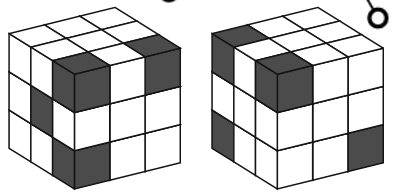
A 3×3×3 cube is made of 27 small cubes. Some of the small cubes are removed. Looking at the result from the right, from above, and from the front, you see the same shape each time (shown in the picture). How many small cubes were removed?
Show answer
Answer: E — 7
Show hints
Hint 1 of 2
Each of the three views tells you which columns of small cubes are missing in that direction.
Still stuck? Show hint 2 →
Hint 2 of 2
Find an arrangement that produces all three silhouettes at once, then count the empty little-cube spots.
Show solution
Approach: match all three silhouettes and count the missing cubes
The three given views show notches: some small cubes must be cleared so the right, top and front outlines all look as drawn.
Removing cubes only from positions that are missing in every relevant view, the fewest consistent removals reproduce all three pictures.
Counting those cleared positions gives 7 little cubes removed.
Elisabeth sorts the cards shown above. With each move she is allowed to swap any two cards with each other. What is the smallest number of moves she needs in order to get the word KANGAROO?
Show answer
Answer: B — 3
Show hints
Hint 1 of 3
Write KANGAROO under the cards and mark every letter that is already in the right place.
Still stuck? Show hint 2 →
Hint 2 of 3
Only the wrong letters need to move, so look at just those.
Still stuck? Show hint 3 →
Hint 3 of 3
One swap trades two cards, so it can drop two wrong letters into the right spots at once.
Show solution
Approach: count the swaps that fix two misplaced letters at a time
O A R G O N K A must become K A N G A R O O; the A and the G are already in place.
The six remaining letters split into three pairs that each swap into place: (K↔O), (N↔R), (A↔O).
The triplets Meike, Monika and Zita each want to buy equally expensive hats. However, Meike’s savings were 13, Monika’s 14, and Zita’s 15 smaller than the price of a hat. After the hats were reduced by €9·40, the triplets put their savings together and each bought a hat, with not a single cent left over. How much had a hat cost originally?
Show answer
Answer: D — €36
Show hints
Hint 1 of 2
Write each girl's savings as a fraction of the original price P.
Still stuck? Show hint 2 →
Hint 2 of 2
Their combined savings exactly buy three reduced hats; solve for P.
Show solution
Approach: sum the three savings and set equal to three reduced prices
Savings: Meike 2P/3, Monika 3P/4, Zita 4P/5. Together they buy 3 hats at (P − 9.40) each.
Captain Sparrow and his pirates loot some gold coins and share them equally amongst themselves. If there were four pirates fewer, they would each get 10 coins more. If there were 50 coins fewer, they would each get 5 coins fewer. How many coins did they share between themselves?
Show answer
Answer: D — 150
Show hints
Hint 1 of 2
Let there be p pirates sharing N coins; write the share as N/p.
Still stuck? Show hint 2 →
Hint 2 of 2
The '50 fewer coins means 5 fewer each' clue gives p directly, then use the other clue to find N.
Show solution
Approach: set up share equations and solve
Let p pirates share N coins. '50 fewer coins is 5 fewer each' means 50/p = 5, so p = 10.
'Four fewer pirates means 10 more each' gives N/(p−4) = N/p + 10, i.e. N/6 = N/10 + 10.
Then N/6 − N/10 = 10, so 2N/30 = 10, giving N = 150.
Among 10 different positive whole numbers, exactly 5 are divisible by 5 and exactly 7 are divisible by 7. Let M be the biggest of these numbers. What is the smallest possible value of M?
Show answer
Answer: E — another value
Show hints
Hint 1 of 2
Multiples of 5 and multiples of 7 must fit inside just 10 numbers — they have to overlap.
Still stuck? Show hint 2 →
Hint 2 of 2
Overlap means multiples of 35; how few of those can you get away with, and how small can they be?
Show solution
Approach: count the forced overlap, then keep everything small
Five multiples of 5 plus seven multiples of 7 is 12 'slots' but only 10 numbers, so at least 2 must be multiples of 35.
The two smallest multiples of 35 are 35 and 70, so the largest number M is at least 70.
Choosing 5,10,15,35,70 (the 5's) and 7,14,21,28,35,42,70 worth of 7's gives a valid set of 10 with M = 70.
70 is none of 105, 77, 75, 63, so the answer is (E) another value.
An MP3 player has 5 songs: song A lasts 3 min, song B 2 min 30 s, song C 2 min, song D 1 min 30 s, and song E 4 min. The 5 songs play non-stop, one after another. Song C is playing when Andy leaves the house. Exactly one hour later he returns. Which song is playing when Andy comes back?
Show answer
Answer: A — A
Show hints
Hint 1 of 2
Add the five song lengths to get the length of one full loop, then see how many whole loops fit in an hour.
Still stuck? Show hint 2 →
Hint 2 of 2
After the whole loops, only a few minutes remain; track those extra minutes forward from where song C was playing.
Show solution
Approach: use the loop length, then carry the leftover minutes forward
In 60 minutes there are 4 full loops (52 minutes) plus 8 extra minutes, so the playlist ends up 8 minutes further along the loop than when he left during song C.
Starting from the beginning of C, 8 minutes later covers C, D, E (2 + 1.5 + 4 = 7.5 min) and reaches into song A.
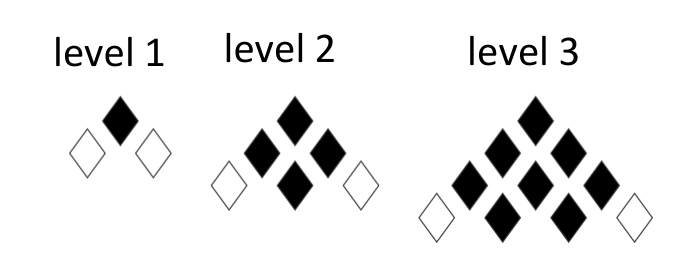
The black diamonds ◆ and white diamonds ◇ follow a fixed pattern. The first 3 levels are shown on the right. Each level (from the 2nd level on) has one more row than the level before. In every level, the two outermost diamonds of the last row are white, and all the other diamonds are black. How many black diamonds are there in level 6?
Show answer
Answer: C — 26
Show hints
Hint 1 of 3
Each level is a little triangle of rows: 1 diamond, then 2, then 3, and so on down.
Still stuck? Show hint 2 →
Hint 2 of 3
Count ALL the diamonds in level 6 first, then take away the white ones.
Still stuck? Show hint 3 →
Hint 3 of 3
In every level only the two ends of the very bottom row are white.
Show solution
Approach: count all the diamonds, then take away the two white ones
Level 6 has 6 + 1 = 7 rows, with 1, 2, 3, 4, 5, 6, 7 diamonds in them.
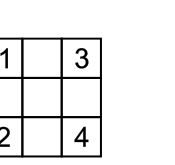
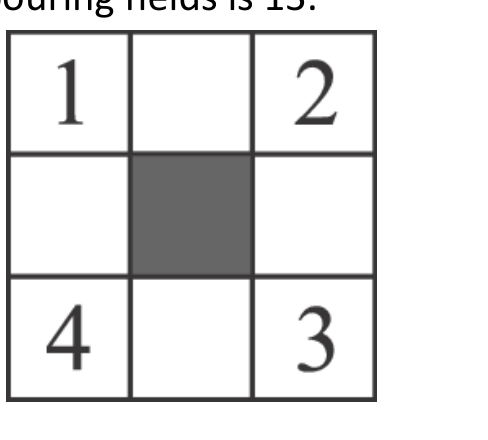
Daniela fills a 3×3 table with the digits 1 to 9, one digit per cell. She has already placed 1, 2, 3, and 4 as shown. Two numbers are “adjacent” if their cells share a side. When she finishes, she notices that the numbers adjacent to 5 add up to 9. What is the sum of the numbers adjacent to 6?
1
3
2
4
Show answer
Answer: E — 29
Show hints
Hint 1 of 2
The corners are fixed (1, 3, 2, 4); the centre and the four edge-middle cells still hold 5, 6, 7, 8, 9.
Still stuck? Show hint 2 →
Hint 2 of 2
An edge-middle cell touches two corners and the centre. Use 'the numbers next to 5 add to 9' to pin down 5 and the centre, then see what is next to 6.
Show solution
Approach: place 5 from its clue, which fixes the centre, then add 6's neighbours
Corners: 1 (top-left), 3 (top-right), 2 (bottom-left), 4 (bottom-right). The centre and the four edge-middle cells take 5, 6, 7, 8, 9.
An edge-middle cell is next to its two corners and the centre. For 5's neighbours to add to 9, the two corners by 5 must be small: only the left edge (corners 1 and 2) works, since 1 + 2 + centre = 9 gives centre = 6.
So 6 sits in the centre, and the centre is next to all four edge-middle cells, which hold 5, 7, 8 and 9.
The numbers adjacent to 6 add to 5 + 7 + 8 + 9 = 29.
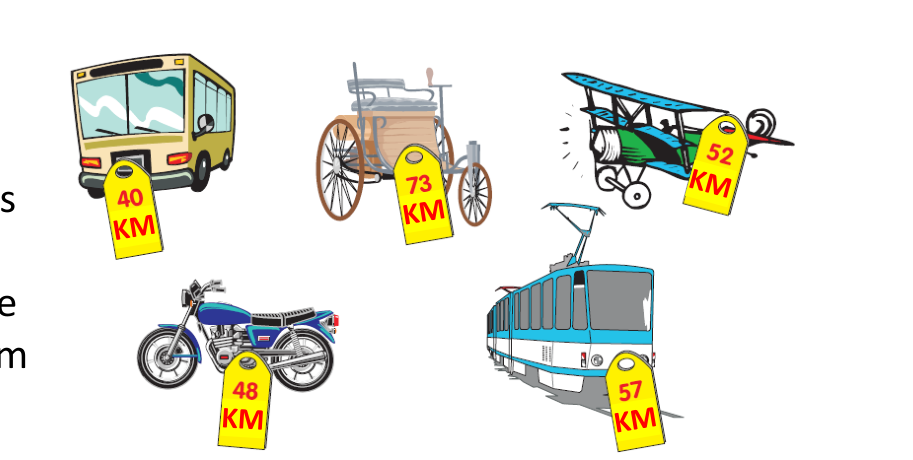
Heinzi the kangaroo has bought some toys. For them he gave 150 kangoo-coins (KC) and received 20 kangoo-coins back. Just before leaving the shop he changed his mind and exchanged one of the toys he had bought for another one. Because of this he received a further 5 kangoo-coins back from the shopkeeper. Which of the toys in the picture has Heinzi taken home with him? (The price of each toy is shown on its tag.)
Show answer
Answer: A — Carriage and Aeroplane
Show hints
Hint 1 of 3
Work out how many coins Heinzi really spent in the end, after all the change he got back.
Still stuck? Show hint 2 →
Hint 2 of 3
He handed over 150, then got 20 back, then 5 more back, so take both amounts away.
Still stuck? Show hint 3 →
Hint 3 of 3
Now look at the price tags and find the toys that add up to exactly that many coins.
Show solution
Approach: net spending, then match a price pair
He paid 150 and got 20 back, then 5 more back after the exchange: net 150 − 20 − 5 = 125.
The toys he kept must cost 125 together.
Carriage (73) + Aeroplane (52) = 125; no other pair fits.
In the equation \(N \times U \times (M + B + E + R) = 33\) each letter stands for a different digit (0, 1, 2, …, 9). In how many different ways can the letters be replaced by different digits?
Show answer
Answer: D — 48
Show hints
Hint 1 of 2
33 factors very few ways into three positive integers using single digits.
Still stuck? Show hint 2 →
Hint 2 of 2
Fix which factor is the bracket sum, then count digit arrangements.
Show solution
Approach: factor 33, pin the bracket sum, then count digit arrangements
The bracket \(M+B+E+R\) is a sum of four different digits, so it lies between \(0+1+2+3=6\) and 30; the only divisor of 33 in that range is 11, forcing \(N\times U=3\), i.e. \(\{N,U\}=\{1,3\}\).
The four bracket digits must be different and avoid 1 and 3; the smallest four-digit total from the remaining digits is \(0+2+4+5=11\), so \(\{M,B,E,R\}=\{0,2,4,5\}\) is the only possibility.
Arrangements: \(2\) ways to assign \(N,U\) times \(4!=24\) ways to assign the bracket digits give \(2\times24=\) 48 ways.
Andy fills a \(3\times 3\) table with the digits 1 to 9 so that each cell contains exactly one digit. He has already placed the digits 1, 2, 3 and 4 as shown in the diagram. Two numbers are ‘neighbouring’ when the cells they are in share one side. After finishing the table he noticed that the sum of the numbers neighbouring 9 equals 15. What is the sum of the numbers neighbouring 8?
Show answer
Answer: E — 27
Show hints
Hint 1 of 2
The corners already hold 1, 2, 3, 4, so 5, 6, 7, 8, 9 fill the four edge cells and the centre.
Still stuck? Show hint 2 →
Hint 2 of 2
An edge cell touches its two corner digits plus the centre, so test where 9 can sit to make its neighbours add to 15.
Show solution
Approach: place 9 from its neighbour-sum, then total the neighbours of 8
The corners are 1, 3 (top) and 2, 4 (bottom); 5–9 fill the four edge cells and the centre.
An edge cell's neighbours are its two adjacent corners plus the centre. For the neighbours of 9 to total 15, the only fit is 9 on the right edge (3 + 4 + centre = 15), forcing the centre to be 8.
The neighbours of the centre 8 are all four edge cells, which hold 9 and the three remaining digits 5, 6, 7.
Let \(a,b,c\) be different real numbers, none equal to zero, and let \(n\) be a positive whole number. It is known that the numbers \((-2)^{2n+3} imes a^{2n+2} imes b^{2n-1} imes c^{3n+2}\) and \((-3)^{2n+2} imes a^{4n+1} imes b^{2n+5} imes c^{3n-4}\) have the same sign. Which of the following statements is definitely true?
Show answer
Answer: D — \(a<0\)
Show hints
Hint 1 of 2
Even powers are always positive, so only the odd-powered factors carry a sign.
Still stuck? Show hint 2 →
Hint 2 of 2
Compare the parities of the exponents in the two products to see what must be true.
Show solution
Approach: track signs through even/odd exponents
In a product, only factors with odd exponents affect the sign; even powers are positive.
Matching the two products' signs forces the contribution of a to flip consistently, and the only sign that is pinned down in every case is that of a.
Working it through shows a must be negative, so (D): a < 0 is definitely true.
The king travels with his messengers at 5 km/h from his castle to his summer residence. Every hour he sends one messenger back to the castle at 10 km/h. What is the difference in arrival times between two messengers who arrive at the castle one after the other?
Show answer
Answer: D — 90 min
Show hints
Hint 1 of 2
Work out when the first two messengers each set off and how far from the castle they start.
Still stuck? Show hint 2 →
Hint 2 of 2
Each messenger travels back at 10 km/h; find its arrival time, then subtract two consecutive arrivals.
Show solution
Approach: find each messenger's start distance and return time
After 1 hour the king is 5 km out; that messenger rides back 5 km at 10 km/h, taking 0.5 h, so it arrives 1 + 0.5 = 1.5 h after departure.
After 2 hours the king is 10 km out; that messenger rides back 10 km at 10 km/h, taking 1 h, so it arrives 2 + 1 = 3 h after departure.
The gap between these two arrivals is 3 − 1.5 = 1.5 h = 90 min (and every later pair gives the same 90 minutes).
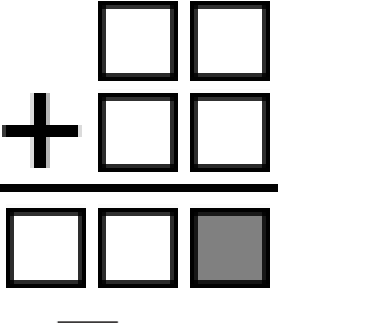
In each box exactly one of the digits 0, 1, 2, 3, 4, 5 and 6 is to be written. Each digit is used only once. The picture on the right shows two 2-digit numbers being added to give a 3-digit number. Which digit has to be written in the grey box so that the sum is correct?
Show answer
Answer: D — 5
Show hints
Hint 1 of 3
The answer has 3 digits, so the two 2-digit numbers must add up to at least 100.
Still stuck? Show hint 2 →
Hint 2 of 3
You only have the digits 0 to 6 once each, so the hundreds digit of the answer can only be 1.
Still stuck? Show hint 3 →
Hint 3 of 3
Once you know the answer starts with 1, fit the remaining digits and read the grey (ones) box.
Show solution
Approach: find the only valid sum, then read the grey (units) box
Two 2-digit numbers add to a 3-digit number using 0..6 once each.
The only working sum is 105 (e.g. 42 + 63), using digits 0,1,2,3,4,5,6.
The grey box is the units digit of the result, which is 5.
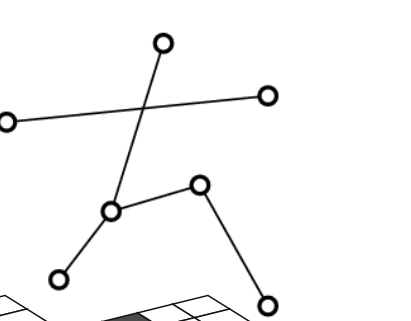
In the diagram Karl wants to add lines, each joining two of the marked points, so that each of the seven marked points is joined to the same number of other marked points. What is the minimum number of lines he must draw?
Show answer
Answer: D — 9
Show hints
Hint 1 of 2
Count the degree (number of lines) already at each of the seven points.
Still stuck? Show hint 2 →
Hint 2 of 2
Add the fewest lines so every point ends with the same degree.
Show solution
Approach: equalise the seven vertex degrees with the fewest added edges
From the diagram the current degrees are 3, 2, 1, 1, 1, 1, 1 (sum 10, i.e. 5 existing lines).
Raising every vertex to a common degree needs a minimum of 9 extra lines.
A set of scales does not always show the correct mass. If something weighs less than 1000 g it shows the exact mass; when something weighs 1000 g or more it shows some mass over 1000 g. You have 5 balls with masses A g, B g, C g, D g and E g, each less than 1000 g. Weighing them in pairs, the scales show: \(B+D=1200\), \(C+E=2100\), \(B+E=800\), \(B+C=900\), \(A+E=700\). Which ball is the heaviest?
Show answer
Answer: D — D
Show hints
Hint 1 of 2
A reading is trustworthy only when the true pair-sum is under 1000g; otherwise it just signals 'over 1000'.
Still stuck? Show hint 2 →
Hint 2 of 2
Pick out the readings below 1000 as exact and see which ball that leaves as the heaviest.
Show solution
Approach: keep only the readings under 1000g as exact
Readings under 1000g are exact; readings of 1200 and 2100 only mean 'the true sum is over 1000g'.
The trustworthy exact sums are B+E = 800, B+C = 900 and A+E = 700, so B, C, E, A are all fairly light.
Since B+D exceeds 1000g while B is small, D must be large; combined with the small reliable sums, D comes out heaviest.
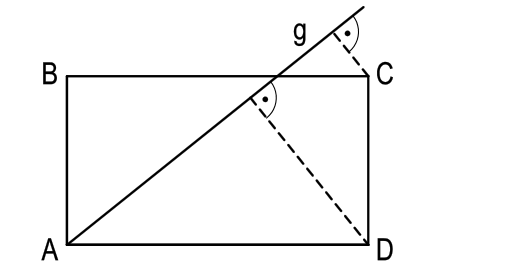
The straight line \(g\) runs through the vertex A of the rectangle ABCD shown. The perpendicular distance from C to \(g\) is 2 and from D to \(g\) is 6. AD is twice as long as AB. Determine the length of AD.
Show answer
Answer: A — 10
Show hints
Hint 1 of 2
Set the line g through A as a direction and measure perpendicular distances of C and D from it.
Still stuck? Show hint 2 →
Hint 2 of 2
With AD = 2·AB the two distance equations combine into a tidy Pythagorean relation.
Show solution
Approach: coordinates with perpendicular-distance formulas
Place A at the origin; write g by its unit normal. The distances of C and D from g are 2 and 6.
Using AD = 2·AB, the distance conditions reduce to AD² = 6² + 8² = 100.
Mia writes three single-digit numbers on the board. Ali adds them and gets 15. Then he deletes one of the three numbers and replaces it with 3. Resi multiplies the three numbers and gets 36. Which numbers could Ali have deleted?
Show answer
Answer: B — either 7 or 8
Show hints
Hint 1 of 2
After swapping one number for 3, the product is 36, so the two untouched numbers multiply to 12.
Still stuck? Show hint 2 →
Hint 2 of 2
List the single-digit pairs that multiply to 12, then use the sum 15 to find the deleted number in each case.
Show solution
Approach: the two kept numbers multiply to 12; use the sum to recover the deleted one
After replacing one number with 3, Resi's product 36 = 3 × (the two numbers Ali kept), so the kept pair multiplies to 12.
Single-digit pairs with product 12 are 3 × 4 and 2 × 6.
Since all three originals add to 15: if the kept pair is 3 and 4 (sum 7), the deleted number is 15 − 7 = 8; if the kept pair is 2 and 6 (sum 8), the deleted number is 15 − 8 = 7.
In the figure on the right a few of the small squares will be painted grey. While doing this, no 2×2 block made of four small grey squares is allowed to appear. At most how many of the squares in the figure can be painted grey?
Show answer
Answer: D — 21
Show hints
Hint 1 of 3
The rule is broken the moment four grey squares make a full 2×2 block, so every 2×2 block needs at least one white square.
Still stuck? Show hint 2 →
Hint 2 of 3
To colour the MOST squares grey, leave as few white squares as you can while still breaking every 2×2 block.
Still stuck? Show hint 3 →
Hint 3 of 3
Spread your white squares out cleverly so each one spoils several 2×2 blocks at once.
Show solution
Approach: leave the fewest white squares that still break every 2x2 block
Every little 2×2 group of squares must have at least one square left white, or it would be a forbidden block.
To keep the most grey, place the white squares far apart so each white square breaks as many 2×2 blocks as possible.
Doing this for the whole figure leaves just a few white squares, and the rest, 21 of them, can be grey.
The diagram shows two different views of the same cube, which is made from 27 small cubes that are either white or black. At most how many black cubes are there?
Show answer
Answer: D — 9
Show hints
Hint 1 of 2
The two pictures show the same cube, so every visible black square must be consistent.
Still stuck? Show hint 2 →
Hint 2 of 2
Maximise the hidden black cubes while keeping both views possible.
Show solution
Approach: the two views pin some faces; make every other small cube black
The two pictures show the outside of the same 3×3×3 cube, so a small cube touching a face that looks white in either view must itself be white there.
Mark white only the surface cubes the pictures force, and colour every remaining small cube black, including the fully hidden ones.
The quadrilateral ABCD has right angles only at corners A and D. The numbers in the diagram give the areas of the triangles in which they are located. What is the area of ABCD?
Show answer
Answer: B — 45
Show hints
Hint 1 of 2
Right angles at A and D make AB and DC both perpendicular to AD, so AB is parallel to DC — ABCD is a trapezoid.
Still stuck? Show hint 2 →
Hint 2 of 2
In a trapezoid the two diagonals cut it into four triangles; the two 'side' triangles (on the legs) always have equal area, and the top and bottom triangles are similar.
Show solution
Approach: use the trapezoid-diagonal area relations
Since the angles at A and D are right angles, AB and DC are both perpendicular to AD, so AB is parallel to DC and ABCD is a trapezoid with diagonals AC and DB.
The two triangles on the legs are equal in area, so the triangle on the right (T) equals the given left triangle: T = 10.
The top triangle (5) and bottom triangle (S) are similar, and a diagonal trapezoid gives \(10^2 = 5 \times S\), so S = 20.
There are 9 kangaroos called the Greatkangs. Each is coloured either white or black. If three Greatkangs meet by chance, the probability that none of them is white is exactly two thirds. How many Greatkangs are black?
Show answer
Answer: E — 8
Show hints
Hint 1 of 2
'None of three is white' means all three are chosen from the black ones.
Still stuck? Show hint 2 →
Hint 2 of 2
Set the probability of an all-black trio equal to 2/3 and solve for how many are black.
Show solution
Approach: ratio of all-black trios to all trios
With b black out of 9, P(all three black) = C(b,3)/C(9,3) = C(b,3)/84.
Grandma gives 180 marbles to her ten grandchildren. No two children get the same number of marbles. Anna gets the most. What is the smallest number of marbles Anna could get?
Show answer
Answer: E — 23
Show hints
Hint 1 of 2
To make Anna's share as small as possible, the other nine children should get as much as they can while still all being different and less than Anna's amount.
Still stuck? Show hint 2 →
Hint 2 of 2
If Anna gets A, the most the group can total is A + (A−1) + ... + (A−9); make that at least 180.
Show solution
Approach: make the other nine as large as possible just below Anna, then see how small Anna can be
To let Anna take as little as possible, the other nine children should grab as much as they can while still all being different and below Anna.
So they take the nine amounts right below Anna's: if Anna has 23, the rest are 22, 21, 20, ..., 14.
Those ten amounts 14 + 15 + ... + 23 add up to exactly 180, the whole bag, so Anna = 23 works.
If Anna had only 22, even the biggest allowed amounts (22, 21, ..., 13) total just 175, too few to reach 180.
So the smallest Anna could get is 23.
The same idea with a quick formulaThe largest ten distinct amounts ending at Anna's value A total 10A − (1+2+⋯+9) = 10A − 45, and this must reach 180, so 10A ≥ 225 and A ≥ 23.
Albin has put each of the digits from 1 to 9 in the fields of the table. In the diagram only 4 of these digits are shown. For the field containing the number 5, Albin noticed that the sum of the numbers in the neighbouring fields is 13 (neighbouring fields are fields which share a side). He noticed exactly the same for the field containing the digit 6. Which digit had Albin written in the grey field?
Show answer
Answer: D — 8
Show hints
Hint 1 of 3
The grey centre square touches all four edge squares, and the four corners 1, 2, 3, 4 are already filled in.
Still stuck? Show hint 2 →
Hint 2 of 3
The missing numbers are 5, 6, 7, 8 and 9, and they go in the centre and the four edge squares.
Still stuck? Show hint 3 →
Hint 3 of 3
Try placing them so that the neighbours of 5 add to 13 and the neighbours of 6 also add to 13.
Show solution
Approach: place 5–9 so both neighbour-sum clues hold
The four corners are 1, 2, 4 and 3; the digits 5, 6, 7, 8, 9 go in the centre and the four edge cells.
The cell holding 5 and the cell holding 6 must each have neighbour-sum 13.
The only arrangement that satisfies both forces 8 into the grey centre.
On an island the frogs are either green or blue. The number of blue frogs increases by 60%, and the number of green frogs decreases by 60%. As a result, the new ratio of blue frogs to green frogs equals the original ratio of green frogs to blue frogs. By what percentage has the total number of frogs changed?
Show answer
Answer: B — 20%
Show hints
Hint 1 of 2
Set up the new blue-to-green ratio equal to the old green-to-blue ratio.
Still stuck? Show hint 2 →
Hint 2 of 2
That equation pins the original green-to-blue ratio; then compare totals.
Show solution
Approach: solve the swapped-ratio equation, then compare totals
With blue B, green G: 1.6B / 0.4G = G / B leads to 4B² = G², so G = 2B.
Old total 3B; new total 1.6B + 0.4(2B) = 2.4B, a drop of 0.6B.
The total changes by 0.6B / 3B = 20% (a decrease).
Jan and Eva take on a challenge to solve mathematics questions. They each get an identical list of 100 questions. For each question, the first to solve it gets 4 points while the slower person gets 1 point. Jan solved 60 questions and Eva also solved 60 questions. Together they scored 312 points. How many questions were solved by both Jan and Eva?
Show answer
Answer: D — 56
Show hints
Hint 1 of 2
Let x be the number of questions both solved; a shared question scores 4 + 1 = 5 points.
Still stuck? Show hint 2 →
Hint 2 of 2
Write the total score in terms of x using how many questions were solved by one person versus both.
Show solution
Approach: count points by 'both' versus 'one only'
Let x questions be solved by both. Each such question gives 4 + 1 = 5 points total.
Jan-only and Eva-only questions number (60−x) + (60−x) = 120 − 2x, each worth 4 points.
Total points: 5x + 4(120 − 2x) = 480 − 3x = 312, so 3x = 168 and x = 56.
In the diagram on the right the following can be seen: a straight line that is the common tangent of two touching circles of radius 1, and a square with one edge on the straight line and the other two vertices one on each of the two circles. How big is the side length of the square?
Show answer
Answer: A — \(\dfrac{2}{5}\)
Show hints
Hint 1 of 2
By symmetry the square is centred on the touching point; put it on coordinates.
Still stuck? Show hint 2 →
Hint 2 of 2
Its top corners sit on the circles — plug a corner into a circle's equation.
Show solution
Approach: coordinates and one circle equation
Centres at (±1,1), the tangent line is y = 0; by symmetry the square's base is centred at the origin.
A top corner (s/2, s) lies on the right circle: (s/2 − 1)² + (s − 1)² = 1.
This gives 5s² − 12s + 4 = 0, whose sensible (small) root is s = 2/5.
Tom has written down a few different positive whole numbers, all smaller than 101. The product of the numbers is not divisible by 18. At most how many numbers could he have written down?
Show answer
Answer: C — 68
Show hints
Hint 1 of 2
18 = 2 × 3², so the product fails only if it lacks a 2 or lacks two 3s.
Still stuck? Show hint 2 →
Hint 2 of 2
Keep as many numbers as possible while keeping the power of 3 below 2.
Show solution
Approach: control the factors of 3 to dodge 18
Keep all 67 numbers from 1–100 that are not multiples of 3.
Add one multiple of 3 that is not a multiple of 9 (one factor of 3 only); the product then isn't divisible by 9, hence not by 18.
David cycles from Edinburgh to his aunty, who lives outside Edinburgh. He wants to arrive at exactly 15:00. After 23 of his planned travel time he had covered 34 of the way. He then cycled more slowly and arrived exactly on time. In what ratio are the average speeds of the two sections of his journey?
Show answer
Answer: C — 3 : 2
Show hints
Hint 1 of 2
Take the planned time as 1 and the distance as 1; the first part used 2/3 of the time for 3/4 of the distance.
Still stuck? Show hint 2 →
Hint 2 of 2
Speed = distance ÷ time for each part, then compare the two speeds.
Show solution
Approach: compute each part's speed as distance over time
Let total time = 1 and total distance = 1. First part: distance 3/4 in time 2/3, so speed = (3/4)/(2/3) = 9/8.
Second part: the remaining 1/4 of distance in the remaining 1/3 of time, so speed = (1/4)/(1/3) = 3/4.
Thomas wants to write down pairwise different positive whole numbers, none of which is bigger than 100. Their product should not be divisible by 54. At most how many numbers can he write down?
Show answer
Answer: D — 69
Show hints
Hint 1 of 2
54 = 2 · 3³. The product fails to be divisible by 54 if it is short on 2's OR short on 3's.
Still stuck? Show hint 2 →
Hint 2 of 2
Keeping the total power of 3 below three is the cheaper restriction — how many numbers does that allow?
Show solution
Approach: avoid 3³ in the product to keep the most numbers
Since 54 = 2·3³, the product avoids 54 if its total power of 3 stays under 3.
All 67 numbers from 1 to 100 that are NOT multiples of 3 contribute no 3's at all.
We may still add two multiples of 3 (each contributing one 3), keeping the total power of 3 at 2.
Every group of three vertices of a cube forms a triangle. How many such triangles are there whose vertices do not all lie on the same face of the cube?
Show answer
Answer: C — 32
Show hints
Hint 1 of 2
Count all triangles from the 8 vertices, then remove the 'flat' ones.
Still stuck? Show hint 2 →
Hint 2 of 2
A triangle is bad exactly when all three vertices lie on one face.
Show solution
Approach: total triangles minus the same-face ones
All triangles: C(8,3) = 56.
Each of the 6 faces has C(4,3) = 4 same-face triangles, so 6 × 4 = 24 are bad.
Two regular polygons with side length 1 lie on opposite sides of the common edge AB. One of them is the 15-sided polygon \(ABC_1D_1E_1\ldots\) and the other is the \(n\)-sided polygon \(ABC_2D_2E_2\ldots\). For which value of \(n\) is the distance from \(C_1\) to \(C_2\) exactly 1?
Show answer
Answer: A — 10
Show hints
Hint 1 of 2
Place the shared edge AB and find the second vertices C₁ and C₂ of each polygon.
Still stuck? Show hint 2 →
Hint 2 of 2
Their separation depends on the polygons' interior angles; test which n makes C₁C₂ = 1.
Show solution
Approach: locate the two C-vertices and set their distance to 1
Put A=(0,0), B=(1,0). For each regular polygon the next vertex C is found from its interior angle (a unit step from B).
The 15-gon fixes C₁; the n-gon (on the other side) fixes C₂.
Trying values, n = 10 makes the distance C₁C₂ exactly 1.
PT is tangent to a circle with centre O, and PB is the bisector of the angle TPA (see diagram). How big is the angle TBP?
Show answer
Answer: B — 45°
Show hints
Hint 1 of 2
Use the tangent–chord angle and the fact that PB bisects angle TPA.
Still stuck? Show hint 2 →
Hint 2 of 2
Chase the angles to show angle TBP does not depend on where P sits.
Show solution
Approach: tangent–chord angle plus the bisector make the P-dependence cancel
Let \(\angle TPA = 2\alpha\), so the bisector gives \(\angle TPB = \alpha\). By the tangent–chord angle, the angle between tangent \(PT\) and chord \(TB\) equals the inscribed angle \(TB\) subtends, namely \(\angle TPB + \angle PBT = \alpha + \angle TBP\) seen from the alternate segment.
Writing the angle sum of triangle \(PTB\) and substituting the tangent–chord relation, every term involving \(\alpha\) (hence the position of \(P\)) cancels.
What remains forces \(\angle TBP = \) 45°, the same for every position of \(P\).
A group of 25 people is made up of knights, rascals and shilly-shalliers. The knights always tell the truth, the rascals are always untruthful, and the shilly-shalliers answer alternately truthfully and falsely (in either order). After the first question to everybody, “Are you a knight?”, 17 answered “Yes!”. After the second question, “Are you a shilly-shallier?”, 12 answered “Yes!”. After the third question, “Are you a rascal?”, 8 answered “Yes!”. How many knights are in this group?
Show answer
Answer: B — 5
Show hints
Hint 1 of 2
Work out how each type answers each question; note that knights and rascals both say 'yes' to 'are you a knight?'.
Still stuck? Show hint 2 →
Hint 2 of 2
Track the shilly-shalliers by their two alternating patterns and turn the three 'yes' counts into equations.
Show solution
Approach: translate each yes-count into an equation
Split shilly-shalliers into those answering true-false-true and those answering false-true-false across the three questions.
Question 3 ('are you a rascal?'): only the false-true-false shillies say yes, so that group has 8 people.
Question 2 ('are you a shilly?'): rascals plus those same shillies say yes: r + 8 = 12, so r = 4.
Question 1 ('are you a knight?'): knights, rascals and those shillies say yes: k + 4 + 8 = 17, so k = 5 knights.
The chain of equations \(k=(2014+m)^{ rac{1}{n}}=1024^{ rac{1}{n}}+1\) should hold for the positive whole numbers \(k\), \(m\), \(n\). How many different values can \(m\) take?
Show answer
Answer: C — 2
Show hints
Hint 1 of 2
From the right-hand side, 1024^{1/n} must be a whole number, so 1024 is a perfect n-th power.
Still stuck? Show hint 2 →
Hint 2 of 2
1024 = 2^{10}; which n make (k−1)^n = 2^{10} work, and then is m positive?
Show solution
Approach: force 1024 to be a perfect power, then check m > 0
The equation needs (k−1)^n = 1024 = 2^{10}, so n must divide 10: n ∈ {1,2,5,10}.
Then k = 2^{10/n} + 1 and m = k^n − 2014.
n=1 and n=2 give negative m; n=5 gives m = 1111 and n=10 gives m = 57035 (both positive).
Consider all 7-digit numbers that use each of the digits 1 to 7 exactly once. Write these numbers in increasing order and split the list exactly in the middle into two lists of equal size. What is the last number of the first list?
Show answer
Answer: E — 4376521
Show hints
Hint 1 of 2
There are 7! such numbers in order; the split point is right in the middle.
Still stuck? Show hint 2 →
Hint 2 of 2
Find the 2520th smallest arrangement of the digits 1–7.
Show solution
Approach: locate the middle permutation by digit blocks
There are 7! = 5040 numbers, so the first list ends at the 2520th smallest.
Counting in blocks (each leading digit gives 6! = 720 numbers): 2520 = 3·720 + 360, landing among the numbers starting with 4, then resolving the rest.
Several different positive whole numbers are written on a blackboard. Exactly two of these numbers are divisible by 2, and exactly 13 of these numbers are divisible by 13. The biggest number on the board is M. What is the smallest value that M can have?
Show answer
Answer: C — 273
Show hints
Hint 1 of 2
You need 13 multiples of 13, but only 2 of all the numbers may be even.
Still stuck? Show hint 2 →
Hint 2 of 2
Use odd multiples of 13 as much as possible; how many odd multiples of 13 do you need, and how big is the last one?
Show solution
Approach: use odd multiples of 13 to respect the 'only 2 even' limit
Thirteen of the numbers are multiples of 13, but at most 2 numbers overall may be even.
An even multiple of 13 is also divisible by 2, so among the thirteen multiples at most 2 can be even, meaning at least 11 must be odd multiples of 13.
The odd multiples of 13 are 13·1, 13·3, 13·5, …; the 11th of these is 13 × 21 = 273.
In the diagram a closed polygon can be seen whose vertices are the midpoints of the edges of the die. The interior angles are, as usual, the angles that two sides of the polygon make at a common vertex. How big is the sum of all interior angles of the polygon?
Show answer
Answer: B — \(1080°\)
Show hints
Hint 1 of 2
First count the vertices: the closed path visits the midpoints of six of the cube's edges.
Still stuck? Show hint 2 →
Hint 2 of 2
The polygon is skew (it does not lie in one plane), so its angle sum is not the flat-hexagon 720°; find each interior angle from the directions of the two edges meeting there.
Show solution
Approach: count the vertices, then add the interior angles of the skew hexagon
The closed path joins the midpoints of six cube edges, so it is a hexagon (six vertices, six sides).
Each side connects two edge-midpoints, and at every vertex the two sides meet at an interior angle of 180° — the path goes 'straight through' each midpoint as seen along its turn — giving six equal angles.
In triangle ABC, AB = 6 cm, AC = 8 cm and BC = 10 cm. M is the midpoint of side BC. AMDE is a square, and MD meets AC at point F. What is the area of the quadrilateral AFDE in cm²?
Show answer
Answer: B — 1258
Show hints
Hint 1 of 2
The 6–8–10 triangle is right-angled at A, which makes coordinates easy.
Still stuck? Show hint 2 →
Hint 2 of 2
Place A at the origin, build the square on AM, and find where MD meets AC.
Show solution
Approach: coordinates: right angle at A, square on AM, intersection F
Since 6² + 8² = 10², angle A is right; set A = (0,0), B = (6,0), C = (0,8), so M = (3,4).
Square AMDE has side AM = 5; building it and intersecting line MD with AC gives F = (0, 6.25).
On a pond, 16 lily pads are arranged in a \(4\times 4\) grid as shown in the diagram. A frog sits on a lily pad in one of the corners of the grid (see picture). The frog jumps from one lily pad to another horizontally or vertically, always jumping over at least one lily pad, and never lands on the same lily pad twice. What is the maximum number of lily pads, including the one he starts on, on which he can land?
Show answer
Answer: A — 16
Show hints
Hint 1 of 2
Each jump skips at least one pad, so from a column or row the frog lands two or more cells away.
Still stuck? Show hint 2 →
Hint 2 of 2
Try to build a route that visits every pad without repeating; can all 16 be reached?
Show solution
Approach: construct a route touching every pad
From a corner the frog can hop horizontally or vertically, always clearing at least one pad in between.
Designing the path carefully, it is possible to thread through every row and column so that no pad is repeated.
Such a route reaches all of them, so the maximum number of pads is the full 16.
The mapping \(f:\mathbb{Z} o\mathbb{Z}\) fulfils the conditions \(f(4)=6\) and \(xf(x)=(x-3)f(x+1)\). What is the value of the expression \(f(4) imes f(7) imes f(10) imes\ldots imes f(2011) imes f(2014)\)?
Show answer
Answer: D — \(2013!\)
Show hints
Hint 1 of 2
The relation x·f(x) = (x−3)·f(x+1) lets you step f from one integer to the next.
Still stuck? Show hint 2 →
Hint 2 of 2
When you multiply the wanted terms, look for a massive telescoping cancellation.
Show solution
Approach: use the recurrence and telescope the product
The condition gives f(x+1) = x·f(x)/(x−3), so with f(4)=6 every value of f is determined.
Forming f(4)·f(7)·f(10)·…·f(2014) and simplifying, the fractions telescope.
2014 people stand next to each other in a row. Each person is either a liar (who always lies) or a knight (who always tells the truth). Each person says: “To the left of me there are more liars than there are knights to the right of me.” How many liars are in the row?
Show answer
Answer: C — 1007
Show hints
Hint 1 of 2
Translate each claim into 'liars on my left' vs 'knights on my right'.
Still stuck? Show hint 2 →
Hint 2 of 2
Track how those two counts change as you move along the row to find the only consistent split.
Show solution
Approach: reason about left-liars vs right-knights along the row (deferred to official key)
A knight's claim 'more liars to my left than knights to my right' is true; a liar's is false.
Working through how the two running counts must compare forces the count of liars.
A \(5\times 5\) square is covered with \(1\times 1\) tiles. The design on each tile is made up of three dark triangles and one light triangle (see diagram). The triangles of neighbouring tiles always have the same colour where they join along an edge. The border of the large square is made of dark and light triangles. What is the smallest number of dark triangles that could be among them?
Show answer
Answer: B — 5
Show hints
Hint 1 of 2
Neighbouring tiles must match colour along each shared edge, which constrains how the dark and light triangles line up.
Still stuck? Show hint 2 →
Hint 2 of 2
Focus on the border triangles and arrange the tiles to use as few dark ones there as the matching rule allows.
Show solution
Approach: minimise dark triangles under the edge-matching rule
Every tile has three dark and one light triangle, and triangles meeting along a shared edge must be the same colour.
This matching rule links the colours of adjacent tiles' edge triangles, limiting how the single light triangle of each tile can be aimed outward.
Arranging the tiles so the most light triangles fall on the border leaves the fewest dark ones there.
The smallest possible number of dark border triangles is 5.
In the forests of a magical island kingdom there are three kinds of animals: lions, wolves and goats. Wolves can eat goats, and lions can eat both wolves and goats. Since it is a magical island kingdom, a wolf that eats a goat changes into a lion, a lion that eats a goat changes into a wolf, and a lion that eats a wolf changes into a goat. To begin with there were 17 goats, 55 wolves and 6 lions on the island. After some time no more eating is possible. What is the maximum number of animals that can still be on the island?
Show answer
Answer: D — 23
Show hints
Hint 1 of 2
Every meal removes exactly one animal, so the total only goes down.
Still stuck? Show hint 2 →
Hint 2 of 2
Eating stops only when a single species remains — which species can grow largest?
Show solution
Approach: track the invariant; eating ends with one species
Each eating event removes one animal, so the herd can only shrink, and it stops only when just one kind of animal is left (any two different kinds can still eat).
Following the allowed transformations from 17 goats, 55 wolves, 6 lions, the largest single-species end state reachable is all lions.