Problem 12 · 2014 Math Kangaroo
Hard
Geometry & Measurement
area-decomposition
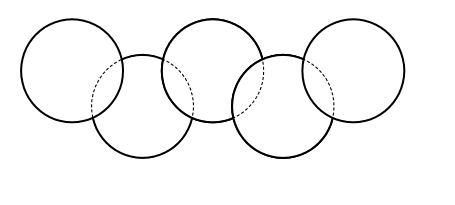
Five circles, each with an area of \(1\text{ cm}^2\), overlap to form the figure in the diagram. The regions where two circles overlap each have an area of 18\(\text{ cm}^2\). What is the area completely covered by the figure in the diagram?
Show answer
Answer: B — 92\(\text{ cm}^2\)
Show hints
Hint 1 of 2
If you just add the five circle areas, the overlap regions get counted twice.
Still stuck? Show hint 2 →
Hint 2 of 2
Use inclusion–exclusion: total area = sum of circles − sum of the doubly-covered overlaps.
Show solution
Approach: inclusion–exclusion on overlapping areas
- Adding the five circles gives 5 × 1 = 5 cm², but every overlap region is then counted twice.
- There are four overlaps, each of area 1/8 cm², so subtract 4 × 1/8 = 1/2 cm².
- Covered area = 5 − 1/2 = 9/2 cm².
Mark:
· log in to save