Problem 23 · 2018 AMC 8
Hard
Counting & Probability
complementary-countingcareful-counting
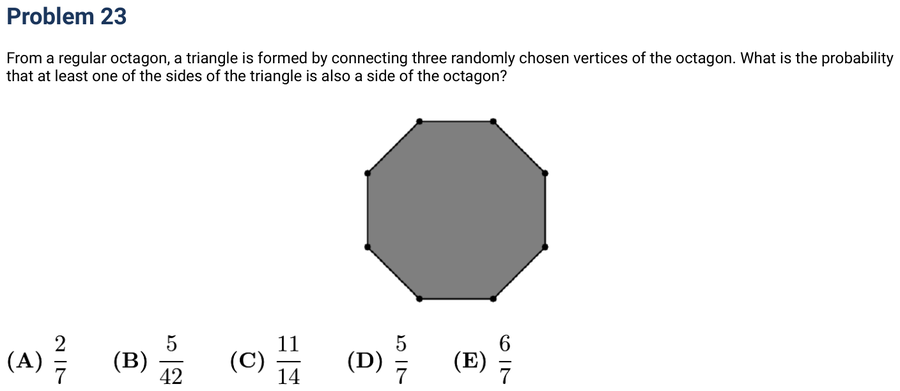
Show answer
Answer: D — 5/7.
Show hints
Hint 1 of 2
"At least one" is the classic flag to flip the question: counting triangles that touch a side splits into messy cases, but triangles with no octagon-side are one clean family — their three vertices are all spread apart. Find that, then subtract from 1.
Still stuck? Show hint 2 →
Hint 2 of 2
The technique pairs complementary counting with gaps / stars-and-bars: a no-side triangle means every gap between chosen vertices is ≥ 1. Counting solutions to gap1+gap2+gap3 = 5 with all gaps ≥ 1 is a stars-and-bars count.
Show solution
Approach: complementary counting with gap variables
- Flip to the easier event: triangles with NO side on the octagon. Fix one vertex A; the three chosen vertices split the remaining 5 vertices into three gaps x, y, z (skipped vertices between consecutive chosen ones), with x + y + z = 5.
- Total triangles through A: choose the other 2 vertices from the remaining 7, C(7, 2) = 21.
- "No octagon-side" means no two chosen vertices are adjacent, i.e. every gap ≥ 1. Stars-and-bars for x, y, z ≥ 1 summing to 5 gives C(4, 2) = 6.
- P(no side) = 6/21 = 2/7, so P(at least one side) = 1 − 2/7 = 5/7.
- You'll see it again: "at least one" almost always wants complementary counting, and "keep chosen things non-adjacent around a ring" is a gap/stars-and-bars setup.
Another way — count the favorable triangles directly:
- Total triangles from 8 vertices: C(8, 3) = 56. Now count those using at least one octagon side directly.
- Exactly-one-side triangles: pick one of the 8 sides as an edge (8 ways), then a third vertex not adjacent to that side (to avoid a second side): 4 choices each, giving 8 × 4 = 32.
- Exactly-two-side triangles: these use two adjacent sides sharing a vertex — one per vertex, so 8 of them.
- Favorable = 32 + 8 = 40, and 40/56 = 5/7 — matching the complement, a good cross-check.
Mark:
· log in to save