Problem 23 · 2023 AMC 8
Hard
Counting & Probability
careful-counting
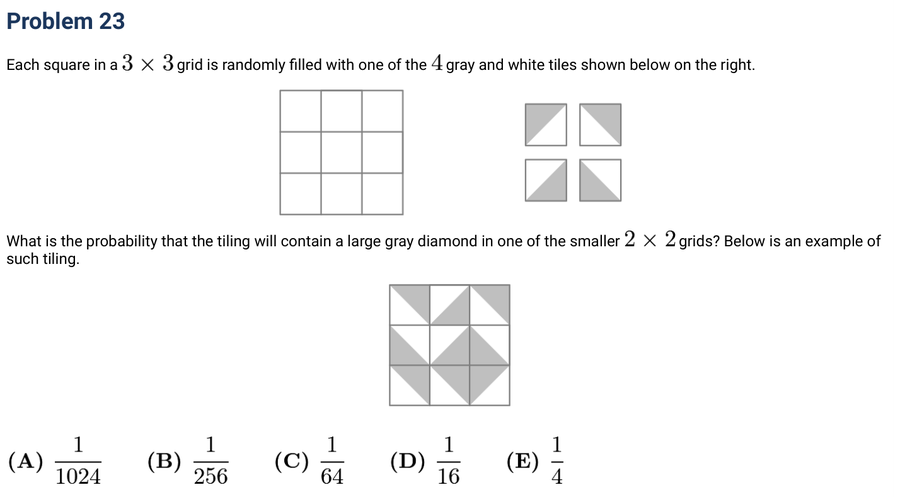
Show answer
Answer: C — 1/64.
Show hints
Hint 1 of 2
A diamond is built from four tiles meeting at one point — and any 2×2 diamond must use the center cell. So the center tile is already ‘there’; the question is whether its three neighbors line up.
Still stuck? Show hint 2 →
Hint 2 of 2
Once the center tile shows a gray corner, the three tiles touching that corner each need one specific orientation out of 4 to complete the diamond. Three independent 1-in-4 events — multiply.
Show solution
Approach: three neighbor tiles must each orient correctly
- Picture how a diamond forms: four gray triangles meet at a single point, and that point is always a corner of the center cell. So the center tile is automatically part of any diamond — whatever gray corner it happens to show is the corner the diamond grows from.
- To complete that diamond, the three tiles touching that gray corner must each be turned the right way. Each tile has 4 equally likely orientations, exactly 1 of which works, so each contributes probability 14 — independently.
- Multiply: 14 × 14 × 14 = 164. Why this is faster: instead of counting all 49 tilings, condition on the piece that's always involved (the center) and only the constraints that matter survive.
Another way — count favorable tilings (MAA):
- Total tilings: each of the 9 cells takes 1 of 4 tiles, so 49 in all.
- Favorable: a diamond's center can sit at any of the 4 corners of the middle cell (4 choices). Once chosen, the 4 tiles forming it are forced, but the other 5 cells are free: 45. So favorable = 4 × 45 = 46.
- Probability = 46 / 49 = 1/43 = 1/64.
Mark:
· log in to save