Problem 24 · 2018 AMC 8
Hard
Geometry & Measurement
pythagorean-tripleareaspatial-reasoning
Show answer
Answer: C — R² = 3/2.
Show hints
Hint 1 of 2
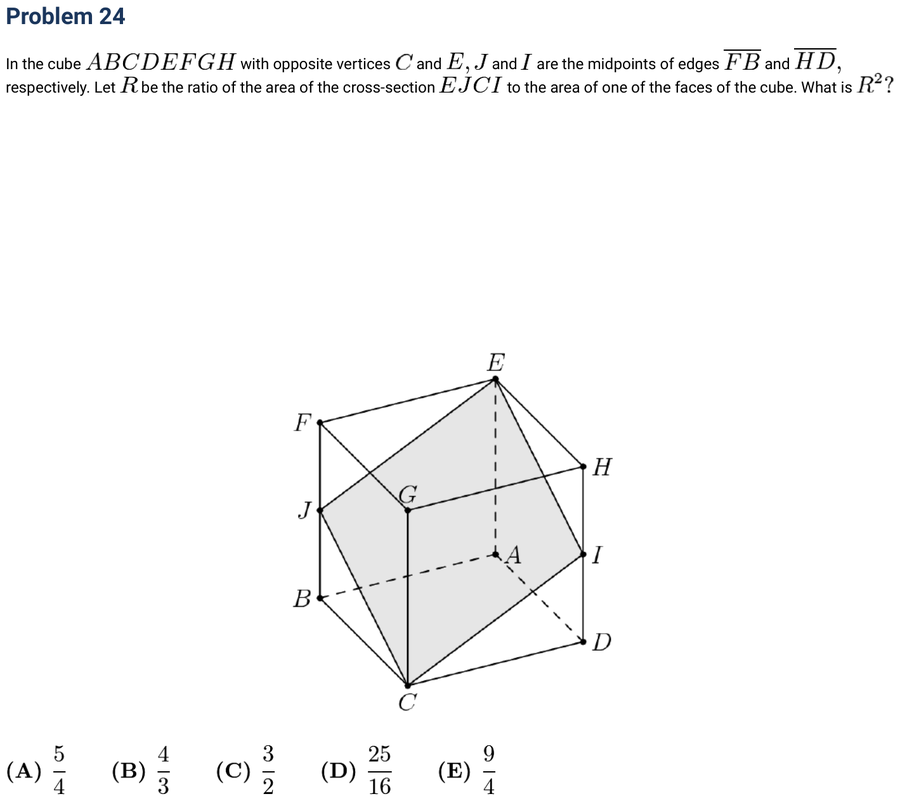
Don't fight the slanted quadrilateral head-on. Each of its four sides runs from a corner of the cube to a midpoint of an edge the same distance away — so all four sides are equal length. That single observation tells you the cross-section is a rhombus.
Still stuck? Show hint 2 →
Hint 2 of 2
The technique: for a rhombus, area = (1/2) × (one diagonal) × (other diagonal). Here the diagonals are familiar cube distances — a face diagonal and the space diagonal — so Pythagoras hands you both, and the side s cancels out at the end.
Show solution
Approach: compute rhombus area via diagonals
- Each side of EJCI joins a cube corner to a midpoint of an edge; by symmetry all four are equal, so EJCI is a rhombus. Its two diagonals are IJ and CE.
- Diagonal IJ connects the midpoints of two parallel edges, so it equals a face diagonal: IJ = s√2 (Pythagoras on a face). Diagonal CE joins opposite corners of the cube: the space diagonal CE = s√3.
- Rhombus area = (1/2)(s√2)(s√3) = s2√6 / 2.
- R = (cross-section) / (face) = (s2√6 / 2) ÷ s2 = √6 / 2 — the s2 cancels, so the answer doesn't depend on the cube's size.
- R2 = 6/4 = 3/2. (The question asks for R2 precisely to dodge the messy square roots — squaring at the end is cleaner.)
- You'll see it again: recognizing a rhombus (or kite) lets you swap the hard base×height for the easy half-product-of-diagonals; the diagonals of a cube cross-section are almost always a face diagonal (√2) or space diagonal (√3).
Mark:
· log in to save