Problem 18 · 2015 AMC 8
Medium
Algebra & Patterns
arithmetic-sequencemiddle-is-average
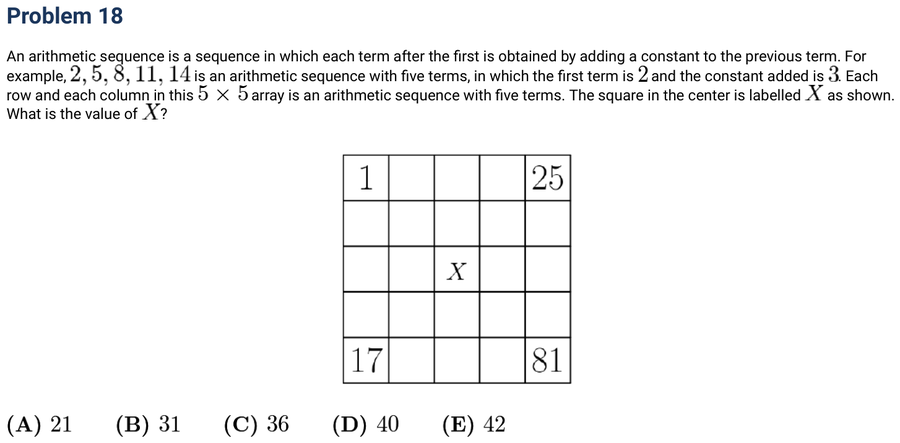
An arithmetic sequence is a sequence in which each term after the first is obtained by adding a constant to the previous term. For example, 2, 5, 8, 11, 14 is an arithmetic sequence with five terms, in which the first term is 2 and the constant added is 3. Each row and each column in this 5 × 5 array is an arithmetic sequence with five terms. The square in the center is labelled X. What is the value of X?
Show answer
Answer: B — X = 31.
Show hints
Hint 1 of 2
You don't need to fill in the whole grid. In any arithmetic sequence the middle term is just the average of the two ends — the constant step makes it sit exactly halfway. So a center value is reachable straight from outer values.
Still stuck? Show hint 2 →
Hint 2 of 2
Use that fact like stepping stones: the corners give you the middles of the top and bottom rows, and those two give you X. (Only the four corners ever matter.)
Show solution
Approach: middle term = average of the two endpoints, applied twice
- Middle term = average of endpoints: top row middle = (1 + 25)/2 = 13, bottom row middle = (17 + 81)/2 = 49.
- X is the middle of the center column, whose ends are those two: X = (13 + 49)/2 = 31.
- Why this transfers: 'middle = average of the ends' (because the step cancels symmetrically) collapses these grid problems — you never need the interior entries.
Another way — X is the average of the four corners:
- Averaging the top corners then the bottom corners then those two results is the same as averaging all four corners at once.
- X = (1 + 25 + 17 + 81)/4 = 124/4 = 31 — one clean computation, no intermediate values.
Mark:
· log in to save