Lucius is counting backward by 7s. His first three numbers are 100, 93, and 86. What is his 10th number?
Show answer
Answer: B — 37.
Show hints
Hint 1 of 2
Careful — the 1st number is free. Getting from the 1st to the 10th, how many subtractions of 7 do you actually perform?
Still stuck? Show hint 2 →
Hint 2 of 2
It's 9 steps, not 10 (like fenceposts: 10 posts, 9 gaps). So how much is subtracted from 100 in total?
Show solution
Approach: count the steps, not the terms (arithmetic sequence)
The trap is multiplying by 10. But the 1st number cost no subtraction — going from the 1st to the 10th is only 9 steps, not 10. (Think fenceposts: 10 posts have 9 gaps between them.)
Each step subtracts 7, so you subtract 9 × 7 = 63 total: 100 − 63 = 37.
Why this transfers: the nth term of a sequence starting at the 1st uses n − 1 steps, not n. This off-by-one (fencepost) idea shows up in any "count from term 1 to term n" question. Sanity check: 37 + 63 = 100. ✓
with temperature in °F and wind speed in mph. If the air temperature is 36°F and the wind speed is 18 mph, which is closest to the wind chill?
Show answer
Answer: B — About 23.
Show hints
Hint 1 of 2
‘Closest’ tells you not to sweat the decimals — estimate. Wind makes it feel colder, so your answer must come out below 36.
Still stuck? Show hint 2 →
Hint 2 of 2
Put the numbers into the formula: multiply 0.7 × (wind speed) first, then subtract that from the temperature.
Show solution
Approach: substitute into the formula, then pick the closest choice
The word ‘closest’ is a hint that you can estimate. 0.7 × 18 is close to 0.7 × 18 = 12.6, and even rounding to ‘about 13 colder’ already points at choice (B).
Exactly: 0.7 × 18 = 12.6.
Subtract from the temperature: 36 − 12.6 = 23.4.
Closest choice is 23. Sanity check: wind should make it feel colder, so the answer must be below 36 — it is.
A strange symbol like ◆ or ★ isn't new math — it's just a made-up recipe. Replace each symbol with its rule and it becomes ordinary arithmetic.
Still stuck? Show hint 2 →
Hint 2 of 2
Same rule as always: do the parentheses first. Compute the ◆ inside, then drop that number into the ★ recipe.
Show solution
Approach: a made-up symbol is just a recipe — replace it with its rule, parentheses first
Don't be thrown by the unusual symbols: ◆ and ★ are just nicknames for recipes. Wherever you see one, swap in its definition. Same as always, the parentheses go first.
Inside first: 5 ◆ 3 = 52 − 32 = 25 − 9 = 16.
Now feed 16 into the ★ recipe: 16 ★ 6 = (16 − 6)2 = 102 = 100.
Shortcut to notice: 5 ◆ 3 = 52 − 32 is a difference of squares = (5+3)(5−3) = 8 × 2 = 16, so you never even need to square 5 and 3.
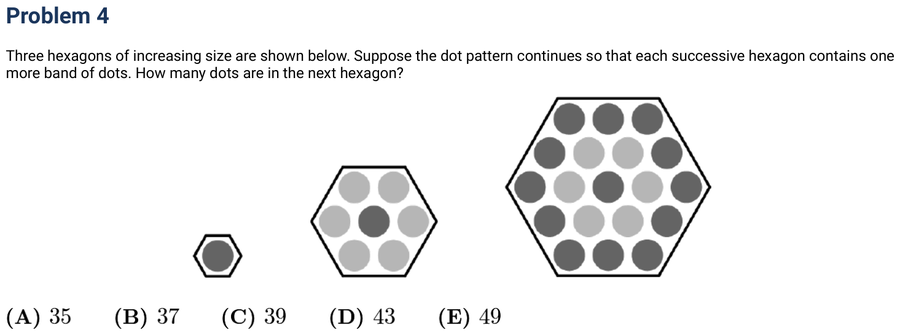
Three hexagons of increasing size are shown below. Suppose the dot pattern continues so that each successive hexagon contains one more band of dots. How many dots are in the next hexagon?
Show answer
Answer: B — 37 dots.
Show hints
Hint 1 of 2
Don't redraw the next hexagon — just figure out how many dots the new outer ring adds. A hexagon ring has 6 corners, so its count grows by 6 each time.
Still stuck? Show hint 2 →
Hint 2 of 2
The bands go 1, then 6, 12, 18, … (each adds 6 more than the last). You already have 1 + 6 + 12 = 19 in hexagon 3; add the next band of 18.
Show solution
Approach: count only the new ring; the rings grow by 6 each time
A hexagon has 6 sides, so each new outer ring adds 6 more dots than the ring before it: the bands are 1, 6, 12, 18, … (a center dot, then rings stepping up by 6).
Hexagon 3 already has 1 + 6 + 12 = 19 dots (matches the picture).
The 4th hexagon just tacks on the next ring of 18: 19 + 18 = 37.
You'll see this again as: “centered hexagonal” growth — when a shape grows by adding a border, count only the border. Its size usually climbs by a fixed step tied to the number of sides (hexagon → +6, square → +8, triangle → +3).
Another way — closed form for centered hexagonal numbers:
Eight friends ate at a restaurant and agreed to share the bill equally. Because Judi forgot her money, each of her seven friends paid an extra $2.50 to cover her portion of the total bill. What was the total bill?
Show answer
Answer: C — $140.
Show hints
Hint 1 of 2
The seven $2.50 extras didn't vanish — together they exactly paid off Judi's one share. So 7 × $2.50 is one person's share of the bill.
Still stuck? Show hint 2 →
Hint 2 of 2
Find the size of one equal part first, then scale up to the whole. One share × (number of shares) = total.
Show solution
Approach: find one share, then multiply by 8
The 7 extra payments covered exactly Judi's portion, so one person's share = 7 × $2.50 = $17.50. (That's the key reframe: the extras add up to one full share.)
Everyone owed the same share, and there are 8 people, so the total bill = 8 × $17.50 = $140.
Sanity check: $17.50 per person feels right for a restaurant, and 8 of them lands at $140 — matching a choice.
The Incredible Hulk can double the distance it jumps with each succeeding jump. If its first jump is 1 meter, the second jump is 2 meters, the third jump is 4 meters, and so on, then on which jump will it first be able to jump more than 1 kilometer (1,000 meters)?
Show answer
Answer: C — 11th jump.
Show hints
Hint 1 of 2
Doubling each time means you're climbing powers of 2: 1, 2, 4, 8, …. The only catch is the off-by-one — jump 1 is 20, not 21. Watch which jump number lines up with which power.
Still stuck? Show hint 2 →
Hint 2 of 2
"Repeated doubling" is always powers of 2. The danger is the exponent offset; anchor it by checking a small case (jump 3 = 4 = 22) before extrapolating.
Show solution
Approach: powers of 2, watching the off-by-one
Jump 1 = 1 = 20, jump 2 = 2 = 21, … so jump n = 2n−1 meters. (The exponent is one behind the jump number — that's the spot people slip.)
Memorized landmark: 210 = 1024 is the first power of 2 over 1000 (since 29 = 512 falls short).
Set n − 1 = 10, so the first jump past 1000 m is the 11th.
Worth keeping: 210 ≈ 1000 is a handy anchor — every 10 doublings multiplies by roughly a thousand.
The sum of six consecutive positive integers is 2013. What is the largest of these six integers?
Show answer
Answer: B — 338.
Show hints
Hint 1 of 2
Consecutive numbers are balanced around their middle, so their sum is just (average) × (count). Divide 2013 by 6 to land right in the center of the six numbers — then the largest is a short hop away.
Still stuck? Show hint 2 →
Hint 2 of 2
For evenly spaced numbers, sum = average × count, and the average sits dead center. Find the center first; the endpoints follow.
Show solution
Approach: divide to find the center, then step to the largest
Six consecutive integers average to sum ÷ 6 = 2013 ÷ 6 = 335.5. With 6 numbers the center falls between the 3rd and 4th, so those two are 335 and 336.
Counting outward, the six are 333, 334, 335, 336, 337, 338, so the largest is 338.
You'll see this again: "sum = average × count" cracks every consecutive-integer problem — find the middle, then walk to whichever term you need.
Another way — algebra with a variable:
Let the smallest be x. The sum is x + (x+1) + … + (x+5) = 6x + 15.
Set 6x + 15 = 2013, so 6x = 1998 and x = 333. Largest = 333 + 5 = 338.
The Fort Worth Zoo has a number of two-legged birds and a number of four-legged mammals. On one visit to the zoo, Margie counted 200 heads and 522 legs. How many of the animals that Margie counted were two-legged birds?
Show answer
Answer: C — 139 birds.
Show hints
Hint 1 of 2
Before reaching for two equations, try a what-if: pretend every animal is a 4-legged mammal. You'd over-count the legs — and the over-count is caused entirely by the birds.
Still stuck? Show hint 2 →
Hint 2 of 2
This is the assume-then-fix trick (a.k.a. the chicken-and-rabbit method): assume the extreme case, see the gap from reality, and let each swapped animal explain a fixed chunk of the gap.
Show solution
Approach: assume all 4-legged, then account for the shortage
Imagine all 200 animals are 4-legged: that would be 200 × 4 = 800 legs — one easy multiplication instead of solving a system.
Reality shows only 522 legs, a shortage of 800 − 522 = 278.
Every bird counted as a mammal hides 2 legs (it has 2, not 4), so each bird explains exactly 2 of the missing legs: birds = 278 / 2 = 139.
Let t = birds, f = mammals. Heads: t + f = 200. Legs: 2t + 4f = 522.
Double the head equation: 2t + 2f = 400, and subtract it from the leg equation to clear t... or subtract from the legs to clear f: 2f = 122, so f = 61.
Then t = 200 − 61 = 139 birds. The shortcut above is just this subtraction done in your head.
In a jar of red, green, and blue marbles, all but 6 are red marbles, all but 8 are green, and all but 4 are blue. How many marbles are in the jar?
Show answer
Answer: C — 9 marbles.
Show hints
Hint 1 of 2
Flip each statement around. "All but 6 are red" isn't about red — it says the non-red marbles (green + blue) number 6. Rewrite all three the same way.
Still stuck? Show hint 2 →
Hint 2 of 2
Now add your three equations and watch what happens: each color shows up in exactly two of them. The technique is add-them-all and exploit the symmetry.
Show solution
Approach: rephrase as two-color sums, then add
Reverse each clue into a count of the other two colors: green + blue = 6, red + blue = 8, red + green = 4.
Add all three. Every color appears in exactly two equations, so the left side is 2(red + green + blue): 2 × Total = 6 + 8 + 4 = 18.
Therefore Total = 18 / 2 = 9 marbles.
Why the ÷2: summing "all but" statements double-counts every marble, so the total is half the sum of the three given numbers — a handy shortcut for any "all but" puzzle.
Another way — find each color, then total:
From green + blue = 6 and red + blue = 8, subtract: red − green = 2. Combine with red + green = 4 to get red = 3, green = 1.
Then blue = 6 − green = 5. Total = 3 + 1 + 5 = 9, matching the shortcut.
If a@b = a × ba + b for a, b positive integers, then what is 5@10?
Show answer
Answer: D — 10/3.
Show hints
Hint 1 of 2
The ‘@’ is just a made-up recipe: it tells you exactly what to do with the two numbers. Read it as ‘product on top, sum on the bottom.’
Still stuck? Show hint 2 →
Hint 2 of 2
With any new symbol, copy the rule and drop your numbers into the matching slots — a and b are placeholders waiting to be filled.
Show solution
Approach: substitute into the definition
Plug a = 5, b = 10 into product-over-sum: 5@10 = (5 · 10)/(5 + 10) = 50/15.
Simplify by dividing top and bottom by 5: 50/15 = 10/3.
Why this transfers: a strange symbol like @, ★, or ◇ is never magic — it's a one-line instruction. Substitute carefully and the ‘hard’ problem becomes ordinary arithmetic.
The top of one tree is 16 feet higher than the top of another tree. The heights of the two trees are in the ratio 3 : 4. In feet, how tall is the taller tree?
Show answer
Answer: B — 64 feet.
Show hints
Hint 1 of 2
Think of the trees as made of equal ‘parts’: one is 3 parts tall, the other 4. The 16-foot difference is just the one extra part. So one part = 16 ft.
Still stuck? Show hint 2 →
Hint 2 of 2
In a ratio, the difference between the numbers is also measured in those same parts. Find the value of one part, then scale up.
Show solution
Approach: find the value of one ratio part
The heights are 3 parts and 4 parts. The gap between them is 4 − 3 = 1 part, and that gap is the given 16 ft — so 1 part = 16 ft.
The taller tree is 4 parts: 4 · 16 = 64 ft.
Why this transfers: ‘ratio + a difference (or sum)’ almost always cracks open by pricing one part. Match the given number to how many parts it represents, then multiply.
Bridget bought a bag of apples at the grocery store. She gave half of the apples to Ann. Then she gave Cassie 3 apples, keeping 4 apples for herself. How many apples did Bridget buy?
Show answer
Answer: E — 14 apples.
Show hints
Hint 1 of 2
The story runs forward (give away, give away, keep), but you know the END, not the start. So play the movie in reverse.
Still stuck? Show hint 2 →
Hint 2 of 2
To undo a story, reverse the order AND flip each action: gave away → add back, took half → double.
Show solution
Approach: work backward, inverting each step
Start from what's known: 4 apples kept. The last thing before that was giving Cassie 3, so undo it — add them back: 4 + 3 = 7. That 7 is what she had right after giving Ann half.
Giving away half means 7 is the OTHER half, so the original was double: 2 × 7 = 14.
Why this transfers: whenever a problem hands you the finish and asks for the start, work-backward turns it into pure arithmetic — just remember to invert each operation (subtract becomes add, halve becomes double).
Another way — algebra (one equation):
Let she bought n. After giving Ann half she has n/2; after Cassie's 3 she has n/2 − 3 = 4.
A sequence of numbers starts with 1, 2, and 3. The fourth number of the sequence is the sum of the previous three numbers in the sequence: 1 + 2 + 3 = 6. In the same way, every number after the fourth is the sum of the previous three numbers. What is the eighth number in the sequence?
Show answer
Answer: D — 68.
Show hints
Hint 1 of 2
There's no clever shortcut to hunt for — the rule itself IS the tool. Each new term only needs the three just before it, so you can roll forward step by step.
Still stuck? Show hint 2 →
Hint 2 of 2
Keep a sliding window of the last three numbers; add them for the next term, then slide the window forward one.
Show solution
Approach: iterate the recurrence (sliding window of 3)
Each term = sum of the previous three. Roll forward: 1, 2, 3, then 1+2+3 = 6, then 2+3+6 = 11, then 3+6+11 = 20, then 6+11+20 = 37, then 11+20+37 = 68.
That 68 is the 8th term. Sanity check: terms should grow but not explode — each roughly doubles, and 37 → 68 fits, so we didn't skip or double-count a term.
You'll meet this again: a rule like "each term = sum of the last few" is a recurrence (this one is the Tribonacci pattern, cousin of Fibonacci). For a small target index, just iterate — only reach for formulas when the index is huge.
Pick two consecutive positive integers whose sum is less than 100. Square both of those integers and then find the difference of the squares. Which of the following could be the difference?
Show answer
Answer: C — 79.
Show hints
Hint 1 of 2
Try it with real numbers first: 42 − 32 = 7, and 3 + 4 = 7. The difference of the squares is just the sum of the two integers — which is always odd. So two of the choices are dead on arrival.
Still stuck? Show hint 2 →
Hint 2 of 2
Difference of squares:p2 − q2 = (p+q)(p−q); for consecutive integers the second factor is 1, so it collapses to p+q.
Show solution
Approach: factor the difference, then screen by parity
Let the integers be x and x+1. Then (x+1)2 − x2 = (2x+1)(1) = 2x+1 — exactly the sum of the two numbers.
So the difference is odd (it's 2x+1) and, since the sum is under 100, less than 100.
Scan the choices: 2 and 64 are even (out); 131 is over 100 (out). Only 79 is odd and below 100.
Big idea: the gap between consecutive squares grows by odd numbers (1, 3, 5, 7, …) — so every consecutive-square difference is odd. That parity test killed three options instantly.
What is the product of 32 × 43 × 54 × … × 20062005?
Show answer
Answer: C — 1003.
Show hints
Hint 1 of 2
Don't multiply anything yet! Write out just the first few fractions and look for numbers that appear on both a top and a bottom — those cancel.
Still stuck? Show hint 2 →
Hint 2 of 2
This is a telescoping product: every numerator (3, 4, 5, …) reappears as the next denominator and cancels. Only the very first bottom and very last top survive.
Show solution
Approach: telescoping — let the chain cancel itself
Line them up: (3/2)(4/3)(5/4)…(2006/2005). The 3 on top of the first fraction cancels the 3 on the bottom of the second; the 4 cancels the 4, and so on all the way down.
Everything in the middle wipes out. What's left is just the first denominator (2) and the last numerator (2006): 2006 ÷ 2 = 1003.
You'll see it again: any product where each term's top equals the next term's bottom telescopes — the answer is simply (last top) ÷ (first bottom). Spotting the cancellation pattern saves you from a 2004-step multiplication.
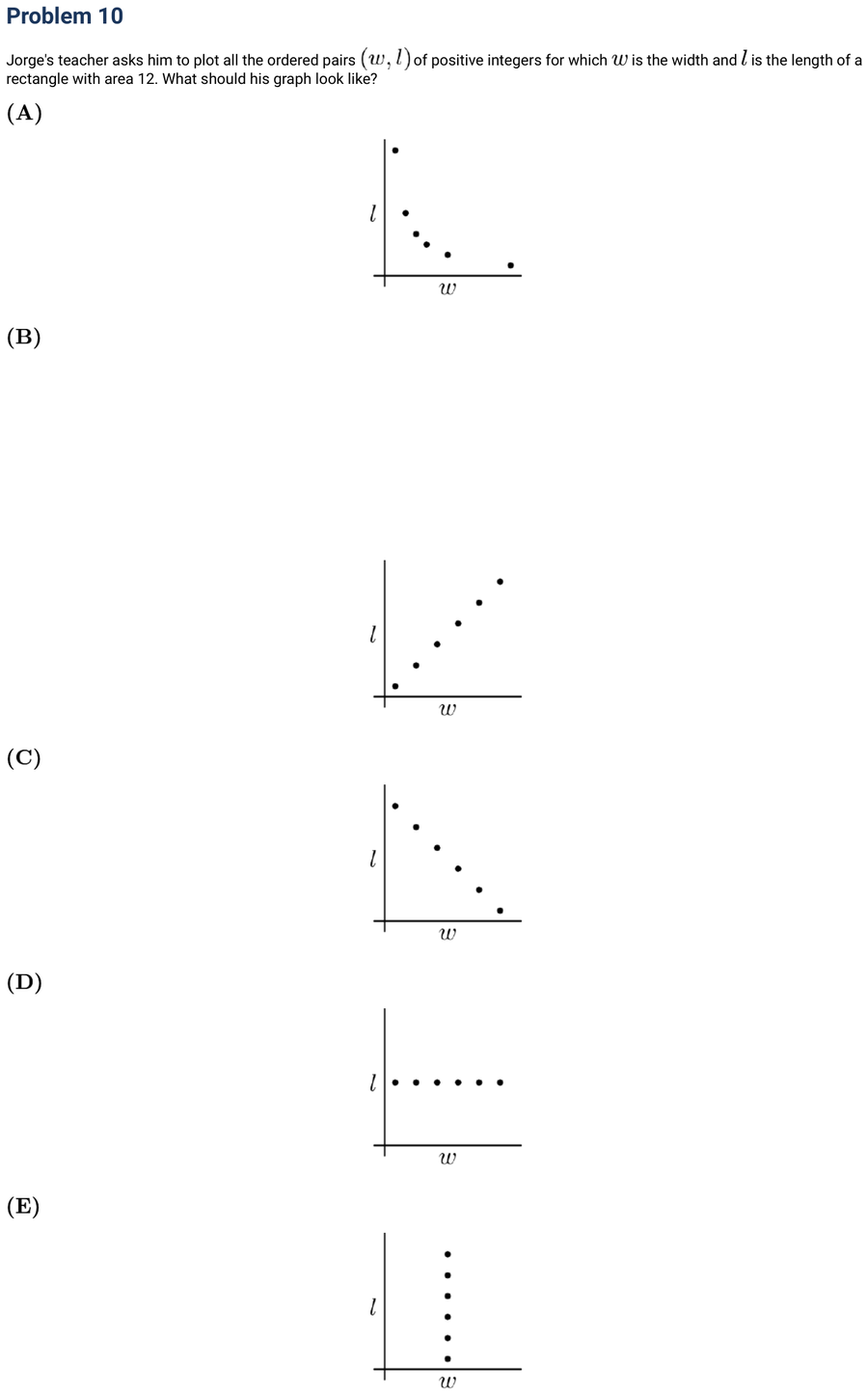
Jorge's teacher asks him to plot all the ordered pairs (w, l) of positive integers for which w is the width and l is the length of a rectangle with area 12. What should his graph look like?
Show answer
Answer: A — Graph A.
Show hints
Hint 1 of 2
Don't reason about the graph abstractly — just LIST the actual rectangles. Which whole-number widths and lengths multiply to 12?
Still stuck? Show hint 2 →
Hint 2 of 2
Two clues separate the choices: (1) only whole numbers work, so you get a few separate dots, not a solid line; (2) wl = 12 means as w grows, l shrinks — an inverse relationship, which curves rather than going straight.
Show solution
Approach: list the integer points and read their shape
Find every pair of positive integers multiplying to 12: (1,12), (2,6), (3,4), (4,3), (6,2), (12,1). That's six separate dots — not a continuous line.
As w goes 1, 2, 3, 4, 6, 12 the length l drops 12, 6, 4, 3, 2, 1: a falling pattern, but the drops get smaller and smaller (a curve that bends, not a straight slant).
Six dots, falling and curving — that's graph A.
How to rule out look-alikes: a straight falling line (C) would need equal-sized drops, but inverse proportion (l = 12/w) bends. Constant l (D) or rising dots (B) ignore the rule entirely. Listing the points makes the right shape obvious.
Big Al the ape ate 100 delicious yellow bananas from May 1 through May 5. Each day he ate six more bananas than on the previous day. How many delicious bananas did Big Al eat on May 5?
Show answer
Answer: D — 32.
Show hints
Hint 1 of 2
Five days, each 6 more than the last — the amounts step up evenly. In any such evenly-stepping list, the middle day equals the average. So don't set up a big equation; find the average first.
Still stuck? Show hint 2 →
Hint 2 of 2
The middle term of an odd-length arithmetic sequence is its mean. From the middle, count steps of 6 outward to any day you want.
Show solution
Approach: the middle day is the average
Total is 100 over 5 days, so the average per day is 100 ÷ 5 = 20. Because the increase is steady, that average lands exactly on the middle day, May 3.
May 5 is two days past the middle, each day +6: 20 + 2·6 = 32.
Why this transfers: for any arithmetic sequence with an odd count of terms, sum ÷ count gives the center term instantly — far faster than solving for the first term. (Note 30, choice C, is the trap for stopping one step short.)
Another way — name the middle day x:
Let May 3 = x. The five days are x−12, x−6, x, x+6, x+12; the ±12 and ±6 cancel, so the sum is just 5x.
5x = 100 ⇒ x = 20, and May 5 = x+12 = 32. Centering the variable makes the symmetric terms cancel cleanly.
A group of children riding on bicycles and tricycles rode past Billy Bob's house. Billy Bob counted 7 children and 19 wheels. How many tricycles were there?
Show answer
Answer: C — 5 tricycles.
Show hints
Hint 1 of 2
Don't set up two equations — pretend every child is on a bicycle first and watch what's missing.
Still stuck? Show hint 2 →
Hint 2 of 2
Each tricycle is just a bicycle with one extra wheel, so the leftover wheels count the tricycles directly.
Show solution
Approach: assume all bicycles, then the leftover wheels count the tricycles
Suppose all 7 children rode bicycles. That would be 7 × 2 = 14 wheels — but only counts as a starting guess.
We actually see 19 wheels, so 19 − 14 = 5 wheels are unaccounted for. A tricycle is just a bicycle with one extra wheel, so each leftover wheel marks one tricycle: 5 tricycles.
You'll see this again: the "assume the cheapest option, then spend the surplus" trick cracks chickens-and-rabbits, coins, and stamp problems without any algebra.
Another way — solve the system:
With b bicycles and t tricycles: b + t = 7 and 2b + 3t = 19.
Subtract twice the first from the second: t = 19 − 14 = 5.
I'm thinking of two whole numbers. Their product is 24 and their sum is 11. What is the larger number?
Show answer
Answer: D — 8.
Show hints
Hint 1 of 2
The product 24 is the strong clue — it only has a few factor pairs, so list those first and the sum filters them.
Still stuck? Show hint 2 →
Hint 2 of 2
"Two numbers with a known product and sum" is a classic setup; scanning factor pairs beats setting up algebra here.
Show solution
Approach: scan the factor pairs of 24
Start from the product, because 24 has only four factor pairs: 1·24, 2·12, 3·8, 4·6.
Now apply the sum filter — which pair adds to 11? Only 3 + 8 = 11.
The larger of the two is 8. Whenever you know two numbers' product AND sum, list the factor pairs first; you'll meet the same idea later as factoring x² − 11x + 24.
For x = 7, which of the following is the smallest?
Show answer
Answer: B — 6/(x+1).
Show hints
Hint 1 of 2
You don't have to rank all five — a fraction is smallest when it has the biggest bottom sitting under a small top. Which choice has the largest denominator?
Still stuck? Show hint 2 →
Hint 2 of 2
Sorting fractions: with the same small numerator (6), the one with the biggest denominator wins for smallest. Choices D and E are bigger than 1, so they can't be smallest — ignore them.
Show solution
Approach: biggest bottom under a small top = smallest fraction
Don't grind all five. First notice D = 7/6 and E = 8/6 are each more than 1, while A, B, C all have top 6 under a bottom of 6 or more, so they're at most 1 — the smallest must be among A, B, C.
Those three are 6/7, 6/8, 6/6. Same top of 6, so the biggest bottom makes the smallest fraction: that's 6/8, which is 6/(x+1).
Why this transfers: when fractions share a numerator, more in the denominator means a smaller value — you split the same 6 among more pieces. You'll reuse this to compare fractions on sight without finding a common denominator.
A made-up symbol can't trick you — it's just a recipe. Read off which numbers play the roles of a, b, c, d, then follow the recipe exactly.
Still stuck? Show hint 2 →
Hint 2 of 2
The rule a·d − b·c is a criss-cross: multiply the two corners on one diagonal, subtract the product of the other diagonal.
Show solution
Approach: follow the recipe (criss-cross of the corners)
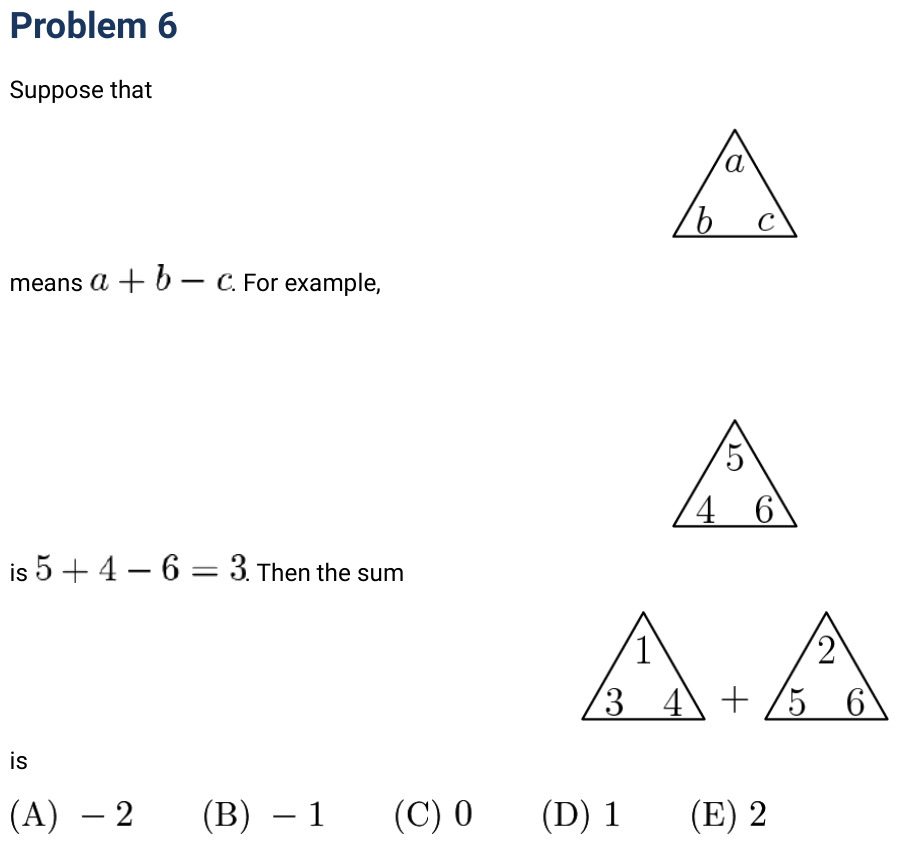
Match the positions to the rule: a = 3 (top-left), b = 4 (top-right), c = 1 (bottom-left), d = 2 (bottom-right). The rule wants a·d − b·c.
So 3·2 − 4·1 = 6 − 4 = 2.
Why this transfers: contests love inventing a brand-new symbol just to see if you'll calmly substitute into the definition. There's nothing to memorize — locate the inputs, run the recipe. (This particular criss-cross is the 2×2 determinant you'll meet again later.)
Ahn chooses a two-digit integer, subtracts it from 200, and doubles the result. What is the largest number Ahn can get?
Show answer
Answer: D — 380.
Show hints
Hint 1 of 2
Don't try numbers at random — ask which way the dial turns. You subtract Ahn's number, so a SMALLER number subtracted means a BIGGER result.
Still stuck? Show hint 2 →
Hint 2 of 2
To maximize an answer, drive each piece to its best extreme: pick the smallest legal two-digit number.
Show solution
Approach: push the variable to its best extreme
The result is 2 × (200 − n). Subtracting n then doubling, so the only way to make it big is to make n as small as possible — the value drops as n grows.
The smallest two-digit number is 10 (not 00 or 1, which aren't two digits), giving 2 × (200 − 10) = 2 × 190 = 380.
Trap check: the choices include 398, which you'd get from n = 1 — but 1 isn't a two-digit number. Re-reading the rules catches it.
You'll see it again: for 'largest/smallest possible value' problems, find which direction helps and slam each free choice to its boundary.
Jose is 4 years younger than Zack. Zack is 3 years older than Inez. Inez is 15 years old. How old is Jose?
Show answer
Answer: C — 14.
Show hints
Hint 1 of 2
Only one person has a real number: Inez is 15. Start where you actually know something and build outward.
Still stuck? Show hint 2 →
Hint 2 of 2
Each clue is a 'how far apart' link — follow the chain Inez → Zack → Jose, adding or subtracting at each link.
Show solution
Approach: anchor at the known value, then walk the chain
Don't try to solve everyone at once — start from the one fixed fact: Inez is 15.
Zack is 3 years older than Inez, so Zack is 15 + 3 = 18.
Jose is 4 years younger than Zack, so Jose is 18 − 4 = 14.
The habit that transfers: in a chain of comparisons, find the one person with a number and walk outward one link at a time — never juggle all the unknowns together.
Rohan keeps a total of 90 guppies in 4 fish tanks.
There is 1 more guppy in the 2nd tank than in the 1st tank.
There are 2 more guppies in the 3rd tank than in the 2nd tank.
There are 3 more guppies in the 4th tank than in the 3rd tank.
How many guppies are in the 4th tank?
Show answer
Answer: E — 26 guppies.
Show hints
Hint 1 of 2
The clues chain off each other, so anchor everything to ONE tank. From tank 1, each later tank is tank 1 plus a running total: +1, then +1+2 = +3, then +1+2+3 = +6.
Still stuck? Show hint 2 →
Hint 2 of 2
Technique: write all four as tank 1 + (0, 1, 3, 6). Their sum is 4·(tank 1) + 10 = 90 — one equation for one unknown.
Show solution
Approach: express every tank in terms of tank 1
The differences chain, so pin everything to tank 1 = x. Then tank 2 = x + 1, tank 3 = (x+1) + 2 = x + 3, tank 4 = (x+3) + 3 = x + 6.
Adding: 4x + (1 + 3 + 6) = 4x + 10 = 90, so x = 20.
The question wants tank 4, not tank 1 — so finish the job: tank 4 = 20 + 6 = 26. Watch out: solving for x = 20 and stopping is the classic trap; always re-read what's being asked.
Another way — level the tanks against the total:
If all four tanks matched tank 1, the total would be 4·(tank 1). The real total is 10 more (the built-in extras 0+1+3+6), so 4·(tank 1) = 90 − 10 = 80 → tank 1 = 20.
How many positive integers can fill the blank in the sentence below?
"One positive integer is ___ more than twice another, and the sum of the two numbers is 28."
Show answer
Answer: D — 9 values.
Show hints
Hint 1 of 2
The blank isn't free to be anything — once you choose the smaller number, the sum of 28 forces the blank. So really you're counting how many smaller numbers are allowed.
Still stuck? Show hint 2 →
Hint 2 of 2
Smaller = a, larger = 2a + (blank). Their sum 28 gives blank = 28 − 3a. Now ask: which a keep both the blank and the numbers positive?
Show solution
Approach: the blank is determined by the smaller number, so count valid smaller numbers
Insight: don't search for blanks — each choice of the smaller number forces the blank. Let smaller = a; then larger = 2a + (blank), and the sum is 3a + (blank) = 28, so blank = 28 − 3a.
For the blank to be a positive integer, 28 − 3a ≥ 1, i.e. a ≤ 9; and a ≥ 1. Each such a gives a different blank, so the count of blanks equals the count of a.
a ∈ {1, 2, …, 9} ⇒ 9 values for the blank.
Sanity check:a = 1 gives blank 25 (numbers 1 and 27); a = 9 gives blank 1 (numbers 9 and 19) — both endpoints valid. ✓
One row is completely filled in — that quietly tells you the shared sum, which unlocks every blank.
Still stuck? Show hint 2 →
Hint 2 of 2
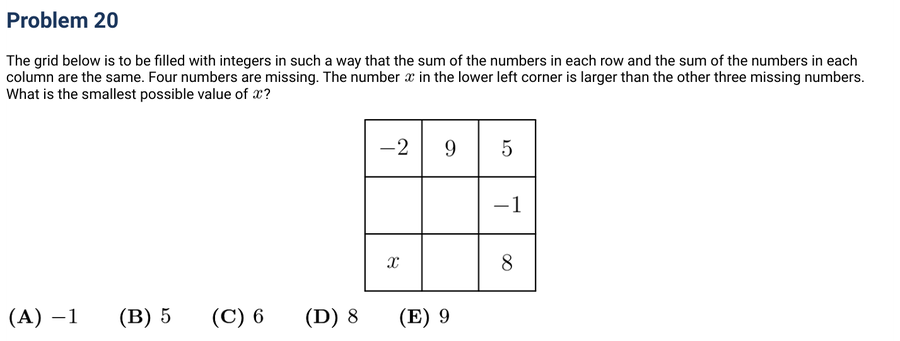
The common sum is −2 + 9 + 5 = 12. Use that to write each of the three other missing cells in terms of x; then “x is the largest” turns into a few inequalities.
Show solution
Approach: the full top row gives the common sum; express every blank in terms of x
Insight: the top row is fully known, so it hands you the magic sum for free: −2 + 9 + 5 = 12. Every row and column must total 12, so each blank is forced once you write it against that 12.
Cell above x (first column): −2 + ? + x = 12 ⇒ ? = 14 − x.
Center (middle row): (14−x) + ? + (−1) = 12 ⇒ ? = x − 1.
Now “x beats all three”: x > 14−x ⇒ x > 7 (the binding one); x > 4−x and x > x−1 are easier. Smallest integer with x > 7 is 8.
Sanity check at x = 8: blanks become 6, −4, 7; the grid reads [−2, 9, 5 / 6, 7, −1 / 8, −4, 8] — every row and column sums to 12, and 8 is the largest of {6, −4, 7, 8}. ✓
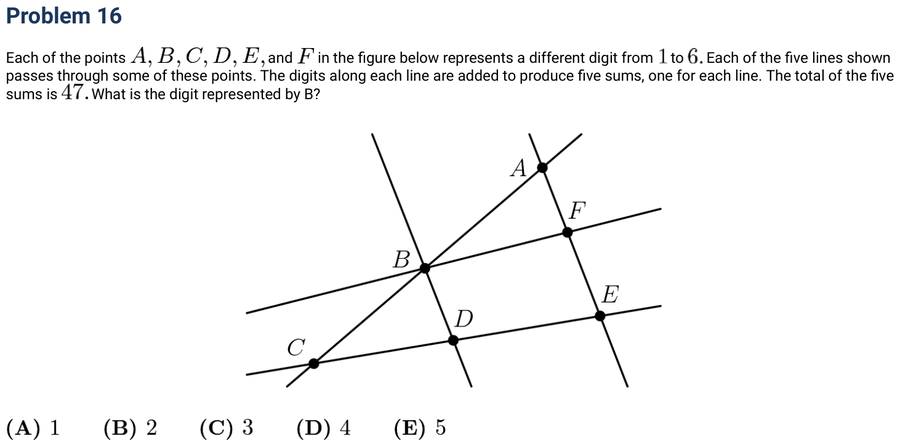
Don't chase individual line-sums. When you add all five sums together, each digit gets counted once for every line it sits on. So ask: how many lines pass through each point?
Still stuck? Show hint 2 →
Hint 2 of 2
Every point is on 2 lines except B, which is the busy crossing on 3. So the grand total counts each digit twice, plus B one extra time: 2(A+B+C+D+E+F) + B = 47.
Show solution
Approach: count incidences — each digit appears once per line it's on
Adding all five line-sums counts each point once per line through it. Reading the figure, A, C, D, E, F lie on 2 lines each, and B (the busy crossing) lies on 3. So the grand total is 2(A+B+C+D+E+F) + B = 47.
The digits 1–6 are used once each, so A+B+C+D+E+F = 1+2+3+4+5+6 = 21. Then 2(21) + B = 42 + B = 47.
B = 5.
Why this transfers: for “sum of all the line totals” problems, count incidences — a point on k lines contributes its value k times. The whole figure collapses to one equation, no casework on which digit goes where.
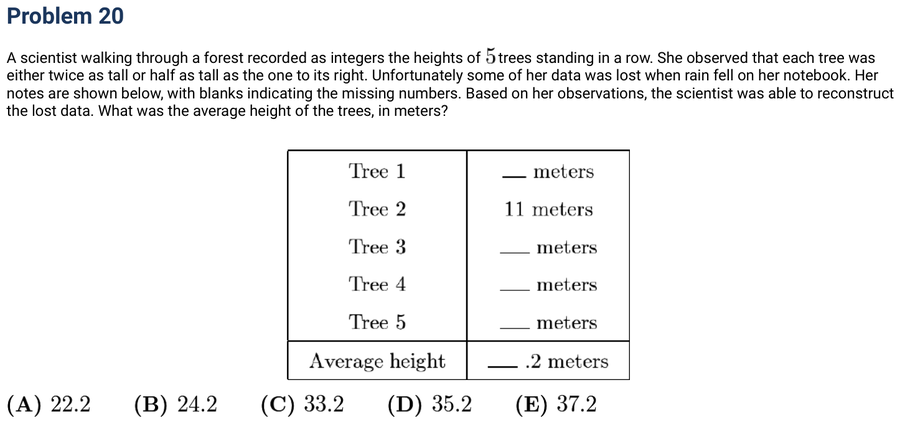
The only number you're handed is 11 — an odd one. Since every height is a whole number, no neighbor can be ‘half of 11’ (that's 5.5). So the trees touching Tree 2 are forced upward, not down.
Still stuck? Show hint 2 →
Hint 2 of 2
Once the integer rule fixes Tree 1 and Tree 3, only a couple of branches remain for Trees 4 and 5. Don't compute all the averages — the answer must end in ‘.2’, so use that to pick the right branch.
Show solution
Approach: let the odd value 11 force integers, then filter by the ‘.2’ ending
The doubling/halving rule says each neighbor is twice or half of 11. Half of 11 is 5.5 — not a whole number — so Tree 1 and Tree 3 are both forced to 22.
Tree 4 is twice or half of Tree 3 (22), so 44 or 11; Tree 5 then doubles or halves Tree 4.
Rather than grinding every average, lean on the clue that it ends in ‘.2’: (44, 88) → 37.4; (44, 22) → 121/5 = 24.2; (11, 22) → 17.6; (11, 5.5) is rejected (not an integer).
Only (44, 22) ends in .2, giving average = 24.2 meters.
Why this transfers: an integer constraint is a powerful filter — start from the value that can't be halved (here the odd 11) and it forces its neighbors, collapsing a tree of possibilities to a handful. Then use a second clue (the ‘.2’) to finish without exhausting every case.
How many different real numbers x satisfy the equation
(x2 − 5)2 = 16 ?
Show answer
Answer: D — 4 real numbers.
Show hints
Hint 1 of 2
The question asks how many solutions — so peel the equation one square at a time. Something squared equals 16 means that something is +4 or −4. Don't lose the negative branch.
Still stuck? Show hint 2 →
Hint 2 of 2
Each branch leaves x2 = (a positive number), and a positive x2 always gives two values of x. Count the branches that stay positive.
Show solution
Approach: undo each square, keeping both signs
(x2 − 5)2 = 16 means x2 − 5 = +4 or −4 — both, since either squares to 16.
Branch +4: x2 = 9 ⇒ x = ±3 (two reals).
Branch −4: x2 = 1 ⇒ x = ±1 (two more).
Both branches gave a positivex2, so each yields 2 real roots: 4 total.
Why this transfers: each square you undo can double the solution count — but only when the inside is positive (a negative x2 would give zero real roots). Track the ± at every layer.
Starting with some gold coins and some empty treasure chests, I tried to put 9 gold coins in each treasure chest, but that left 2 treasure chests empty. So instead I put 6 gold coins in each treasure chest, but then I had 3 gold coins left over. How many gold coins did I have?
Show answer
Answer: C — 45 coins.
Show hints
Hint 1 of 2
The coin pile never changes — only how it's distributed. Write the same number of coins two ways, one for each filling, and set those expressions equal.
Still stuck? Show hint 2 →
Hint 2 of 2
"2 chests empty" means only n − 2 chests get the 9 coins. Equate g = 9(n − 2) with g = 6n + 3 and solve.
Show solution
Approach: count the same coins two ways
Let n = chests and g = coins. Filling 9 each but leaving 2 chests empty uses only n − 2 chests: g = 9(n − 2). Filling 6 each with 3 left over: g = 6n + 3.
Same g, so 9(n − 2) = 6n + 3 ⇒ 9n − 18 = 6n + 3 ⇒ 3n = 21 ⇒ n = 7.
g = 6(7) + 3 = 45.
Why this transfers: any "distribute the same total two different ways" puzzle becomes one equation by writing the unchanging total twice and matching them.
Another way — track the difference per chest:
Going from 6-per-chest to 9-per-chest adds 3 coins to each of the 7 chests... but instead reason forward: the two schemes differ. Switching from 9s to 6s frees 3 coins from every filled chest, plus the 2 chests that were empty now also get 6 each.
Quick check the answer: with 7 chests, 9×(7−2) = 45 and 6×7 + 3 = 45 — both give 45, confirming the count is consistent.
Hui is an avid reader. She bought a copy of the best seller Math is Beautiful. On the first day, Hui read 1/5 of the pages plus 12 more, and on the second day she read 1/4 of the remaining pages plus 15 pages. On the third day she read 1/3 of the remaining pages plus 18 pages. She then realized that there were only 62 pages left to read, which she read the next day. How many pages are in this book?
Show answer
Answer: C — 240 pages.
Show hints
Hint 1 of 3
The only number you actually know for sure is the 62 pages left at the very end. So run the story in reverse — start from 62 and undo each day.
Still stuck? Show hint 2 →
Hint 2 of 3
Undoing a day: if she read 1/3 of the pile plus 18, then 2/3 of the pile minus 18 is what's left. First add the 18 back, then the leftover is 2/3 of the pile — so multiply by 3/2 to recover the start of that day.
Still stuck? Show hint 3 →
Hint 3 of 3
Repeat the same undo for day 2, then day 1, each time recovering the pile at the start of that day.
Show solution
Approach: work backwards, undoing one day at a time
Start from the end: 62 pages remain after day 3. She'd read 1/3 of that day's pile plus 18, leaving 2/3 of it minus 18. So (2/3)·pile − 18 = 62 ⇒ (2/3)·pile = 80 ⇒ pile = 120 at the start of day 3.
Undo day 2 the same way: (3/4)·pile − 15 = 120 ⇒ (3/4)·pile = 135 ⇒ pile = 180 at the start of day 2.
Undo day 1: (4/5)·pile − 12 = 180 ⇒ (4/5)·pile = 192 ⇒ pile = 240 — the whole book.
Why this transfers: when a process ‘take a fraction, then a fixed amount’ repeats and you only know the final state, working backward is far cleaner than one giant forward equation — you invert each step in turn (add the constant back, then scale up).
Another way — forward algebra in one variable:
Let the book be N pages. After day 1, remaining = N − (N/5 + 12) = (4/5)N − 12.
After day 2 (read 1/4 of that plus 15), remaining = (3/4)[(4/5)N − 12] − 15 = (3/5)N − 24.
After day 3 (read 1/3 of that plus 18), remaining = (2/3)[(3/5)N − 24] − 18 = (2/5)N − 34.
Set that to 62: (2/5)N = 96 ⇒ N = 240 — matching the backward method.
The letters A, B, C, and D represent digits. If AB + CA = DA and AB − CA = A, what digit does D represent?
Show answer
Answer: E — 9.
Show hints
Hint 1 of 2
Attack the UNITS column first — it's almost never tangled by carries. In the addition, the units give B + A ending in A, which forces B = 0.
Still stuck? Show hint 2 →
Hint 2 of 2
Once B = 0 you know AB = 10A (a round number). Feed that into the subtraction AB − CA = A to pin down A and C, then read off D.
Show solution
Approach: crack the units column, then use the subtraction
Units of the addition: B + A ends in A. Adding B leaves the last digit unchanged only if B = 0 (and there's no carry). So B = 0, making AB = 10A.
Subtraction: 10A − (10C + A) = A ⇒ 9A − 10C = A ⇒ 8A = 10C ⇒ 4A = 5C.
4A = 5C needs A divisible by 5 and C by 4 (single digits): A = 5, C = 4.
Then DA = AB + CA = 50 + 45 = 95, so D = 9 (and the units '5' matches A — consistent).
Why this transfers: in any cryptarithm, start where carries are simplest (units of a sum) to lock one letter, then substitute forward. A relation like 4A = 5C is solved by divisibility, not by trying all 100 pairs.
In a mathematics contest with ten problems, a student gains 5 points for a correct answer and loses 2 points for an incorrect answer. If Olivia answered every problem and her score was 29, how many correct answers did she have?
Show answer
Answer: C — 7.
Show hints
Hint 1 of 2
Skip the algebra: pretend she aced all 10, then ask what flipping one answer to *wrong* costs her.
Still stuck? Show hint 2 →
Hint 2 of 2
Flipping right→wrong is a double hit — you *lose* the 5 you'd have earned *and* drop 2 more, a swing of 5 + 2 = 7 per wrong answer.
Show solution
Approach: start from a perfect score and subtract
Anchor at a perfect paper: all 10 right scores 5 × 10 = 50.
Each answer flipped to wrong costs 7 (the 5 forgone *plus* the 2 penalty). She's 50 − 29 = 21 below perfect, and 21 = 3 × 7.
So 3 were wrong, leaving 7 correct.
*Why this transfers:* anchoring at an extreme (all right, all wrong, all zero) and counting the cost of each swap turns many "right vs. wrong" point problems into a single division — no equation needed.
Another way — set up an equation:
Let x = number correct, so 10 − x are wrong: 5x − 2(10 − x) = 29.
The operation ⊗ is defined for all nonzero numbers by a ⊗ b = a2 / b. Determine [(1 ⊗ 2) ⊗ 3] − [1 ⊗ (2 ⊗ 3)].
Show answer
Answer: A — −2/3.
Show hints
Hint 1 of 2
A made-up symbol is just a recipe — obey the brackets exactly, working the innermost operation first. The whole point of the problem is that the brackets are placed *differently* on the two sides.
Still stuck? Show hint 2 →
Hint 2 of 2
This operation is NOT associative: (a⊗b)⊗c and a⊗(b⊗c) genuinely differ. So you can't shuffle the parentheses — compute each side honestly and subtract.
Show solution
Approach: obey the brackets, innermost first, on each side
Left side: 1 ⊗ 2 = 1²/2 = ½, then (½) ⊗ 3 = (½)²/3 = (¼)/3 = 1/12.
Right side: 2 ⊗ 3 = 2²/3 = 4/3, then 1 ⊗ (4/3) = 1²/(4/3) = 3/4.
Difference = 1/12 − 3/4 = 1/12 − 9/12 = −2/3.
You'll see it again: for an unfamiliar operation, treat the definition as a literal substitution recipe and never assume the usual algebra rules (associativity, commutativity) carry over — that the two bracketings disagree is exactly the trap being tested.
Don't multiply anything out — line up the fractions and watch the 3, then 4, then 5… appear on top of one fraction AND on the bottom of the next. They annihilate in a chain.
Still stuck? Show hint 2 →
Hint 2 of 2
This is a telescoping product: in 3/2 · 4/3 · 5/4 · … every numerator cancels the following denominator, collapsing the whole chain to (last top) / (first bottom).
Show solution
Approach: telescoping cancellation
Each numerator equals the next fraction's denominator (the 3 on top of 3/2 cancels the 3 under 4/3, and so on), so the entire product collapses to a/2 — only the very last numerator and the very first denominator survive.
Set a/2 = 9 → a = 18. Since each fraction is (top)/(top − 1), b = a − 1 = 17.
Sum = 18 + 17 = 35.
Why this transfers: whenever consecutive terms share a factor that cancels its neighbor, the long product (or sum) telescopes to just the endpoints — recognizing the pattern saves all the multiplying.
Don't add 1996 terms one at a time. Look at the signs: +, −, −, +, then they repeat. A repeating sign pattern begs you to chop the sum into matching chunks. Try grouping four terms at a time.
Still stuck? Show hint 2 →
Hint 2 of 2
Group as (1 − 2 − 3 + 4) + (5 − 6 − 7 + 8) + …. Compute just ONE block; if every block gives the same thing, you only need to know how many blocks there are.
Show solution
Approach: group into blocks of four
The signs cycle +, −, −, + with period 4, so split into blocks of four consecutive numbers. The first block is 1 − 2 − 3 + 4 = 0, and every later block has the same shape (e.g. 5 − 6 − 7 + 8 = 0), so each one is 0 too.
Since 1996 = 4 × 499, the sum is exactly 499 blocks, each worth 0 — total 0. (No need to check leftovers: 1996 divides evenly by 4.)
Why this transfers: a repeating sign or value pattern means 'group by the period, evaluate one group, multiply by the count.' Always check whether the length is a clean multiple of the period — leftovers are where these problems hide their answer.
A special key on a calculator replaces the displayed number x with 1 ÷ (1 − x). (For example, from 2 it gives 1 ÷ (1 − 2) = −1.) If the calculator shows 5 and the key is pressed 100 times in a row, the calculator will display
Show answer
Answer: A — −0.25.
Show hints
Hint 1 of 2
100 presses is way too many to do by hand — but you don't have to. Press the key a few times and watch what happens to the numbers. These repeat-an-operation problems almost always loop back on themselves.
Still stuck? Show hint 2 →
Hint 2 of 2
Once a value you've already seen comes back, you've found a CYCLE. Count its length, then figure out where press #100 lands by seeing how many full cycles fit and what's left over.
Show solution
Approach: find the cycle, then reduce 100 by its length
Press from 5 and track: 5 → 1 ÷ (1 − 5) = −0.25 → 1 ÷ (1 + 0.25) = 0.8 → 1 ÷ (1 − 0.8) = 5. It's back to 5 after 3 presses — a cycle of length 3.
So presses 3, 6, 9, … (every multiple of 3) return to 5. Since 100 = 3·33 + 1, press #100 is 1 step past a full cycle — the same as press #1: −0.25.
Why this transfers: for any 'apply this rule N times' problem with N large, hunt for a repeating cycle, then take N's leftover after dividing by the cycle length. The huge count collapses to a tiny one.
The manager of a company planned to give a $50 bonus to each employee from the company fund, but the fund was $5 short of what was needed. Instead the manager gave each employee a $45 bonus and kept the remaining $95 in the fund. How much money was in the company fund before any bonuses were paid?
Show answer
Answer: E — 995 dollars.
Show hints
Hint 1 of 2
The fund never changed — only the plans for it did. Write the SAME fund two different ways: once for the $50 plan (which fell $5 short) and once for the $45 plan (which left $95 over). Two expressions for one quantity means you can set them equal.
Still stuck? Show hint 2 →
Hint 2 of 2
With n employees: the $50 plan needs 50n but the fund is $5 less, so fund = 50n − 5. The $45 plan uses 45n and leaves $95, so fund = 45n + 95. Equate them to find n.
Show solution
Approach: write the same fund two ways and equate
Let n be the number of employees. The fund equals 50n − 5 (it was $5 short of giving everyone $50) and also 45n + 95 (after $45 each, $95 stayed in). Same fund, so 50n − 5 = 45n + 95.
That gives 5n = 100, so n = 20, and the fund is 45·20 + 95 = $995.
Why this transfers: when one quantity is described two ways, set the two descriptions equal — the unknown pops out. No need to find the fund first to get n.
Another way — follow the $5-per-person savings:
Cutting each bonus from $50 to $45 frees up $5 per employee. That freed-up money is exactly what turns a $5 shortfall into a $95 surplus — a total swing of 5 + 95 = $100.
So 5 × (employees) = 100, meaning 20 employees, and the fund = 45·20 + 95 = $995.
Pauline can shovel snow at the rate of 20 cubic yards for the first hour, 19 cubic yards for the second, 18 for the third, and so on, always shoveling one cubic yard less per hour than the previous hour. If her driveway is 4 yards wide, 10 yards long, and covered with snow 3 yards deep, then the number of hours it will take her to shovel it clean is closest to
Show answer
Answer: D — 7.
Show hints
Hint 1 of 2
Two separate jobs hide here. First, how much snow is there at all? It's a box: width × length × depth.
Still stuck? Show hint 2 →
Hint 2 of 2
Her rate drops each hour, so you can't just divide. Keep a running total — 20, then 20+19, then +18, … — and stop the moment it reaches the goal volume.
Show solution
Approach: accumulate the decreasing hourly amounts
Volume of snow = 4 × 10 × 3 = 120 cubic yards (it's a rectangular box).
Now stack up her hourly amounts and watch the running total: 20, 39, 57, 74, 90, 105, 119. After 7 hours she's cleared 119 — just 1 cubic yard short of 120, which she finishes a sliver into hour 8.
Since 119 is essentially the whole job, the time is closest to 7 hours. Don't let choice (E) 12 fool you — that's the hour her rate would hit zero (20−12+1=9... she'd actually stall), but the snow runs out long before then.
Lesson: when a rate changes step by step, accumulate term-by-term rather than dividing total by a single rate — and read the question's wording ('closest to') to know you can stop at 'almost there.'
Another way — estimate with an average rate:
Over the first several hours her rate averages roughly the middle of 20 and the low teens — about 17 yds/hr. Then 120 ÷ 17 ≈ 7, pointing straight at 7 hours without summing every term.
A quick average is a great gut-check before (or instead of) the exact running total.
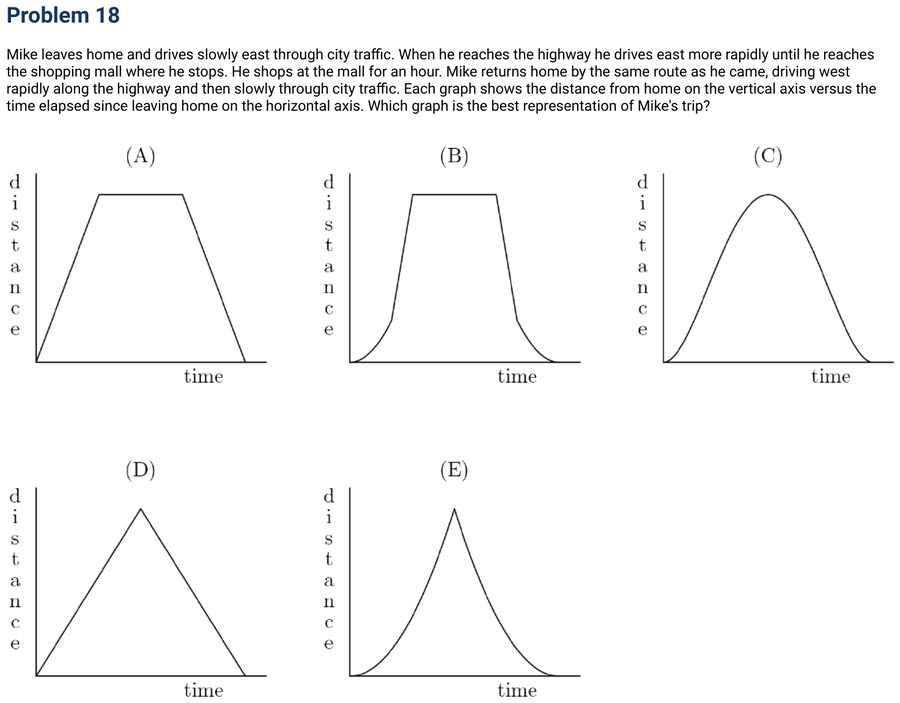
Read the SHAPE of the story, not numbers: distance-from-home goes UP while driving out, stays FLAT during the hour of shopping, then comes back DOWN. That flat top kills any graph without a level stretch (C, D, E).
Still stuck? Show hint 2 →
Hint 2 of 2
Now the tie-breaker between A and B: on a distance-vs-time graph, slope IS speed. Mike has TWO speeds each way (slow city, fast highway), so each side can't be a single straight line — its steepness must change partway.
Show solution
Approach: match each changing-speed leg to the graph's slope
First filter on the overall shape: out (rising), shop (flat), back (falling). Only graphs with a flat plateau survive — that's A and B (C, D, E have a single peak, no time spent at the mall).
Now use 'slope = speed.' Going out he's slow in the city (gentle rise) then fast on the highway (steep rise), so the outgoing side BENDS from shallow to steep — not one straight ramp. Coming home reverses: steep highway, then gentle city.
Graph B shows each side bending between two slopes; graph A's straight sides would mean one single constant speed the whole way out and back, which contradicts the city-then-highway change.
Reusable idea: on distance-time graphs, steeper = faster and flat = stopped. Treat 'match the graph' problems as a checklist — eliminate on the big features (flat? rising? falling?) first, then settle the survivors on the fine detail (straight vs. bending).
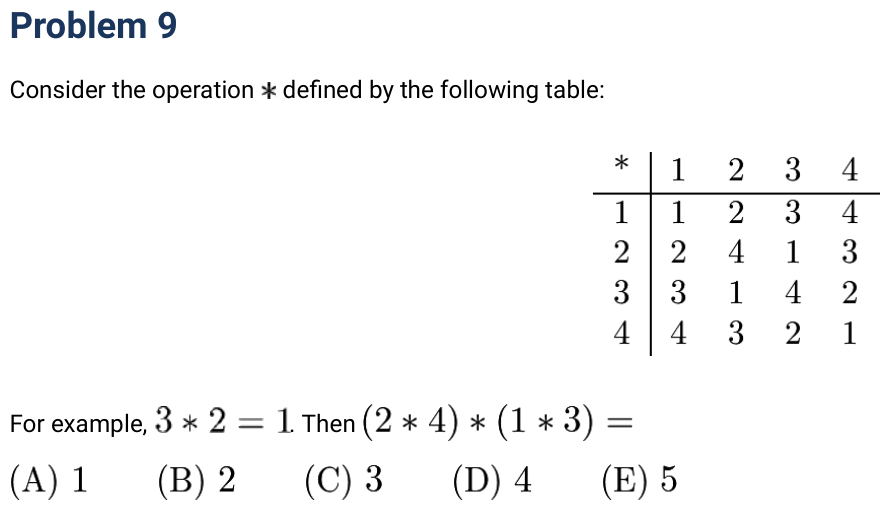
The ∗ table is just a lookup grid, like a multiplication table for a made-up operation: find the left number on the side, the right number on top, read where they meet. No rule to figure out — just look it up.
Still stuck? Show hint 2 →
Hint 2 of 2
Respect the parentheses. Evaluate each inner (a ∗ b) first to get two numbers, THEN star those two together — same as order of operations with ×.
Show solution
Approach: evaluate the parentheses by table lookup, then combine
Inner first. For 2 ∗ 4, go to row 2, column 4: that cell is 3. For 1 ∗ 3, row 1 column 3: that's 3. (Row = left number, column = right number.)
Now the expression is 3 ∗ 3. Row 3, column 3 reads 4. So (2 ∗ 4) ∗ (1 ∗ 3) = 4.
Why this transfers: a 'defined operation' problem is never about discovering a formula — it's careful reading. Lock down which input is the row and which is the column, then it's pure lookup. Don't assume the table is symmetric; always read row then column.
Don't add up either giant sum. Pair them up instead: 1901 with 101, 1902 with 102, … Every top number is the same distance above its partner. What's that distance?
Still stuck? Show hint 2 →
Hint 2 of 2
Each pair differs by exactly 1901 − 101 = 1800. If you know how many pairs there are, the whole subtraction is one multiplication.
Show solution
Approach: subtract term-by-term, then multiply
Match each top term with the bottom term directly below it: 1901−101, 1902−102, …, 1993−193. Every single pair differs by 1800.
Count the pairs: from 1901 to 1993 is 1993 − 1901 + 1 = 93 terms (and likewise 101 to 193). So the answer is 93 × 1800 = 167,400.
Why this transfers: subtracting two long sums term-by-term beats computing each sum separately — the messy totals never appear. Just watch the count: 'how many numbers from a to b' is b − a + 1, the classic off-by-one to nail down.
The distance between the 5th and 26th exits on an interstate highway is 118 miles. If any two exits are at least 5 miles apart, then what is the largest number of miles there can be between two consecutive exits that are between the 5th and 26th exits?
Show answer
Answer: C — 18 miles.
Show hints
Hint 1 of 3
You have a fixed 118 miles to split among the gaps. To make ONE gap as long as possible, what should you do with all the OTHER gaps?
Still stuck? Show hint 2 →
Hint 2 of 3
Maximize-one-thing problems: push everything else to its limit in the opposite direction. Squeeze every other gap down to its smallest allowed size, freeing the leftover for your one big gap.
Still stuck? Show hint 3 →
Hint 3 of 3
Count the gaps carefully — from exit 5 to exit 26 there are 26 − 5 = 21 gaps, not 21 exits. The minimum each gap can be is 5 miles.
Show solution
Approach: shrink every other gap to the 5-mile minimum, leaving the rest for one
From the 5th to the 26th exit there are 26 − 5 = 21 gaps sharing the 118 miles. To stretch one gap as far as possible, make the other 20 as short as the rules allow: 5 miles each, using 20 × 5 = 100 miles.
Whatever's left goes into the one big gap: 118 − 100 = 18 miles.
Why this transfers: to maximize one quantity under a fixed total, minimize all the others to their limits — that frees up the most for the one you care about. (To minimize one instead, you'd maximize the others.)
Sanity check: 18 + 100 = 118 exactly, and 18 comfortably beats the 5-mile minimum, so this arrangement is legal.
The average (arithmetic mean) of 10 different positive whole numbers is 10. The largest possible value of any of these numbers is
Show answer
Answer: C — 55.
Show hints
Hint 1 of 3
Average 10 over 10 numbers means a FIXED total — the ten numbers always add to 100, a fixed pie. To give one number the biggest possible slice, what should the other nine slices be?
Still stuck? Show hint 2 →
Hint 2 of 3
The total is locked at 100. One number is huge only if the other nine are as TINY as possible — and they must be different positive whole numbers. What are the nine smallest such numbers?
Still stuck? Show hint 3 →
Hint 3 of 3
The nine smallest different positive whole numbers are 1, 2, 3, …, 9. Take their sum away from 100.
Show solution
Approach: fix the total, then starve the other nine numbers
Average 10 across 10 numbers means the total is fixed: 10 × 10 = 100. With a fixed total, one number is biggest exactly when the rest are smallest.
The nine others must be different positive whole numbers, so the smallest they can be is 1, 2, 3, …, 9. That sum is (9 × 10) ÷ 2 = 45.
The largest number takes whatever's left: 100 − 45 = 55.
Why this transfers: a fixed average is a fixed total — a budget. To maximize one part of a fixed budget, push every other part to its allowed minimum (and use the "different" rule to make them 1, 2, 3, …). The same "minimize the rest" move solves countless extremal problems.
Trap to dodge: 91 (= 100 − 9, leaving 1's) ignores "different"; the values must be distinct, forcing 1 through 9, not nine copies of 1.
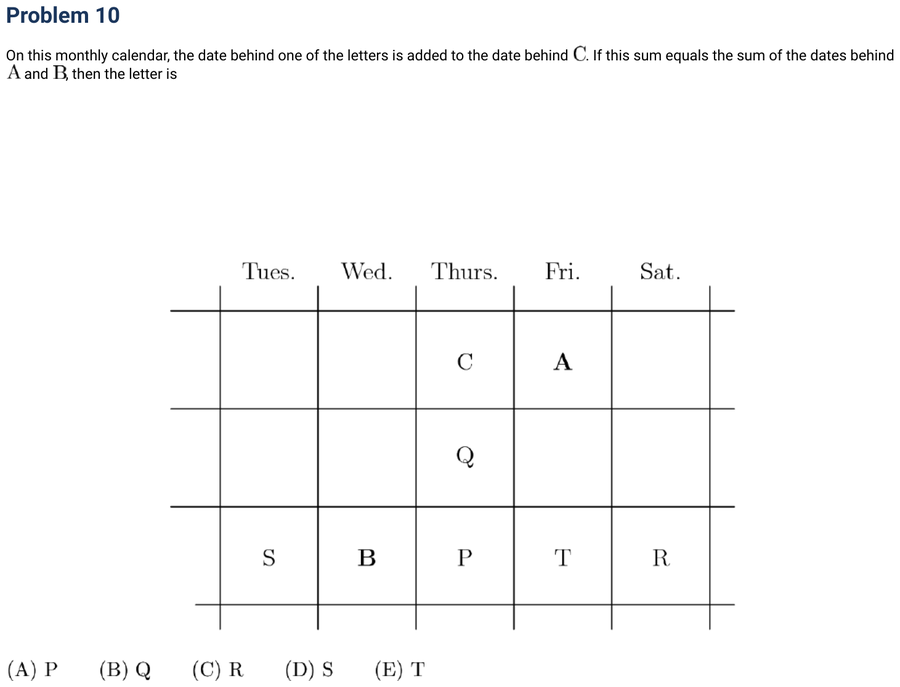
You don't need the real dates — only how the squares relate. On any calendar, the box just below a date is +7 (a week later), and the box to the right is +1 (the next day). Write every letter as 'C plus something.'
Still stuck? Show hint 2 →
Hint 2 of 2
Express each letter as an offset from C, add the ones you're told to, and just read off which letter matches the total. The actual month never matters — pick C = 0 if you like.
Show solution
Approach: label every box as an offset from C (down = +7, right = +1)
Anchor on C. Moving one box right adds 1 (next day); moving one box down adds 7 (next week). Reading the grid: A is the box right of C, so A = C + 1. B sits two rows below and one column left of C, so B = C + 14 − 1 = C + 13.
We need a letter X with X + C = A + B. The right side is (C+1) + (C+13) = 2C + 14, so X = C + 14.
C + 14 is two rows straight down from C — that box is P. (Quick check with a real month: if C = 8, A = 9, B = 21, P = 22, and 22 + 8 = 30 = 9 + 21. ✓)
*Why this transfers:* on calendar-grid puzzles, never plug in real dates — turn each cell into 'anchor ± (7×rows + 1×columns)' and the arithmetic collapses.
The signs go +, −, +, −… so the terms beg to be grouped two at a time. What does each (big − smaller) pair come out to? They're all the same easy number.
Still stuck? Show hint 2 →
Hint 2 of 2
Group adjacent terms into +/− pairs so each becomes a constant — then it's just (how many pairs) × (that constant). Just be careful about a term left over at the end.
Show solution
Approach: group into +/− pairs so each collapses to a constant
The alternating signs let you pair: (1990−1980), (1970−1960), …, (30−20). Every pair is exactly 10 — a long sum just became 'count the pairs.'
The numbers run by tens from 20 up to 1990, that's how many pairs: the tops are 1990, 1970, …, 30 — 99 of them. So the pairs give 99 × 10 = 990.
One term is left unpaired: the final +10. Add it: 990 + 10 = 1000.
*Worth keeping:* alternating-sign sums almost always want pairing — group neighbors so each pair becomes a constant, then multiply. Always check whether one lonely term is stranded at the end.
The number N is between 9 and 17. The average of 6, 10, and N could be
Show answer
Answer: B — 10.
Show hints
Hint 1 of 3
The word 'could be' is the clue: N isn't fixed, so the average isn't either — it lives in a range. Find the two ends of that range by trying N at its smallest and largest.
Still stuck? Show hint 2 →
Hint 2 of 3
When a quantity slides between bounds, find the smallest and largest possible results; the answer must land inside that window.
Still stuck? Show hint 3 →
Hint 3 of 3
Average = (6 + 10 + N)⁄3 = (16 + N)⁄3. As N creeps from just above 9 to just below 17, watch where this lands — then see which single choice fits.
Show solution
Approach: bound the average between its extremes
Write the average as (6 + 10 + N)⁄3 = (16 + N)⁄3. Since the average grows steadily as N grows, its smallest and largest values come from N's endpoints.
Smallest: N just above 9 gives just above 25⁄3 ≈ 8.3. Largest: N just below 17 gives just below 33⁄3 = 11. So the average can be anything between roughly 8.3 and 11.
Only 10 sits inside that window (it happens at N = 14). The why: a quantity built from a sliding input takes every value between its two extremes, so 'could be' questions are really 'is it inside the range?' questions.
Many calculators have a reciprocal key 1/x that replaces the current number displayed with its reciprocal. For example, if the display is 00004 and the 1/x key is pressed, then the display becomes 000.25. If 00032 is currently displayed, what is the fewest positive number of times you must depress the 1/x key so the display again reads 00032?
Show answer
Answer: B — 2.
Show hints
Hint 1 of 3
Don't assume it takes many presses — just do it once and see what's on the screen, then ask whether one more press undoes it.
Still stuck? Show hint 2 →
Hint 2 of 3
Flipping a fraction upside down, then flipping again, lands you exactly where you started: the reciprocal of the reciprocal is the original number.
Still stuck? Show hint 3 →
Hint 3 of 3
32 = 32⁄1; one press flips it to 1⁄32; the next press flips it back.
Show solution
Approach: the reciprocal undoes itself
Press once: 32 (which is 32⁄1) flips to 1⁄32. Press again: 1⁄32 flips back to 32. So the display returns after exactly 2 presses.
Why this works: taking a reciprocal twice cancels itself — like flipping a card over and over, every even number of presses returns the original. An operation that is its own undo is called self-inverse, and it always cycles with period 2 (unless the number is 1, which never changes).
What is the 100th number in the arithmetic sequence: 1, 5, 9, 13, 17, 21, 25, …?
Show answer
Answer: A — 397.
Show hints
Hint 1 of 2
Each term is 4 more than the one before. The catch: getting from the *1st* term to the *100th* term takes how many steps of 4 — 100, or one fewer?
Still stuck? Show hint 2 →
Hint 2 of 2
It's 99 steps, not 100, because the first term needs no step to reach itself. So the 100th term = 1 + 99 × 4.
Show solution
Approach: start value + (number of steps) × step size
The list climbs by 4 each time. To reach the 100th term from the 1st you take 99 steps (the 2nd is 1 step out, the 3rd is 2 steps out, … the 100th is 99 steps out). So the 100th term = 1 + 99 × 4 = 1 + 396 = 397.
Trap to avoid: choice 401 comes from using 100 steps instead of 99. The number of *gaps* between terms is always one less than the number of terms — the same reason a fence with 100 posts has only 99 gaps.
Why this transfers: any evenly-spaced list works as start + (n − 1) × step. The (n − 1) is the fence-post idea: count the gaps you cross, not the terms you land on.
The sale ad read: "Buy three tires at the regular price and get the fourth tire for three dollars." Sam paid 240 dollars for a set of four tires at the sale. What was the regular price of one tire?
Show answer
Answer: D — 79 dollars.
Show hints
Hint 1 of 2
Not all four tires cost the same — one is a flat $3. Peel that special tire off the total before splitting the rest.
Still stuck? Show hint 2 →
Hint 2 of 2
Of the $240, exactly $3 paid for the fourth tire. The remaining money bought three tires at the same regular price.
Show solution
Approach: set the odd-one-out aside first
The fourth tire was a flat $3, so it accounts for $3 of the $240. That leaves 240 − 3 = 237 dollars covering the three full-price tires.
Those three are equal, so the regular price is 237 ⁄ 3 = 79 dollars.
Trap-check: dividing 240 ⁄ 4 = 60 pretends all four tires cost the same — but the $3 tire breaks that. Always remove the unequal piece before averaging the rest.
A calculator has a squaring key x² which replaces the current number displayed with its square. For example, if the display is 000003 and the x² key is depressed, then the display becomes 000009. If the display reads 000002, how many times must you depress the x² key to produce a displayed number greater than 500?
Show answer
Answer: A — 4.
Show hints
Hint 1 of 2
Squaring isn't adding — each press multiplies the number by itself, so it grows ferociously. Just list the displays and stop the moment one passes 500.
Still stuck? Show hint 2 →
Hint 2 of 2
Track the exponent instead: each squaring DOUBLES the exponent of 2. Starting at 2¹, the powers go 2 → 4 → 8 → 16…
256 is still below 500, so three presses aren't enough; 65536 clears 500, so it takes 4 presses.
Why this transfers: squaring doubles the exponent, so the display is 2^(2ⁿ) after n presses — that's 2¹, 2², 2⁴, 2⁸, 2¹⁶. Doubling exponents means the size explodes, so 'how many presses' is always small. Don't confuse 4 presses with the wrong-units traps 8 or 250.
The ✶ symbol is a made-up rule, not real multiplication — translate it into plain English first. "(A + B) ⁄ 2" is just the *average* of A and B.
Still stuck? Show hint 2 →
Hint 2 of 2
Like nested parentheses, do the inside first: find 3 ✶ 5, then combine that result with 8.
Show solution
Approach: decode the symbol, work inside-out
Translate ✶: A ✶ B is simply the average (midpoint) of A and B. That turns a strange symbol into something familiar.
Inside first: 3 ✶ 5 is the average of 3 and 5, which is 4. Then 4 ✶ 8 is the average of 4 and 8, which is 6.
Watch the trap: ✶ is *not* ×, so 3 ✶ 5 is 4, not 15. With custom operators, always rewrite the rule in words before computing.
Sanity check: each ✶ produces a number between its two inputs, so the final answer must sit between 4 and 8 — 6 fits, while choices like 12, 16, 30 can't.
Nine copies of a certain pamphlet cost less than $10.00 while ten copies of the same pamphlet (at the same price) cost more than $11.00. How much does one copy of this pamphlet cost?
Show answer
Answer: E — $1.11.
Show hints
Hint 1 of 2
Each clue gives a boundary on the single-copy price: '9 copies under $10' caps it from above, '10 copies over $11' lifts it from below. Together they squeeze the price into a narrow window — then just see which choice fits.
Still stuck? Show hint 2 →
Hint 2 of 2
Translate words to bounds: 9p < 10 means p is below 10⁄9; 10p > 11 means p is above 11⁄10. The answer is the only listed price caught between the two.
Show solution
Approach: bracket p from both inequalities
Upper bound: 9 copies cost less than $10, so p < 10⁄9 ≈ $1.111.
Lower bound: 10 copies cost more than $11, so p > 11⁄10 = $1.10.
Price is trapped in 1.10 < p < 1.111. The only choice in that sliver is $1.11.
Sanity check: at $1.11, nine copies cost $9.99 (under $10 ✓) and ten copies cost $11.10 (over $11 ✓). The window is barely a penny wide, which is exactly why only one option survives.
Jami picked three equally spaced integers on the number line. The sum of the first and second is 40, and the sum of the second and third is 60. What is the sum of all three numbers?
Show answer
Answer: B — 75.
Show hints
Hint 1 of 2
‘Equally spaced’ is the magic phrase: the middle number is exactly the average of the outer two. So how does the middle number relate to the whole sum of three?
Still stuck? Show hint 2 →
Hint 2 of 2
Add the two given sums (40 + 60). The middle number gets counted twice and the outer two once each — turn that into the value of the middle, then triple it.
Show solution
Approach: the middle number is the average — and the whole sum is just 3 times it
For three equally spaced numbers, the middle one is the average of all three, so the total is simply 3 × middle. Find the middle.
Add the two given sums: (first + second) + (second + third) = 40 + 60 = 100. The middle got counted twice, the outer two once each, so 100 = (first + second + third) + second. Also first + third = 2·second, giving 100 = 4·second, so the middle is 25.
Total = 3 × 25 = 75.
Why this transfers: in any evenly-spaced list, the middle term is the mean, so sum = (count) × (middle). Spotting ‘equally spaced’ lets you skip solving for the individual numbers.
Another way — name the spacing and watch it cancel:
Call the numbers m−d, m, m+d. The first sum is 2m−d = 40 and the second is 2m+d = 60.
Add them: 4m = 100, so m = 25. The total is exactly 3m = 75 — the spacing d never matters.
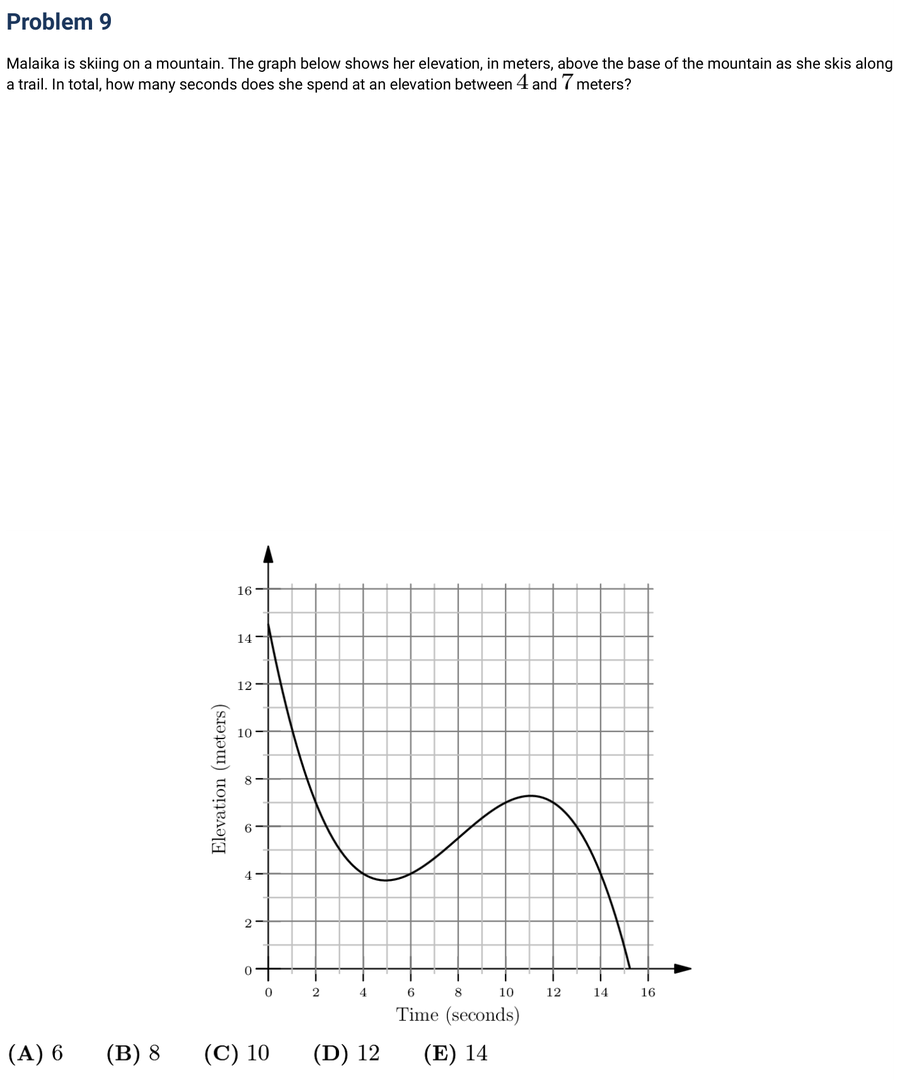
You don't care how high she is — only when she's inside the 4-to-7 band. Think of it as a horizontal stripe on the graph.
Still stuck? Show hint 2 →
Hint 2 of 2
Draw horizontal lines at 4 and 7; the curve enters and leaves that stripe a few times. Add up how long it stays inside each time.
Show solution
Approach: read the graph between two horizontal lines
Re-frame the question as a horizontal stripe: shade the band between elevation 4 and 7. The answer is just how much time (horizontal distance) the curve spends inside that band — her actual height inside it is irrelevant.
The curve dips into and out of the band three times: roughly t = 2 to 4 (2 sec), t = 6 to 10 (4 sec), and t = 12 to 14 (2 sec).
Total: 2 + 4 + 2 = 8 seconds. This transfers: ‘how long is the value between A and B’ on any graph means ‘sum the horizontal widths where the curve lies between two horizontal lines.’
Three positive integers are equally spaced on a number line. The middle number is 15 and the largest number is 4 times the smallest number. What is the smallest of these three numbers?
Show answer
Answer: C — 6.
Show hints
Hint 1 of 2
“Equally spaced” is the key word: the middle number sits exactly halfway between the other two, so it's their average.
Still stuck? Show hint 2 →
Hint 2 of 2
So smallest + largest = 2 × 15 = 30. And largest = 4 × smallest, so smallest + 4×smallest = 30.
Show solution
Approach: equally spaced ⇒ middle is the average of the outer two
Insight: “equally spaced” means the middle is the average of the outer two, so the two outer numbers add to 2 × 15 = 30 — no spacing variable needed.
The two outer numbers are the smallest and 4 times the smallest, which together make 5 of the smallest. So 5 × smallest = 30 ⇒ smallest = 6.
Sanity check: the three numbers are 6, 15, 24 — gaps 9 and 9, equally spaced, and 24 = 4 × 6. ✓
Ricardo has 2020 coins, some of which are pennies (1-cent coins) and the rest of which are nickels (5-cent coins). He has at least one penny and at least one nickel. What is the difference in cents between the greatest possible and least possible amounts of money that Ricardo can have?
Show answer
Answer: C — 8072 cents.
Show hints
Hint 1 of 2
Don't compute the max and min money separately. Picture turning one penny into a nickel: the coin count stays 2020 but the value jumps by 4 cents. So the difference is just 4 cents per swap, times how many swaps are possible.
Still stuck? Show hint 2 →
Hint 2 of 2
Total = p + 5n = (p+n) + 4n = 2020 + 4n. The fixed 2020 cancels in the difference, leaving 4 × (range of n).
Show solution
Approach: the difference is just (extra value per swap) × (number of swaps)
Every coin is worth at least 1 cent, so write Total = p + 5n = (p + n) + 4n = 2020 + 4n. The 2020 is fixed; only the 4n changes.
Constraints “at least one of each” with p + n = 2020 give n from 1 up to 2019.
Max total has n = 2019, min has n = 1. The fixed 2020 cancels, so the difference is 4(2019 − 1) = 4 × 2018 = 8072.
You'll see this again as: for “max minus min” questions, peel off the constant part — the spread depends only on what varies. Here each penny→nickel swap adds a constant 4 cents, so the answer is (per-swap gain) × (allowed swaps).
Suppose that a ∗ b means 3a − b. What is the value of x if
2 ∗ (5 ∗ x) = 1 ?
Show answer
Answer: D — x = 10.
Show hints
Hint 1 of 2
The ∗ symbol is just a made-up RECIPE: "triple the first thing, then subtract the second." It's not scary new math — treat it like a function and obey the recipe.
Still stuck? Show hint 2 →
Hint 2 of 2
Just like ordinary nested parentheses, do the INSIDE ∗ first: 5 ∗ x = 3(5) − x = 15 − x. Then feed that result into the outer ∗.
Why this transfers: any invented operator (∗, ⊕, ⊗) is just a substitution rule; replace the symbol with its definition and work the innermost piece outward exactly like nested parentheses.
On her first day of work, Janabel sold one widget. On day two, she sold three widgets. On day three, she sold five widgets, and on each succeeding day, she sold two more widgets than she had sold on the previous day. How many widgets in total had Janabel sold after working 20 days?
Show answer
Answer: D — 400 widgets.
Show hints
Hint 1 of 2
Write out the daily sales: 1, 3, 5, 7, … — those are exactly the odd numbers, in order. Over 20 days you're adding the first 20 odd numbers.
Still stuck? Show hint 2 →
Hint 2 of 2
There's a gem worth memorizing: the sum of the first n odd numbers is always n2 (1 = 12, 1+3 = 22, 1+3+5 = 32, …). So no long addition is needed.
Show solution
Approach: recognize the odd numbers; their running total is a perfect square
Day k sales = 2k − 1, so over 20 days the total is 1 + 3 + 5 + … + 39 — the first 20 odd numbers.
Key fact: 1 + 3 + 5 + … + (2n−1) = n2. (Picture building an n×n square one L-shaped layer at a time: each new layer adds the next odd number of unit squares.)
Total = 202 = 400.
Another way — pair the ends (Gauss pairing):
Pair first-with-last: (1 + 39), (3 + 37), (5 + 35), … Each pair sums to 40.
The 20 terms make 10 such pairs, so the total is 10 × 40 = 400.
This is the all-purpose arithmetic-series trick: sum = (number of terms) × (first + last)/2 = 20 · (1 + 39)/2 = 400.
In a middle-school mentoring program, a number of the sixth graders are paired with a ninth-grade student as a buddy. No ninth grader is assigned more than one sixth-grade buddy. If 13 of all the ninth graders are paired with 25 of all the sixth graders, what fraction of the total number of sixth and ninth graders have a buddy?
Show answer
Answer: B — 4/11.
Show hints
Hint 1 of 2
Buddies come in pairs, so the count of paired ninth-graders equals the count of paired sixth-graders — one body on each side of every handshake. That hidden equality links the two unknown group sizes.
Still stuck? Show hint 2 →
Hint 2 of 2
There are no actual totals given, so invent friendly ones: with no specified size, pick numbers that make both fractions land on whole people, then just count heads.
Show solution
Approach: pick concrete sizes so the fractions are whole numbers
Pairs are one-to-one, so paired ninth-graders = paired sixth-graders. Pick small numbers that make both fractions whole: ninth = 6, sixth = 5.
Then paired ninth = (1/3)(6) = 2 and paired sixth = (2/5)(5) = 2. ✓
Total students = 6 + 5 = 11. Buddied students = 2 + 2 = 4. Fraction = 4/11.
Why this transfers: when a problem gives only ratios and no totals, the answer can't depend on the actual size — so plug in the smallest sizes that make every fraction whole and read off the result.
Another way — algebra:
Let n = ninth-graders, s = sixth-graders. (1/3)n = (2/5)s ⇒ 5n = 6s.
Buddied / total = ((1/3)n + (2/5)s) / (n + s) = (2 · (1/3)n) / (n + s) (since the two numerators are equal).
Jeremy's father drives him to school in rush hour traffic in 20 minutes. One day there is no traffic, so his father can drive him 18 miles per hour faster and gets him to school in 12 minutes. How far in miles is it to school?
Show answer
Answer: D — 9 miles.
Show hints
Hint 1 of 2
The two trips cover the same distance — that's the anchor. Write that one distance two ways (each as speed × time) and set them equal; the matching distances kill the unknown distance and leave you solving for the speed.
Still stuck? Show hint 2 →
Hint 2 of 2
Turn the minutes into hours so speed × time gives miles: 20 min = 1/3 h, 12 min = 1/5 h. Then solve s · (1/3) = (s + 18) · (1/5).
Show solution
Approach: the distance is the same both days — equate the two expressions
Let the rush-hour speed be s mph. Same distance both days: s · (1/3) = (s + 18) · (1/5).
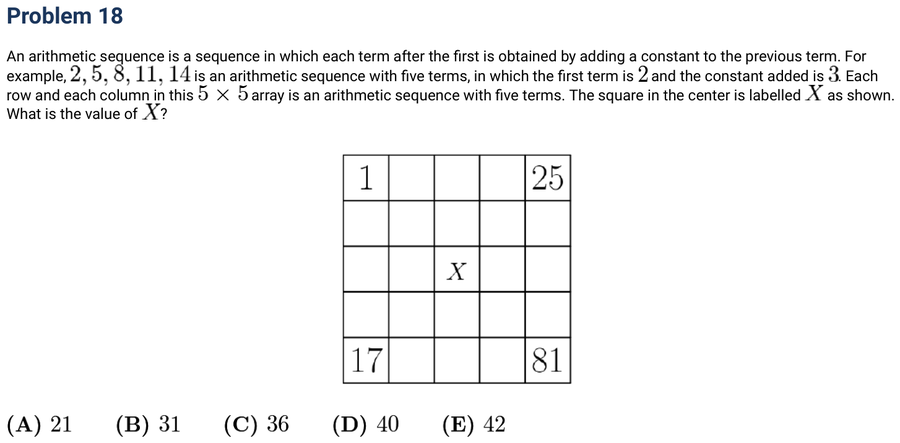
An arithmetic sequence is a sequence in which each term after the first is obtained by adding a constant to the previous term. For example, 2, 5, 8, 11, 14 is an arithmetic sequence with five terms, in which the first term is 2 and the constant added is 3. Each row and each column in this 5 × 5 array is an arithmetic sequence with five terms. The square in the center is labelled X. What is the value of X?
Show answer
Answer: B — X = 31.
Show hints
Hint 1 of 2
You don't need to fill in the whole grid. In any arithmetic sequence the middle term is just the average of the two ends — the constant step makes it sit exactly halfway. So a center value is reachable straight from outer values.
Still stuck? Show hint 2 →
Hint 2 of 2
Use that fact like stepping stones: the corners give you the middles of the top and bottom rows, and those two give you X. (Only the four corners ever matter.)
Show solution
Approach: middle term = average of the two endpoints, applied twice
Middle term = average of endpoints: top row middle = (1 + 25)/2 = 13, bottom row middle = (17 + 81)/2 = 49.
X is the middle of the center column, whose ends are those two: X = (13 + 49)/2 = 31.
Why this transfers: 'middle = average of the ends' (because the step cancels symmetrically) collapses these grid problems — you never need the interior entries.
Another way — X is the average of the four corners:
Averaging the top corners then the bottom corners then those two results is the same as averaging all four corners at once.
X = (1 + 25 + 17 + 81)/4 = 124/4 = 31 — one clean computation, no intermediate values.
Ralph went to the store and bought 12 pairs of socks for a total of $24. Some of the socks he bought cost $1 a pair, some of the socks he bought cost $3 a pair, and some of the socks he bought cost $4 a pair. If he bought at least one pair of each type, how many pairs of $1 socks did Ralph buy?
Show answer
Answer: D — 7 pairs.
Show hints
Hint 1 of 2
Three unknowns but only two equations — that feels underdetermined, but the counts must be whole positive numbers, and that's enough. Notice a appears with the same coefficient (1) in both the count equation and the cost equation: subtract them and a vanishes.
Still stuck? Show hint 2 →
Hint 2 of 2
Subtracting leaves 2b + 3c = 12 with b, c ≥ 1. Since 2b is even and 12 is even, 3c must be even, so c is even — parity nails it down.
Show solution
Approach: eliminate a by subtracting, then use parity
Counts: a + b + c = 12. Cost: a + 3b + 4c = 24. Both have a single a, so subtract to erase it: 2b + 3c = 12.
Parity: 2b and 12 are even, forcing 3c — hence c — to be even. With at least one of each type, 0 < c < 4, so c = 2.
Back-substitute: 2b = 6 ⇒ b = 3, then a = 12 − 3 − 2 = 7.
Why this transfers: when a variable shares the same coefficient across two equations, subtract to delete it; then parity/divisibility usually finishes off the few whole-number possibilities.
A 2-digit number is such that the product of the digits plus the sum of the digits is equal to the number. What is the units digit of the number?
Show answer
Answer: E — Units digit 9.
Show hints
Hint 1 of 2
The notice is that "digits" means place value: a 2-digit number is 10×(tens) + (units). Write the condition that way and watch how much cancels.
Still stuck? Show hint 2 →
Hint 2 of 2
The units digit b appears on both sides and vanishes; so does most of the rest, leaving a tiny equation that pins down one digit.
Show solution
Approach: place value, then cancel
Write the number as 10a + b (tens digit a, units digit b). The condition "product + sum = number" becomes ab + a + b = 10a + b.
The b on each side cancels, leaving ab = 9a.
Since a ≠ 0 (it's the leading digit), divide by a: b = 9. The units digit is forced — the tens digit can be anything.
Check: 1·9 + 1 + 9 = 19 ✓ (and 29, 39, … all work too).
Why this transfers: turning "the digits" into 10a + b converts a word puzzle into algebra, and the magic here is that the answer doesn't depend on a at all — a sign the question only ever cared about the units digit.
If 3p + 34 = 90, 2r + 44 = 76, and 53 + 6s = 1421, what is the product of p, r, and s?
Show answer
Answer: B — 40.
Show hints
Hint 1 of 2
Each equation has one known power and one unknown power. Move the known number to the right side first, and you're left with "(base)? = (a number)" — just ask which power of that base it is.
Still stuck? Show hint 2 →
Hint 2 of 2
To solve bx = N by hand, rewrite N as a power of b and read off the exponent. Recognizing small powers (32=9, 25=32, 64=1296) is the whole skill here.
Show solution
Approach: isolate each power, then recognize it
Equation 1: 3p = 90 − 34 = 90 − 81 = 9 = 32, so p = 2.
Equation 2: 2r = 76 − 44 = 32 = 25, so r = 5.
Equation 3: 6s = 1421 − 53 = 1421 − 125 = 1296 = 64, so s = 4.
Product = 2 · 5 · 4 = 40.
Tip: when an exponential equation has a clean integer answer, the leftover number is almost always a recognizable power of the base — match by eye instead of guessing.
Each of the digits 0, 1, 2, 3, 4, 5, 6, 7, 8, and 9 is used only once to make two five-digit numbers so that they have the largest possible sum. Which of the following could be one of the numbers?
Show answer
Answer: C — 87431.
Show hints
Hint 1 of 2
A digit in the ten-thousands place is worth far more than the same digit in the ones place. So to make the sum biggest, the biggest digits must sit in the highest places — greed wins here.
Still stuck? Show hint 2 →
Hint 2 of 2
This is a place-value greedy argument: the two ten-thousands digits should be 9 and 8, the two thousands digits 7 and 6, and so on down. That forces each position to use a known pair — then just check which answer fits.
Show solution
Approach: biggest digits to biggest places (greedy), then match the pairs
Since a higher place multiplies a digit by more, dropping a big digit into a high place adds the most to the sum. So assign greedily from the top: the two leading digits use {9, 8}, the next pair {7, 6}, then {5, 4}, then {3, 2}, then {1, 0}.
That means whichever number you look at, its digits left-to-right must come one from each pair: position 1 from {9,8}, position 2 from {7,6}, position 3 from {5,4}, position 4 from {3,2}, position 5 from {1,0}.
Test the choices against this stencil — only 87431 fits: 8∈{9,8}, 7∈{7,6}, 4∈{5,4}, 3∈{3,2}, 1∈{1,0}. ✓
Why greedy is safe here: moving a larger digit to a higher place never hurts the sum, so the maximum must look exactly like this. The same "big digits to big places" logic handles most digit-arrangement extremes.
The lengths of the sides of a triangle in inches are three consecutive integers. The length of the shortest side is 30% of the perimeter. What is the length of the longest side?
Show answer
Answer: E — 11 inches.
Show hints
Hint 1 of 2
Consecutive integers are evenly spaced, so the middle side is exactly the average — meaning the perimeter is 3 times the middle side. That single fact replaces a lot of algebra.
Still stuck? Show hint 2 →
Hint 2 of 2
When three numbers are evenly spaced, their sum is 3 × the middle one. Now ‘shortest = 30% of perimeter’ becomes a clean comparison.
Show solution
Approach: use the evenly-spaced middle term
Sides are m−1, m, m+1 around a middle value m. Their sum (the perimeter) is exactly 3m.
The shortest side is 30% of the perimeter: m−1 = 0.30 · 3m = 0.9m. So 0.1m = 1, giving m = 10.
Longest = m+1 = 11.
Why this transfers: for any evenly-spaced list, swapping in ‘sum = (count) × middle’ collapses messy sums to one variable. It's the same idea behind averaging a run of consecutive numbers.
Another way — test the answer choices:
Longest options are 7…11; try the longest = 11, so sides are 9, 10, 11 with perimeter 30.
Is the shortest 30% of 30? 0.30 · 30 = 9 = shortest. It fits, so the longest side is 11 — a fast check when you'd rather verify than solve.
The hundreds digit of a three-digit number is 2 more than the units digit. The digits of the three-digit number are reversed, and the result is subtracted from the original three-digit number. What is the units digit of the result?
Show answer
Answer: E — 8.
Show hints
Hint 1 of 3
When you reverse a 3-digit number, the tens digit doesn't move — only the hundreds and units swap. So in the subtraction, the tens completely cancel and won't affect the answer.
Still stuck? Show hint 2 →
Hint 2 of 3
Reversing always gives a difference of 99 × (hundreds digit − units digit). Here that gap is fixed at 2, so the difference is a single fixed number — no variables survive.
Still stuck? Show hint 3 →
Hint 3 of 3
So you don't need the actual digits: just compute 99 × 2 and read off its units digit.
Show solution
Approach: the tens digit cancels; difference is forced
Write the number as 100·(hundreds) + 10·(tens) + (units). Reversing swaps hundreds and units, so when you subtract, the 10·(tens) terms cancel exactly.
What's left is 99·(hundreds − units). The hundreds digit is 2 more than the units, so hundreds − units = 2, every time.
Difference = 99 × 2 = 198, whose units digit is 8.
Why this transfers: ‘a number minus its reversal’ is always a multiple of 99 (for 3 digits), and only the gap between the outer digits matters. Spotting that the middle digit cancels means you can answer without ever choosing specific digits.
Another way — try a concrete example:
Pick any number fitting the rule, say hundreds 2 more than units: 301. Reverse to 103.
301 − 103 = 198 ⇒ units digit 8. Trying 412 − 214 = 198 too — the units digit is locked at 8 no matter what you choose, which is the whole point.
What is the correct ordering of the three numbers, 108, 512, and 224?
Show answer
Answer: A — 2^24 < 10^8 < 5^12.
Show hints
Hint 1 of 2
You can't compare powers with different bases and different exponents. So make one of them match — the exponents 8, 12, 24 all share the factor 4, so force every exponent down to 4.
Still stuck? Show hint 2 →
Hint 2 of 2
amn = (am)n: rewrite each as something-to-the-4th. Once the exponents agree, just compare the bases.
Show solution
Approach: rewrite all three with a common exponent of 4
The exponents 8, 12, 24 are all multiples of 4, so pull each into a 4th power: 108 = (102)4 = 1004, 512 = (53)4 = 1254, 224 = (26)4 = 644.
Now the exponent is identical (4), so larger base means larger number: 64 < 100 < 125.
Therefore 224 < 108 < 512.
Why this transfers: to compare exponentials, match either the bases or the exponents — whichever the numbers make easy. A shared exponent factor (here 4) is the giveaway to convert and just eyeball the bases.
Another way — factor out a common eighth power, compare pairwise:
224 vs 108: write 224 = 28·48 and 108 = 28·58. The shared 28 cancels and 4 < 5, so 224 < 108.
108 vs 512: write 108 = 44·58 and 512 = 54·58. The shared 58 cancels and 44=256 < 625=54, so 108 < 512.
Andy and Bethany have a rectangular array of numbers with 40 rows and 75 columns. Andy adds the numbers in each row. The average of his 40 sums is A. Bethany adds the numbers in each column. The average of her 75 sums is B. What is the value of AB?
Show answer
Answer: D — 15/8.
Show hints
Hint 1 of 2
The actual numbers never matter. Andy's row-sums and Bethany's column-sums both add up EVERY entry of the array exactly once — so the two grand totals are identical.
Still stuck? Show hint 2 →
Hint 2 of 2
Average = total ÷ (how many you averaged). Andy divided the grand total by 40, Bethany by 75. Write both totals as one shared value S.
Show solution
Approach: both grand totals are the same number
Let S = sum of all entries. Adding by rows or by columns both reach S, so 40A = S and 75B = S. Hence 40A = 75B.
Rearrange: A/B = 75/40 = 15/8.
Sanity check: fewer rows (40) than columns (75) means each row-sum is bigger on average, so A > B — and 15/8 > 1. Good. This transfers as a counting invariant: when one total can be tallied two ways, set the two tallies equal.
On the last day of school, Mrs. Awesome gave jelly beans to her class. She gave each boy as many jelly beans as there were boys in the class. She gave each girl as many jelly beans as there were girls in the class. She brought 400 jelly beans, and when she finished, she had six jelly beans left. There were two more boys than girls in her class. How many students were in her class?
Show answer
Answer: B — 28 students.
Show hints
Hint 1 of 2
"Each boy gets one bean per boy" means the boys together get b × b = b2 beans — a square! Likewise girls get g2. Beans handed out = 400 − 6 = 394, so b2 + g2 = 394.
Still stuck? Show hint 2 →
Hint 2 of 2
You now want two squares (with b just 2 more than g) that add to 394. Since 394 ≈ 14² + 14², the numbers sit right near 14 — so a quick guess-and-check beats heavy algebra.
Show solution
Approach: two squares summing to 394, with b = g + 2
Each boy receives b beans and there are b boys ⇒ b2 beans to boys; similarly g2 to girls. Given out: 400 − 6 = 394. So b2 + g2 = 394 with b = g + 2.
The two squares average about 197, and √197 ≈ 14 — so test the consecutive-even-apart pair around 14: g = 13, b = 15 gives 169 + 225 = 394. It works.
Students = 13 + 15 = 28.
Why this transfers: "sum of two squares near a known total" almost always yields to estimating the size (√half-the-total) and checking a couple of nearby values — lighter than expanding a quadratic.
A ball is dropped from a height of 3 meters. On its first bounce it rises to a height of 2 meters. It keeps falling and bouncing to 23 of the height it reached in the previous bounce. On which bounce will it rise to a height less than 0.5 meters?
Show answer
Answer: C — 5th bounce.
Show hints
Hint 1 of 2
Each bounce just keeps two-thirds of the last height — so don't restart from 3 each time, multiply the height you already have by 2/3.
Still stuck? Show hint 2 →
Hint 2 of 2
Walk the heights down one bounce at a time and stop the moment you cross below 0.5; with only a few bounces, listing beats any formula.
Bounce 4 is still above 0.5; bounce 5 is the first below 0.5, so the answer is 5.
Why this transfers: a sequence where each term is a fixed multiple of the last is geometric — for "when does it cross a threshold" just iterate; for far-off terms use height = 2·(2/3)n−1.
Another way — closed-form check:
Measuring from the drop, height after bounce n is 3·(2/3)n.
Mr. Harman needs to know the combined weight in pounds of three boxes he wants to mail. However, the only available scale is not accurate for weights less than 100 pounds or more than 150 pounds. So the boxes are weighed in pairs in every possible way. The results are 122, 125 and 127 pounds. What is the combined weight in pounds of the three boxes?
Show answer
Answer: C — 187 pounds.
Show hints
Hint 1 of 2
Don't solve for the three weights separately — you only need their total. Add all three pair-readings and see what you've actually counted.
Still stuck? Show hint 2 →
Hint 2 of 2
With three boxes, every box sits in exactly 2 of the 3 pairs, so adding the pair-sums counts each box twice.
Show solution
Approach: add the pair-sums, then halve
Each box (a, b, c) appears in two of the three pairings, so 122 + 125 + 127 = (a+b) + (a+c) + (b+c) = 2(a+b+c). The grand total double-counts everyone.
So 374 = 2·(total), giving total = 374 ÷ 2 = 187. No need to untangle the individual weights.
Why this transfers: when items are summed in overlapping groups, add all the group-sums and divide by how many times each item was counted — a clean shortcut to the grand total.
Ms. Osborne asks each student in her class to draw a rectangle with integer side lengths and a perimeter of 50 units. All of her students calculate the area of the rectangle they draw. What is the difference between the largest and smallest possible areas of the rectangles?
Show answer
Answer: D — 132.
Show hints
Hint 1 of 2
Perimeter 50 fixes l + w = 25 — the two sides always add to 25, you only get to choose how to split it.
Still stuck? Show hint 2 →
Hint 2 of 2
For a fixed sum, the product (area) is biggest when the two sides are nearly equal and smallest when they're as lopsided as allowed.
Show solution
Approach: fixed sum ⇒ balanced is biggest, lopsided is smallest
Half the perimeter is l + w = 25. With that sum fixed, area l·w is largest when the sides are as close as possible: 12 × 13 = 156.
It's smallest when the sides are most lopsided. Sides must be positive integers, so the extreme is 1 × 24 = 24.
Difference: 156 − 24 = 132.
Why this transfers: for any fixed perimeter, "square-ish" rectangles enclose the most area — the same reason a square beats every other rectangle of equal perimeter.
The students in Mr. Neatkin's class took a penmanship test. Two-thirds of the boys and 3/4 of the girls passed the test, and an equal number of boys and girls passed the test. What is the minimum possible number of students in the class?
Show answer
Answer: B — 17.
Show hints
Hint 1 of 2
The phrase "an equal number of boys and girls passed" is the hinge — name that shared count and build everything from it.
Still stuck? Show hint 2 →
Hint 2 of 2
Both the boy-count and girl-count must be whole numbers, so the shared passing count has to be divisible by the right denominators; take the smallest one that works.
Show solution
Approach: name the shared passing count, then make the head-counts whole
Let p = the number who passed in each group. Since 2/3 of boys passed, boys = p ÷ (2/3) = (3/2)p; since 3/4 of girls passed, girls = p ÷ (3/4) = (4/3)p.
For both head-counts to be whole numbers, p must be divisible by 2 (for the boys) and by 3 (for the girls) — smallest such p is 6. Then boys = 9, girls = 8.
Total = 9 + 8 = 17.
Why this transfers: when fractions of two groups must come out whole, the unknown has to clear every denominator at once — the smallest case is their LCM.
Let a, b and c be numbers with 0 < a < b < c. Which of the following is impossible?
Show answer
Answer: A — a + c < b is impossible.
Show hints
Hint 1 of 2
'Impossible' means it can never happen, so look for the one choice that follows from the rules alone — no clever numbers can break it. Compare each side against b.
Still stuck? Show hint 2 →
Hint 2 of 2
Adding only makes things bigger: with c > b already, adding a positive a can't drag the sum below b. Multiplying by a fraction, though, can shrink — that's where the 'possible' ones live.
Show solution
Approach: prove one is forced, exhibit examples for the rest
(A) says a + c < b. But c is already bigger than b, and a is positive, so a + c > c > b. It can never dip below b — (A) is impossible.
The others survive with small fractions, because multiplying by something under 1 shrinks a number: take a = 1/3, b = 1/2, c = 1. Then a·c = 1/3 < 1/2 = b (D works), a+b < c and a·b < c (B, C), and b/c = a is easy to arrange too.
Only (A) is locked out, so the answer is (A).
Strategy that transfers: on 'which is impossible' problems, one choice is provable from the given order and the rest fall to a single well-chosen example — fractions between 0 and 1 are your best test values.
Amanda draws five circles with radii 1, 2, 3, 4 and 5. Then for each circle she plots the point (C, A), where C is its circumference and A is its area. Which of the following could be her graph?
Show answer
Answer: A — Graph A.
Show hints
Hint 1 of 2
You don't need actual numbers — just ask how area grows compared to circumference. Circumference is linear in r, but area is squared, so as C climbs steadily, A should shoot up faster and faster.
Still stuck? Show hint 2 →
Hint 2 of 2
Eliminate the radius to see the relationship: with C = 2πr and A = πr2, A = C2/(4π) — a curve that bends upward, not a straight line.
Show solution
Approach: decide the shape of the A-vs-C curve
Substitute r = C/(2π) into A = πr2 to get A = C2/(4π). So A is proportional to Csquared.
That's a curve through the origin that rises and steepens — concave up — never a straight line. Only graph A bends that way.
Mental check: plot the smallest and a bigger circle: (2π, π) then (10π, 25π). The y-values blow up much faster than the x-values — the hallmark of a parabola, which rules out every straight-line option.
Before district play, the Unicorns had won 45% of their basketball games. During district play, they won six more games and lost two, to finish the season having won half their games. How many games did the Unicorns play in all?
Show answer
Answer: A — 48 games.
Show hints
Hint 1 of 2
The unknown isn't the answer they want — let x be the games before district play, write wins both before and after, and set them equal to 'half the season.'
Still stuck? Show hint 2 →
Hint 2 of 2
Name the natural variable, then translate each sentence into an equation: 'won 45%' → 0.45x wins; 'won half' → wins = total/2.
Show solution
Approach: let x = pre-district games, equate the two win counts
Before district: x games, 0.45x wins. District adds 6 wins and 2 losses, so the season is x+8 games with 0.45x+6 wins.
Why 45% is the clue to x: 0.45x must be a whole number of wins, so x is a multiple of 20. That alone narrows pre-district games to 20, 40, 60… — a fast reality check on the algebra.
Another way — test the divisibility-friendly value:
For 45% = 9/20 of x to be a whole number, x must be a multiple of 20. Try x = 40: wins = 18.
After district: 18 + 6 = 24 wins out of 40 + 8 = 48 games — exactly half. So the total is 48.
Three different one-digit positive integers are placed in the bottom row of cells. Numbers in adjacent cells are added and the sum is placed in the cell above them. In the second row, continue the same process to obtain a number in the top cell. What is the difference between the largest and smallest numbers possible in the top cell?
Show answer
Answer: D — 26.
Show hints
Hint 1 of 2
Don't guess-and-check piles of triples. First trace one general bottom row up the pyramid with letters a, b, c — the top cell becomes a single formula.
Still stuck? Show hint 2 →
Hint 2 of 2
When you build it, the MIDDLE number flows up through both second-row cells, so it gets counted twice: top = a + 2b + c. To make the top big, put your biggest digit in the middle; to make it small, put your smallest there.
Show solution
Approach: derive top = a + 2b + c, then place digits by weight
Bottom a, b, c gives second row a+b and b+c; adding those gives top = a + 2b + c. The middle cell b carries double weight.
Smallest top: use digits 1, 2, 3 with the smallest (1) in the doubled middle — b=1, ends a,c=2,3, giving 2 + 2·1 + 3 = 7.
Largest top: use 7, 8, 9 with the largest (9) in the middle — b=9, ends 8,7, giving 8 + 2·9 + 7 = 33.
Difference: 33 − 7 = 26.
The reusable idea: in any add-upward pyramid the cells don't count equally — positions deeper in the middle get multiplied more (here the row reads weights 1, 2, 1). Once you know the weights, optimizing is just "biggest digit on the heaviest spot."
A sequence of squares is made of identical square tiles. Each square's edge is one tile longer than the edge of the previous square. The first three squares are shown. How many more tiles does the seventh square require than the sixth?
Show answer
Answer: C — 13.
Show hints
Hint 1 of 2
Don't build the whole 7×7 square — think about what you *add* when growing a square by one. You glue tiles along two sides and one corner.
Still stuck? Show hint 2 →
Hint 2 of 2
Going from side 6 to side 7, you add a strip down one side (6), a strip across the top (6), plus 1 corner tile: 6 + 6 + 1.
Show solution
Approach: the nth square uses n² tiles
A square n tiles on a side uses n² tiles, so the seventh needs 7² = 49 and the sixth needs 6² = 36. The extra tiles: 49 − 36 = 13.
*The pattern to keep:* growing a square from side n to n+1 always adds an L-shaped border of (n) + (n) + 1 = 2n + 1 tiles — an odd number. Here that's 2·6 + 1 = 13, no squaring needed.
Another way — difference of squares:
The gap between consecutive squares factors instantly: 7² − 6² = (7 + 6)(7 − 6) = 13 × 1 = 13.
*Reusable:* any a² − b² = (a + b)(a − b), which turns a scary subtraction of big squares into one easy product.
What is the value of 2(1 − 12) + 3(1 − 13) + 4(1 − 14) + … + 10(1 − 110)?
Show answer
Answer: A — 45.
Show hints
Hint 1 of 2
A long, repetitive sum is a hint to simplify ONE typical piece and find its pattern, rather than crunching the whole thing. Look hard at a single chunk like 4(1 − 1/4) — what does it collapse to?
Still stuck? Show hint 2 →
Hint 2 of 2
Spread the multiplication over one term: k·(1 − 1/k) = k − k·(1/k) = k − 1. Each term is just one less than its front number.
Show solution
Approach: collapse one term, reveal a running count
Crack open a single term: k(1 − 1/k) = k − 1 (the k times 1/k cancels to 1). So 2(1−½) = 1, 3(1−⅓) = 2, 4(1−¼) = 3, and so on — each term is just one less than its leading number.
The whole sum collapses to 1 + 2 + 3 + … + 9.
Add by pairing from the ends (Gauss's trick): 1+9, 2+8, 3+7, 4+6 each make 10, that's four 10s = 40, plus the lonely middle 5, totaling 45.
Why this transfers: when terms all share a shape, simplify the general term first — the messy sum almost always melts into something familiar like 1 + 2 + … + n.
Laura is training her pet white rabbit, Ghost, to climb a flight of 10 steps. Ghost can hop up 1 step or 2 steps at a time. He never hops down, only up. How many different ways can Ghost hop up the whole flight of 10 steps?
Show answer
Answer: 89 ways
Show hints
Hint 1 of 4
The number 10 is big and a little scary. Start tiny! How many ways can Ghost climb a staircase with just 1 step? With just 2 steps? Write out every possible hopping pattern for the small cases.
Still stuck? Show hint 2 →
Hint 2 of 4
Make a table. For 1, 2, 3, 4, 5 steps, list every sequence of 1-hops and 2-hops and count them. You should get 1, 2, 3, 5, 8. Careful: 1, 2, 3 looks like ordinary counting, but keep going — the next number is 5, not 4!
Still stuck? Show hint 3 →
Hint 3 of 4
Think about Ghost's very last hop. To land on step \(n\), he either came from step \(n-1\) (a 1-hop) or from step \(n-2\) (a 2-hop). So the number of ways to reach step \(n\) is the ways to reach step \(n-1\) PLUS the ways to reach step \(n-2\).
Show solution
Approach: Reduce and expand — shrink to tiny staircases, find the Fibonacci pattern, grow it back
Ghost's final hop onto step \(n\) came from step \(n-1\) (a 1-hop) or step \(n-2\) (a 2-hop), so ways(\(n\)) = ways(\(n-1\)) + ways(\(n-2\)).
Tiny cases by listing: a 1-step staircase has 1 way; a 2-step staircase has 2 ways ('1-1' or '2').
Now add the two previous each time to build the table:
Steps
Ways
1
1
2
2
3
3
4
5
5
8
6
13
7
21
8
34
9
55
10
89
These are the Fibonacci numbers. Reading the table at 10 steps gives the answer: Ghost can climb the flight in \(89\) different ways.
Two friends want to buy a horse, but neither has enough alone. The first says, 'If you gave me half of your money, I'd have exactly enough to buy the horse.' The second says, 'And if you gave me a third of your money, I'd have exactly enough to buy the horse.' Find the smallest whole-number amounts each friend could have, and the price of the horse. (Give the horse's price.)
Show answer
Answer: First has 3, second has 4, horse costs 5
Show hints
Hint 1 of 4
Turn the sentences into equations. Let \(A\) and \(B\) be the friends' money and \(H\) the horse's price. 'I plus half of yours' gives \(A + \tfrac{B}{2} = H\); the second gives \(B + \tfrac{A}{3} = H\).
Still stuck? Show hint 2 →
Hint 2 of 4
Multiply the first equation by 2 and the second by 3 to clear fractions: \(2A + B = 2H\) and \(A + 3B = 3H\).
Still stuck? Show hint 3 →
Hint 3 of 4
Substitute to compare \(A\) and \(B\).
Show solution
Approach: Set up two equations, clear fractions, solve the ratio
Let \(A\) = first friend's money, \(B\) = second's, \(H\) = horse price. Then \(A + \tfrac{1}{2}B = H\) and \(B + \tfrac{1}{3}A = H\).
Clear fractions: \(2A + B = 2H\) and \(A + 3B = 3H\). From the first, \(B = 2H - 2A\).
Substitute: \(A + 3(2H - 2A) = 3H \Rightarrow A + 6H - 6A = 3H \Rightarrow -5A = -3H \Rightarrow A = \tfrac{3}{5}H\), and \(B = 2H - \tfrac{6}{5}H = \tfrac{4}{5}H\). So \(A : B : H = 3 : 4 : 5\).
Smallest whole numbers: \(A = 3, B = 4, H = 5\). Check: \(3 + \tfrac12(4) = 5\) and \(4 + \tfrac13(3) = 5\). The horse costs 5.
Forty-two birds sit on three trees. Then 3 birds fly from tree 1 to tree 2, and 7 birds fly from tree 2 to tree 3. Now there are twice as many birds on tree 2 as on tree 1, and twice as many on tree 3 as on tree 2. How many birds were on each tree at the start?
Show answer
Answer: 9, 16, and 17 birds on trees 1, 2, 3
Show hints
Hint 1 of 4
The nice moment is AFTER the birds move, when the counts come in the ratio 1 : 2 : 4.
Still stuck? Show hint 2 →
Hint 2 of 4
Call the number on tree 1 (after moving) one 'part'. Then tree 2 has 2 parts and tree 3 has 4 parts. How many parts total, and what do they add to?
Still stuck? Show hint 3 →
Hint 3 of 4
\(1 + 2 + 4 = 7\) parts make 42 birds, so one part is \(42 \div 7 = 6\). Now you know all three after-counts.
Show solution
Approach: Solve the easy after-state ratio, then work backward
After the move the three trees are in the ratio 1 : 2 : 4. Think of tree 1's count as one part, so the trees hold \(1 + 2 + 4 = 7\) parts totaling 42 birds: 1 part \(= 42 \div 7 = 6\). So after the move the trees hold 6, 12, and 24 birds.
Rewind: tree 1 lost 3 birds, so it started with \(6 + 3 = 9\). Tree 3 gained 7, so it started with \(24 - 7 = 17\). Tree 2 is the rest: \(42 - 9 - 17 = 16\).
Check: tree 2 received 3 and lost 7, a change of \(-4\), and \(16 - 4 = 12\). Correct!
Originally there were 9, 16, and 17 birds on trees 1, 2, and 3.
Find the sum \(7+77+777+7777+77777\) (five terms). Then describe the pattern for the sum of any number of such terms.
Show answer
Answer: 86415
Show hints
Hint 1 of 4
The 7's are awkward. Try the easier cousin first: \(9+99+999+\cdots\). A string of \(k\) nines is just \(10^k-1\) (for example \(999=1000-1\)).
Still stuck? Show hint 2 →
Hint 2 of 4
So \(9+99+999+9999+99999=(10-1)+(100-1)+(1000-1)+(10000-1)+(100000-1)\). Add the round numbers, then subtract the five 1's.
Still stuck? Show hint 3 →
Hint 3 of 4
Every digit 7 is exactly \(\tfrac79\) of a digit 9. So your 7's-sum is \(\tfrac79\) of the 9's-sum.
Show solution
Approach: Do the 9's first, then take 7/9
Start with the easier version using 9's, because a block of \(k\) nines equals \(10^k-1\): \(9+99+999+9999+99999=(10+100+1000+10000+100000)-5\).
The round numbers add to \(111110\), so the nines-sum is \(111110-5=111105\).
Now scale by \(\tfrac79\), since every 7 is \(\tfrac79\) of a 9: \(7+77+777+7777+77777=\tfrac{7}{9}\times111105=7\times12345=86415\).
Direct check by adding: \(7+77=84\), \(+777=861\), \(+7777=8638\), \(+77777=86415\).
Pattern: the sum of the first \(n\) such terms is \(\dfrac{7\,(10^{n+1}-9n-10)}{81}\); a neat fact is that for \(n\le 9\) the answer is \(7\) times \(123\ldots n\) (here \(7\times12345=86415\)).
Three children pool their pocket money. You are told only the pair totals: Anya and Ben together have 20 dollars; Ben and Carla together have 30 dollars; Carla and Anya together have 40 dollars. How much does Carla have?
Show answer
Answer: Carla has 25 dollars (Anya 15, Ben 5)
Show hints
Hint 1 of 4
Write the three facts as equations: \(A + B = 20\), \(B + C = 30\), \(C + A = 40\). Each child shows up more than once — a hint there's a slicker move than one variable at a time.
Still stuck? Show hint 2 →
Hint 2 of 4
Try ADDING all three pair-totals. Every child appears in exactly two of the pairs, so \(20 + 30 + 40\) counts everyone's money TWICE.
Still stuck? Show hint 3 →
Hint 3 of 4
\(20 + 30 + 40 = 90 = 2 \times (A + B + C)\), so all three together have \(90 \div 2 = 45\) dollars.
Show solution
Approach: Add all the equations to get the total, then subtract
Let \(A, B, C\) be Anya, Ben, Carla's money: \(A + B = 20\), \(B + C = 30\), \(C + A = 40\).
Add all three: \((A+B) + (B+C) + (C+A) = 90\). Each child appears in two pairs, so the left side is \(2(A+B+C)\), giving \(A + B + C = 45\).
What is the smallest result that can be obtained from the following process? Choose three different numbers from the set {3, 5, 7, 11, 13, 17}, add two of them, then multiply their sum by the third number.
Show answer
Answer: C — 36.
Show hints
Hint 1 of 2
The multiplier matters most — it scales the whole sum. To keep the product small, which of the three jobs should the smallest number do: be added, or be the multiplier?
Still stuck? Show hint 2 →
Hint 2 of 2
Give the smallest number (3) the multiplying job, since multiplying blows things up the fastest. Then make the two added numbers as small as possible too.
Show solution
Approach: make the smallest number the multiplier
The multiplier scales the entire sum, so it does the most 'damage' to keeping things small — give that role to the smallest number, 3. Then pick the next two smallest, 5 and 7, to add: (5 + 7) × 3 = 36.
Sanity-check against the tempting alternative: swapping so 5 multiplies, (3 + 7) × 5 = 50 — bigger. Any other split is larger still, so the smallest is 36.
Why this transfers: in (sum) × (factor), the factor controls the scale. To minimize, give the smallest value the most powerful role; to maximize, give it the weakest. Spot which slot amplifies.
Find the pair of numbers \((x,y)\) that makes both equations true: \(123x+321y=345\) and \(321x+123y=543\).
Show answer
Answer: (x,y)=(3/2, 1/2)
Show hints
Hint 1 of 4
Don't panic at the big numbers. Notice the coefficients are mirror images: 123 and 321 just swap places. That's a hint to add and subtract the equations instead of substituting.
Still stuck? Show hint 2 →
Hint 2 of 4
Add the two equations. The \(x\)-coefficient becomes \(123+321=444\) and so does the \(y\)-coefficient, giving \(444x+444y=888\). Divide by 444.
Still stuck? Show hint 3 →
Hint 3 of 4
Subtract the first equation from the second. The \(x\)-coefficient becomes \(321-123=198\) and the \(y\)-coefficient becomes \(-198\), giving \(198x-198y=198\). Divide by 198.
Show solution
Approach: Use the mirror-image symmetry: add and subtract the equations
The coefficients are mirror images, so add and subtract.
Add the equations: \((123+321)x+(321+123)y=345+543\Rightarrow 444x+444y=888\Rightarrow x+y=2\).
Subtract the first from the second: \((321-123)x+(123-321)y=543-345\Rightarrow 198x-198y=198\Rightarrow x-y=1\).
Solve \(x+y=2\) and \(x-y=1\): adding gives \(2x=3\), so \(x=\tfrac32\), and then \(y=\tfrac12\). So \((x,y)=\left(\tfrac32,\tfrac12\right)\).
Many students freeze on \(5x=3x\) because there seems to be 'nothing' on the right. Solve \(5x=3x\) using the same first step you would use for \(5x=3x+6\).
Show answer
Answer: x = 0
Show hints
Hint 1 of 4
Do the very same first step you would do for \(5x=3x+6\): get all the \(x\)'s onto one side. Don't be thrown off by the missing number.
Still stuck? Show hint 2 →
Hint 2 of 4
Subtract \(3x\) from both sides. What is left on the left? What is left on the right?
Still stuck? Show hint 3 →
Hint 3 of 4
You get \(2x=0\). The right side is the NUMBER zero — a real number you can work with, not 'nothing.'
Show solution
Approach: Treat zero as a number and solve normally
Use the same move as for \(5x=3x+6\): subtract \(3x\) from both sides.
\(5x-3x=3x-3x\) gives \(2x=0\). The right side is the NUMBER zero, not 'nothing.'
Divide both sides by \(2\): \(x=0\).
So \(x=0\). The equation was never harder than the first one — it only felt that way because \(0\) can look like 'nothing.'
Two hikers need to reach a village 12 km away as fast as possible. They walk at 4 km/h and ride a bike at 12 km/h, but they have only one bike, carrying one rider. Using the smartest plan, what is the shortest time (in hours) for BOTH of them to arrive?
Show answer
Answer: 2 hours (average speed 6 km/h)
Show hints
Hint 1 of 4
The two hikers are identical, so the fair, symmetric plan is to share the bike equally and have both arrive at the same moment.
Still stuck? Show hint 2 →
Hint 2 of 4
Hiker 1 rides, then leaves the bike on the road and walks the rest. Hiker 2 walks until he reaches the parked bike, then rides. Where should the bike be dropped so they tie?
Still stuck? Show hint 3 →
Hint 3 of 4
Drop the bike exactly at the halfway point, 6 km. Then each rides 6 km and walks 6 km. Compute the time for one hiker: \(\tfrac{\text{riding}}{12} + \tfrac{\text{walking}}{4}\).
Show solution
Approach: Symmetric bike-sharing: each rides half, walks half
Since both hikers have the same speeds, the smartest plan is symmetric: split the biking equally so they arrive together.
Hiker 1 rides the first 6 km, leaves the bike, and walks the last 6 km. Hiker 2 walks the first 6 km, finds the parked bike, and rides the last 6 km. Each rides 6 km and walks 6 km, so by symmetry they arrive together.
For either hiker: \(T = \tfrac{6}{12} + \tfrac{6}{4} = 0.5 + 1.5 = 2\) hours.
So both arrive in 2 hours. (Average speed \(= \tfrac{12}{2} = 6\) km/h, the harmonic mean of 4 and 12.)
Fuel flows steadily into a tank at \(2{,}000\) liters per hour. The day is split into six \(4\)-hour periods. During those periods the tank uses \(6{,}000\), \(13{,}500\), \(7{,}300\), \(10{,}000\), \(8{,}000\), and \(3{,}200\) liters, in that order. Each day repeats the same pattern. What is the capacity (in liters) of the smallest tank that can always keep at least \(200\) liters of fuel inside?
Show answer
Answer: 7,000 liters
Show hints
Hint 1 of 4
First, how much fuel flows IN during one 4-hour period? It's \(4\times2000=8000\) liters every period.
Still stuck? Show hint 2 →
Hint 2 of 4
For each period, the net change is (inflow \(8000\)) minus (that period's usage). Make a table and keep a running total, starting from some unknown amount \(x\) at the beginning of the day.
Still stuck? Show hint 3 →
Hint 3 of 4
After all six periods, find the lowest running total and the highest running total. The lowest must stay at or above 200; that tells you the smallest starting amount \(x\).
Show solution
Approach: Running-total table, then bound by the lowest and highest levels
Each 4-hour period brings in \(4\times2000=8000\) liters. Let \(x\) be the amount at the start of the day; the net change in a period is \(8000\) minus the usage.
Track the running total:
Period
Usage
Net (8000−usage)
Tank after
1
6000
+2000
x+2000
2
13500
−5500
x−3500
3
7300
+700
x−2800
4
10000
−2000
x−4800
5
8000
0
x−4800
6
3200
+4800
x
The lowest the tank ever gets is \(x-4800\). To keep at least 200 liters: \(x-4800\ge200\Rightarrow x\ge5000\).
Using the smallest allowed start \(x=5000\), the highest the tank ever gets is \(x+2000=7000\). The tank must hold that peak, so the smallest workable capacity is \(7000\) liters.
If 5 times a number is 2, then 100 times the reciprocal of the number is
Show answer
Answer: D — 250.
Show hints
Hint 1 of 2
'5 times the number is 2' pins the number down. Find it first, then remember the reciprocal just flips the fraction upside down.
Still stuck? Show hint 2 →
Hint 2 of 2
5 × number = 2 means the number is 2/5; flipping gives the reciprocal 5/2. Then it's one multiplication.
Show solution
Approach: find the number, then flip and scale
From 5 × number = 2, the number is 2/5. The reciprocal flips it: 5/2.
100 × (5/2) = 250. So the answer is 250.
Sanity-check: 5/2 = 2.5, and 100 × 2.5 = 250 — a sensible result, and the tempting trap 100 × (2/5) = 40 (choice B) is what you'd get if you forgot to flip.
Another way — scale the given relation directly:
100 × reciprocal = 100 ÷ number. The given says 5 × number = 2, so number = 2 ÷ 5.
Then 100 ÷ (2 ÷ 5) = 100 × 5 ÷ 2 = 500 ÷ 2 = 250 — no need to write a separate reciprocal step.
Let x be the number 0.00…01, where there are 1996 zeros after the decimal point before the 1. Which of the following expressions represents the largest number?
Show answer
Answer: D — 3/x.
Show hints
Hint 1 of 2
You never need the actual value of x — it's just 'a microscopically tiny positive number.' The question is which OPERATION makes something huge. Adding, subtracting, or multiplying by a tiny number barely changes things. What about dividing?
Still stuck? Show hint 2 →
Hint 2 of 2
Dividing BY a tiny number is the one move that explodes: 3 ÷ (almost zero) is enormous. Watch the trap — x/3 has the x on top, so it stays tiny. You want x on the BOTTOM.
Show solution
Approach: ask which operation explodes
Treat x as basically zero. Then 3 + x ≈ 3, 3 − x ≈ 3, 3·x ≈ 0, and x/3 ≈ 0 — none of those gets big. The only expression that behaves differently is the one dividing BY x.
3/x divides 3 by something microscopic, which makes it gigantic, so 3/x is the largest. (Don't be fooled by x/3 — that has x on top, so it's tiny, not large.)
Why this transfers: dividing by a near-zero number sends a result toward infinity; multiplying by it sends it toward zero. When a problem says 'very small/large,' track which slot the extreme value sits in — top or bottom — instead of computing.
Start with one triangle (stage 0). Connect the midpoints of its sides to cut it into 4 small triangles, keep the 3 corner ones, and throw away the middle (that leaves a triangular HOLE). Do the same to every triangle you kept, again and again. At stage 5, how many shaded triangles are there, and how many holes?
Show answer
Answer: 243 triangles and 121 holes at stage 5
Show hints
Hint 1 of 4
Build a table for the first few stages. Each shaded triangle turns into how many shaded triangles next stage? And how many NEW holes appear?
Still stuck? Show hint 2 →
Hint 2 of 4
Triangles go 1, 3, 9, 27, 81, ... Each stage MULTIPLIES by 3. Write stage \(n\) as a power of 3.
Still stuck? Show hint 3 →
Hint 3 of 4
Holes: each stage you punch one new hole in every triangle that existed the stage before. New holes at stage \(n\) = number of triangles at stage \(n-1\) = \(3^{n-1}\). Add up all the holes made so far.
Show solution
Approach: Find the multiply-by-3 pattern and sum the new holes
Each shaded triangle becomes 3 shaded triangles next stage, so the count triples: \(1, 3, 9, 27, 81, \dots\), giving triangles at stage \(n = 3^n\).
Each stage you punch one new hole in every triangle that was there the stage before, so new holes at stage \(k\) equal \(3^{k-1}\). Holes pile up: holes at stage \(n = 1 + 3 + 9 + \cdots + 3^{n-1}\).
In the same Sierpinski pattern, give the stage-0 triangle an area of 1 and a perimeter of 1. Each stage replaces every triangle with 3 half-size copies. What is the total shaded area at stage 5, as a fraction?
Show answer
Answer: 243/1024 (about 0.24); perimeter is (3/2)^5 = 243/32
Show hints
Hint 1 of 4
Each kept triangle is half as wide and half as tall as its parent. What does cutting the side length in half do to ONE triangle's area? to its perimeter?
Still stuck? Show hint 2 →
Hint 2 of 4
Area: half the side length makes \(\tfrac14\) the area. There are 3 kept triangles, so total area multiplies by \(3 \times \tfrac14 = \tfrac34\) each stage.
Still stuck? Show hint 3 →
Hint 3 of 4
Perimeter: half the side length makes half the perimeter. With 3 triangles, total perimeter multiplies by \(3 \times \tfrac12 = \tfrac32\) each stage.
Show solution
Approach: Track how area and perimeter scale each stage
Halving the side length makes each triangle's area \(\left(\tfrac12\right)^2 = \tfrac14\) as big, and there are 3 copies, so total area multiplies by \(3 \times \tfrac14 = \tfrac34\) every stage: \(\text{Area}(n) = \left(\tfrac34\right)^n\).
Halving the side length makes each perimeter \(\tfrac12\) as big, and there are 3 copies, so total perimeter multiplies by \(3 \times \tfrac12 = \tfrac32\) every stage: \(\text{Perimeter}(n) = \left(\tfrac32\right)^n\).
At stage 5: area \(= \left(\tfrac34\right)^5 = \tfrac{243}{1024} \approx 0.24\); perimeter \(= \left(\tfrac32\right)^5 = \tfrac{243}{32} \approx 7.59\).
So the stage-5 area is \(\tfrac{243}{1024}\). Forever: area shrinks toward 0 while perimeter grows without limit — almost no area but an endlessly long edge.
Solve part (b): \(\sqrt{x - 2} = \sqrt{-1 - x}\). Square both sides to find a candidate, then check whether anything under a square root comes out negative. If there is a real solution give it; if not, answer 'none'.
Show answer
Answer: No real solution
Show hints
Hint 1 of 4
To get rid of the square-root signs, square both sides. But warning: squaring can create fake ('extraneous') answers, so you MUST check at the end.
Still stuck? Show hint 2 →
Hint 2 of 4
Squaring gives \(x - 2 = -1 - x\). Solve it, then check the insides of both square roots at your answer.
Still stuck? Show hint 3 →
Hint 3 of 4
You can't take the square root of a negative number and get a real number. If your candidate makes an inside negative, it's not a real solution.
Show solution
Approach: Square to get a candidate, then test the domain (necessary conditions)
Square both sides: \(x - 2 = -1 - x\). Then \(2x = 1\), so the candidate is \(x = \frac{1}{2}\).
Check the insides at \(x = \frac{1}{2}\): \(x - 2 = -\frac{3}{2}\) (negative) and \(-1 - x = -\frac{3}{2}\) (negative).
Both square roots would be of negative numbers, which are not real. So \(x = \frac{1}{2}\) is a fake answer created by squaring.
Therefore there is no real solution. (The companion equation (a) \(\sqrt{1-x} = \sqrt{x-1}\) does have a solution, \(x = 1\); the lesson is that squaring only gives a candidate — the check confirms it.)
A new symbol is just a recipe. The worked example tells you the recipe is "top + bottom-left − bottom-right." Read the example to decode the rule before touching the question.
Still stuck? Show hint 2 →
Hint 2 of 3
"Made-up operation" problems are about following the given pattern exactly — match each number to its slot, don't invent your own order.
Still stuck? Show hint 3 →
Hint 3 of 3
Compute each triangle to a single number first, THEN combine; don't mix the two triangles' numbers together.
Show solution
Approach: decode the rule from the example, then apply it slot-by-slot
The example 5 + 4 − 6 = 3 tells us the rule: top + bottom-left − bottom-right.
First triangle (top 1, left 3, right 4): 1 + 3 − 4 = 0. Second triangle (top 2, left 5, right 6): 2 + 5 − 6 = 1.
Now add the two results: 0 + 1 = 1.
Why this transfers: any "define a strange symbol" problem is really a substitution exercise — the only skill is plugging each value into the right position of the given formula. No cleverness needed, just careful matching.
A store owner bought 1500 pencils at $0.10 each. If he sells them for $0.25 each, how many of them must he sell to make a profit of exactly $100.00?
Show answer
Answer: C — 1000.
Show hints
Hint 1 of 3
Profit isn't the same as money taken in. Before he earns a single cent of profit, the sales first have to cover what he already spent. How much must come back in before profit even starts?
Still stuck? Show hint 2 →
Hint 2 of 3
Profit = revenue − cost. Rearranged, the revenue he needs is cost + desired profit — pin that target number first.
Still stuck? Show hint 3 →
Hint 3 of 3
Once you know the dollars he must collect, dividing by the price-per-pencil tells you how many pencils that is.
Show solution
Approach: find the revenue target (cost + profit), then divide by price
He first has to earn back his cost: 1500 × $0.10 = $150. To then clear $100 of profit on top, his sales must total $150 + $100 = $250.
Each pencil sells for $0.25, so the number sold is $250 ÷ $0.25 = 1000 pencils.
Why this transfers: in any cost-and-profit problem, money-in must cover money-out before profit begins — so the revenue you aim for is always cost + target profit, never just the profit alone.
Trap to dodge: answer 400 comes from forgetting the cost ($100 ÷ $0.25); 600 comes from forgetting it the other way. The cost has to be repaid first.
If 991 + 993 + 995 + 997 + 999 = 5000 − N, then N =
Show answer
Answer: E — 25.
Show hints
Hint 1 of 3
Five numbers each just shy of 1000 would total exactly 5000 — and the right side is written as 5000 − N. So N isn't the sum; it's how much the sum FALLS SHORT of 5000. How far below 1000 is each term?
Still stuck? Show hint 2 →
Hint 2 of 3
Don't add the five big numbers. Add only the small gaps (how far each is under 1000); those gaps are exactly N.
Still stuck? Show hint 3 →
Hint 3 of 3
The gaps are 9, 7, 5, 3, 1 — consecutive odd numbers. There's a quick way to total those without adding one at a time.
Show solution
Approach: compare each term to 1000 — add the tiny shortfalls instead of the big numbers
The five terms are each near 1000, so pretend they're all 1000: that's 5000. But each is a little less — by 9, 7, 5, 3, 1. The total shortfall is exactly what gets subtracted from 5000.
Add the gaps: 9 + 7 + 5 + 3 + 1 = 25. So the sum is 5000 − 25, matching 5000 − N, which gives N = 25.
Speed note: 9 + 7 + 5 + 3 + 1 is the first five odd numbers, and the sum of the first k odd numbers is always k² — here 5² = 25, no adding needed.
Why this transfers: when numbers cluster near a round value, measure each from that value and add the small differences — far lighter than adding the bulky numbers and far safer than miscounting digits.
For every 3° rise in temperature, the volume of a certain gas expands by 4 cubic centimeters. If the volume of the gas is 24 cubic centimeters when the temperature is 32°, what was the volume in cubic centimeters when the temperature was 20°?
Show answer
Answer: A — 8.
Show hints
Hint 1 of 3
The rule comes in chunks of 3° at a time, so think in STEPS, not in single degrees. Going from 32° back to 20° is how big a temperature change — and how many whole 3° steps does that make?
Still stuck? Show hint 2 →
Hint 2 of 3
Lower temperature means a SMALLER volume (the gas was colder before), so you'll subtract. A 12° drop = four 3° steps, and each step is worth 4 cm³.
Still stuck? Show hint 3 →
Hint 3 of 3
Find the change first (four steps × 4 cm³), then apply it to the known 24 cm³ in the right direction.
Show solution
Approach: count whole 3° steps, then subtract (colder = less)
The rule changes volume only per 3° step, so measure the temperature change in steps. From 32° down to 20° is a 12° drop = 12 ÷ 3 = four steps.
Each step is 4 cm³, so four steps = 16 cm³. Since we're going to a colder 20°, the gas was smaller then — subtract: 24 − 16 = 8 cm³.
Trap to dodge: the easy slip is adding (getting 40) — always check direction: lower temperature shrinks the gas, so the earlier, cooler volume must be the smaller one.
Why this transfers: for any "so much change per fixed step" rule, count the steps first, multiply by the per-step amount, then add or subtract based on which way you're traveling.
If the value of 20 quarters and 10 dimes equals the value of 10 quarters and n dimes, then n =
Show answer
Answer: D — 35.
Show hints
Hint 1 of 3
Both sides already have 10 quarters and 10 dimes in common. What's left over once you mentally cross out the shared coins?
Still stuck? Show hint 2 →
Hint 2 of 3
Cancel anything identical on both sides of an equation first — you only need to balance the difference, not the whole pile.
Still stuck? Show hint 3 →
Hint 3 of 3
After cancelling, you're left with 10 extra quarters on one side that the extra dimes must match in value.
Show solution
Approach: cancel the shared coins, balance the rest
Both sides carry 10 quarters and 10 dimes — cross those out, since identical amounts on each side don't affect the balance. The left keeps 10 extra quarters; the right keeps (n − 10) extra dimes.
So 10 quarters must equal (n − 10) dimes in value: 10 × 25¢ = 250¢, and 250 ÷ 10 = 25 extra dimes. Then n = 10 + 25 = 35.
Why this transfers: in any 'this equals that' setup, deleting whatever is common to both sides shrinks the problem to its real difference — here, 'trade 10 quarters for dimes' instead of juggling 600¢ totals.
Another way — compute both totals in cents:
Left side: 20×25 + 10×10 = 500 + 100 = 600¢.
Right side: 10×25 + n×10 = 250 + 10n. Set 250 + 10n = 600, so 10n = 350 and n = 35.
Don't picture all 37 rows — just look at how one row is built. Each row starts AND ends with white, with blacks tucked between. If the whites are like fence posts, the blacks are the gaps between them. How many gaps for a given number of posts?
Still stuck? Show hint 2 →
Hint 2 of 2
Each row reads white-black-white-black…-white. With the blacks sandwiched strictly between whites, there's always exactly one fewer black than white. Find the white count by the row number, subtract 1.
Show solution
Approach: find the row-n pattern
Count the rows shown: row 1 is 1 white, 0 black; row 2 is W B W (2 white, 1 black); row 3 is W B W B W (3 white, 2 black). Each row's white count equals its row number, and the blacks fill the gaps between whites — one fewer.
So row n has (n − 1) black squares. Row 37: 37 − 1 = 36.
Why this transfers: 'posts and gaps' shows up everywhere — n fence posts make n − 1 gaps, n trees in a row leave n − 1 spaces. Whenever items strictly alternate and the ends match, the inner kind is one fewer.
Sarika, Dev, and Rajiv are sharing a large block of cheese. They take turns cutting off half of what remains and eating it: first Sarika eats half of the cheese, then Dev eats half of the remaining half, then Rajiv eats half of what remains, then back to Sarika, and so on. They stop when the cheese is too small to see. About what fraction of the original block of cheese does Sarika eat in total?
Show answer
Answer: A — 4/7.
Show hints
Hint 1 of 2
Sarika eats on turns 1, 4, 7, … — every third turn. Each bite is half of what's left, so list the sizes of her bites and look for a pattern from one of hers to the next.
Still stuck? Show hint 2 →
Hint 2 of 2
Her bites are 12, then 116, then 1128, … — each is 18 of the one before (three halvings between her turns). That's a geometric series.
Show solution
Approach: sum the geometric series of Sarika's bites
Each turn eats half of what remains, so after turn n there's 1/2n left, and turn n ate 1/2n of the original. Sarika takes turns 1, 4, 7, …, so her bites are 12, 116, 1128, … — each 18 of the previous.
So it's a geometric series, first term a = 12, ratio r = 18.
Sum = a1 − r = 1/27/8 = 4/7.
Why this transfers: a never-ending halving (or any |ratio| < 1) sums to a finite total a1 − r — pull out one person's terms, find the constant ratio between consecutive ones, and apply the formula.
Another way — ratio of bite sizes (no infinite sum):
In every round of three turns, Sarika, Dev, and Rajiv eat in the fixed ratio 12 : 14 : 18 = 4 : 2 : 1 of whatever was there at the round's start.
Since that 4 : 2 : 1 split repeats on every leftover chunk, it holds for the whole block too. Sarika's share is 44 + 2 + 1 = 4/7 — and the cheese is essentially all eaten.
A group of frogs (called an army) is living in a tree. A frog turns green when in the shade and turns yellow when in the sun. Initially, the ratio of green to yellow frogs was 3 : 1. Then 3 green frogs moved to the sunny side and 5 yellow frogs moved to the shady side. Now the ratio is 4 : 1. What is the difference between the number of green frogs and yellow frogs now?
Show answer
Answer: E — 24 frogs.
Show hints
Hint 1 of 2
A 3 : 1 ratio means green = 3 × yellow, so the whole army rides on one number. Call yellow y and write everything in terms of it.
Still stuck? Show hint 2 →
Hint 2 of 2
Technique: track the net change per color (frogs move both ways), then set the new ratio equal to 4. After the moves green = 3y + 2, yellow = y − 2 — so (3y+2)/(y−2) = 4.
Show solution
Approach: let y = initial yellow, then use both ratios
The 3 : 1 ratio pins green to yellow, so use one variable: let y = initial yellow, then initial green = 3y.
Net the movements per color. Green: 5 yellow-turned-green arrive, 3 leave for the sun → 3y + 5 − 3 = 3y + 2. Yellow: 3 sun-turned-yellow arrive, 5 leave for shade → y + 3 − 5 = y − 2.
New ratio 4 : 1 means green is 4 times yellow: 3y + 2 = 4(y − 2) = 4y − 8 → y = 10. So now green = 32, yellow = 8.
The question asks the DIFFERENCE now: 32 − 8 = 24. Watch the ask: it wants the current gap, not the original counts — easy to stop a step early.
Another way — the total army never changes:
Every move just recolors a frog (sun↔shade), so the total is fixed. Initially green:yellow = 3:1, so the total is a multiple of 3+1 = 4; finally it's 4:1, a multiple of 4+1 = 5. The total is a multiple of both, so a multiple of 20.
Now the difference. Finally green:yellow = 4:1, so the gap is 4−1 = 3 parts out of 5, i.e. 35 of the total. With the total = 40 (the value consistent with the 3 net-out yellow and 4:1 split), the difference is 35×40 = 24.
Fifteen integers a1, a2, a3, …, a15 are arranged in order on a number line. The integers are equally spaced and have the property that
1 ≤ a1 ≤ 10, 13 ≤ a2 ≤ 20, and 241 ≤ a15 ≤ 250.
What is the sum of the digits of a14?
Show answer
Answer: A — 8.
Show hints
Hint 1 of 2
‘Equally spaced integers’ means an arithmetic sequence: every step adds the same whole number d. The whole problem turns on pinning down that single d.
Still stuck? Show hint 2 →
Hint 2 of 2
The span a15 − a1 = 14d. Squeeze it: subtract the smallest a1 from the largest a15 for the upper end and vice-versa, getting 231 ≤ 14d ≤ 249. Only one multiple of 14 lives there.
Show solution
Approach: nail d from bounds, then a1, then a14
Equally spaced = arithmetic, so a fixed integer d is added each step. The clever part: although a1 and a15 are each only known within a window, their difference 14d is squeezed into a narrow range — and that range may contain just one multiple of 14.
Widest and narrowest gaps: 241 − 10 ≤ 14d ≤ 250 − 1, i.e. 231 ≤ 14d ≤ 249. The only multiple of 14 in there is 238 = 14 × 17, so d = 17.
Now back-substitute: a2 = a1 + 17 ≤ 20 forces a1 ≤ 3, while a15 = a1 + 238 ≥ 241 forces a1 ≥ 3. The two pincers meet at a1 = 3.
a14 = a15 − d = (3 + 238) − 17 = 224, so the digit sum is 2 + 2 + 4 = 8. This transfers: when loose bounds multiply into a tight one, a divisibility condition (here ‘multiple of 14’) often leaves a single survivor — squeeze, then sieve.
You have three unknown side lengths but only want s2. Don't try to solve for all three — look for two expressions (the width and the height) where the other two unknowns will cancel when you subtract.
Still stuck? Show hint 2 →
Hint 2 of 2
Width = s1 + s2 + s3. The height threads through R2 and S3; since R2's height is s1 − s2, the height = s1 − s2 + s3. Notice s2 appears with opposite signs in the two.
Show solution
Approach: build width and height so subtracting kills s1 and s3
Across the top, the three squares span the full width: s1 + s2 + s3 = 3322.
Down the right side, the height is R2's height plus s3. From the figure, R2's height equals s1 − s2, so the height is s1 − s2 + s3 = 2020.
Subtract the second from the first: the s1 and s3 vanish and the two s2 terms add: 2s2 = 3322 − 2020 = 1302, so s2 = 651.
Why this transfers: with more unknowns than you care about, don't solve the whole system — combine equations so the unwanted variables cancel. Here width and height were engineered so that subtracting wiped out s1 and s3 in one stroke, leaving only the target.
After Euclid High School's last basketball game, it was determined that 14 of the team's points were scored by Alexa and 27 were scored by Brittany. Chelsea scored 15 points. None of the other 7 team members scored more than 2 points. What was the total number of points scored by the other 7 team members?
Show answer
Answer: B — 11 points.
Show hints
Hint 1 of 2
Scores are whole numbers, so T/4 and 2T/7 must be integers. That forces T to be a multiple of both 4 and 7 — i.e. a multiple of 28. Suddenly only a few totals are possible.
Still stuck? Show hint 2 →
Hint 2 of 2
The 7 others score at most 2 each, so their total is between 0 and 14. Write "others" in terms of T, then test T = 28, 56, … until it lands in that window.
Show solution
Approach: divisibility narrows T to multiples of 28, then bound it
Let T be the team total. Alexa's T/4 and Brittany's 2T/7 must both be whole numbers, so T is a multiple of lcm(4, 7) = 28.
Others' points = T − T4 − 2T7 − 15 = 13T28 − 15, and this must sit in [0, 14] since 7 players score ≤ 2 each.
Test multiples of 28: T = 28 gives 13 − 15 = −2 (impossible); T = 56 gives 26 − 15 = 11 ✓ (in range); T = 84 gives 39 − 15 = 24 (too big). Only T = 56 works.
Why this transfers: when unknowns are split by fractions, the denominators force the total to be a multiple of their lcm — combine that with a realistic bound (here, ≤14) and the candidate list is tiny.
Suppose a, b, and c are nonzero real numbers, and a + b + c = 0. What are the possible value(s) for
a|a| + b|b| + c|c| + abc|abc| ?
Show answer
Answer: A — 0.
Show hints
Hint 1 of 2
Each x/|x| is just a sign: +1 if positive, −1 if negative. So the whole expression is (sign of a) + (sign of b) + (sign of c) + (sign of abc).
Still stuck? Show hint 2 →
Hint 2 of 2
The constraint a+b+c=0 forbids all-same-sign, so the count of negatives is exactly 1 or 2. Notice the last term's sign is determined by the first three: an odd number of negatives makes abc negative.
Show solution
Approach: read everything as signs (+1/−1)
Each x/|x| equals +1 (if x>0) or −1 (if x<0). So we're adding four signs — three for a, b, c, and one for their product abc.
Since the three sum to 0 and none is zero, they aren't all the same sign: exactly one or exactly two of a, b, c are negative.
Two positive, one negative: the three signs are +1, +1, −1 (sum +1); one negative factor makes abc negative, sign −1. Total: +1 − 1 = 0.
Two negative, one positive: signs −1, −1, +1 (sum −1); two negatives make abc positive, sign +1. Total: −1 + 1 = 0.
Both cases give 0. The deeper reason: the abc sign always cancels the sum of the first three, because the product's sign tracks the parity of how many are negative.
Another way — pick a concrete example to kill wrong choices:
The value can't depend on which specific numbers you pick, so test one: a=1, b=1, c=−2 (sum 0). Then signs give 1 + 1 + (−1) + (−1) = 0.
A single value of 0 already eliminates every choice except (A); the casework above confirms 0 is the only value, so the answer is 0.
Test-taking tip: when a problem asks 'what are the possible values' and the answer must be constant, computing one clean example often pins it instantly.
Answer: A — the cat in the bottom-right square, the mouse on the bottom-left segment.
Show hints
Hint 1 of 2
247 is huge, but each animal just loops — so don't trace 247 steps, find each one's cycle length and use only the remainder.
Still stuck? Show hint 2 →
Hint 2 of 2
The cat returns home every 4 moves (4 squares); the mouse every 8 (8 segments). Divide 247 by each and keep the remainder.
Show solution
Approach: reduce 247 by each cycle length separately
Both animals repeat, so after a full loop they're back to start — only the remainder of 247 matters, and the two can be handled independently.
Cat: 4 squares per loop. 247 = 4·61 + 3, remainder 3, so the cat sits where it is after move 3 — the bottom-right square.
Mouse: 8 segments per loop. 247 = 8·30 + 7, remainder 7, so the mouse sits where it is after move 7 — the bottom-left segment.
The only picture with the cat bottom-right and mouse bottom-left is A.
You'll see this again: for two things cycling at different rates, reduce the big move count mod each cycle separately — remainder by 4 for the cat, by 8 for the mouse — rather than tracking them together.
Loki, Moe, Nick, and Ott are good friends. Ott had no money, but the others did. Moe gave Ott one-fifth of his money, Loki gave Ott one-fourth of his money, and Nick gave Ott one-third of his money. Each gave Ott the same amount of money. What fractional part of the group's money does Ott now have?
Show answer
Answer: B — 1/4.
Show hints
Hint 1 of 2
The fractions 1/5, 1/4, 1/3 look mismatched, but the problem hands you a gift: all three gifts are the *same dollar amount*. Name that shared amount — say $1 — and everything else falls out.
Still stuck? Show hint 2 →
Hint 2 of 2
If $1 is one-fifth of Moe's money, Moe had $5; likewise Loki $4, Nick $3. And notice money only moves *around* — the group total never changes.
Show solution
Approach: set the equal gift to a convenient $1
Anchor on the equal gift: let each be $1. Then $1 = ⅕ of Moe → $5, = ¼ of Loki → $4, = ⅓ of Nick → $3.
Giving money away doesn't create or destroy any: the group total stays $5 + $4 + $3 = $12. Ott now holds the three $1 gifts = $3.
Ott's share = 3/12 = 1/4.
*Two ideas worth keeping:* (1) when several quantities share a common value, set *that* value to a friendly number and back out the rest; (2) money passed within a group conserves the total — so a "fraction of the whole" question only needs the unchanged grand total as its denominator.
Terri builds a sequence of positive integers by these rules: if the integer is less than 10, multiply it by 9; if it is even and greater than 9, divide it by 2; if it is odd and greater than 9, subtract 5. Find the 98th term of the sequence that begins 98, 49, … .
Show answer
Answer: D — 27.
Show hints
Hint 1 of 2
Nobody computes 98 terms by hand. These rule-driven sequences always trap into a repeating loop — generate terms only until you SEE a number come back, and you've found the cycle.
Still stuck? Show hint 2 →
Hint 2 of 2
Once the loop's length is L, terms repeat every L steps. Find where the cycle starts, then use the leftover after dividing to jump straight to the 98th term.
Show solution
Approach: generate until it loops, then use the cycle length to skip ahead
Run the rules: 98 →(÷2) 49 →(−5) 44 →(÷2) 22 →(÷2) 11 →(−5) 6 →(×9) 54 →(÷2) 27 →(−5) 22 … The 22 has returned, so from term 4 on it cycles 22, 11, 6, 54, 27 — a loop of length 5.
Terms 4, 5, 6, 7, 8 are positions 0, 1, 2, 3, 4 of the cycle. For term 98, step in from term 4: that's 98 − 4 = 94 steps, and 94 leaves a leftover of 4 when shared into groups of 5. Position 4 of the cycle is 27.
Why this transfers: any 'find the very-far term' of a rule-based sequence is really 'find the cycle, then take the step-count's leftover (its remainder) as your position.' The big index 98 never needs all 98 terms.
Don't try to draw the 8th figure. Make a tiny table of the first four and track two separate counts as they grow: how many little triangles total, and how many are shaded (the downward-pointing ones).
Still stuck? Show hint 2 →
Hint 2 of 2
Totals go 1, 4, 9, 16 — the perfect squares (n²). Shaded go 0, 1, 3, 6 — the triangular numbers (each adds one more than the last). Recognizing these named patterns lets you leap to the 8th figure without drawing.
Show solution
Approach: tabulate two patterns (squares and triangular numbers), jump to n = 8
Total little triangles in figures 1–4: 1, 4, 9, 16 — these are the squares, so the nth figure has n². The 8th has 8² = 64.
Shaded (downward) triangles: 0, 1, 3, 6 — the triangular numbers, each step adding the next whole number. By the 8th figure the shaded count is 1 + 2 + 3 + 4 + 5 + 6 + 7 = 28.
Shaded fraction = 28/64 = 7/16.
Why this transfers: 'what happens at the big nth step' problems are solved by naming the pattern in the small cases. Two of the most common are the squares (1,4,9,16…) and the triangular numbers (1,3,6,10…) — spot them and you can skip straight to any term.
Three generous friends redistribute their money as follows: Amy gives Jan and Toy enough to double each of their amounts; then Jan gives Amy and Toy enough to double theirs; finally Toy gives Amy and Jan enough to double theirs. Toy had $36 at the beginning and $36 at the end. What is the total amount the three friends have?
Show answer
Answer: D — $252.
Show hints
Hint 1 of 2
Money is only handed around, never created or destroyed — so the grand total is the SAME at every moment. You just need to catch it at one convenient instant.
Still stuck? Show hint 2 →
Hint 2 of 2
Watch Toy. In the first two rounds he's a receiver, and each time his amount is doubled. So follow Toy's pile from $36 up to the moment right before his own turn.
Show solution
Approach: use the unchanging total; track Toy through his two doublings
Key idea: the total never changes, since every step just moves dollars between people. So if we can pin the total at any single moment, we're done.
Toy receives (and doubles) in rounds 1 and 2: $36 → $72 → $144 just before his own turn.
On his turn Toy gives away enough to double Amy and Jan, and he ends at $36 — so he handed out 144 − 36 = $108. That $108 was exactly what it took to double Amy and Jan together, meaning they held $108 between them just before.
At that instant the total is Toy's 144 + the others' 108 = $252 — and since the total is constant, that's the answer.
Why this transfers: in any 'pass things around' puzzle, first ask what stays fixed (here, the total). An invariant lets you ignore the messy middle and read the answer off one clean snapshot.
Another way — work backward from the end:
Suppose the total is T. At the very end all three have whole amounts and Toy has $36. The last move (Toy doubling Amy and Jan) means just before it, Amy and Jan each had half their final amount, and Toy had everything else.
Peeling back each doubling step in reverse keeps the total T fixed at every stage. Using Toy's $36 start, the backward chain pins T = $252, matching the invariant method — a good check that working forward, backward, or by invariant must all agree.
Two numbers add up to \(12\), and when you multiply them you get \(4\). Without finding the two numbers, find the sum of their reciprocals (one over each number added together).
Show answer
Answer: 3
Show hints
Hint 1 of 3
You do NOT need to find the two numbers. Give them friendly names: call them \(x\) and \(y\). You are told \(x+y=12\) and \(x\cdot y=4\).
Still stuck? Show hint 2 →
Hint 2 of 3
You want \(\frac{1}{x}+\frac{1}{y}\). To add two fractions, put them over a common denominator. What single fraction do you get?
Still stuck? Show hint 3 →
Hint 3 of 3
Adding gives \(\frac{1}{x}+\frac{1}{y} = \frac{y}{xy}+\frac{x}{xy} = \frac{x+y}{xy}\). Now plug in the two numbers you already know.
Show solution
Approach: Asking key questions — combine the reciprocals into sum-over-product
Call the numbers \(x\) and \(y\). We are told the sum \(x+y=12\) and the product \(xy=4\).
We want \(\frac{1}{x}+\frac{1}{y}\). Adding fractions means a common denominator, which is \(xy\): \(\frac{1}{x}+\frac{1}{y} = \frac{y}{xy}+\frac{x}{xy} = \frac{x+y}{xy}\).
The top is the SUM and the bottom is the PRODUCT, both of which we already know, so \(\frac{1}{x}+\frac{1}{y} = \frac{12}{4} = 3\). We never had to find the two messy numbers themselves.
In the equation \(Ax^2+Bx+C=0\), the two solutions (roots) turn out to be exactly \(A\) and \(B\). Here \(A\), \(B\), \(C\) are nonzero whole numbers (they may be negative). Find \(A\), \(B\), and \(C\).
Show answer
Answer: A=-2, B=4, C=16
Show hints
Hint 1 of 4
Useful fact: for \(Ax^2+Bx+C=0\), the two roots add up to \(-\tfrac{B}{A}\) and multiply to \(\tfrac{C}{A}\). Here the roots are \(A\) and \(B\) themselves, so \(A+B=-\tfrac{B}{A}\).
Still stuck? Show hint 2 →
Hint 2 of 4
Multiply that by \(A\) to clear the fraction: \(A^2+AB=-B\). Get \(B\) alone: \(B(A+1)=-A^2\), so \(B=\dfrac{-A^2}{A+1}\).
Still stuck? Show hint 3 →
Hint 3 of 4
For \(B\) to be a whole number, \(A+1\) has to divide \(A^2\) evenly. A short division shows the only way is \(A+1=-1\), giving \(A=-2\). Plug in to find \(B\).
Show solution
Approach: Sum of roots equals -B/A, force the leftover to be a whole number
For \(Ax^2+Bx+C=0\) the roots add to \(-\tfrac{B}{A}\). Since the roots are \(A\) and \(B\), \(A+B=-\tfrac{B}{A}\).
Multiply both sides by \(A\): \(A^2+AB=-B\), so \(B(A+1)=-A^2\) and \(B=\dfrac{-A^2}{A+1}\).
Rewrite \(\dfrac{A^2}{A+1}=A-1+\dfrac{1}{A+1}\); the leftover \(\dfrac{1}{A+1}\) is a whole number only when \(A+1=\pm1\). Since \(A\ne0\), we can't use \(A+1=1\), so \(A+1=-1\), giving \(A=-2\).
Then \(B=\dfrac{-(-2)^2}{-2+1}=\dfrac{-4}{-1}=4\).
Use that \(B=4\) is a root of \(-2x^2+4x+C=0\): plug \(x=4\) to get \(-2(16)+4(4)+C=0\Rightarrow-32+16+C=0\Rightarrow C=16\).
Check: \(-2x^2+4x+16=-2(x-4)(x+2)\), whose roots are \(4\) and \(-2\) — exactly \(B\) and \(A\). So \(A=-2,\ B=4,\ C=16\).
Three friends sit in a circle, each holding some money. Going around, each says, 'If I doubled my money by taking what the next person has, I could buy the prize.' If the friends hold \(x_1, x_2, x_3\) and the prize costs \(h\), the three statements are \(x_1 + x_2 = h\), \(x_2 + x_3 = h\), \(x_3 + x_1 = h\). How much does each friend hold, in terms of \(h\)?
Show answer
Answer: each holds h/2
Show hints
Hint 1 of 4
All three equations look the same as you go around the circle — that's a symmetry. Try comparing two equations directly instead of grinding through substitution.
Still stuck? Show hint 2 →
Hint 2 of 4
Subtract the first equation from the second: \((x_2 + x_3) - (x_1 + x_2) = h - h\). The \(x_2\) cancels, leaving \(x_3 - x_1 = 0\), so \(x_3 = x_1\). Do this with another pair.
Still stuck? Show hint 3 →
Hint 3 of 4
Comparing pairs shows \(x_1 = x_2 = x_3\). Call it \(x\). Then any equation becomes \(x + x = h\).
Show solution
Approach: Exploit the rotational symmetry by subtracting equations
The three equations are identical in form around the circle, a strong hint the three amounts are equal.
Subtract the first from the second: \((x_2 + x_3) - (x_1 + x_2) = 0 \Rightarrow x_3 = x_1\). Subtract the second from the third: \((x_3 + x_1) - (x_2 + x_3) = 0 \Rightarrow x_1 = x_2\).
So \(x_1 = x_2 = x_3\). Call the common amount \(x\); any equation reads \(x + x = h\), so \(2x = h\) and \(x = \tfrac{h}{2}\).
Each friend holds exactly half the prize price, \(\tfrac{h}{2}\).
Insisting the rule \(x^m\cdot x^n=x^{m+n}\) keeps working tells you what new exponents must mean. Multiplying \(x^{1/2}\) by itself gives \(x^{1/2}\cdot x^{1/2}=x^{1}=x\). So \(x^{1/2}\) equals which familiar expression in \(x\)? (Write it using a square root, e.g. sqrt(x).)
Show answer
Answer: the square root of x
Show hints
Hint 1 of 4
Don't try to picture a 'negative bag' or a 'half bag.' Instead demand that 'when you multiply, you add the exponents' still works.
Still stuck? Show hint 2 →
Hint 2 of 4
Multiply \(x^{1/2}\) by itself: the rule gives \(x^{1/2}\cdot x^{1/2}=x^{1/2+1/2}=x^{1}=x\).
Still stuck? Show hint 3 →
Hint 3 of 4
A number that, times itself, gives \(x\) is a square root of \(x\).
Show solution
Approach: Extend a pattern by requiring the exponent rule to keep holding
Throw away the 'bag of x's' picture for new exponents and REQUIRE \(x^m\cdot x^n=x^{m+n}\) to keep holding; the rule then forces the definitions.
Multiply \(x^{1/2}\) by itself: \(x^{1/2}\cdot x^{1/2}=x^{\frac12+\frac12}=x^{1}=x\).
So \(x^{1/2}\) is a number that times itself gives \(x\) — that is exactly the square root: \(x^{1/2}=\sqrt{x}\).
The same trick handles negatives: \(x^{-3}\cdot x^{3}=x^{0}=1\), so \(x^{-3}=\frac{1}{x^3}\). We keep the useful rule and let it define the new cases.
Three numbers add up to \(13\), multiply to \(-165\), and the sum of their squares is \(155\). What are the three numbers?
Show answer
Answer: The numbers are -3, 5, 11
Show hints
Hint 1 of 4
The product is negative (\(-165\)) and not too big, so at least one number is negative and they are probably small whole numbers. Factor \(165=3\times5\times11\) to get candidate sizes.
Still stuck? Show hint 2 →
Hint 2 of 4
Useful identity: \((a+b+c)^2=a^2+b^2+c^2+2(ab+ac+bc)\). You know the sum (13) and the sum of squares (155), so you can find the 'sum of products' \(ab+ac+bc\).
Still stuck? Show hint 3 →
Hint 3 of 4
Plug in: \(13^2=155+2(ab+ac+bc)\), so \(169=155+2(\ldots)\), giving \(ab+ac+bc=7\).
Show solution
Approach: Squaring identity to get the pairwise-product sum, then factor-based guess-and-check
Because the product \(-165=3\times5\times11\) is small and negative, the three numbers are probably small whole numbers with one negative.
Use the identity \((a+b+c)^2=a^2+b^2+c^2+2(ab+ac+bc)\). With \(a+b+c=13\) and \(a^2+b^2+c^2=155\): \(169=155+2(ab+ac+bc)\Rightarrow ab+ac+bc=7\).
We need three numbers with sum \(13\), pairwise-product sum \(7\), and product \(-165\). The factors of \(165\) are \(3,5,11\). Try \(-3,\,5,\,11\).
Check: sum \(-3+5+11=13\); product \((-3)(5)(11)=-165\); sum of squares \(9+25+121=155\). All three conditions match, so the numbers are \(-3,\ 5,\ 11\).
Number TheoryCounting & ProbabilityAlgebra & Patternspattern-recognitionintelligent-guessing-and-testingorganizing-data
Bending a wire of whole-number length \(n\) at two marks to make a triangle gives some number of bending-point choices. The counts for lengths 3 through 15 are: 1, 0, 3, 1, 6, 3, 10, 6, 15, 10, 21, 15, 28. The row looks scrambled. What sequence of numbers is hidden inside it? (Hint: look at odd lengths and even lengths separately.)
The numbers jump around because TWO patterns are tangled together. Separate them: write down only the odd-length answers, then only the even-length answers.
Still stuck? Show hint 2 →
Hint 2 of 4
Odd lengths 3,5,7,9,11,13,15 give 1,3,6,10,15,21,28. Even lengths 4,6,8,10,12,14 give 0,1,3,6,10,15. Do you recognize 1,3,6,10,15,...?
Still stuck? Show hint 3 →
Hint 3 of 4
These are the TRIANGULAR NUMBERS: 1, 3, 6, 10, 15, 21, 28, ... formed by 1, 1+2, 1+2+3, 1+2+3+4, and so on. The \(k\)-th one is \(1+2+\cdots+k\).
Show solution
Approach: Split odd and even lengths to reveal triangular numbers
Separate the row by parity. Odd lengths 3, 5, 7, 9, 11, 13, 15 give 1, 3, 6, 10, 15, 21, 28. Even lengths 4, 6, 8, 10, 12, 14 give 0, 1, 3, 6, 10, 15.
Both lists are the triangular numbers \(T_k = 1 + 2 + \cdots + k\): \(T_1=1, T_2=3, T_3=6, T_4=10, T_5=15, T_6=21, T_7=28\).
Why? Counting by the first bend gives a staircase \(1 + 2 + 3 + \cdots\), exactly the X-staircase from the 9-inch wire. Odd lengths start one row higher than even lengths (an even wire wastes its exact-middle mark), so the even list is shifted down.
So the hidden pattern is the triangular numbers \(1, 3, 6, 10, 15, 21, 28, \dots\), interleaved — and an even-length wire gives the same count as the odd-length wire 3 inches shorter (14 gives 15, same as 11; 10 gives 6, same as 7).
When you multiply out \((x+y)^4\), you get \(x^4 + 4x^3y + 6x^2y^2 + 4xy^3 + y^4\). The numbers out front are \(1, 4, 6, 4, 1\), and they add up to \(16\). Without multiplying anything out, find the sum of the front numbers for \((x+y)^8\).
Show answer
Answer: \(2^8 = 256\)
Show hints
Hint 1 of 3
Here is the trick: the 'sum of the front numbers' is just what you get if you plug in \(x=1\) and \(y=1\), because then every \(x\) and \(y\) turns into \(1\) and each term becomes only its number.
Still stuck? Show hint 2 →
Hint 2 of 3
Check it on the small example: \((1+1)^4 = 2^4 = 16\), which matches \(1+4+6+4+1\). Cool!
Still stuck? Show hint 3 →
Hint 3 of 3
So for \((x+y)^8\), just compute \((1+1)^8 = 2^8\).
Show solution
Approach: Reduce and expand — set the variables to 1
To add up the front numbers (coefficients), set \(x=1\) and \(y=1\). Then every term becomes just its front number, so the whole expression equals the sum of those numbers.
Check on the warm-up: \((1+1)^4 = 2^4 = 16\), and indeed \(1+4+6+4+1 = 16\).
Do the same for the eighth power: \((1+1)^8 = 2^8 = 256\). So the front numbers of \((x+y)^8\) add up to \(256\) — no multiplying out required.
A number raised to a power equals \(1\) in more ways than people expect. Suppose \(\left(x^2-5x+5\right)^{\,x^2-9x+20}=1\). Find every value of \(x\) that works.
Show answer
Answer: x=1,2,3,4,5
Show hints
Hint 1 of 4
When is \(A^B=1\)? There are three different ways. Try to list them before solving.
Still stuck? Show hint 2 →
Hint 2 of 4
Way 1: the base is \(1\) (then \(1\) to any power is \(1\)). Way 2: the exponent is \(0\) (then anything nonzero to the \(0\) power is \(1\)). Way 3: the base is \(-1\) AND the exponent is an even number.
Still stuck? Show hint 3 →
Hint 3 of 4
Turn each way into a small equation. Base \(=1\): \(x^2-5x+5=1\). Exponent \(=0\): \(x^2-9x+20=0\). Base \(=-1\): \(x^2-5x+5=-1\).
Show solution
Approach: Three ways to make a power equal 1, checked case by case
Way 1: base \(=1\). \(x^2-5x+5=1\) becomes \(x^2-5x+4=(x-1)(x-4)=0\), so \(x=1\) or \(x=4\).
Way 2: exponent \(=0\) (base not \(0\)). \(x^2-9x+20=(x-4)(x-5)=0\), so \(x=4\) or \(x=5\). At \(x=5\) base \(=5\), at \(x=4\) base \(=1\); both fine.
Way 3: base \(=-1\) with even exponent. \(x^2-5x+5=-1\) becomes \(x^2-5x+6=(x-2)(x-3)=0\), so \(x=2\) or \(x=3\). Exponent is \(6\) at \(x=2\) and \(2\) at \(x=3\) — both even, so both fine.
You have a tower of \(n\) discs stacked biggest-on-bottom on one of three rods. Move the whole tower to another rod, moving only one disc at a time and never putting a bigger disc on a smaller one. What is the fewest moves needed, as a formula in \(n\)?
Show answer
Answer: 2^n - 1 moves
Show hints
Hint 1 of 4
Play it by hand. With 1 disc it takes 1 move. With 2 discs, 3 moves. With 3 discs, 7 moves. Write these down.
Still stuck? Show hint 2 →
Hint 2 of 4
Clever idea: to move a tower of \(n\), first move the top \(n-1\) discs to the spare rod, then the big bottom disc, then the \(n-1\) discs back on top.
Still stuck? Show hint 3 →
Hint 3 of 4
So \(H(n) = 2 \times H(n-1) + 1\). Build the list: 1, 3, 7, 15, 31, ... How does each compare to a power of 2?
Show solution
Approach: Recursion, then read off the closed form
To move an \(n\)-disc tower: move the top \(n-1\) to the spare rod (\(H(n-1)\) moves), move the biggest disc (1 move), move the \(n-1\) back on top (\(H(n-1)\) moves). So \(H(n) = 2H(n-1) + 1\), which is best possible since the bottom disc can't move until everything above it is parked elsewhere.
The values \(1, 3, 7, 15, 31, \dots\) are each one less than a power of 2, so \(H(n) = 2^n - 1\).
Check: \(2H(n) + 1 = 2(2^n - 1) + 1 = 2^{n+1} - 1 = H(n+1)\), so the formula \(H(n) = 2^n - 1\) holds forever.
How many numbers \(x\) make \(|x - 2| + |x - 6| < 3\) true? (If none, answer \(0\).)
Show answer
Answer: 0 (no solution)
Show hints
Hint 1 of 4
Think about what \(|x - 2|\) and \(|x - 6|\) mean: the distance from \(x\) to \(2\), and the distance from \(x\) to \(6\). So the left side is (distance to \(2\)) + (distance to \(6\)).
Still stuck? Show hint 2 →
Hint 2 of 4
The points \(2\) and \(6\) are \(4\) apart. If \(x\) sits between them, the two distances must add up to exactly \(4\). Could that ever be less than \(3\)?
Still stuck? Show hint 3 →
Hint 3 of 4
If \(x\) is outside the interval (below \(2\) or above \(6\)), the two distances add up to MORE than \(4\). So the sum is never smaller than \(4\).
Show solution
Approach: Read absolute values as distances on a number line
Read the left side as distances: \(|x - 2|\) is how far \(x\) is from \(2\), and \(|x - 6|\) is how far \(x\) is from \(6\). The left side is the total distance to both points.
The points \(2\) and \(6\) are \(4\) apart. If \(x\) is between them, the two distances split the gap and add to exactly \(4\); if \(x\) is outside, the total is even more than \(4\).
So no matter what \(x\) is, the left side is always at least \(4\), and can never be less than \(3\).
Therefore there is no solution: \(0\) values of \(x\) work.
A list of 8 numbers is formed by beginning with two given numbers. Each new number in the list is the product of the two previous numbers. Find the first number if the last three numbers are 16, 64, 1024.
Show answer
Answer: B — 1/4.
Show hints
Hint 1 of 2
You're given the END of the list and asked for the START — that's a signal to run the rule *backward*. The forward rule is 'multiply the two before,' so the reverse is a division. Which two numbers do you divide?
Still stuck? Show hint 2 →
Hint 2 of 2
If a term equals (term before it) × (term two before it), then 'two before' = (this term) ÷ (the one just before). Keep peeling backward one step at a time until you reach the first number.
Show solution
Approach: work backward — undo each multiply with a divide
Label the list t₁…t₈; the rule is tₙ = tₙ₋₁ × tₙ₋₂. We know t₆=16, t₇=64, t₈=1024 (and indeed 16×64 = 1024 ✓, a good consistency check).
So the first number is 1/4. (Verify forward: 1/4, 4 → 1, 4, 4, 16, 64, 1024 ✓.)
*Why this transfers:* when a problem hands you the end of a chain, reverse the operation (multiply→divide, add→subtract) and walk back — always sanity-check by running it forward.
A balance scale is just an equals sign you can see. Write down what each picture says: 3 triangles + 1 diamond = 9 circles, and 1 triangle = 1 diamond + 1 circle.
Still stuck? Show hint 2 →
Hint 2 of 2
The first balance has triangles in the way, but the second tells you exactly what one triangle is *made of*. Swap every triangle for 'a diamond and a circle' — substitution — and only diamonds and circles are left.
Show solution
Approach: substitute the simpler balance to clear out the triangles
Read the scales as equations: 3T + D = 9C, and T = D + C. You want how many circles equal two diamonds (2D).
The second balance lets you replace each triangle by 'one diamond + one circle.' Swap all three triangles in the first balance: 3(D + C) + D = 9C, i.e. 4D + 3C = 9C.
Take the 3C off both sides (remove 3 circles from each pan): 4D = 6C. Cut everything in half: 2D = 3C. So two diamonds balance 3 circles.
*Why this transfers:* when one unknown is given in terms of others, substitute it in to wipe that unknown out — and on a balance you can always add or remove the same thing from both pans without tipping it.
Another way — stay concrete — double the simpler balance:
From the right scale, 1 triangle = 1 diamond + 1 circle, so 3 triangles = 3 diamonds + 3 circles.
The left scale says 3 triangles + 1 diamond = 9 circles. Replace the 3 triangles: (3 diamonds + 3 circles) + 1 diamond = 9 circles, so 4 diamonds + 3 circles = 9 circles.
Remove 3 circles from each side: 4 diamonds = 6 circles. Halve it: 2 diamonds = 3 circles — exactly the two diamonds in the question.
A fifth number, n, is added to the set {3, 6, 9, 10} to make the mean of the set of five numbers equal to its median. The number of possible values of n is
Show answer
Answer: C — 3.
Show hints
Hint 1 of 2
The mean is easy — it's always (3 + 6 + 9 + 10 + n) ⁄ 5. The median is the tricky one: it's whichever number ends up in the middle once you sort, and that *depends on where n lands*. What are the possible middle numbers?
Still stuck? Show hint 2 →
Hint 2 of 2
Split into cases by where n falls: small (median stays 6), in the middle (median is n itself), or large (median stays 9). Set mean = median in each case — and then check the n you get actually belongs in that case.
Show solution
Approach: case on where n lands in the sorted list
The mean is always (28 + n) ⁄ 5. The median is the 3rd value after sorting {3, 6, 9, 10, n}, which depends on n:
• If n is small (n ≤ 6): the order is n, 3, 6, 9, 10 → median 6. Set (28 + n)⁄5 = 6 → n = 2, and 2 ≤ 6 ✓.
• If n is in the middle (6 ≤ n ≤ 9): median is n. Set (28 + n)⁄5 = n → 28 + n = 5n → n = 7, and 6 ≤ 7 ≤ 9 ✓.
• If n is large (n ≥ 9): median 9. Set (28 + n)⁄5 = 9 → n = 17, and 17 ≥ 9 ✓.
All three candidates land inside their own case, so n = 2, 7, 17 all work — 3 values.
Why this transfers: the median has no single formula — its value changes as the unknown crosses the other numbers. Whenever an unknown can sit in different positions of a sorted list, break into cases, solve each, and *verify the answer falls in the case you assumed* (a candidate that escapes its range is rejected).
A multiple choice examination consists of 20 questions. The scoring is +5 for each correct answer, −2 for each incorrect answer, and 0 for each unanswered question. John's score on the examination is 48. What is the maximum number of questions he could have answered correctly?
Show answer
Answer: D — 12.
Show hints
Hint 1 of 2
Write the score as 5c − 2w = 48 with c correct and w wrong. Before bounding anything, notice what parity 5c must have — that alone restricts c.
Still stuck? Show hint 2 →
Hint 2 of 2
Since 48 and 2w are both even, 5c must be even, which forces c to be even. So only even values of c are possible — test the largest ones downward.
Show solution
Approach: use parity to limit c, then check the largest candidates
Let c = correct, w = wrong, so 5c − 2w = 48. The right side 48 and the 2w are both even, so 5c is even — meaning c itself must be even. Candidates: c = 14, 12, 10, …
Try c = 14: 5(14) − 2w = 48 → 2w = 22 → w = 11, but then c + w = 25 > 20 questions. Too many. Try c = 12: 2w = 60 − 48 = 12 → w = 6, and c + w = 18 ≤ 20. This works.
So the maximum is c = 12.
Why this transfers: a parity check ('5c must be even ⇒ c even') instantly throws out odd choices like 9 and 11, so you only test a couple of values instead of all five.
The three corner circles are each shared by TWO sides, while each middle circle belongs to just one side. So when you add up all three side-sums, the corners get counted twice and the middles once. That imbalance is the key — which numbers do you want in the doubly-counted corners?
Still stuck? Show hint 2 →
Hint 2 of 3
Add the three side-sums together: that total is (every number once) + (each corner one extra time) = 75 + (corner sum). To make S as big as possible, load the corners with the three largest numbers so the corner sum is largest.
Still stuck? Show hint 3 →
Hint 3 of 3
Once you decide the corners, double-check it's actually buildable: each side must hit the SAME S, so the leftover numbers have to land as the right middles.
Show solution
Approach: double-count the corner contributions
All six numbers total 10 + 11 + ⋯ + 15 = 75. Adding the three side-sums counts each corner twice and each middle once, so 3S = 75 + (corner sum). Bigger corners → bigger S, so put the three largest at the corners: 13 + 14 + 15 = 42.
Then 3S = 75 + 42 = 117, so S = 39.
Confirm it's achievable: corner pairs sum to 27, 28, 29, and each side needs the middle to fill up to 39 — that's middles 12, 11, 10 (= the three leftover numbers, perfectly). So S = 39 really works.
Why this transfers: in 'shared-vertex' sum puzzles, add ALL the line-sums first — the shared spots get over-counted, and steering the big (or small) values into the over-counted spots is how you maximize (or minimize) the common total.