Problem 25 · 2007 AMC 8
Hard
Counting & Probability
area-weighted-probabilityparity-sum
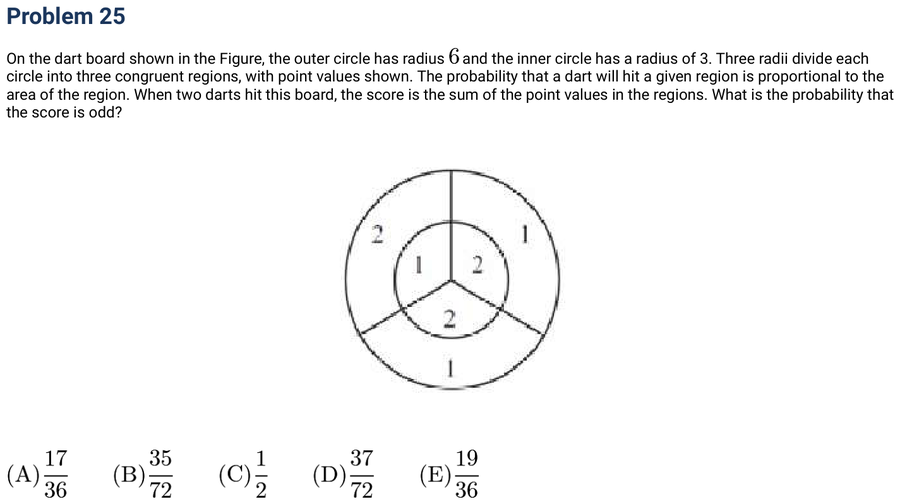
On the dart board shown in the figure, the outer circle has radius 6 and the inner circle has a radius of 3. Three radii divide each circle into three congruent regions, with point values shown. The probability that a dart will hit a given region is proportional to the area of the region. When two darts hit this board, the score is the sum of the point values of the regions hit. What is the probability that the score is odd?
Show answer
Answer: B — 35/72.
Show hints
Hint 1 of 2
Sum of two scores is odd only when one is even and one is odd — here that means exactly one dart lands on a 1 and the other on a 2. So you never need each region separately, just P(hit a 1) and P(hit a 2).
Still stuck? Show hint 2 →
Hint 2 of 2
Collapse the regions into two outcomes: lump all '1' regions into P(1) and all '2' regions into P(2); 'odd total' then becomes the simple two-color event.
Show solution
Approach: reduce to P(1) and P(2), then 2·P(1)·P(2)
- Areas drive the chances. Inner circle = 9π in 3 equal sectors ⇒ each inner region = 3π, probability 3π/36π = 1/12. Outer ring = 36π − 9π = 27π in 3 sectors ⇒ each outer region = 9π, probability 1/4.
- From the board: inner regions are 1, 2, 2; outer regions are 1, 1, 2.
- P(hit a 1) = 1/12 (inner) + 2 · 1/4 (outer) = 1/12 + 6/12 = 7/12.
- P(hit a 2) = 2 · 1/12 (inner) + 1/4 (outer) = 2/12 + 3/12 = 5/12. (Check: 7/12 + 5/12 = 1, since every region is a 1 or a 2.)
- Odd total = one 1 and one 2, in either order: 2 · (7/12)(5/12) = 35/72.
- Why the factor of 2: '1 then 2' and '2 then 1' are distinct equally-likely orders, so the mixed event gets counted twice — the same 2·p·q that shows up in coin-flip 'exactly one heads' problems.
Mark:
· log in to save