Problem 25 · 2026 AMC 8
Stretch
Counting & Probability
corner-cuttingcasework
Show answer
Answer: E — 8.
Show hints
Hint 1 of 2
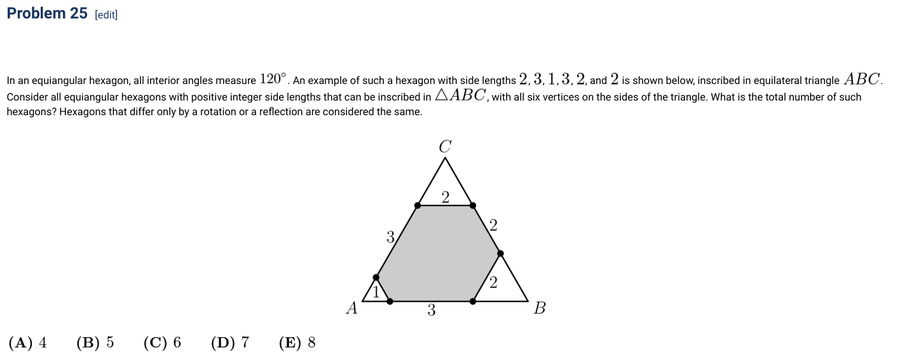
Don't think ‘hexagon’ — think about what's missing. An equiangular hexagon inscribed this way is exactly the equilateral triangle with a small equilateral triangle snipped off each corner. So describe a hexagon by its three corner-cut sizes a, b, c instead of its six sides.
Still stuck? Show hint 2 →
Hint 2 of 2
Each side of the big triangle is split into cut + middle + cut, and the middle piece must be a real side (length ≥ 1). With triangle side 6, that says a + b ≤ 5 for every pair. Then count the triples — remembering rotations/reflections are the same, so order doesn't matter.
Show solution
Approach: describe each hexagon by its three corner cuts, then count valid triples
- Reframe the shape: an equiangular hexagon with all six vertices on the triangle is the triangle with a small equilateral triangle cut off each corner. So a hexagon is fully pinned down by the three integer cut sizes a, b, c at the corners — far fewer numbers than six sides.
- Find the triangle's side: the example's bottom edge reads 1 + 3 + 2 = 6, so the triangle has side 6. Each edge is cut + middle + cut, e.g. a + (middle) + b = 6, and the middle must be an actual hexagon side, so 6 − a − b ≥ 1, i.e. a + b ≤ 5 for every pair of cuts.
- Since rotations and reflections are the same, count unordered triples {a, b, c} of positive integers with all pairwise sums ≤ 5: {1,1,1}, {1,1,2}, {1,1,3}, {1,1,4}, {1,2,2}, {1,2,3}, {2,2,2}, {2,2,3}. That's 8.
- Why this transfers: a shape defined by lots of side conditions often has far fewer real degrees of freedom — here three corner cuts — and ‘up to rotation/reflection’ means count unordered/symmetric configurations, not every labeled one.
Mark:
· log in to save