Don't read it as one long line — notice the signs themselves repeat in a short cycle. What does that cycle tell you about how to chunk the terms?
Still stuck? Show hint 2 →
Hint 2 of 2
The signs run +, +, − over and over. That's the group-by-the-pattern trick: chop into groups of three and add the group totals instead of the 12 separate terms.
Show solution
Approach: let the sign pattern choose the group size
The signs march +, +, − over and over — that's a clue to chop the 12 terms into groups of three, not to slog left to right.
Each group is (small + next − bigger). The first few: 1+2−3 = 0, 4+5−6 = 3, 7+8−9 = 6, 10+11−12 = 9. The group totals just climb by 3.
Add the four group totals: 0 + 3 + 6 + 9 = 18.
Why this transfers: when a long expression has a repeating sign or operation pattern, group by the length of that pattern — the messy string usually collapses into a short, regular list you can add in your head.
Another way — split into a clean +-sum and a -sum:
Add every term as if all were positive: 1+2+…+12 = 12×132 = 78.
The subtracted terms are 3, 6, 9, 12; we had counted them as +, so we must remove them twice: 2 × (3+6+9+12) = 2 × 30 = 60.
In the array shown below, three 3s are surrounded by 2s, which are in turn surrounded by a border of 1s. What is the sum of the numbers in the array?
1
1
1
1
1
1
1
1
2
2
2
2
2
1
1
2
3
3
3
2
1
1
2
2
2
2
2
1
1
1
1
1
1
1
1
A 5 × 7 array of numbers.
Show answer
Answer: C — The answer is 53.
Show hints
Hint 1 of 2
Before adding 35 numbers, look at the rows: some are exact copies of each other. Can you avoid adding the same row twice?
Still stuck? Show hint 2 →
Hint 2 of 2
Lean on the mirror symmetry — top matches bottom, 2nd matches 4th — so you only add three different rows and double two of them. (Or count how many 1s, 2s, and 3s there are.)
Show solution
Approach: use the mirror symmetry — only three rows are really different
The grid is a mirror image top-to-bottom: row 1 = row 5, and row 2 = row 4. So you only have to add up three rows, then double two of them.
Why this transfers: whenever a figure repeats or mirrors, add one copy of each distinct piece and multiply — the symmetry does most of the counting for you.
Another way — count how many of each number, not row by row:
The three 3s sit in the center: 3 × 3 = 9.
The 2s form a ring — five in row 2, five in row 4, two in the middle row = 12 twos: 12 × 2 = 24.
Everything else is a 1. The grid is 5×7 = 35 cells, so the 1s number 35 − 3 − 12 = 20, worth 20.
Haruki has a piece of wire that is 24 centimeters long. He wants to bend it to form each of the following shapes, one at a time.
A regular hexagon with side length 5 cm.
A square of area 36 cm2.
A right triangle whose legs are 6 and 8 cm long.
Which of the shapes can Haruki make?
Show answer
Answer: D — Square and triangle only.
Show hints
Hint 1 of 2
The wire is one fixed length and can't stretch. So what single number must every makeable shape's outline equal?
Still stuck? Show hint 2 →
Hint 2 of 2
A shape works only if its perimeter equals 24 cm. Find each perimeter — and for the triangle, watch for a familiar right-triangle (the 6-8-10) so you don't have to compute a square root.
Show solution
Approach: the wire never stretches — only perimeter = 24 works
A fixed loop of wire can only bend into a shape whose perimeter is exactly 24 cm. So the whole problem becomes: find each perimeter and check it against 24.
Hexagon: 6 sides × 5 = 30 cm. Too long — no. (Notice you don't even need the others to rule this one out.)
Square of area 36: the side is √36 = 6, so perimeter 4 × 6 = 24 cm. ✓
Right triangle, legs 6 and 8: spot the 6-8-10 Pythagorean triple — the hypotenuse is 10, so perimeter 6 + 8 + 10 = 24 cm. ✓
Only the square and the triangle fit, so the answer is Square and triangle only.
You'll see it again: 3-4-5 and its scalings (6-8-10, 9-12-15…) are the most common right triangles on contests — recognizing one saves you the square-root work.
Brynn's savings decreased by 20% in July, then increased by 50% of the new amount in August. Brynn's savings are now what percent of the original amount?
Show answer
Answer: E — 120%.
Show hints
Hint 1 of 2
Careful — the answer isn't simply −20 + 50 = +30%. The 50% rise acts on the already-shrunk amount, so the two changes don't just add.
Still stuck? Show hint 2 →
Hint 2 of 2
Turn each change into a multiplier (×0.8, then ×1.5) and multiply them — that's how percent changes compound, and you never need the starting amount.
Show solution
Approach: turn each percent change into a multiplier
A percent change is really a multiplier: down 20% leaves 80%, so × 0.8; up 50% means × 1.5. And changes chain by multiplying, so you never need a starting amount.
0.8 × 1.5 = 1.2, which is 120% of the original.
Watch the trap: the answer is not −20% + 50% = +30%. Percents stack by multiplying, not adding, because the +50% applies to the shrunken amount, not the original.
Another way — plug in a friendly number:
Pretend Brynn started with $100. July: down 20% leaves $80. August: up 50% of $80 adds $40, giving $120.
$120 out of the original $100 is 120%. Picking 100 makes the percent fall right out.
Casey went on a road trip that covered 100 miles, stopping only for a lunch break along the way. The trip took 3 hours in total and her average speed while driving was 40 miles per hour. In minutes, how long was the lunch break?
Show answer
Answer: B — 30 minutes.
Show hints
Hint 1 of 2
The 40 mph only describes the part where she's actually moving — the 3 hours also hides the lunch stop. Which piece can you compute directly?
Still stuck? Show hint 2 →
Hint 2 of 2
Time = distance ÷ speed gives the driving time only. Subtract that from the 3 total hours and what's left is the break.
Show solution
Approach: the 3 hours is driving + break; only driving obeys distance ÷ speed
The 40 mph is her speed while driving, so distance ÷ speed gives only the driving time, not the whole trip. Find that first: 100 ÷ 40 = 2.5 hours.
Whatever's left of the 3 total hours is the lunch break: 3 − 2.5 = 0.5 hour = 30 minutes.
Sanity check: 30 minutes of lunch is reasonable, and 2.5 h of driving at 40 mph really does cover 100 miles. The reusable idea: always separate ‘moving time’ from total time before using rate = distance ÷ time — the rate only describes the moving part.
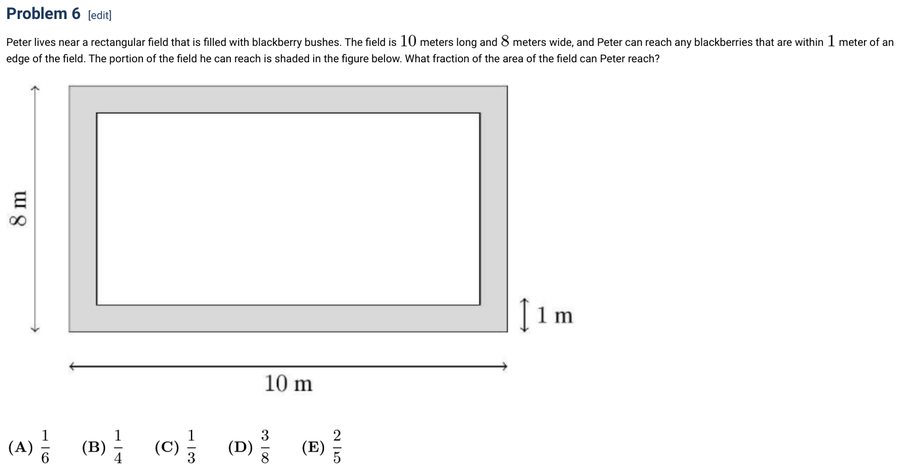
The reachable border is a frame around the field — an awkward shape. Don't measure it directly; what's the easy shape you'd subtract to leave only the frame?
Still stuck? Show hint 2 →
Hint 2 of 2
Find the unreachable inner rectangle instead (everything more than 1 m from every edge): a 1 m strip on each side shrinks each dimension by 2. Then border = whole − inner.
Show solution
Approach: complementary counting — subtract the easy inner rectangle
The reachable strip is a frame, which is fiddly to measure head-on. Flip it: the unreachable part is the rectangle more than 1 m from every edge — a clean rectangle.
A 1 m margin on each side trims 1 + 1 = 2 from each dimension: the inner rectangle is (10 − 2) × (8 − 2) = 8 × 6 = 48, out of the full 10 × 8 = 80.
So the reachable frame is 80 − 48 = 32, giving the fraction 32/80 = 2/5.
Why this transfers: a border/frame is almost always easiest as (whole rectangle) − (inner rectangle) — and remember a uniform margin shrinks each side by twice the margin, not once.
Mika wants to estimate how far a new electric bike goes on a full charge. She made two trips totaling 40 miles: the first used 12 of the battery and the second used 310 of the battery. How many miles can the bike go on a fully charged battery?
Show answer
Answer: C — 50 miles.
Show hints
Hint 1 of 2
The 40 miles didn't drain a full battery. First combine the two trips: what single fraction of the battery did the 40 miles actually use?
Still stuck? Show hint 2 →
Hint 2 of 2
Once you know 40 miles used some fraction of the charge, the rest is one proportion: scale that fraction up to a whole battery (the full charge is 5/5).
Show solution
Approach: find the fraction the 40 miles used, then scale to a whole battery
Combine the two trips: ½ + 3/10. With a common denominator, 5/10 + 3/10 = 8/10 = 4/5 of the battery powered the 40 miles.
If 4/5 of a charge gives 40 miles, each fifth gives 40 ÷ 4 = 10 miles, so a full 5/5 gives 5 × 10 = 50 miles.
Why this works: ‘a fraction of the whole equals a known amount’ is a proportion — find the value of one unit piece (here, one-fifth = 10 mi), then multiply up to the whole.
Another way — divide by the fraction:
4/5 of the battery = 40 miles, so the full battery is 40 ÷ 45 = 40 × 54 = 50 miles.
A poll asked some people whether they liked solving mathematics problems, and exactly 74% answered "yes." What is the fewest possible number of people who could have been asked?
Show answer
Answer: D — 50 people.
Show hints
Hint 1 of 2
You can't have a fraction of a person, so 74% of the group has to land on a whole number. What does that force about the group size?
Still stuck? Show hint 2 →
Hint 2 of 2
Reduce 74/100 to lowest terms. The denominator of the reduced fraction is the smallest group size that makes the count whole.
Show solution
Approach: the reduced denominator is the smallest workable group
‘74% said yes’ means (yes count) = 74100 × (group), and that has to be a whole number of people.
Reduce: 74100 = 3750. Since 37 and 50 share no factors, the group must be a multiple of 50 for 37/50 of it to be whole — so the fewest is 50 people (with 37 yeses).
Why this transfers: ‘exactly p% must be a whole count’ problems always come down to reducing p/100 — the smallest group is the reduced denominator, because that's the first size that clears the fraction.
Top and bottom are built from the very same numbers, 16 and 81, just with their roles swapped. That symmetry says: simplify each piece the same way and the answer should be a clean ratio — both are perfect squares and perfect fourth powers.
Still stuck? Show hint 2 →
Hint 2 of 2
Work each square root from the inside out: simplify the inner root, multiply, then take the outer root. Or notice 16 = 2⁴ and 81 = 3⁴ and ride the exponents.
Show solution
Approach: simplify each nested root from the inside out
Start with the innermost roots: √81 = 9 and √16 = 4. Now the insides are plain numbers.
Five runners finished a race: Luke, Melina, Nico, Olympia, and Pedro. Nico finished 11 minutes behind Pedro. Olympia finished 2 minutes ahead of Melina but 3 minutes behind Pedro. Olympia finished 6 minutes ahead of Luke. Which runner finished fourth?
Show answer
Answer: A — Luke.
Show hints
Hint 1 of 2
The clues compare runners to each other in a tangle. Pick one person as the zero mark and pin everybody's finish time to that single reference — which runner is mentioned most often?
Still stuck? Show hint 2 →
Hint 2 of 2
Pedro is the natural anchor (he appears in two clues). Put 0 at Pedro and write each other runner as ‘so many minutes behind Pedro,’ then just read the list in order.
Show solution
Approach: anchor everyone to one runner, then read the order
Pin everyone to Pedro at 0 (minutes behind him). Olympia is 3 behind → +3. Melina is 2 behind Olympia → +5. Luke is 6 behind Olympia → +9. Nico is 11 behind Pedro → +11.
Sorted front to back: Pedro (0), Olympia (3), Melina (5), Luke (9), Nico (11). Fourth across the line is Luke.
Why this transfers: for any ‘A is ahead/behind B’ ordering puzzle, convert every relative clue into a position on one number line anchored to a single person — the ranking then just falls out by sorting.
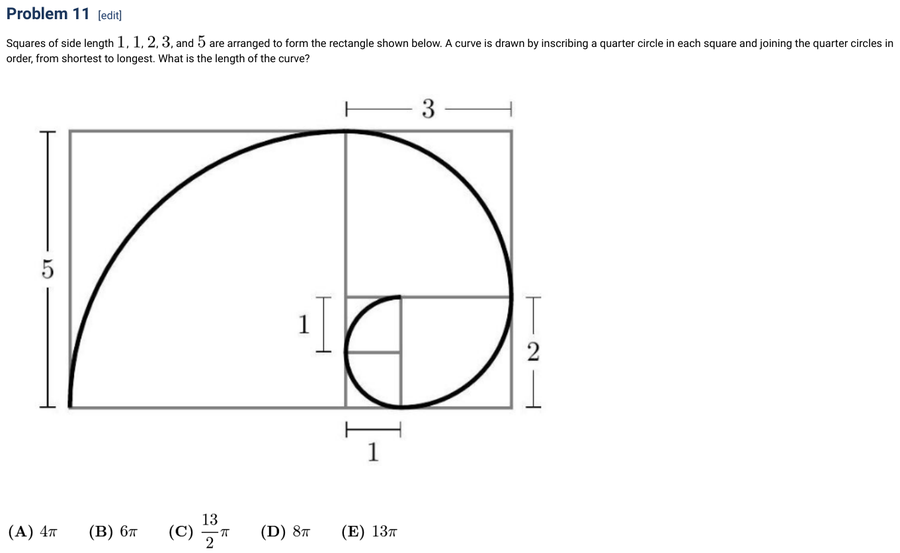
The spiral isn't one weird curve — it's five separate quarter-circles, one per square. In a square of side s, the inscribed quarter-circle has radius s. What is a quarter of that circle's circumference?
Still stuck? Show hint 2 →
Hint 2 of 2
Each arc is ¼ × 2πs = πs/2 — the arc length is just proportional to the side. So factor out π/2 and add the five sides.
Show solution
Approach: each square gives a quarter-circle; arc length scales with the side
Break the spiral into its five pieces: in each square of side s, the inscribed quarter-circle has radius s, so its arc is one-fourth of the full circumference: ¼ × 2πs = πs/2.
Every arc is just (π/2) times its side, so factor that out and total the sides 1, 1, 2, 3, 5: total = (π/2)(1 + 1 + 2 + 3 + 5) = (π/2)(12) = 6π.
Why this transfers: when a curve is built from circular arcs, handle each arc as (its fraction of a turn) × (2π × its radius), then add — you never need to draw the whole curve, just account for each arc's radius and how much of a full turn it sweeps.
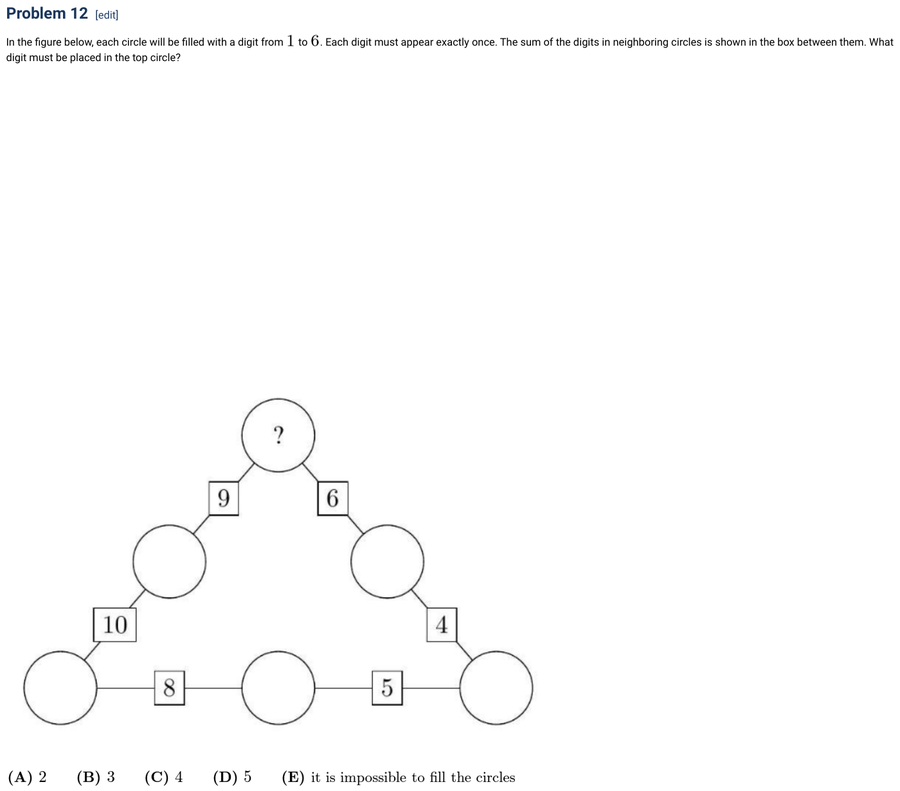
Don't guess the top circle — attack the most constrained edge first. With only the digits 1–6, which edge-sum can be made in only one way?
Still stuck? Show hint 2 →
Hint 2 of 2
The edge labeled 10 is the tightest: among 1–6, the only pair adding to 10 is 4 + 6. Pin those two circles down, then each neighboring sum forces the next digit like dominoes.
Show solution
Approach: start at the most-constrained edge, then let the sums force each digit
Scan for the edge with the fewest options. The sum 10 is the giveaway: out of 1–6, only 4 + 6 reaches 10, so that left edge's two circles are 4 and 6 in some order.
Test which way round: the edge above it sums to 9. If the upper circle is 4, the top is 9 − 4 = 5; the lower one is then 6. (The other way, top = 9 − 6 = 3, collides later.)
Now the dominoes fall: bottom-left 6 with edge 8 → bottom-middle 2; edge 5 → bottom-right 3; right edge 4 → upper-right 1; and the last check 5 + 1 = 6 matches the top-right edge. Digits used: {5,4,6,2,3,1} = 1–6 exactly once. ✓
So the top circle is 5.
Why this transfers: in any fill-the-grid / fill-the-graph puzzle, begin at the cell with the fewest legal choices — one forced value usually triggers a chain that solves the rest with no guessing.
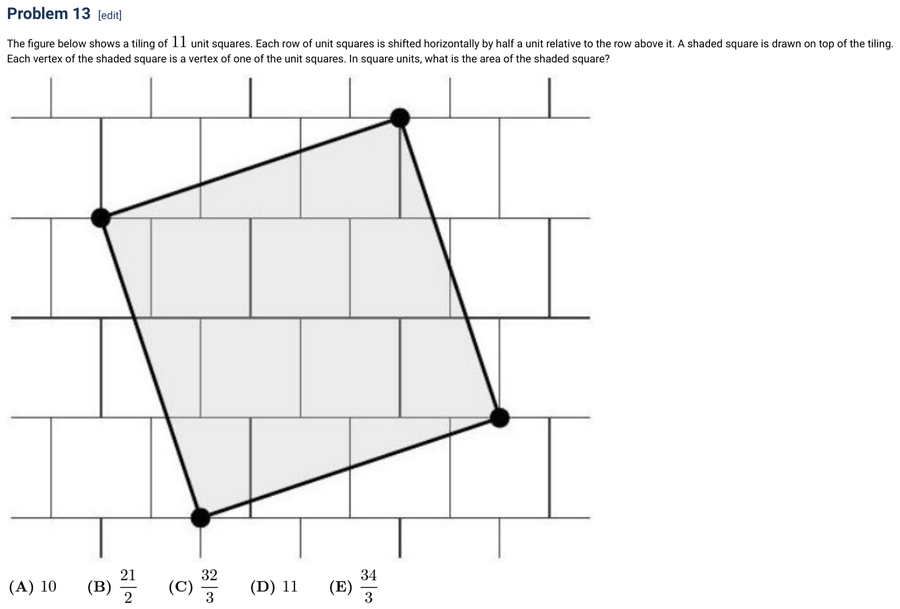
Don't try to measure the slanted side directly. The area of any square is just (side length)² — so you only need side², never the side itself.
Still stuck? Show hint 2 →
Hint 2 of 2
Treat one tilted side as a journey across the grid: so many units right and so many up. By the Pythagorean theorem, side² = (across)² + (up)², and that is the area — no square roots needed.
Show solution
Approach: area = side², and side² = (horizontal step)² + (vertical step)²
Pick one side of the shaded square and trace it from corner to corner across the tiling: it moves 1 unit across and 3 units up (the half-unit row shifts let the vertices land on lattice points).
That side is the hypotenuse of a right triangle with legs 1 and 3, so side² = 1² + 3² = 10. But the area of the square is side², so the area is 10 — you never even compute the side.
Why this transfers: for any tilted square on a grid, the area is just (horizontal step)² + (vertical step)² of one side. This is the ‘tilted-square shortcut’ — it skips both the square root and the messier ‘big square minus 4 corner triangles’ method.
Another way — bounding box minus four corner triangles:
Enclose the tilted square in the smallest upright square. With side-steps of 1 and 3, that box is 4 × 4 = 16.
The four right-triangle corners each have legs 1 and 3, area ½·1·3 = 1.5, so four of them remove 4 × 1.5 = 6.
Tilted-square area = 16 − 6 = 10, matching the shortcut.
Jami picked three equally spaced integers on the number line. The sum of the first and second is 40, and the sum of the second and third is 60. What is the sum of all three numbers?
Show answer
Answer: B — 75.
Show hints
Hint 1 of 2
‘Equally spaced’ is the magic phrase: the middle number is exactly the average of the outer two. So how does the middle number relate to the whole sum of three?
Still stuck? Show hint 2 →
Hint 2 of 2
Add the two given sums (40 + 60). The middle number gets counted twice and the outer two once each — turn that into the value of the middle, then triple it.
Show solution
Approach: the middle number is the average — and the whole sum is just 3 times it
For three equally spaced numbers, the middle one is the average of all three, so the total is simply 3 × middle. Find the middle.
Add the two given sums: (first + second) + (second + third) = 40 + 60 = 100. The middle got counted twice, the outer two once each, so 100 = (first + second + third) + second. Also first + third = 2·second, giving 100 = 4·second, so the middle is 25.
Total = 3 × 25 = 75.
Why this transfers: in any evenly-spaced list, the middle term is the mean, so sum = (count) × (middle). Spotting ‘equally spaced’ lets you skip solving for the individual numbers.
Another way — name the spacing and watch it cancel:
Call the numbers m−d, m, m+d. The first sum is 2m−d = 40 and the second is 2m+d = 60.
Add them: 4m = 100, so m = 25. The total is exactly 3m = 75 — the spacing d never matters.
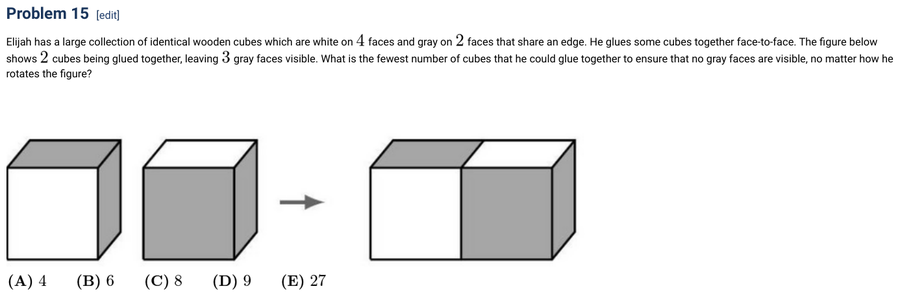
Focus on what one cube needs. Its two gray faces meet at an edge (they're adjacent, not opposite). To bury both, the cube must be glued on two faces that also meet at an edge.
Still stuck? Show hint 2 →
Hint 2 of 2
So a straight line of cubes can't work — the inside cubes are only glued on opposite faces. Every cube needs two glued faces sharing a corner. What's the smallest cluster where every cube gets that?
Show solution
Approach: each cube must be glued on two faces that share an edge
Zoom in on a single cube. Its two gray faces are adjacent (they share an edge), so to hide both, the cube has to touch neighbors on two faces that share an edge — an ‘L’ of contact, not a straight-through pair.
That rules out a straight row: an end cube is glued on only one face, and a middle cube is glued on two opposite faces — either way a gray face is left showing. You need the cubes to turn a corner.
Arrange four cubes in a 2 × 2 square. Every cube then touches two neighbors on faces that meet at an edge, so its gray pair can point into that corner and stay hidden. Three or fewer cubes can't give all of them an L of contacts.
The fewest is 4.
Why this transfers: ‘hide adjacent faces’ problems hinge on which faces get covered, not just how many — opposite-face contact (a straight line) and edge-sharing contact (a corner) are very different, and the gray-face geometry tells you which you need.
Consider all positive four-digit integers whose digits are all even. What fraction of these integers are divisible by 4?
Show answer
Answer: D — 3/5.
Show hints
Hint 1 of 2
Don't count the thousands of numbers. Divisibility by 4 cares only about the last two digits — so the first two even digits are free and just cancel out of the fraction.
Still stuck? Show hint 2 →
Hint 2 of 2
Here's the lucky break: the tens digit is even, so 10×(tens) is a multiple of 20, hence already a multiple of 4. That leaves the units digit as the only thing that decides divisibility by 4.
Show solution
Approach: divisibility by 4 collapses onto the units digit alone
Divisibility by 4 depends only on the last two digits, so the thousands and hundreds digits don't matter — whatever fraction works for the last two digits is the answer for the whole pile.
Split the last two digits as 10·(tens) + units. The tens digit is even, so 10·(tens) is a multiple of 20, which is already a multiple of 4. That means the number is divisible by 4 exactly when the units digit alone is — i.e. units ∈ {0, 4, 8}.
Of the 5 allowed even units {0, 2, 4, 6, 8}, three (0, 4, 8) work, and this holds no matter what the other digits are. So the fraction is 3/5 → 3/5.
Why this transfers: a divisibility rule lets you ignore most digits — isolate just the digits the rule depends on, and check whether the ‘free’ part is automatically handled so the count reduces to one digit.
Four students sit in a row and chat with the people next to them. They then rearrange themselves so that no one is seated next to anyone they sat next to before. How many such rearrangements are possible?
Show answer
Answer: A — 2.
Show hints
Hint 1 of 2
Label the original seats 1, 2, 3, 4. The forbidden new-neighbor pairs are exactly the old neighbors: 1-2, 2-3, 3-4. Instead of listing what's banned, flip it — which pairs are allowed to sit together?
Still stuck? Show hint 2 →
Hint 2 of 2
List the allowed pairs (1-3, 1-4, 2-4) and you'll see they chain together in essentially one way. A valid row is just a path that uses every student through allowed links.
Show solution
Approach: build the ‘allowed-neighbor’ chain instead of testing all 24 orders
The banned new-neighbor pairs are the old ones: 1-2, 2-3, 3-4. Flip to the allowed pairs — everything else: 1-3, 1-4, and 2-4. A legal new row is a path that strings all four students together using only allowed links.
Trace the allowed links: 2 connects only to 4, and 3 connects only to 1, so 2 and 3 must be the ends. The only way to join them is 2–4–1–3.
That chain read either direction gives 2–4–1–3 and 3–1–4–2, so there are 2 rearrangements.
Why this transfers: ‘who may sit/stand next to whom’ problems become much easier as a graph — draw the allowed connections and count paths through all the vertices, rather than testing every permutation against a list of bans.
In how many ways can 60 be written as the sum of two or more consecutive odd positive integers, arranged in increasing order?
Show answer
Answer: B — 2.
Show hints
Hint 1 of 2
Before any algebra, use parity: a sum of k odd numbers is even exactly when k is even. Since 60 is even, that already says something about how many terms you can have.
Still stuck? Show hint 2 →
Hint 2 of 2
A run of k consecutive odd numbers starting at a sums to k(a + k − 1) = 60. Test only the evenk that divide 60, keeping those with a positive odd start.
Show solution
Approach: parity narrows k, then the run-sum formula finishes it
First a free filter: adding k odd numbers gives a result with the same parity as k. Our target 60 is even, so the number of terms k must be even — we never even test odd k.
A run of k consecutive odds starting at a is a + (a+2) + … = k(a + k − 1) = 60, so a = 60/k − (k − 1). Check the even k ≥ 2 dividing 60:
k = 2 → a = 29 (29 + 31 = 60); k = 6 → a = 5 (5+7+9+11+13+15 = 60); k = 4, 10, 12… give a ≤ 0 or non-odd. Two runs work.
So there are 2 ways.
Why this transfers: on ‘sum of consecutive’ problems, a parity (or mod) check on the target usually kills most cases for free before you grind the algebra — cheap filters first, formula second.
Miguel and his dog Luna start together at a park entrance. Miguel throws a ball straight ahead to a tree and keeps walking at a steady pace. Luna sprints to the ball and immediately brings it back to Miguel. Luna runs 5 times as fast as Miguel walks. What fraction of the entrance-to-tree distance does Miguel cover by the time Luna brings him the ball?
Show answer
Answer: D — 1/3.
Show hints
Hint 1 of 2
They run for the same amount of time, so forget the clock entirely — in equal time, distance is just proportional to speed. Luna covers 5 times as far as Miguel, whatever that distance turns out to be.
Still stuck? Show hint 2 →
Hint 2 of 2
Picture Luna's actual route: entrance → tree → back to wherever Miguel has walked to. Set that whole length equal to 5 times Miguel's short walk and solve.
Show solution
Approach: same time ⇒ Luna's path length = 5 × Miguel's
Because they move for the same time, the time cancels: Luna's total distance is simply 5 times Miguel's. So set their path lengths in a 5-to-1 ratio — no need for actual speeds or seconds.
Let the entrance-to-tree distance be 1 and Miguel's walk be d. Luna runs to the tree (1) and back to Miguel, who has moved up to d, so the return leg is 1 − d. Luna's path = 1 + (1 − d) = 2 − d.
Equal time means Luna's path = 5d: 5d = 2 − d ⇒ 6d = 2 ⇒ d = 1/3.
Why this transfers: when two movers share the same time window, drop the clock — their distances are in the ratio of their speeds, turning a rate problem into a one-line distance equation.
The land of Catania uses gold coins (1 mm thick) and silver coins (3 mm thick). In how many ways can Taylor make a stack exactly 8 mm tall using any arrangement of gold and silver coins, where order matters?
Show answer
Answer: D — 13.
Show hints
Hint 1 of 2
Listing every 8 mm stack by hand is error-prone. Instead build the answer from smaller stacks: focus on just the top coin — it's either gold (1 mm) or silver (3 mm). What height of stack sits underneath in each case?
Still stuck? Show hint 2 →
Hint 2 of 2
If f(n) counts stacks of height n, a gold top leaves f(n−1) below it and a silver top leaves f(n−3). So f(n) = f(n−1) + f(n−3). Build up from small heights.
Show solution
Approach: recursion by the top coin: f(n) = f(n−1) + f(n−3)
Sort stacks of height n by what the top coin is. If it's gold (1 mm), the rest is any stack of height n−1; if it's silver (3 mm), the rest is any stack of height n−3. Those cases don't overlap and cover everything, so f(n) = f(n−1) + f(n−3).
Seed the small cases: f(0) = 1 (the empty stack), f(1) = 1, f(2) = 1 (only gold fits). Then climb: f(3)=2, f(4)=3, f(5)=4, f(6)=6, f(7)=9, f(8)=13.
So there are 13 stacks.
Why this transfers: ‘order matters’ counting with a few fixed step sizes is almost always a recursion — condition on the last piece, and the count for n becomes a sum of counts for smaller totals (this is the same engine behind staircase / tiling problems).
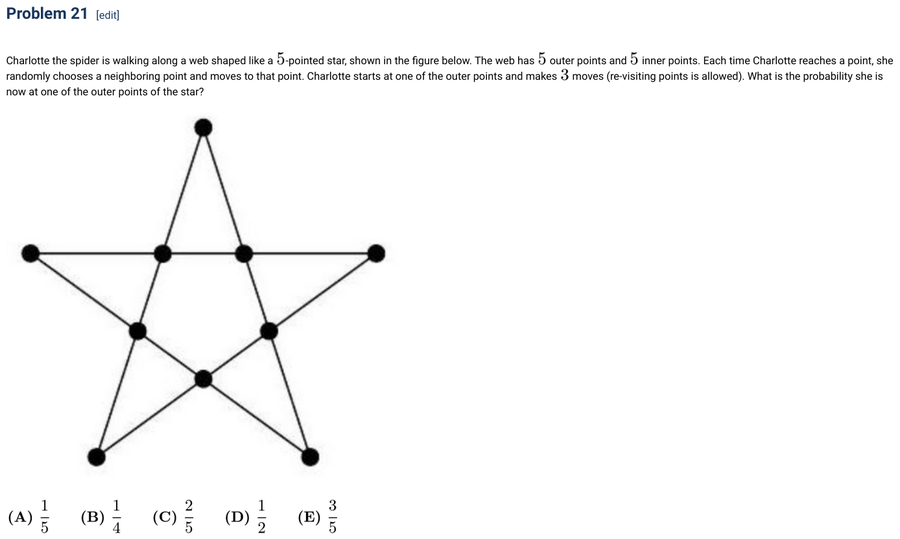
Ten points is too many to track one by one — but notice every point is one of just two types. An outer tip touches only 2 inner points (degree 2); an inner point touches 2 outer tips and 2 inner points (degree 4). So collapse the whole web into ‘outer vs. inner’.
Still stuck? Show hint 2 →
Hint 2 of 2
Now it's a 2-state chain. From outer you always step inner; from inner you step outer with probability 2/4 = ½. Track just ‘chance of being outer’ move by move.
Show solution
Approach: collapse 10 points to two states (outer/inner) and track the probability
The 10 points come in only two kinds, so lump them: an outer tip has both edges going inward (so outer → inner for sure), while an inner point has 4 edges, 2 to outer tips and 2 to inner points (so inner → outer with probability 2/4 = ½). By symmetry it doesn't matter which tip we start at.
Start outer. Move 1: forced inward, so the spider is surely inner.
Move 2: from inner it goes outer with probability ½, inner with probability ½.
Move 3: to finish on an outer tip, the only route is to have stayed inner on move 2 (½), then step outward on move 3 (½). (Being outer after move 2 forces it back inner on move 3 — a dead end.) So the chance is ½ × ½ = 1/4.
Why this transfers: when a random walk lives on a symmetric graph, group the vertices into a few ‘types’ that behave alike — the problem shrinks from many points to a tiny state machine you can track by hand.
The integers 1 through 25 are arbitrarily separated into five groups of 5 numbers each. The median of each group is found, and M is the median of those five medians. What is the least possible value of M?
Show answer
Answer: A — 9.
Show hints
Hint 1 of 2
Unpack what M even is: it's the median of the five medians, i.e. the 3rd-smallest of them. To push M down, you need three groups whose medians are all small at once.
Still stuck? Show hint 2 →
Hint 2 of 2
Here's the bottleneck: a group's median needs two strictly smaller numbers sitting below it. Three small medians plus their six ‘below’ numbers eat up a lot of the tiny values — and tiny values are scarce. Count how many you'd need.
Show solution
Approach: lower-bound by counting scarce small numbers, then build a matching example
First decode M: it is the 3rd-smallest of the five group medians. So making M tiny requires three groups to each have a small median simultaneously.
Now the scarcity argument. Each of those three medians needs two numbers strictly below it inside its group. Suppose M ≤ 8. Then three medians (each ≤ 8) together with their six below-numbers (each smaller still) are 9 distinct values all ≤ 8 — impossible, since only 8 numbers (1–8) are that small. So M ≥ 9.
Then show 9 is actually reachable: {1, 2, 7, 24, 25}, {3, 4, 8, 22, 23}, {5, 6, 9, 20, 21} have medians 7, 8, 9, while the last two groups {10–14} and {15–19} absorb the big numbers (medians 12, 17). The five medians 7, 8, 9, 12, 17 have median 9.
Bound met by an example ⇒ the least value is 9.
Why this transfers: extremal problems are won by pairing a lower bound (a counting/pigeonhole reason it can't be smaller) with a construction (an explicit example hitting that bound). Neither half alone is a proof — you need both jaws of the vise.
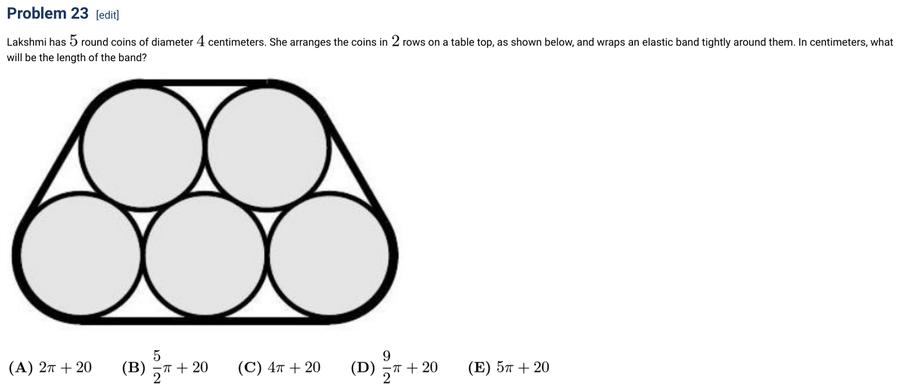
Split the band into two kinds of pieces: the straight stretches (lying along flat tangent lines between coins) and the curved stretches (hugging a coin). Handle the two kinds separately.
Still stuck? Show hint 2 →
Hint 2 of 2
Key fact: going once around any convex bunch, the band turns through exactly 360°, so all its curved pieces together make one full circle. The straight pieces are each tangent, so they're as long as the gaps between the outer coin centers — i.e. the perimeter of the polygon joining those centers.
Show solution
Approach: curves sum to one whole circle; straights trace the outer-center polygon
Diameter 4 means radius 2. Break the band into straight tangent segments and curved arcs that wrap the outer coins.
The arcs: as the band loops all the way around, its direction turns through a full 360°, and each arc bends along a radius-2 coin. All the arcs together sweep one complete turn, so they add up to exactly one full circle: 2π × 2 = 4π.
The straights: each tangent segment runs parallel to the line joining two neighboring outer coin centers and has the same length. So the straight pieces total the perimeter of the trapezoid through the four outer centers. With touching radius-2 coins, the bottom span is 8 and the other three center-to-center sides are each 4: 8 + 4 + 4 + 4 = 20.
Band length = 4π + 20 → 4π + 20 centimeters.
Why this transfers: for a belt/band tight around any bunch of equal circles, the answer is always (one full circle from the radius) + (perimeter of the polygon through the outer centers). The curved parts re-assemble into a single circle because the total turning is one full 360°.
The notation n! is the product of the first n positive integers. Define the superfactorial of n to be the product of the factorials 1! · 2! · 3! · … · n! (so the superfactorial of 3 is 1! · 2! · 3! = 12). How many factors of 7 appear in the prime factorization of the superfactorial of 51?
Show answer
Answer: E — 171.
Show hints
Hint 1 of 2
The superfactorial is a product of factorials, and exponents add across a product. So the total number of 7s is just the sum of the 7-counts of 1!, 2!, …, 51! — turn one big product into a sum.
Still stuck? Show hint 2 →
Hint 2 of 2
Count the 7s in a single k! with Legendre's formula: ⌊k/7⌋ + ⌊k/49⌋ (multiples of 7 give one, multiples of 49 give an extra). Then group the values of k by how many 7s they contribute — the count is constant on each block of 7 consecutive values.
Show solution
Approach: Legendre's 7-count, summed over every factorial in blocks
Across a product, exponents add, so the number of 7s in 1!·2!·…·51! is the sum of v₇(k!) for k = 1 to 51, where Legendre's formula gives v₇(k!) = ⌊k/7⌋ + ⌊k/49⌋.
Track how the count grows as k rises. For k = 1–6 it's 0; then it steps up by 1 each time k passes a new multiple of 7, staying flat in between — so v₇(k!) = 1 for the 7 values 7–13, = 2 for 14–20, …, up to = 6 for 42–48.
That block sums to 7×(1+2+3+4+5+6) = 7×21 = 147. Then at k = 49 the count jumps to 8 (= ⌊49/7⌋ + ⌊49/49⌋ = 7 + 1), and k = 49, 50, 51 each give 8, adding 3×8 = 24.
Total = 147 + 24 = 171.
Why this transfers: to count a prime p in a factorial, use ⌊k/p⌋ + ⌊k/p²⌋ + …; the higher powers (here 49 = 7²) are exactly what create the surprise ‘jump’ that an easy 1+2+3+… guess would miss.
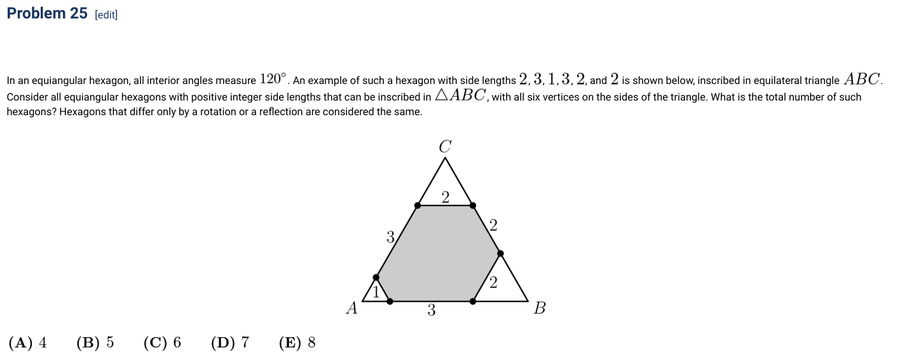
Don't think ‘hexagon’ — think about what's missing. An equiangular hexagon inscribed this way is exactly the equilateral triangle with a small equilateral triangle snipped off each corner. So describe a hexagon by its three corner-cut sizes a, b, c instead of its six sides.
Still stuck? Show hint 2 →
Hint 2 of 2
Each side of the big triangle is split into cut + middle + cut, and the middle piece must be a real side (length ≥ 1). With triangle side 6, that says a + b ≤ 5 for every pair. Then count the triples — remembering rotations/reflections are the same, so order doesn't matter.
Show solution
Approach: describe each hexagon by its three corner cuts, then count valid triples
Reframe the shape: an equiangular hexagon with all six vertices on the triangle is the triangle with a small equilateral triangle cut off each corner. So a hexagon is fully pinned down by the three integer cut sizesa, b, c at the corners — far fewer numbers than six sides.
Find the triangle's side: the example's bottom edge reads 1 + 3 + 2 = 6, so the triangle has side 6. Each edge is cut + middle + cut, e.g. a + (middle) + b = 6, and the middle must be an actual hexagon side, so 6 − a − b ≥ 1, i.e. a + b ≤ 5 for every pair of cuts.
Since rotations and reflections are the same, count unordered triples {a, b, c} of positive integers with all pairwise sums ≤ 5: {1,1,1}, {1,1,2}, {1,1,3}, {1,1,4}, {1,2,2}, {1,2,3}, {2,2,2}, {2,2,3}. That's 8.
Why this transfers: a shape defined by lots of side conditions often has far fewer real degrees of freedom — here three corner cuts — and ‘up to rotation/reflection’ means count unordered/symmetric configurations, not every labeled one.