Theresa's parents have agreed to buy her tickets to see her favorite band if she spends an average of 10 hours per week helping around the house for 6 weeks. For the first 5 weeks she helps around the house for 8, 11, 7, 12 and 10 hours. How many hours must she work for the final week to earn the tickets?
Show answer
Answer: D — 12 hours.
Show hints
Hint 1 of 2
An average is a promise about the total: averaging 10 over 6 weeks means 60 hours total, no matter how they're split up. So don't average — just chase the total.
Still stuck? Show hint 2 →
Hint 2 of 2
This is the target-total trick: average × count = total needed, then subtract what's banked.
Show solution
Approach: convert the average into a required total
Turn the average into a goal: averaging 10 hours over 6 weeks means a total of 6 · 10 = 60 hours. That's the whole game — how the hours are spread doesn't matter.
Bank so far: 8 + 11 + 7 + 12 + 10 = 48 hours.
Final week = 60 − 48 = 12.
You'll see this again: any 'what's needed to hit an average' problem — final exam scores, gas mileage — collapses the moment you write average × count = total.
Another way — balance the surpluses and deficits:
Score each week against the goal of 10: −2, +1, −3, +2, 0. They net to −2.
She's 2 hours behind, so the last week must beat 10 by 2: 10 + 2 = 12.
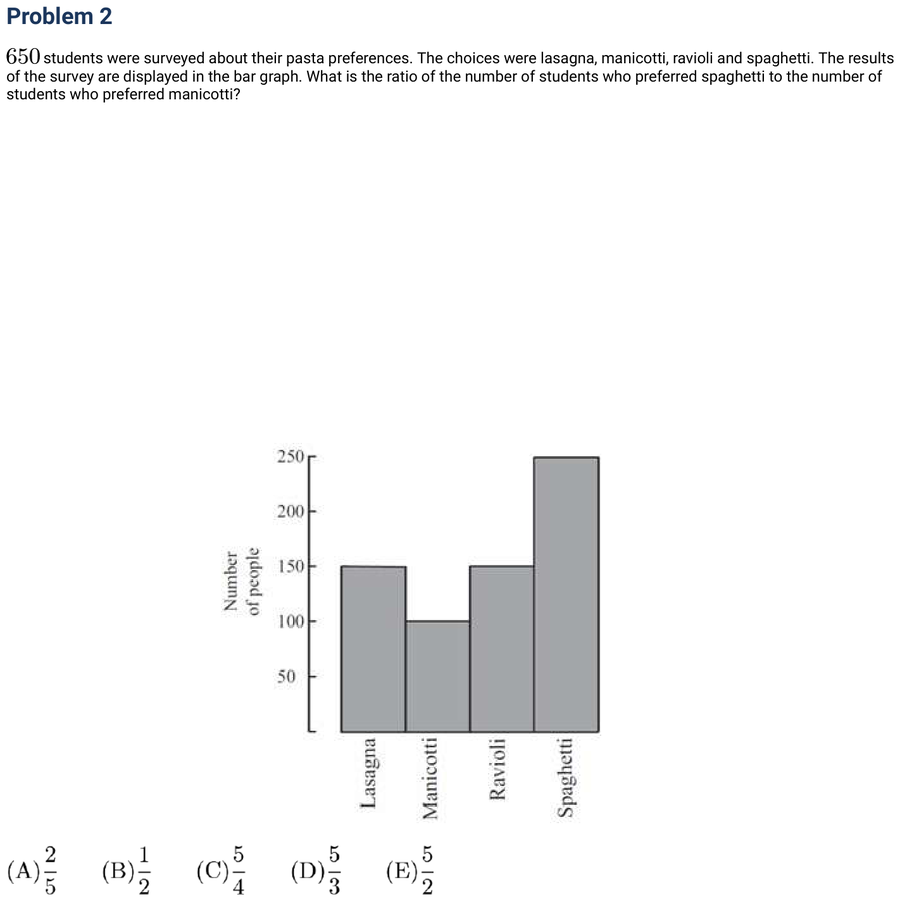
650 students were surveyed about their pasta preferences. The choices were lasagna, manicotti, ravioli and spaghetti. The results of the survey are displayed in the bar graph. What is the ratio of the number of students who preferred spaghetti to the number of students who preferred manicotti?
Show answer
Answer: E — 5/2.
Show hints
Hint 1 of 2
The 650 total and the other two foods are decoys — a ratio only needs the two bars it asks about. Read the height of just the spaghetti and manicotti bars.
Still stuck? Show hint 2 →
Hint 2 of 2
A ratio question is a 'pull out only what's asked' question: ignore every number the comparison doesn't mention.
Show solution
Approach: read the two relevant bars, then reduce
Read only the two bars named: spaghetti = 250, manicotti = 100. (The 650 total and the other foods are scenery.)
Ratio = 250 : 100. Cancel the common 50: that's 5 : 2, i.e. 5/2.
Sanity check: spaghetti is clearly more than double manicotti, and 5/2 = 2.5, so it points the right way.
What is the sum of the two smallest prime factors of 250?
Show answer
Answer: C — 7.
Show hints
Hint 1 of 2
250 ends in 0, so it's even and a multiple of 5 — you already know its two smallest primes without dividing anything.
Still stuck? Show hint 2 →
Hint 2 of 2
The smallest prime factors hide in the last digit: even ⇒ 2 lives there; ending in 0 or 5 ⇒ 5 lives there.
Show solution
Approach: spot the primes from the last digit
250 ends in 0, which means it's divisible by both 2 and by 5 — the two smallest primes any number can have. So the two smallest are 2 and 5 with no work.
Sum: 2 + 5 = 7.
Why you can stop: 2 and 5 are the smallest two primes that exist, so once a number has both, nothing smaller can sneak in. (Fully, 250 = 2 · 53, but you never needed that.)
Chandler wants to buy a 500 dollar mountain bike. For his birthday, his grandparents send him 50 dollars, his aunt sends him 35 dollars and his cousin gives him 15 dollars. He earns 16 dollars per week for his paper route. He will use all of his birthday money and all of the money he earns from his paper route. In how many weeks will he be able to buy the mountain bike?
Show answer
Answer: B — 25 weeks.
Show hints
Hint 1 of 2
The gift money is a head start — subtract it first so only the paper-route money has to close the gap. Don't make the weekly route 'pay' for what's already in hand.
Still stuck? Show hint 2 →
Hint 2 of 2
Gap ÷ rate: figure out how much is still missing, then divide by the per-week amount.
Show solution
Approach: close the remaining gap at the weekly rate
Birthday head start: 50 + 35 + 15 = 100. That shrinks the goal to 500 − 100 = 400 left to earn.
Each week the route adds 16, so weeks = 400 ÷ 16 = 25.
Pattern to keep: 'how long to reach a goal' is almost always (goal − what you already have) ÷ (rate per step). Knock out the head start before dividing.
The average cost of a long-distance call in the USA in 1985 was 41 cents per minute, and the average cost of a long-distance call in the USA in 2005 was 7 cents per minute. Find the approximate percent decrease in the cost per minute of a long-distance call.
Show answer
Answer: E — About 80%.
Show hints
Hint 1 of 2
Percent decrease compares the drop to where you started, not where you ended — the 41 is the reference, not the 7. And the answers are far apart, so a rough estimate is enough.
Still stuck? Show hint 2 →
Hint 2 of 2
Percent change = (change) ÷ (original). The original is always the denominator.
Show solution
Approach: drop over the starting value, estimated
The drop is 41 − 7 = 34, measured against the starting price 41 (not the ending 7).
34/41 is just under 34/40, and 34 is most of 41 — clearly in the 80s percent, so 80%.
Common trap: dividing by the new value (7) instead of the original (41) inflates the answer. Decrease always references the start.
Another way — the price almost vanished:
7 cents is roughly one-sixth of 41 cents, so about 5/6 of the cost disappeared.
The average age of 5 people in a room is 30 years. An 18-year-old person leaves the room. What is the average age of the four remaining people?
Show answer
Answer: D — 33.
Show hints
Hint 1 of 2
You can't average ages directly when someone leaves — rebuild the total first. An average is just a total in disguise: 5 people at 30 means 150 years of age in the room.
Still stuck? Show hint 2 →
Hint 2 of 2
Average problems run on the total: convert average→total, adjust the total, then divide by the new count.
Show solution
Approach: work with the total of ages, not the averages
Convert to a total: 5 people averaging 30 means 5 · 30 = 150 years all together.
The 18-year-old walks out, taking 18 with them: 150 − 18 = 132 years among the 4 left.
New average = 132 ÷ 4 = 33.
Intuition check: removing someone younger than average should pull the average up — and 33 > 30, as expected.
Another way — see why it rises by 3:
The leaver was 18 — that's 12 below the old average of 30.
Those 12 'missing low' years get redistributed over the 4 who remain: 12 ÷ 4 = 3 added each, so 30 + 3 = 33.
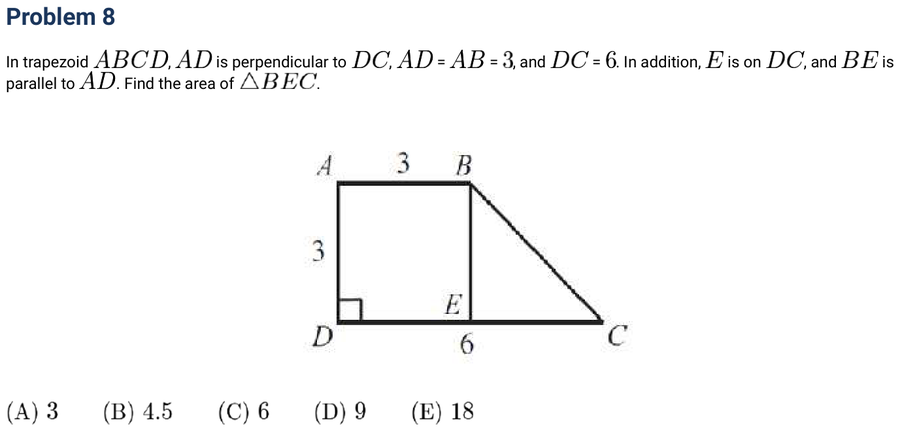
In trapezoid ABCD, AD is perpendicular to DC, AD = AB = 3, and DC = 6. In addition, E is on DC, and BE is parallel to AD. Find the area of ▵BEC.
Show answer
Answer: B — 4.5.
Show hints
Hint 1 of 2
Drop BE straight down and the shape splits into a square ABED and the triangle. The square hands you both legs of the triangle for free.
Still stuck? Show hint 2 →
Hint 2 of 2
Slice an awkward shape into a familiar one: a parallel-and-perpendicular setup usually hides a rectangle (here a square) you can read lengths off of.
Show solution
Approach: carve off the square to expose a right triangle
Since BE ∥ AD and AD ⊥ DC, segment BE is also ⊥ DC. With AB ∥ DC too, ABED is a rectangle — in fact a square, because AD = AB = 3. So BE = 3 and DE = 3.
That leaves EC = DC − DE = 6 − 3 = 3, and ▵BEC is right-angled at E with legs 3 and 3.
Area = (1/2)(3)(3) = 4.5.
Worth keeping: when one side is parallel to a perpendicular height, that height is just the rectangle's width — no Pythagoras needed.
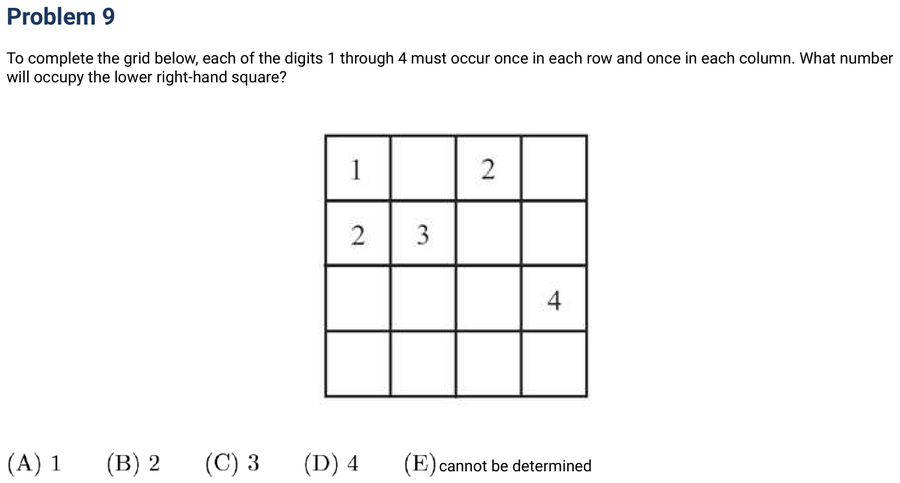
To complete the grid below, each of the digits 1 through 4 must occur once in each row and once in each column. What number will occupy the lower right-hand square?
Show answer
Answer: B — 2.
Show hints
Hint 1 of 2
The question asks about one cell, so don't solve the whole puzzle — only follow the row and column that pass through that corner.
Still stuck? Show hint 2 →
Hint 2 of 2
Sudoku logic: attack the most-filled line first. A cell forbids every digit already in its row or column, so the tightest spots get forced one at a time, and each forced cell tightens the next.
Show solution
Approach: force the target cell using only its own column
Aim at column 4, the column through the corner we want. It already holds a 4 (row 3), so no other cell in it can be 4 — that's the lever.
Row 1's two blanks are 3 and 4, but column 4 has banned 4, so row 1 col 4 = 3. Same move on row 2 (blanks 1 and 4): col 4 = 1.
Column 4 now shows 3, 1, 4, leaving only one digit for the bottom-right square: 2.
Transfers everywhere: in any Latin-square / Sudoku cell, when three of four values are accounted for in a line, the fourth is forced — chase eliminations, not the whole grid.
For any positive integer n, define [n] to be the sum of the positive factors of n. For example, [6] = 1 + 2 + 3 + 6 = 12. Find [[11]].
Show answer
Answer: D — 28.
Show hints
Hint 1 of 2
Nested brackets mean work inside-out: settle [11] completely before touching the outer bracket. The clue is that 11 is prime — its only factors are 1 and itself.
Still stuck? Show hint 2 →
Hint 2 of 2
Factors come in pairs: list divisors as pairs that multiply to n (1&12, 2&6, 3&4) so you never miss one.
Show solution
Approach: evaluate the inner bracket first, then the outer
Inner first: 11 is prime, so its only factors are 1 and 11 ⇒ [11] = 1 + 11 = 12.
Now [12]. Pair up the divisors so none escape: 1·12, 2·6, 3·4 — that's {1, 2, 3, 4, 6, 12}.
Add them: 1 + 2 + 3 + 4 + 6 + 12 = 28.
Habit worth forming: finding divisors in multiply-to-n pairs guarantees a complete list — the same trick that makes counting factors fast.
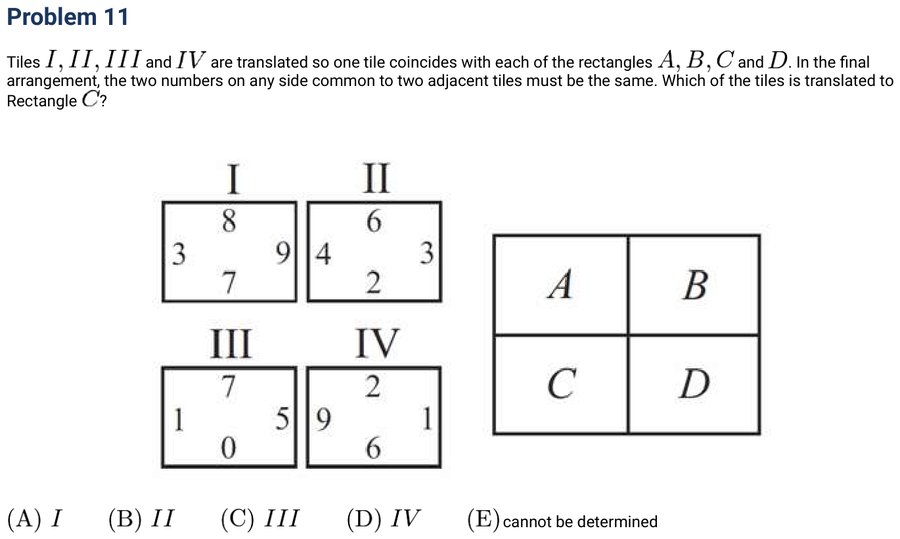
Tiles I, II, III and IV are translated so one tile coincides with each of the rectangles A, B, C and D. In the final arrangement, the two numbers on any side common to two adjacent tiles must be the same. Which of the tiles is translated to Rectangle C?
Show answer
Answer: D — Tile IV.
Show hints
Hint 1 of 2
A number that appears on only one tile-edge has no partner to match against — so that edge can't be an interior seam. It must face outward, which pins the tile to the boundary.
Still stuck? Show hint 2 →
Hint 2 of 2
Solve constraint puzzles from the unique pieces in: anchor the forced tile first, then propagate by matching the shared-edge numbers to its neighbors, one link at a time.
Show solution
Approach: anchor on outside-only numbers, then propagate matches
Some edge numbers appear on only one tile (no other tile carries that number), so those edges must lie on the outer boundary of the 2 × 2 arrangement. Pinning those tiles into their forced corners removes most of the freedom.
From the anchored tile, walk to its neighbors by matching the shared edge number. The chain forces tile IV into rectangle C.
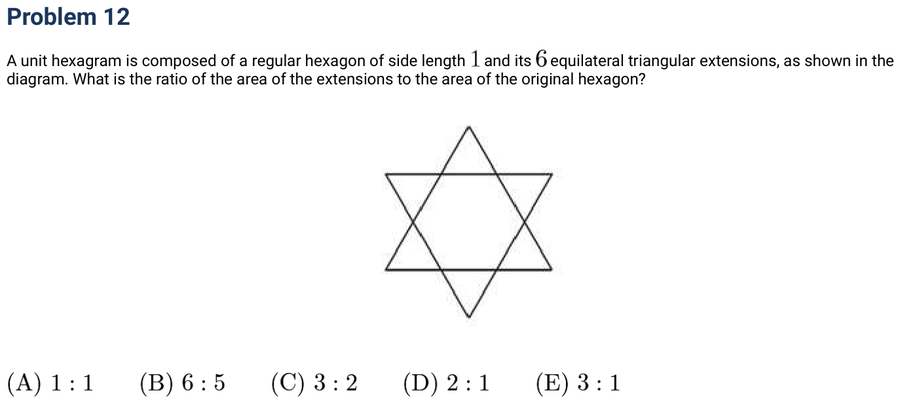
A unit hexagram is composed of a regular hexagon of side length 1 and its 6 equilateral triangular extensions, as shown in the diagram. What is the ratio of the area of the extensions to the area of the original hexagon?
Show answer
Answer: A — 1 : 1.
Show hints
Hint 1 of 2
Don't compute any area — count triangles. Draw the three long diagonals of the hexagon and it falls into 6 little triangles that are identical to the 6 spikes glued on the outside.
Still stuck? Show hint 2 →
Hint 2 of 2
Match shapes instead of measuring: if you can show two regions are made of congruent pieces, their areas are equal — no formula required.
Show solution
Approach: cut the hexagon into copies of the spikes
Connect the hexagon's center to its 6 corners. A regular hexagon splits into 6 equilateral triangles, each with side 1.
Each outer spike is also an equilateral triangle of side 1, built on one edge of the hexagon — so it's congruent to one of the inner triangles.
6 inner triangles vs. 6 identical outer triangles: the areas are equal, so the ratio is 1 : 1.
Reusable idea: a regular hexagon is exactly 6 equilateral triangles of its side length — a fact that turns most hexagon-area problems into simple counting.
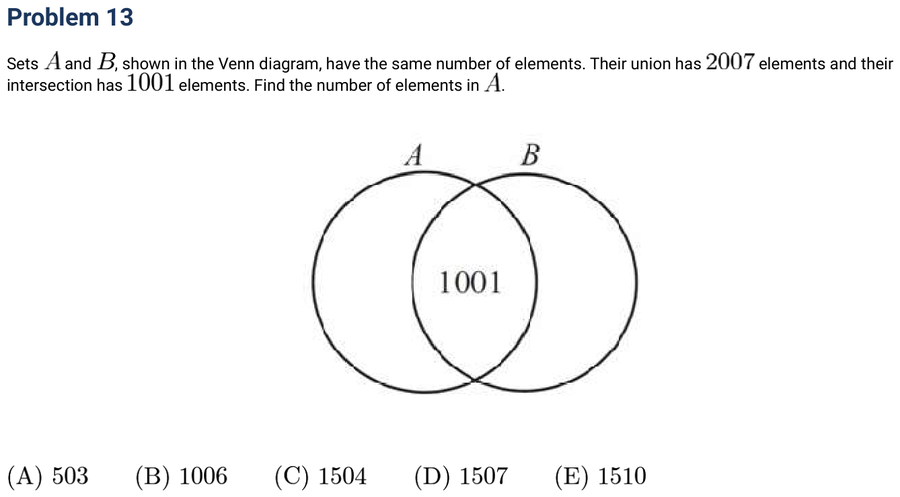
Sets A and B, shown in the Venn diagram, have the same number of elements. Their union has 2007 elements and their intersection has 1001 elements. Find the number of elements in A.
Show answer
Answer: C — 1504.
Show hints
Hint 1 of 2
If you add the two circles, the overlap gets counted twice — so |A| + |B| overshoots the union by exactly the intersection. That's the whole equation.
Still stuck? Show hint 2 →
Hint 2 of 2
Inclusion-exclusion: |A ∪ B| = |A| + |B| − |A ∩ B|, because the shared part is double-counted once.
Show solution
Approach: inclusion-exclusion with equal sets
Since |A| = |B|, write both as x. The two circles together cover the union plus one extra copy of the overlap: x + x − 1001 = 2007.
So 2x = 2007 + 1001 = 3008, giving x = 1504.
Sanity check: each set must be at least as big as the intersection (1001) and at most the union (2007); 1504 sits comfortably between, as it should.
Another way — count the three regions of the diagram:
The middle (both) holds 1001. The union has 2007, so the two outer-only slivers together hold 2007 − 1001 = 1006.
Equal sets means the slivers split evenly: 503 each. Then |A| = its sliver + the middle = 503 + 1001 = 1504.
The base of isosceles ▵ABC is 24 and its area is 60. What is the length of one of the congruent sides?
Show answer
Answer: C — 13.
Show hints
Hint 1 of 2
In an isosceles triangle, the altitude to the base lands dead center, splitting it into two mirror-image right triangles. The area hands you that altitude's length.
Still stuck? Show hint 2 →
Hint 2 of 2
Drop the altitude from the apex: it halves the base and creates a right triangle, turning a side-length question into Pythagoras.
Show solution
Approach: altitude splits it into a right triangle
Back the height out of the area: 60 = (1/2)(24)(h) ⇒ h = 5.
That altitude bisects the base, so each right triangle has legs 5 (height) and 12 (half of 24).
Hypotenuse = the congruent side = √(52 + 122) = √169 = 13.
Recognize it: 5-12-13 is one of the famous Pythagorean triples — spotting 5 and 12 lets you write 13 instantly, no square root needed.
Let a, b and c be numbers with 0 < a < b < c. Which of the following is impossible?
Show answer
Answer: A — a + c < b is impossible.
Show hints
Hint 1 of 2
'Impossible' means it can never happen, so look for the one choice that follows from the rules alone — no clever numbers can break it. Compare each side against b.
Still stuck? Show hint 2 →
Hint 2 of 2
Adding only makes things bigger: with c > b already, adding a positive a can't drag the sum below b. Multiplying by a fraction, though, can shrink — that's where the 'possible' ones live.
Show solution
Approach: prove one is forced, exhibit examples for the rest
(A) says a + c < b. But c is already bigger than b, and a is positive, so a + c > c > b. It can never dip below b — (A) is impossible.
The others survive with small fractions, because multiplying by something under 1 shrinks a number: take a = 1/3, b = 1/2, c = 1. Then a·c = 1/3 < 1/2 = b (D works), a+b < c and a·b < c (B, C), and b/c = a is easy to arrange too.
Only (A) is locked out, so the answer is (A).
Strategy that transfers: on 'which is impossible' problems, one choice is provable from the given order and the rest fall to a single well-chosen example — fractions between 0 and 1 are your best test values.
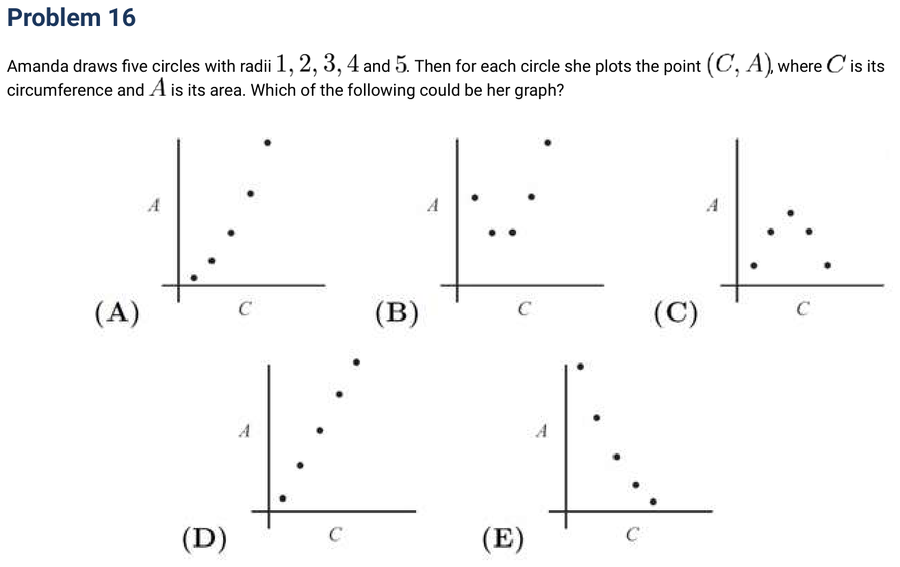
Amanda draws five circles with radii 1, 2, 3, 4 and 5. Then for each circle she plots the point (C, A), where C is its circumference and A is its area. Which of the following could be her graph?
Show answer
Answer: A — Graph A.
Show hints
Hint 1 of 2
You don't need actual numbers — just ask how area grows compared to circumference. Circumference is linear in r, but area is squared, so as C climbs steadily, A should shoot up faster and faster.
Still stuck? Show hint 2 →
Hint 2 of 2
Eliminate the radius to see the relationship: with C = 2πr and A = πr2, A = C2/(4π) — a curve that bends upward, not a straight line.
Show solution
Approach: decide the shape of the A-vs-C curve
Substitute r = C/(2π) into A = πr2 to get A = C2/(4π). So A is proportional to Csquared.
That's a curve through the origin that rises and steepens — concave up — never a straight line. Only graph A bends that way.
Mental check: plot the smallest and a bigger circle: (2π, π) then (10π, 25π). The y-values blow up much faster than the x-values — the hallmark of a parabola, which rules out every straight-line option.
A mixture of 30 liters of paint is 25% red tint, 30% yellow tint and 45% water. Five liters of yellow tint are added to the original mixture. What is the percent of yellow tint in the new mixture?
Show answer
Answer: C — 40%.
Show hints
Hint 1 of 2
Percentages of a changing total are slippery — switch to actual liters. Pouring in yellow grows the yellow and the whole batch, so both the top and bottom of the fraction move.
Still stuck? Show hint 2 →
Hint 2 of 2
Convert percents to amounts before mixing: track the quantity you care about and the total separately, then re-form the percent at the end.
Show solution
Approach: switch to liters, update both parts
Yellow at the start: 30% of 30 = 9 L. (The red and water percents are scenery — ignore them.)
Add 5 L of yellow: yellow becomes 9 + 5 = 14 L, and the whole batch grows to 30 + 5 = 35 L.
New yellow percent = 14/35 = 2/5 = 40%.
Common trap: the answer isn't 30% + something simple — you must enlarge the denominator too. Yellow jumped from 9/30 to 14/35 because both numbers changed.
The product of the two 99-digit numbers 303,030,303,…,030,303 and 505,050,505,…,050,505 has thousands digit A and units digit B. What is the sum of A and B?
Show answer
Answer: D — 8.
Show hints
Hint 1 of 2
Those 99-digit monsters are a scare tactic — the last few digits of a product depend only on the last few digits of the factors. Lop off everything but the tails.
Still stuck? Show hint 2 →
Hint 2 of 2
Work mod a power of 10: to get the last 4 digits of a product, multiply the last 4 digits of each number; the front digits can't reach back that far.
Show solution
Approach: keep only the tails of each factor
We need the last 4 digits, so keep just the last 4 of each number: 0303 and 0505. Everything to the left lands far past the thousands place.
Multiply the short versions: 303 · 505 = 153015.
Read off the last four digits, 3015: thousands digit A = 3, units digit B = 5.
A + B = 3 + 5 = 8.
Why this is safe: any digit of the product is built only from digit-pairs at or below its place value, so chopping the high digits leaves the last 4 untouched — the standard 'last digits' shortcut.
Pick two consecutive positive integers whose sum is less than 100. Square both of those integers and then find the difference of the squares. Which of the following could be the difference?
Show answer
Answer: C — 79.
Show hints
Hint 1 of 2
Try it with real numbers first: 42 − 32 = 7, and 3 + 4 = 7. The difference of the squares is just the sum of the two integers — which is always odd. So two of the choices are dead on arrival.
Still stuck? Show hint 2 →
Hint 2 of 2
Difference of squares:p2 − q2 = (p+q)(p−q); for consecutive integers the second factor is 1, so it collapses to p+q.
Show solution
Approach: factor the difference, then screen by parity
Let the integers be x and x+1. Then (x+1)2 − x2 = (2x+1)(1) = 2x+1 — exactly the sum of the two numbers.
So the difference is odd (it's 2x+1) and, since the sum is under 100, less than 100.
Scan the choices: 2 and 64 are even (out); 131 is over 100 (out). Only 79 is odd and below 100.
Big idea: the gap between consecutive squares grows by odd numbers (1, 3, 5, 7, …) — so every consecutive-square difference is odd. That parity test killed three options instantly.
Before district play, the Unicorns had won 45% of their basketball games. During district play, they won six more games and lost two, to finish the season having won half their games. How many games did the Unicorns play in all?
Show answer
Answer: A — 48 games.
Show hints
Hint 1 of 2
The unknown isn't the answer they want — let x be the games before district play, write wins both before and after, and set them equal to 'half the season.'
Still stuck? Show hint 2 →
Hint 2 of 2
Name the natural variable, then translate each sentence into an equation: 'won 45%' → 0.45x wins; 'won half' → wins = total/2.
Show solution
Approach: let x = pre-district games, equate the two win counts
Before district: x games, 0.45x wins. District adds 6 wins and 2 losses, so the season is x+8 games with 0.45x+6 wins.
Why 45% is the clue to x: 0.45x must be a whole number of wins, so x is a multiple of 20. That alone narrows pre-district games to 20, 40, 60… — a fast reality check on the algebra.
Another way — test the divisibility-friendly value:
For 45% = 9/20 of x to be a whole number, x must be a multiple of 20. Try x = 40: wins = 18.
After district: 18 + 6 = 24 wins out of 40 + 8 = 48 games — exactly half. So the total is 48.
Two cards are dealt from a deck of four red cards labeled A, B, C, D and four green cards labeled A, B, C, D. A winning pair is two of the same color or two of the same letter. What is the probability of drawing a winning pair?
Show answer
Answer: D — 4/7.
Show hints
Hint 1 of 2
Don't worry about which card comes first — whatever it is, the picture from the second card's point of view is identical. So freeze the first card and just ask: which of the 7 leftover cards pairs with it?
Still stuck? Show hint 2 →
Hint 2 of 2
Fix one outcome to kill the symmetry: by symmetry the first card's identity doesn't matter, so condition on it and count favorable second cards out of the rest.
Show solution
Approach: fix the first card, count winning seconds
Hold the first card fixed; 7 cards remain. Count which of them make a winning pair with it.
Same color (different letters): the 3 other cards of that color — all winners.
Same letter (different color): exactly 1 card — also a winner.
So 3 + 1 = 4 of the 7 remaining cards win: probability 4/7.
Why no double-count: a same-color card has a different letter and vice versa, so the two winning sets never overlap — you can just add them.
Another way — count via the losing pairs instead:
A pair loses only when it's different color AND different letter. Fix the first card: of the 7 left, 3 share its color and 1 shares its letter, so 7 − 4 = 3 are total mismatches (losers).
A lemming sits at a corner of a square with side length 10 meters. The lemming runs 6.2 meters along a diagonal toward the opposite corner. It stops, makes a 90° right turn and runs 2 more meters. A scientist measures the shortest distance between the lemming and each side of the square. What is the average of these four distances in meters?
Show answer
Answer: C — 5.
Show hints
Hint 1 of 2
Resist plotting the exact spot — the 6.2 and the 2 are bait. For any point inside the square, its distance to the left wall plus its distance to the right wall is the full width, 10. Same up-and-down.
Still stuck? Show hint 2 →
Hint 2 of 2
Hunt for the invariant: when a problem buries you in specific lengths but asks for a sum or average, check whether that quantity stays fixed no matter where the point lands.
Show solution
Approach: an inside point's opposite-wall distances always sum to the side
First confirm the lemming is still inside: it travels 6.2 then 2, well within a 10×10 square. So it's an interior point — the exact spot won't matter.
Left-wall distance + right-wall distance spans the whole width = 10. Top + bottom likewise = 10. All four distances sum to 20.
Average = 20 ÷ 4 = 5.
The payoff: the messy 6.2 and 2 never entered the math — the four distances always total 2×(side), so the average is always side÷2. Spotting that invariant beats any coordinate grind.
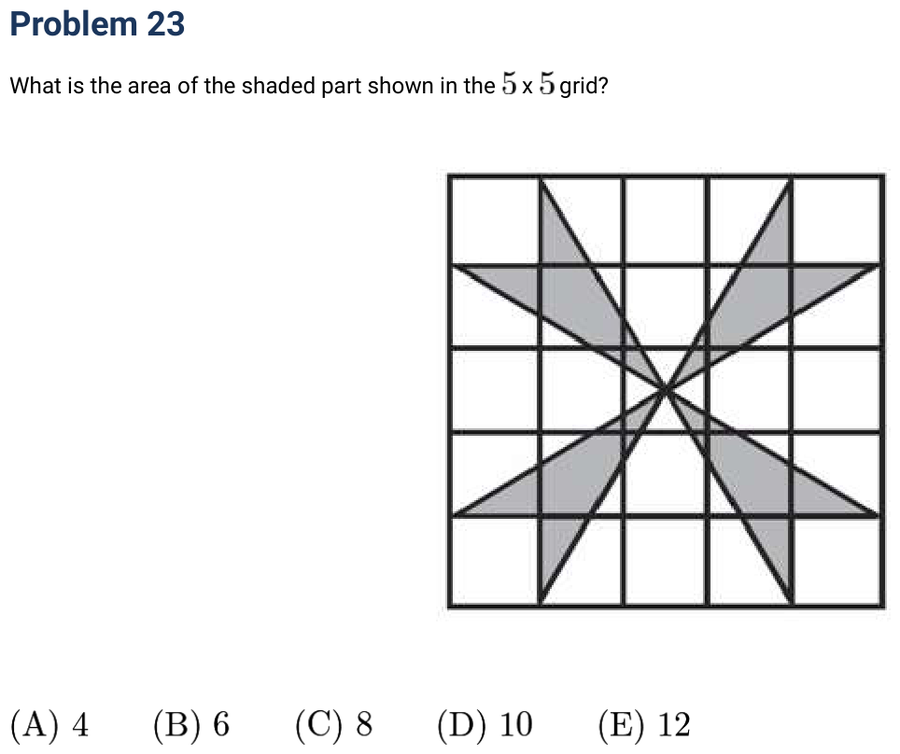
What is the area of the shaded pinwheel shown in the 5 × 5 grid?
Show answer
Answer: B — 6.
Show hints
Hint 1 of 2
The shaded pinwheel has slanted, awkward edges — but the unshaded leftovers are tidy squares and triangles. Measure what's easy and subtract from the whole 5×5.
Still stuck? Show hint 2 →
Hint 2 of 2
Complementary area: when the region you want is jagged, find the area of its simple complement and subtract from the total.
Show solution
Approach: whole grid minus the easy unshaded pieces
Total grid area = 52 = 25.
The unshaded part is 4 corner unit squares (4 · 1 = 4) plus 4 congruent triangles, each with base 3 and height 5/2.
Those triangles total 4 · (1/2)(3)(5/2) = 15. Unshaded = 4 + 15 = 19.
Shaded pinwheel = 25 − 19 = 6.
Reusable move: never wrestle a slanted shape directly — subtracting the clean complement from a bounding rectangle is almost always faster and less error-prone.
A bag contains four pieces of paper, each labeled with one of the digits 1, 2, 3, or 4, with no repeats. Three of these pieces are drawn, one at a time without replacement, to construct a three-digit number. What is the probability that the three-digit number is a multiple of 3?
Show answer
Answer: C — 1/2.
Show hints
Hint 1 of 2
Divisibility by 3 cares about the digit-sum, and a sum doesn't notice the order — so forget the three-digit arrangements entirely and just ask which trio of digits got drawn.
Still stuck? Show hint 2 →
Hint 2 of 2
Divisible by 3 ⇔ digit-sum divisible by 3. Since order can't change a sum, this is really a 'which 3 did I pick' question, not a 'which number' question.
Show solution
Approach: drawing 3 of 4 = leaving 1 out
Order is irrelevant for divisibility by 3, so picking 3 of the 4 digits is the same as choosing which single digit to leave behind.
All four digits sum to 1+2+3+4 = 10. Leaving out d makes the drawn sum 10 − d, which is a multiple of 3 exactly when d = 1 (sum 9) or d = 4 (sum 6).
So 2 of the 4 equally likely 'leftover' digits work: probability = 2/4 = 1/2.
Slick reframing: 'choose 3 from 4' is always 'discard 1 from 4' — turning a messy selection into one easy choice is a counting habit worth keeping.
Another way — list the four subsets directly:
The size-3 subsets of {1,2,3,4} are {1,2,3}, {1,2,4}, {1,3,4}, {2,3,4} with sums 6, 7, 8, 9.
Multiples of 3: sums 6 and 9 — 2 of the 4 subsets. Probability 2/4 = 1/2.
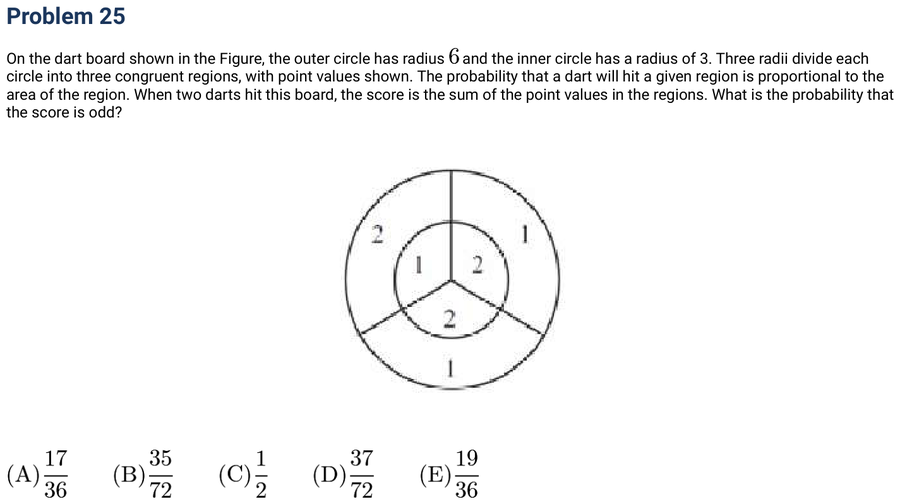
On the dart board shown in the figure, the outer circle has radius 6 and the inner circle has a radius of 3. Three radii divide each circle into three congruent regions, with point values shown. The probability that a dart will hit a given region is proportional to the area of the region. When two darts hit this board, the score is the sum of the point values of the regions hit. What is the probability that the score is odd?
Show answer
Answer: B — 35/72.
Show hints
Hint 1 of 2
Sum of two scores is odd only when one is even and one is odd — here that means exactly one dart lands on a 1 and the other on a 2. So you never need each region separately, just P(hit a 1) and P(hit a 2).
Still stuck? Show hint 2 →
Hint 2 of 2
Collapse the regions into two outcomes: lump all '1' regions into P(1) and all '2' regions into P(2); 'odd total' then becomes the simple two-color event.
Show solution
Approach: reduce to P(1) and P(2), then 2·P(1)·P(2)
Areas drive the chances. Inner circle = 9π in 3 equal sectors ⇒ each inner region = 3π, probability 3π/36π = 1/12. Outer ring = 36π − 9π = 27π in 3 sectors ⇒ each outer region = 9π, probability 1/4.
From the board: inner regions are 1, 2, 2; outer regions are 1, 1, 2.
P(hit a 2) = 2 · 1/12 (inner) + 1/4 (outer) = 2/12 + 3/12 = 5/12. (Check: 7/12 + 5/12 = 1, since every region is a 1 or a 2.)
Odd total = one 1 and one 2, in either order: 2 · (7/12)(5/12) = 35/72.
Why the factor of 2: '1 then 2' and '2 then 1' are distinct equally-likely orders, so the mixed event gets counted twice — the same 2·p·q that shows up in coin-flip 'exactly one heads' problems.