Problem 25 · 2005 AMC 8
Hard
Geometry & Measurement
equal-area-balance
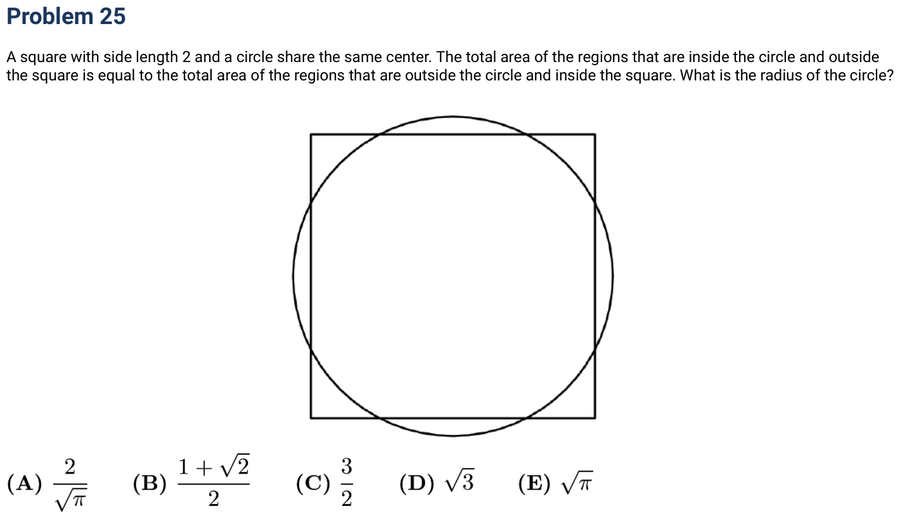
A square with side length 2 and a circle share the same center. The total area of the regions that are inside the circle and outside the square is equal to the total area of the regions that are outside the circle and inside the square. What is the radius of the circle?
Show answer
Answer: A — 2/√π.
Show hints
Hint 1 of 2
The overlap region (inside both) belongs to neither of the two 'sticking-out' areas. Both shapes share that exact same overlap — so when you set the two leftover bits equal, the overlap simply cancels.
Still stuck? Show hint 2 →
Hint 2 of 2
Don't try to find the messy crescent and corner pieces. Add the shared overlap back to both sides: the condition collapses to 'circle area = square area.'
Show solution
Approach: the shared overlap cancels ⇒ equal total areas
- Call the overlap (inside both shapes) I. Then inside-circle-but-outside-square = πr² − I, and outside-circle-but-inside-square = 4 − I (the square's area is 2² = 4).
- Setting them equal: πr² − I = 4 − I. The unknown overlap I cancels, leaving πr² = 4.
- So r² = 4/π and r = 2/√π = 2/√π.
- The big idea: 'sticking-out area on one side = sticking-out area on the other' is just a disguised way of saying the two whole shapes have equal area — because both share the same overlap, it never needs to be computed. Spotting that you can add the common piece back to both sides is the whole problem.
Mark:
· log in to save