Problem 15 · 2004 AMC 8
Medium
Counting & Probability
hex-rings
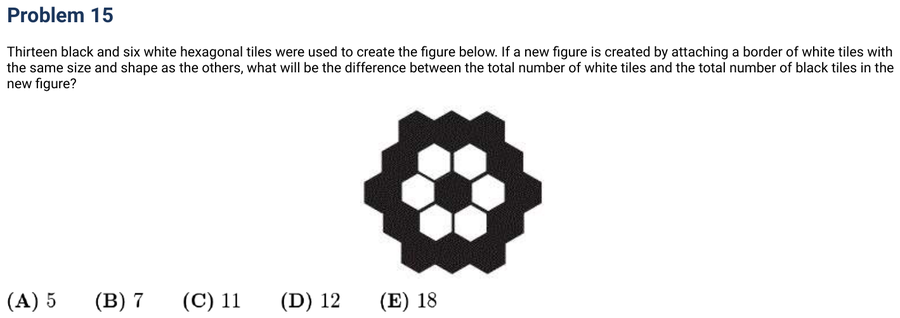
Thirteen black and six white hexagonal tiles were used to create the figure below. If a new figure is created by attaching a border of white tiles with the same size and shape as the others, what will be the difference between the total number of white tiles and the total number of black tiles in the new figure?
Show answer
Answer: C — 11.
Show hints
Hint 1 of 2
Don't recount the picture — look for the ring pattern. A center hex is surrounded by a ring of 6, then a ring of 12, and so on. Spot the rule for how big the next ring is, and you've solved it.
Still stuck? Show hint 2 →
Hint 2 of 2
The pattern is ring n holds 6n hexagons (6, 12, 18, …). The new border is the next ring out, so you only need its size — the inner tiles don't change.
Show solution
Approach: hexagonal ring counts
- The figure is rings around a center hex: ring 1 has 6, ring 2 has 12 — the rule is 6n. The new white border is ring 3, so it adds 6 × 3 = 18 tiles.
- Black stays put at 13. White becomes the old 6 plus the new 18 = 24.
- Difference: 24 − 13 = 11.
- Sanity check via the change: nothing black was added, and 18 new white tiles arrived, so the white-minus-black gap should jump by 18 from its old value. Old gap was 6 − 13 = −7; +18 gives −7 + 18 = 11. The two routes agree.
- This 6n ring idea reappears in hex-grid and honeycomb problems — concentric rings grow by a fixed step.
Mark:
· log in to save