Problem 14 · 2004 AMC 8
Hard
Geometry & Measurement
picks-theorem
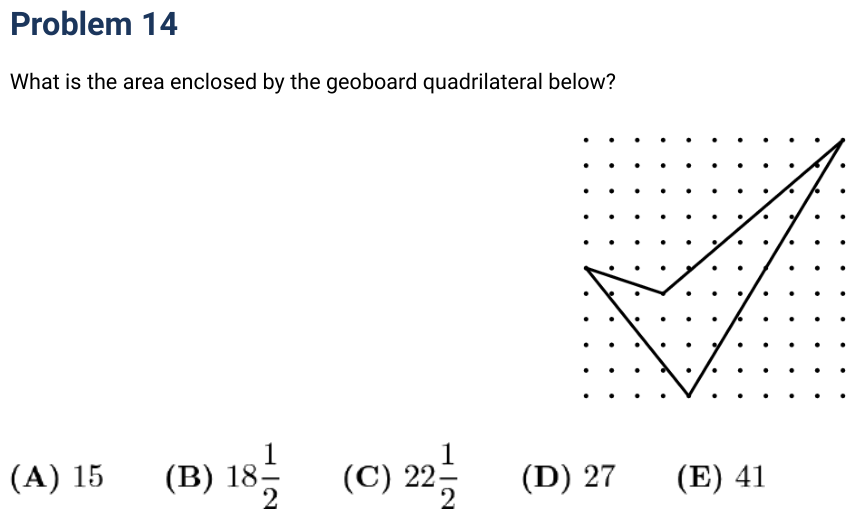
What is the area enclosed by the geoboard quadrilateral below?
Show answer
Answer: C — 22½.
Show hints
Hint 1 of 2
The shape is a slanted 'arrow' on dots — awkward to slice into clean triangles. When every corner sits on a grid point, you have a special tool that turns area into counting dots instead of measuring.
Still stuck? Show hint 2 →
Hint 2 of 2
That tool is Pick's Theorem: A = I + B/2 − 1, where I = dots strictly inside the shape and B = dots on the boundary. It works for any lattice polygon, no matter how jagged — that's its power.
Show solution
Approach: Pick's theorem (count the dots)
- Because all four corners are lattice points, skip slicing — just count dots. Boundary dots: the 4 corners plus 1 grid point an edge passes through, so B = 5. Interior dots: I = 21.
- Apply Pick: A = I + B/2 − 1 = 21 + 5/2 − 1 = 20 + 2½ = 22½.
- Why this transfers: Pick's Theorem reduces any geoboard-area problem to two careful counts — inside dots and edge dots — and the half-integer answer (the ½) is itself a hint that an even number of boundary dots wasn't in play.
Another way — box minus surrounding triangles (decomposition):
- Enclose the dart in the smallest grid rectangle that contains all four vertices.
- Subtract the right triangles (and any rectangles) trapped between the dart's slanted edges and the box's sides — each such triangle has area ½ · base · height with whole-number legs.
- What remains is the dart's area, 22½ — a good independent check on the dot-counting, which is easy to slip on.
Mark:
· log in to save