Problem 15 · 2025 AMC 8
Stretch
Counting & Probability
careful-countingcasework
Show answer
Answer: C — 16.
Show hints
Hint 1 of 2
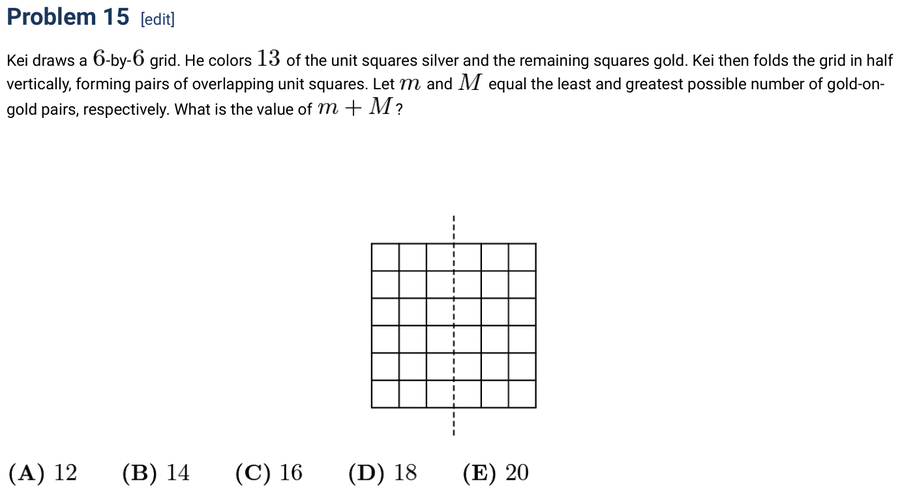
The fold turns 36 squares into 18 overlapping pairs. First, how many gold squares are there — and how does that compare to 18?
Still stuck? Show hint 2 →
Hint 2 of 2
There are more golds (23) than pairs (18), so some doubling-up is unavoidable. To make it rare, spread golds one-per-pair first; to make it common, glue golds together two-at-a-time.
Show solution
Approach: for an extreme, push the arrangement all the way to one side
- Count gold: 36 − 13 = 23 golds, and the fold makes 18 pairs. Since 23 > 18, gold-on-gold pairs can't be avoided entirely — that tension is the whole problem.
- Fewest (m): spread golds so each of the 18 pairs gets one first; that uses 18, and the remaining 23 − 18 = 5 are forced to land on already-gold squares. So m = 5.
- Most (M): instead pile golds two-to-a-pair. 23 = 2 × 11 + 1, so you fill 11 pairs fully with 1 gold left over. So M = 11.
- m + M = 5 + 11 = 16.
- Why this transfers: to find a min or max of a count, don't search randomly — deliberately arrange things to the extreme (spread out for the minimum, clump together for the maximum). The leftover after even distribution is exactly the pigeonhole surplus, 23 − 18 = 5.
Mark:
· log in to save