Problem 25 · 2003 AMC 8
Stretch
Geometry & Measurement
foldingareasquare-area
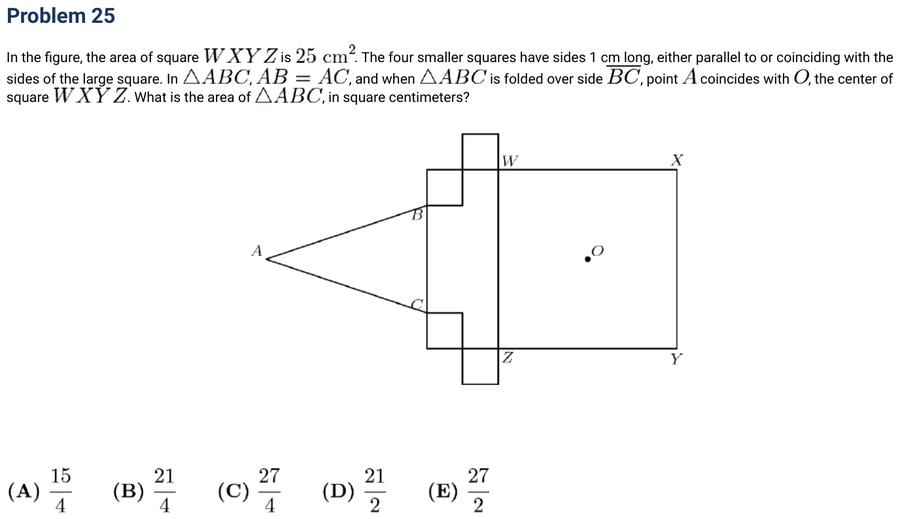
Show answer
Answer: C — 27/4 square centimeters.
Show hints
Hint 1 of 3
The whole problem is area = ½ × base × height — the base is BC and the height is A's distance from line BC. Find those two lengths.
Still stuck? Show hint 2 →
Hint 2 of 3
"Fold across BC and A lands on O" is the key: folding is a mirror reflection over line BC, so A and O are equally far from BC on opposite sides. That hands you the height.
Still stuck? Show hint 3 →
Hint 3 of 3
Set the side of the big square (from area 25) and use the unit squares to locate BC.
Show solution
Approach: turn the fold into a reflection to get the height
- Square WXYZ has area 25, so its side is √25 = 5 and its center O lies 5/2 = 2.5 cm in from side WZ.
- The base BC sits 2 cm outside WZ (the two stacked 1-cm squares), and it spans the gap between them, so BC = 5 − 2 = 3 cm. The distance from BC across to O is 2 + 2.5 = 9/2 cm.
- Here's the unlock: folding the triangle over line BC sends A exactly onto O, and a fold is a mirror reflection across that line. A mirror keeps distances, so A starts as far from BC as O ends up — both 9/2 cm. That 9/2 is the triangle's height (A is the apex, BC the base).
- Area = ½ × base × height = ½ × 3 × 9/2 = 27/4 cm².
- You'll see this again: a fold = a reflection across the fold line, and reflections preserve distance. So "folds onto point P" instantly tells you the original point is the mirror image of P — same perpendicular distance, opposite side.
Mark:
· log in to save