Problem 8 · 2000 AMC 8
Medium
Arithmetic & Operations
complementary-counting
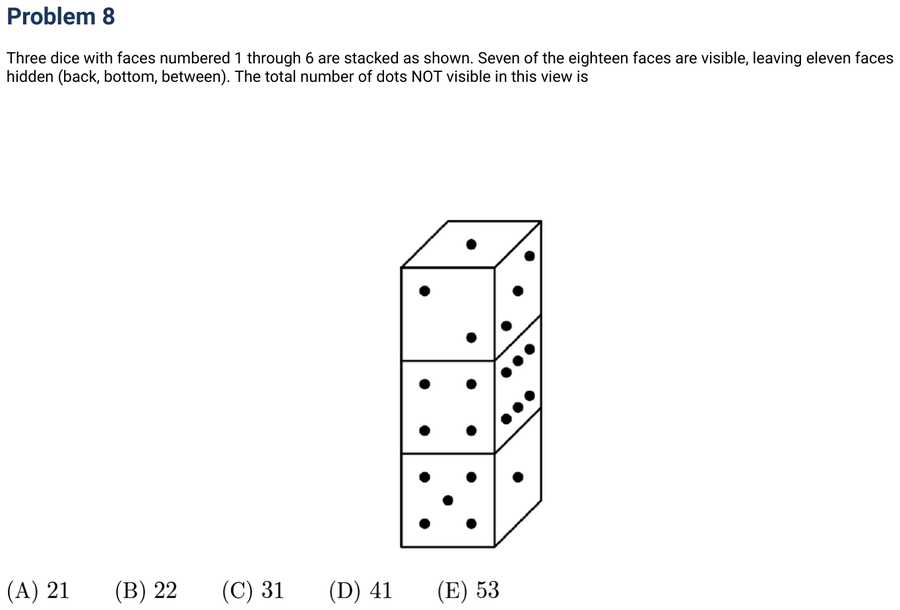
Show answer
Answer: D — 41.
Show hints
Hint 1 of 2
Eleven hidden faces is a lot to track — but every face, hidden or not, belongs to a die whose six faces total a *fixed* amount. So compute the grand total and subtract only what you CAN see.
Still stuck? Show hint 2 →
Hint 2 of 2
This is complementary counting: hidden = (everything) − (visible). It's far less error-prone than reasoning about which specific hidden faces are which.
Show solution
Approach: complementary counting — total dots minus visible dots
- One die's faces always sum to 1+2+3+4+5+6 = 21, so three dice hold 3 × 21 = 63 dots no matter how they're stacked.
- Add up only the seven visible faces: 1 + 1 + 2 + 3 + 4 + 5 + 6 = 22.
- Hidden dots = 63 − 22 = 41.
- You'll see it again: when the 'unseen' part is messy but the 'whole' is easy and fixed, count the whole and subtract the seen — the hard part cancels out.
Mark:
· log in to save