Don't read it as one long line — notice the signs themselves repeat in a short cycle. What does that cycle tell you about how to chunk the terms?
Still stuck? Show hint 2 →
Hint 2 of 2
The signs run +, +, − over and over. That's the group-by-the-pattern trick: chop into groups of three and add the group totals instead of the 12 separate terms.
Show solution
Approach: let the sign pattern choose the group size
The signs march +, +, − over and over — that's a clue to chop the 12 terms into groups of three, not to slog left to right.
Each group is (small + next − bigger). The first few: 1+2−3 = 0, 4+5−6 = 3, 7+8−9 = 6, 10+11−12 = 9. The group totals just climb by 3.
Add the four group totals: 0 + 3 + 6 + 9 = 18.
Why this transfers: when a long expression has a repeating sign or operation pattern, group by the length of that pattern — the messy string usually collapses into a short, regular list you can add in your head.
Another way — split into a clean +-sum and a -sum:
Add every term as if all were positive: 1+2+…+12 = 12×132 = 78.
The subtracted terms are 3, 6, 9, 12; we had counted them as +, so we must remove them twice: 2 × (3+6+9+12) = 2 × 30 = 60.
In the array shown below, three 3s are surrounded by 2s, which are in turn surrounded by a border of 1s. What is the sum of the numbers in the array?
1
1
1
1
1
1
1
1
2
2
2
2
2
1
1
2
3
3
3
2
1
1
2
2
2
2
2
1
1
1
1
1
1
1
1
A 5 × 7 array of numbers.
Show answer
Answer: C — The answer is 53.
Show hints
Hint 1 of 2
Before adding 35 numbers, look at the rows: some are exact copies of each other. Can you avoid adding the same row twice?
Still stuck? Show hint 2 →
Hint 2 of 2
Lean on the mirror symmetry — top matches bottom, 2nd matches 4th — so you only add three different rows and double two of them. (Or count how many 1s, 2s, and 3s there are.)
Show solution
Approach: use the mirror symmetry — only three rows are really different
The grid is a mirror image top-to-bottom: row 1 = row 5, and row 2 = row 4. So you only have to add up three rows, then double two of them.
Why this transfers: whenever a figure repeats or mirrors, add one copy of each distinct piece and multiply — the symmetry does most of the counting for you.
Another way — count how many of each number, not row by row:
The three 3s sit in the center: 3 × 3 = 9.
The 2s form a ring — five in row 2, five in row 4, two in the middle row = 12 twos: 12 × 2 = 24.
Everything else is a 1. The grid is 5×7 = 35 cells, so the 1s number 35 − 3 − 12 = 20, worth 20.
Unlike our digits, here position doesn't matter — a symbol is worth the same wherever it appears. So you only need to count how many of each kind.
Still stuck? Show hint 2 →
Hint 2 of 2
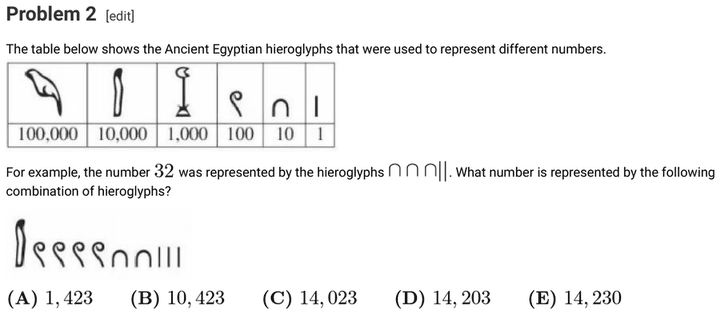
Tally each symbol type and add their table values, just like the example (three ∩ arches and two | strokes made 32). Notice there's no thousands symbol — what does that force the thousands digit to be?
Show solution
Approach: count each symbol type, then add the values
The key idea: in this Egyptian system a symbol's value doesn't depend on where it sits — you just count how many of each kind there are. So tally: one 10,000, four 100s, two 10s, three 1s.
Buffalo Shuffle-o is a card game in which all the cards are distributed evenly among all players at the start of the game. When Annika and 3 of her friends play Buffalo Shuffle-o, each player is dealt 15 cards. Suppose 2 more friends join the next game. How many cards will be dealt to each player?
Show answer
Answer: C — 10 cards each.
Show hints
Hint 1 of 2
More friends show up, but no new cards do. What's the one number here that stays exactly the same?
Still stuck? Show hint 2 →
Hint 2 of 2
The total number of cards is fixed. Find that total from the first game, then share it among the new, larger group.
Show solution
Approach: fixed total of cards, redistribute among players
The deck doesn't grow when friends arrive — the total number of cards is the thing that stays fixed. Find it: 4 players × 15 cards = 60 cards.
Now redeal that same 60 among 4 + 2 = 6 players: 60 ÷ 6 = 10 cards each.
Why this transfers: in any "shared evenly" problem, hunt for the quantity that doesn't change (here, the total). Pin it down once, then it answers every version of the question.
The two parentheses use the same three numbers — only the multiply sign moved. So the difference is really a contest between ‘8 × 4’ and ‘4 × 2’.
Still stuck? Show hint 2 →
Hint 2 of 2
Inside each parentheses, the rule is multiply before you add (order of operations). Evaluate each group, then subtract.
Show solution
Approach: order of operations: multiply before you add
The two parentheses look almost identical — same numbers 8, 4, 2 — but the × sits in a different spot. That's the whole trick: the answer comes from where the multiplication lands, not from the numbers themselves.
First parentheses: multiply first, so 8 × 4 + 2 = 32 + 2 = 34.
Second parentheses: 8 + 4 × 2 = 8 + 8 = 16.
Subtract: 34 − 16 = 18. Sanity check: the first group is much bigger because the big multiply (8 × 4) happens there, so a positive answer feels right.
Four friends do yardwork for their neighbors over the weekend, earning $15, $20, $25, and $40, respectively. They decide to split their earnings equally among themselves. In total how much will the friend who earned $40 give to the others?
Show answer
Answer: C — $15.
Show hints
Hint 1 of 2
“Splitting equally” means everyone ends at the average. The $40 friend only gives away the part that's above average — you don't need to track who receives it.
Still stuck? Show hint 2 →
Hint 2 of 2
Find the fair share (the average), then the $40 friend hands over exactly the amount they sit above it.
Show solution
Approach: everyone ends at the average; give away the surplus
Equal split means each friend ends with the average: (15 + 20 + 25 + 40) ÷ 4 = 100 ÷ 4 = $25.
The $40 friend keeps $25 and gives away the surplus above average: $40 − $25 = $15.
Why this transfers: in any “pool and share equally” problem, only the gaps from the average move — people above the average pay exactly their surplus, people below receive their shortfall. (Sanity check: those below average, $15 and $20, are short by $10 and $5 — together $15, matching what the $40 friend gives.)
Carrie has a rectangular garden that measures 6 feet by 8 feet. She plants the entire garden with strawberry plants. Carrie is able to plant 4 strawberry plants per square foot, and she harvests an average of 10 strawberries per plant. How many strawberries can she expect to harvest?
Show answer
Answer: D — 1920 strawberries.
Show hint
Hint 1
Follow the units like a relay: square feet → plants → strawberries. Each “per” is just a multiply, and the units hand off cleanly down the chain.
You'll see this again as: chained “per” rates just multiply, and the units cancel like a relay baton (sq ft → plants → berries). Tracking the words stops you from dividing when you should multiply.
Another way — regroup the easy factors first:
4 plants/sq ft × 10 berries/plant = 40 berries per square foot.
48 sq ft × 40 = 1920. Multiplying the small numbers together first keeps the arithmetic light.
Ike and Mike go into a sandwich shop with a total of $30.00 to spend. Sandwiches cost $4.50 each and soft drinks cost $1.00 each. Ike and Mike plan to buy as many sandwiches as they can and use the remaining money to buy soft drinks. Counting both soft drinks and sandwiches, how many items will they buy?
Show answer
Answer: D — 9 items.
Show hints
Hint 1 of 2
The plan is greedy: buy the expensive item until you can't, then the change becomes cheap items. So really only one question matters — how many sandwiches fit in $30?
Still stuck? Show hint 2 →
Hint 2 of 2
Sandwiches are the bottleneck; the leftover dollars convert 1-to-1 into sodas. Find the most sandwiches, then count whatever's left.
Show solution
Approach: greedy: max the expensive item, change becomes cheap items
Sandwiches are the only limiting purchase, so ask how many fit: $30 ÷ $4.50 = 6 with $3 left (a 7th would need $31.50 — too much).
Each soda is exactly $1, so the $3 leftover turns straight into 3 sodas — no arithmetic, just read it off.
Total items: 6 + 3 = 9.
Why this transfers: any "buy as many of A as possible, then fill with B" problem is a division-with-remainder — the quotient is the A count, the remainder funds the B's.
Don't add hundreds of numbers. Notice the odds and evens almost interleave: pair each even with the odd just above it (3 with 2, 5 with 4…) and every pair collapses to the same tiny number.
Still stuck? Show hint 2 →
Hint 2 of 2
The technique is pairing for a constant difference: line up the two lists so neighbors differ by 1, count the pairs, and the leftover term is what's sticking out at the start.
Show solution
Approach: pair adjacent odd/even terms
Regroup as 1 + (3 − 2) + (5 − 4) + … + (2019 − 2018). The 1 at the front has no even partner; every other odd pairs with the even just below it, and each pair equals 1.
The evens run 2, 4, …, 2018, which is 1009 numbers, so there are 1009 pairs — each contributing 1.
Total: 1 + 1009 = 1010. Sanity check: there are 1010 odds and 1009 evens, so one extra positive term survives — a positive answer near 1000, ruling out the negative choices instantly.
You'll see it again: when two long sequences are subtracted term-by-term, pairing turns the whole thing into "(how many pairs) × (the per-pair value)."
Every option uses the same four digits 2, 0, 1, 7 — the only difference is whether a + or a × sits between them. Adding keeps the digits; multiplying by 0 or 1 throws value away.
Still stuck? Show hint 2 →
Hint 2 of 2
Order of operations (PEMDAS): all multiplications happen before any addition. The biggest result comes from the option that multiplies least — here, the all-plus option.
Show solution
Approach: compare without full computation
The insight: all-addition (A) keeps every digit working for you; any × either zeroes out a term (anything × 0) or wastes one (anything × 1). So (A) should win — no arithmetic needed to see it leads.
Largest is (A) = 10. You'll see this again: when options differ only by an operation, ask which operation grows the value rather than computing all five.
What is the value of the expression √(16 · √(8 · √4)) ?
Show answer
Answer: C — 8.
Show hints
Hint 1 of 2
Nested radicals only untangle from the inside out — you can't simplify the outer √ until you know what's under it. Start at the deepest √4.
Still stuck? Show hint 2 →
Hint 2 of 2
Watch for a chain reaction: each square root turns into a whole number, which then makes the next product a perfect square too. That's the design of these problems.
Show solution
Approach: peel from the inside out
Start at the deepest layer: √4 = 2. This is the whole game — it makes the next product land on a perfect square.
Middle layer: √(8 · 2) = √16 = 4. Again a perfect square pops out.
Outer layer: √(16 · 4) = √64 = 8.
Why it works: contest nested radicals are built so every layer collapses to an integer. If yours doesn't, recheck the layer below.
Another way — exponents instead of roots:
Write each √ as a power of 1/2: the expression is (16 · (8 · 4^(1/2))^(1/2))^(1/2).
Innermost 4^(1/2) = 2, then 8·2 = 16 and 16^(1/2) = 4, then 16·4 = 64 and 64^(1/2) = 8 — same collapse, viewed as halving exponents.
When 0.000315 is multiplied by 7,928,564 the product is closest to which of the following?
Show answer
Answer: D — 2400.
Show hints
Hint 1 of 2
The answer choices jump by powers of 10 (210, 2100, 24000…), so you don't need a precise product — you only need the right size. Round each number to one digit.
Still stuck? Show hint 2 →
Hint 2 of 2
Separate the problem into two easy parts: multiply the leading digits (3 × 8), and separately track the powers of 10. That's the heart of scientific-notation estimation.
Show solution
Approach: estimate via scientific notation
Round to one significant figure: 0.000315 ≈ 3 × 10⁻⁴, and 7,928,564 ≈ 8 × 10⁶. The choices are spread by factors of 10, so this rounding is safe.
Multiply the fronts and add the exponents: (3 × 8) × 10−4 + 6 = 24 × 102 = 2400.
Why this transfers: whenever answer choices differ by orders of magnitude, estimate — nail the leading digit and the exponent, and ignore the rest.
Don't multiply the giant top out! The bottom is just an addition, which collapses to a small number — once you know it, look for that number hiding as factors inside the top.
Still stuck? Show hint 2 →
Hint 2 of 2
Technique: never expand a product when you can cancel. Factor the denominator and hunt for those same factors among the terms upstairs.
Show solution
Approach: collapse the sum, then cancel matching factors
First the easy part — the denominator is a sum, not a product: 1 + 2 + … + 8 = 36. (Pair 1+8, 2+7, 3+6, 4+5 = four 9's, or use 8·9/2.) And 36 = 6 · 6.
Now cancel instead of multiply: the top already has a 6, and 2 · 3 builds a second 6 — both 6's wipe out the denominator.
What survives on top: 1 · 4 · 5 · 7 · 8 = 4·5·7·8 = 1120.
Why this transfers: a fraction of products is an invitation to cancel, never to brute-force; reduce before you ever multiply.
Another way — cancel using 36 = 4 · 9:
Write 36 = 4 · 9. The top contains a 4 (cancel it) and a 9 living inside 3 · 6 = 18 = 9 · 2 (cancel the 9, leaving a 2 behind).
After canceling the 4, the 3, and replacing the 6 with 2: top = 1 · 2 · 2 · 5 · 7 · 8 = 1120 — same answer, different factors canceled.
The longest professional tennis match lasted a total of 11 hours and 5 minutes. How many minutes is that?
Show answer
Answer: C — 665 minutes.
Show hints
Hint 1 of 2
You can't just smush "11" and "5" together — hours and minutes are different-sized units. Convert everything to the SAME unit (minutes) before combining.
Still stuck? Show hint 2 →
Hint 2 of 2
Each hour is worth 60 minutes, so the hours become 11 × 60; the 5 loose minutes are already in the right unit and just get added on.
Show solution
Approach: convert to one common unit, then add
Rewrite the hours as minutes: 11 hours = 11 × 60 = 660 minutes.
Sanity check: the answer must be a bit more than 11 × 60 = 660, which rules out 605 and 655 instantly — whenever you convert a big-to-small unit, expect the number to grow.
You'll see this again as: any "mixed unit" problem (feet + inches, dollars + cents, weeks + days) — pick the smallest unit and convert the rest down to it.
Four students take an exam. Three of their scores are 70, 80, and 90. If the average of their four scores is 70, then what is the remaining score?
Show answer
Answer: A — 40.
Show hints
Hint 1 of 2
An average is just the total shared out equally — so multiplying the average back by the count un-shares it and hands you the TOTAL of all four scores.
Still stuck? Show hint 2 →
Hint 2 of 2
Once you know what all four must add to, the missing score is whatever's left after subtracting the three you already know.
Show solution
Approach: average × count rebuilds the total; the unknown is the leftover
The average is the total split 4 ways, so the total = average × count = 70 × 4 = 280.
Three scores are 70 + 80 + 90 = 240, so the missing score is 280 − 240 = 40.
Sanity check: two of the known scores (80, 90) sit ABOVE the average of 70, so something must sit well below to pull it back — a low score like 40 fits, an answer of 70 wouldn't.
You'll see this again as: "find the missing value given the mean" — always convert the average into a total first, then the unknown is just total minus the rest.
Another way — balance around the average:
Measure each score as a deviation from the target average 70: 70 is 0, 80 is +10, 90 is +20. The known scores are +30 total above 70.
For the average to land exactly on 70, the deviations must cancel, so the last score must be 30 BELOW 70: 70 − 30 = 40.
Billy's basketball team scored the following points over the course of the first 11 games of the season: 42, 47, 53, 53, 58, 58, 58, 61, 64, 65, 73. If his team scores 40 in the 12th game, which of the following statistics will show an increase?
Show answer
Answer: A — Range increases.
Show hints
Hint 1 of 2
The one new fact is that 40 sits below the old minimum of 42 — it's a new rock-bottom score. Adding a low value can't pull any average or middle up; ask which statistic actually grows when the bottom drops.
Still stuck? Show hint 2 →
Hint 2 of 2
Sort the five statistics by what they depend on: median/mean/mode react to where the bulk of the data sits, mid-range = (max+min)/2 averages the two ends, but range = max − min is the only one that widens when the minimum falls. Reason about each, don't recompute all of them.
Show solution
Approach: reason about which statistic a new low value can push up
40 is below the old low of 42, so it's the new minimum; the maximum (73) is unchanged.
Range = max − min: was 73 − 42 = 31, now 73 − 40 = 33 → increases. A wider gap is exactly what a new low creates.
Quick rule-out for the rest: mean drops (a below-average score lowers the average), median can only stay or fall (adding a small value never lifts the middle), mode stays 58, and mid-range = (max+min)/2 falls because min fell while max held.
Only the range increases. Why this transfers: before crunching numbers, sort statistics by what each one 'feels' — spread (range, mid-range) vs. center (mean, median, mode) — and a single new value usually moves only the ones it touches.
Harry and Terry are each told to calculate 8 − (2 + 5). Harry gets the correct answer. Terry ignores the parentheses and calculates 8 − 2 + 5. If Harry's answer is H and Terry's answer is T, what is the difference H − T?
Show answer
Answer: A — −10.
Show hints
Hint 1 of 2
A minus sign in front of a parenthesis flips the sign of everything inside. Dropping the parentheses doesn't just add the 5 differently — it changes 8 − 2 − 5 into 8 − 2 + 5.
Still stuck? Show hint 2 →
Hint 2 of 2
Compute both values; the gap between them is exactly twice the number that got its sign flipped (the 5).
Show solution
Approach: subtracting a group flips every sign inside it
Harry (correct): H = 8 − (2 + 5) = 8 − 7 = 1. Subtracting the whole group means subtracting both the 2 and the 5.
Terry (drops the parentheses): T = 8 − 2 + 5 = 6 + 5 = 11. Now the 5 is added instead of subtracted.
H − T = 1 − 11 = −10.
Why this transfers: only the 5 changed roles — it went from −5 to +5, a swing of 10. That's why the answers differ by exactly 10. Whenever you remove parentheses after a minus sign, every term inside must flip.
Paul owes Paula 35 cents and has a pocket full of 5-cent coins, 10-cent coins, and 25-cent coins that he can use to pay her. What is the difference between the largest and the smallest number of coins he can use to pay her?
Show answer
Answer: E — 5 coins difference.
Show hints
Hint 1 of 2
"Most coins" and "fewest coins" are opposite greedy goals for the same total: to pile up the most, use the smallest coin every time; to use the fewest, grab the biggest coin that still fits.
Still stuck? Show hint 2 →
Hint 2 of 2
Find each count separately, then subtract.
Show solution
Approach: two opposite greedy choices
Most coins ⇒ use only the smallest coin (5 cents): 35 ÷ 5 = 7 coins.
Fewest coins ⇒ grab the largest coins first: 25 + 10 = 35 uses just 2 coins.
Difference: 7 − 2 = 5.
You'll see this again: "maximize the count" and "minimize the count" almost always mean "use the smallest pieces" vs. "use the largest pieces" — a greedy idea that works for making change, stamps, and weights.
Isabella had a week to read a book for a school assignment. She read an average of 36 pages per day for the first three days and an average of 44 pages per day for the next three days. She then finished the book by reading 10 pages on the last day. How many pages were in the book?
Show answer
Answer: B — 250 pages.
Show hints
Hint 1 of 2
An average is a stand-in for the real total: "36 pages a day for 3 days" carries the same total as 36 + 36 + 36. So average × days rebuilds each block's pages.
Still stuck? Show hint 2 →
Hint 2 of 2
Add the three blocks: first 3 days, next 3 days, and the final single day.
Show solution
Approach: average × count rebuilds each block's total
First three days: 36 × 3 = 108 pages (the average undoes back into a total).
Next three days: 44 × 3 = 132 pages.
Total: 108 + 132 + 10 = 250.
Key idea you'll reuse: total = average × count. Knowing any two of {total, average, count} gives the third — the same lever solves "find the missing test score" problems.
Six rectangles each with a common base width of 2 have lengths of 1, 4, 9, 16, 25, and 36. What is the sum of the areas of the six rectangles?
Show answer
Answer: D — 182.
Show hints
Hint 1 of 2
Every rectangle shares the same width 2, so instead of computing six areas and adding, factor the 2 out: total = 2 × (sum of all the lengths). One multiply at the end.
Still stuck? Show hint 2 →
Hint 2 of 2
Bonus: the lengths 1, 4, 9, 16, 25, 36 are the first six perfect squares.
Show solution
Approach: factor out the common width (distributive property)
All widths equal 2, so total area = 2×1 + 2×4 + … + 2×36 = 2 × (1 + 4 + 9 + 16 + 25 + 36).
The lengths are the first six squares; their sum is 91.
Total area: 2 × 91 = 182.
Why this transfers: a common factor in every term can always be pulled outside the sum — that's the distributive property doing the heavy lifting, turning six multiplications into one.
The first AMC 8 was given in 1985 and it has been given annually since that time. Samantha turned 12 years old the year that she took the seventh AMC 8. In what year was Samantha born?
Show answer
Answer: A — 1979.
Show hints
Hint 1 of 2
Watch the off-by-one: the 1st contest was 1985, so the 7th is only 6 years later (not 7). Add the gap, not the count.
Still stuck? Show hint 2 →
Hint 2 of 2
Once you have the year she took it, subtract her age to land on her birth year.
Show solution
Approach: fencepost-careful year arithmetic
The 7th AMC 8 is 6 gaps after the 1st: 1985 + 6 = 1991. (1st→7th is 6 steps, not 7 — the classic fencepost.)
She turned 12 that year, so she was born 1991 − 12 = 1979.
Reusable caution: the n-th item in a yearly sequence starting at year Y falls in Y + (n − 1). Counting endpoints instead of gaps is the most common slip in these problems.
What is the value of 4 · (−1 + 2 − 3 + 4 − 5 + 6 − 7 + … + 1000)?
Show answer
Answer: E — 2000.
Show hints
Hint 1 of 2
Don't add left to right — the signs alternate, so reach for a partner instead. Pair each odd with the even right after it: (−1 + 2), (−3 + 4)…. What does every pair equal?
Still stuck? Show hint 2 →
Hint 2 of 2
Pairing turns a long alternating sum into "(value of one pair) × (number of pairs)." The only real work is counting how many pairs there are.
Show solution
Approach: pair each −odd with the next +even
Group as (−1 + 2) + (−3 + 4) + … + (−999 + 1000). Each pair (−k + (k+1)) collapses to exactly +1 — the alternating signs were doing all the work.
The numbers 1 through 1000 form 1000 ÷ 2 = 500 pairs, so the parenthesis is just 500.
Multiply by the outside 4: 4 × 500 = 2000.
Sanity check: 500 small +1's, then quadrupled — landing near 2000 (not 0 or 500) makes sense; choices −10 and 0 ignore the ×4 and the leftover positive.
Hammie is in the 6th grade and weighs 106 pounds. His quadruplet sisters are tiny babies and weigh 5, 5, 6, and 8 pounds. Which is greater, the average (mean) weight of these five children or the median weight, and by how many pounds?
Show answer
Answer: E — Average, by 20.
Show hints
Hint 1 of 2
One giant value (106) sits among four tiny ones. The median ignores how big that outlier is — it only cares about position — but the mean gets dragged toward it. So expect the average to win.
Still stuck? Show hint 2 →
Hint 2 of 2
Median = middle of the sorted list (resistant to outliers); mean = total ÷ count (sensitive to outliers). One lonely large number is what separates them.
Show solution
Approach: find the resistant median, then the outlier-pulled mean
Sort the weights: 5, 5, 6, 8, 106. The median is the middle one = 6 — notice the 106's size never mattered, only that it sits at the end.
Mean = (5 + 5 + 6 + 8 + 106) ÷ 5 = 130 ÷ 5 = 26 — the lone 106 hauls the average up to 26.
The average is larger, by 26 − 6 = 20 pounds.
You'll see this again: whenever one value is wildly bigger than the rest, the mean exceeds the median — that's exactly why incomes are reported by median, not average.
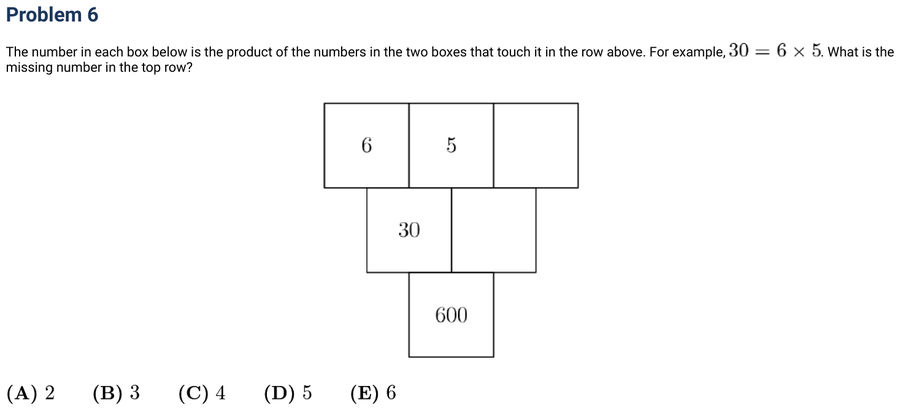
The number in each box below is the product of the numbers in the two boxes that touch it in the row above. For example, 30 = 6 × 5. What is the missing number in the top row?
Show answer
Answer: C — 4.
Show hints
Hint 1 of 2
You can't fill the top box directly — but you can work backwards. The bottom 600 came from multiplying, so a missing factor is found by dividing. Which box can you unlock with 600 ÷ 30?
Still stuck? Show hint 2 →
Hint 2 of 2
In a product pyramid, multiply to go down and divide to go back up. Solve the box you have the most info about first, then chain to the unknown.
On February 13 The Oshkosh Northwester listed the length of daylight as 10 hours and 24 minutes, the sunrise was 6:57 AM, and the sunset as 8:15 PM. The length of daylight and sunrise were correct, but the sunset was wrong. When did the sun really set?
Show answer
Answer: B — 5:21 PM.
Show hints
Hint 1 of 2
The wrong sunset (8:15 PM) is a trap — ignore it completely. Daylight is just the gap between sunrise and sunset, so sunset = sunrise + daylight.
Still stuck? Show hint 2 →
Hint 2 of 2
Add time in two clean stages: whole hours first, then the leftover minutes. Adding 10 h 24 min all at once invites a carrying mistake.
Show solution
Approach: sunset = sunrise + daylight, added in stages
Daylight is the stretch from sunrise to sunset, so just add 10 h 24 min to the 6:57 AM sunrise (the listed 8:15 PM is a decoy).
Add the 10 whole hours first: 6:57 AM + 10 h lands at 4:57 PM.
Now add the 24 minutes: 4:57 + 24 min = 5:21 PM.
Splitting hours from minutes is the reusable trick for any clock arithmetic — it keeps the carry into the next hour easy to see.
Isabella must take four 100-point tests in her math class. Her goal is to achieve an average grade of 95 on the tests. Her first two test scores were 97 and 91. After seeing her score on the third test, she realized she can still reach her goal. What is the lowest possible score she could have made on the third test?
Show answer
Answer: B — 92.
Show hints
Hint 1 of 2
Averages are slippery to push around — convert the goal into a fixed total. An average of 95 over 4 tests is the same as needing a certain number of total points.
Still stuck? Show hint 2 →
Hint 2 of 2
To make ONE score as small as possible, give the other score as much as it can take. The 4th test is the helper here, and it's capped at 100 — this "push the other to its limit" idea is the heart of every min/max problem.
Show solution
Approach: turn the average into a point budget, then max the helper
Average 95 over 4 tests means a total of 4 × 95 = 380 points — a fixed budget is far easier to reason about than a moving average.
She's already used 97 + 91 = 188, leaving 380 − 188 = 192 to split between tests 3 and 4.
To make test 3 smallest, let test 4 grab the most it can: 100. Then test 3 = 192 − 100 = 92.
The transferable move: to minimize one quantity in a fixed total, maximize the others (and vice versa). The cap (here, 100 points) is what makes the answer finite.
The mean, median, and unique mode of the positive integers 3, 4, 5, 6, 6, 7, and x are all equal. What is the value of x?
Show answer
Answer: D — 11.
Show hints
Hint 1 of 2
Three things must be equal, but one of them is already pinned down no matter what x is. Which one? The mode — 6 is the only value that already repeats, and x can't be allowed to create a tie.
Still stuck? Show hint 2 →
Hint 2 of 2
Once you know the common value, the rest is bookkeeping: mean = that value turns the whole thing into one equation, since mean fixes the total.
Show solution
Approach: pin the mode first — it forces the common value, then mean gives x
Start with the most rigid clue. "Unique mode" means exactly one value repeats; only 6 does, so the mode is locked at 6 (and x must avoid 3, 4, 5, 7 or there'd be a tie). So all three equal 6.
Now mean = 6 pins the total: 7 numbers averaging 6 must sum to 7 × 6 = 42.
The six known values sum to 31, so x = 42 − 31 = 11.
Check the median: sorted, the list is 3, 4, 5, 6, 6, 7, 11 — the middle (4th) value is 6 ✓. Lesson: in mean/median/mode puzzles, attack the most-constrained statistic first; it usually reveals the target number.
Here is a list of the numbers of fish that Tyler caught in nine outings last summer: 2, 0, 1, 3, 0, 3, 3, 1, 2. Which statement about the mean, median, and mode is true?
Show answer
Answer: C — mean < median < mode.
Show hints
Hint 1 of 2
Sorting the list does all three jobs at once: it puts the middle value (median) in plain sight, makes the repeated value (mode) easy to spot, and the mean is just the total split 9 ways.
Still stuck? Show hint 2 →
Hint 2 of 2
Mode = the value that appears most, median = the middle one (the 5th of 9), mean = sum ÷ 9 — three different ways to say "a typical value."
Show solution
Approach: sort once, then read off all three
Sorted: 0, 0, 1, 1, 2, 2, 3, 3, 3.
Mode = 3 (it shows up three times). Median = the 5th value = 2. Mean = 15/9 = 5/3 ≈ 1.67.
So 5/3 < 2 < 3 ⇒ mean < median < mode.
Intuition: the two zero-fish days drag the mean down below the middle value, which is why the mean ends up smallest here.
What time was it 2011 minutes after midnight on January 1, 2011?
Show answer
Answer: D — January 2 at 9:31 AM.
Show hints
Hint 1 of 2
2011 minutes is more than one day — a full day is only 24×60 = 1440 minutes. Peel off one whole day first, and the leftover tells you the clock time.
Still stuck? Show hint 2 →
Hint 2 of 2
Convert minutes to hours-and-minutes by dividing by 60: the quotient is hours, the remainder is the minutes.
Show solution
Approach: peel off a full day, then convert the leftover
One day = 1440 minutes. 2011 − 1440 = 571 minutes into the next day, January 2.
571 ÷ 60 = 9 remainder 31, so that's 9 hours 31 minutes after midnight = 9:31 AM on January 2.
Worth keeping: clock and calendar questions are all about remainders — throw away whole days (1440 min) or whole 12-hour blocks, and only the remainder decides the answer.
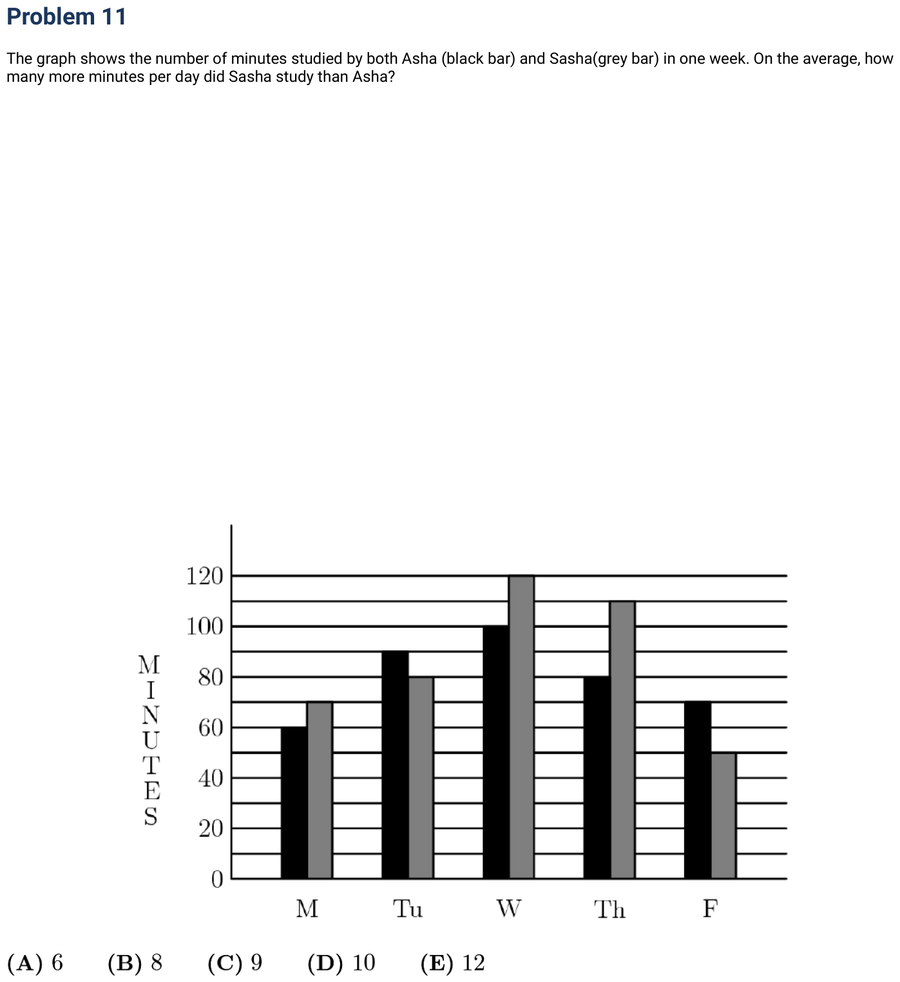
The graph shows the number of minutes studied by both Asha (black bar) and Sasha (grey bar) in one week. On the average, how many more minutes per day did Sasha study than Asha?
Show answer
Answer: A — 6 minutes.
Show hints
Hint 1 of 2
The average difference equals the difference of the totals, so you can just compare the two weekly totals — the days some days are negative is fine, they cancel in the total.
Still stuck? Show hint 2 →
Hint 2 of 2
Average daily gap = (Sasha's total for the week − Asha's total) ÷ 5 days.
Show solution
Approach: compare weekly totals, then divide by the number of days
Read each day's gap (Sasha − Asha): +10, −10, +20, +30, −20. They add to +30 for the week — the negatives (days Asha studied more) correctly subtract.
Spread that over 5 days: 30 ÷ 5 = 6 minutes per day.
Why this works: averaging the daily differences is the same as (sum of differences)÷5, which equals (Sasha's weekly total − Asha's weekly total)÷5 — you never have to average each person separately.
At Euclid Middle School the mathematics teachers are Miss Germain, Mr. Newton, and Mrs. Young. There are 11 students in Mrs. Germain's class, 8 students in Mr. Newton's class, and 9 students in Mrs. Young's class taking the AMC 8 this year. How many mathematics students at Euclid Middle School are taking the contest?
Show answer
Answer: C — 28.
Show hints
Hint 1 of 2
Each class is a separate group of students, and no student is in two of these classes — so the total is just the three counts joined together.
Still stuck? Show hint 2 →
Hint 2 of 2
When groups don't overlap, the whole equals the sum of the parts. Add them.
Show solution
Approach: add disjoint groups
The three classes don't share students, so the total is just 11 + 8 + 9 = 28.
Why this transfers: ‘how many altogether’ is a plain sum only when the groups can't overlap. The moment groups could share members (students in two clubs, say), you'd need to subtract the overlap — that's the inclusion-exclusion idea you'll meet later.
What is the sum of the mean, median, and mode of the numbers 2, 3, 0, 3, 1, 4, 0, 3?
Show answer
Answer: C — 7.5.
Show hints
Hint 1 of 2
Sorting the list once does double duty: it lines up the middle for the median and stacks the repeats so the mode jumps out. Do that single step before anything else.
Still stuck? Show hint 2 →
Hint 2 of 2
Mean / median / mode each answer a different question — the fair share, the middle, the most popular. Sort first, then read two of them straight off the list.
Show solution
Approach: sort once, then read off median and mode
Sort: 0, 0, 1, 2, 3, 3, 3, 4. Now everything is easy to see.
Mode (most repeated) = 3, sitting in an obvious cluster. Median (middle): with 8 numbers, average the 4th and 5th: (2 + 3)/2 = 2.5.
Mean (fair share): sum = 16, so 16/8 = 2.
Total: 3 + 2.5 + 2 = 7.5.
Why this transfers: the three M's are easy to mix up. Naming what each one does — popular, middle, fair-share — keeps you from grabbing the wrong one under time pressure.
Alice needs to replace a light bulb located 10 centimeters below the ceiling in her kitchen. The ceiling is 2.4 meters above the floor. Alice is 1.5 meters tall and can reach 46 centimeters above the top of her head. Standing on a stool, she can just reach the light bulb. What is the height of the stool, in centimeters?
Show answer
Answer: B — 34 cm.
Show hints
Hint 1 of 2
Everything stacks up to the same total height. From the floor: stool + Alice + her reach must equal the height of the bulb. The stool is the only missing piece.
Still stuck? Show hint 2 →
Hint 2 of 2
First make every measurement use the same unit — mixing meters and centimeters is the classic trap here. Turn the meters into centimeters before you add anything.
Show solution
Approach: stack the heights, convert units first
Convert to centimeters so nothing is mismatched: ceiling 240, Alice 150. The bulb hangs 10 below the ceiling, so it's at 240 − 10 = 230 cm.
Standing on the stool, Alice reaches stool + 150 + 46 = stool + 196. That just touches the bulb at 230.
Stool = 230 − 196 = 34 cm.
Why this transfers: in any ‘how tall / how far’ word problem, your very first move is to put all lengths in one unit. The numbers 2.4 m and 150 cm look ready to subtract — they aren't.
The average age of the 6 people in Room A is 40. The average age of the 4 people in Room B is 25. If the two groups are combined, what is the average age of all the people?
Show answer
Answer: D — 34.
Show hints
Hint 1 of 2
You can't just average 40 and 25 — Room A has more people, so it pulls the result toward 40.
Still stuck? Show hint 2 →
Hint 2 of 2
Rebuild each total with total = average × count, then pool everything: combined average = all ages ÷ all people.
Show solution
Approach: recover totals, then pool
An average hides a total: Room A is 6 · 40 = 240 years, Room B is 4 · 25 = 100 years. Now you have real piles you can combine.
Pool them: 340 years across 10 people = 340 ÷ 10 = 34.
Why this transfers: the naive midpoint (40+25)÷2 = 32.5 is the trap answer A — a combined average leans toward the bigger group, so it lands at 34, closer to 40.
Theresa's parents have agreed to buy her tickets to see her favorite band if she spends an average of 10 hours per week helping around the house for 6 weeks. For the first 5 weeks she helps around the house for 8, 11, 7, 12 and 10 hours. How many hours must she work for the final week to earn the tickets?
Show answer
Answer: D — 12 hours.
Show hints
Hint 1 of 2
An average is a promise about the total: averaging 10 over 6 weeks means 60 hours total, no matter how they're split up. So don't average — just chase the total.
Still stuck? Show hint 2 →
Hint 2 of 2
This is the target-total trick: average × count = total needed, then subtract what's banked.
Show solution
Approach: convert the average into a required total
Turn the average into a goal: averaging 10 hours over 6 weeks means a total of 6 · 10 = 60 hours. That's the whole game — how the hours are spread doesn't matter.
Bank so far: 8 + 11 + 7 + 12 + 10 = 48 hours.
Final week = 60 − 48 = 12.
You'll see this again: any 'what's needed to hit an average' problem — final exam scores, gas mileage — collapses the moment you write average × count = total.
Another way — balance the surpluses and deficits:
Score each week against the goal of 10: −2, +1, −3, +2, 0. They net to −2.
She's 2 hours behind, so the last week must beat 10 by 2: 10 + 2 = 12.
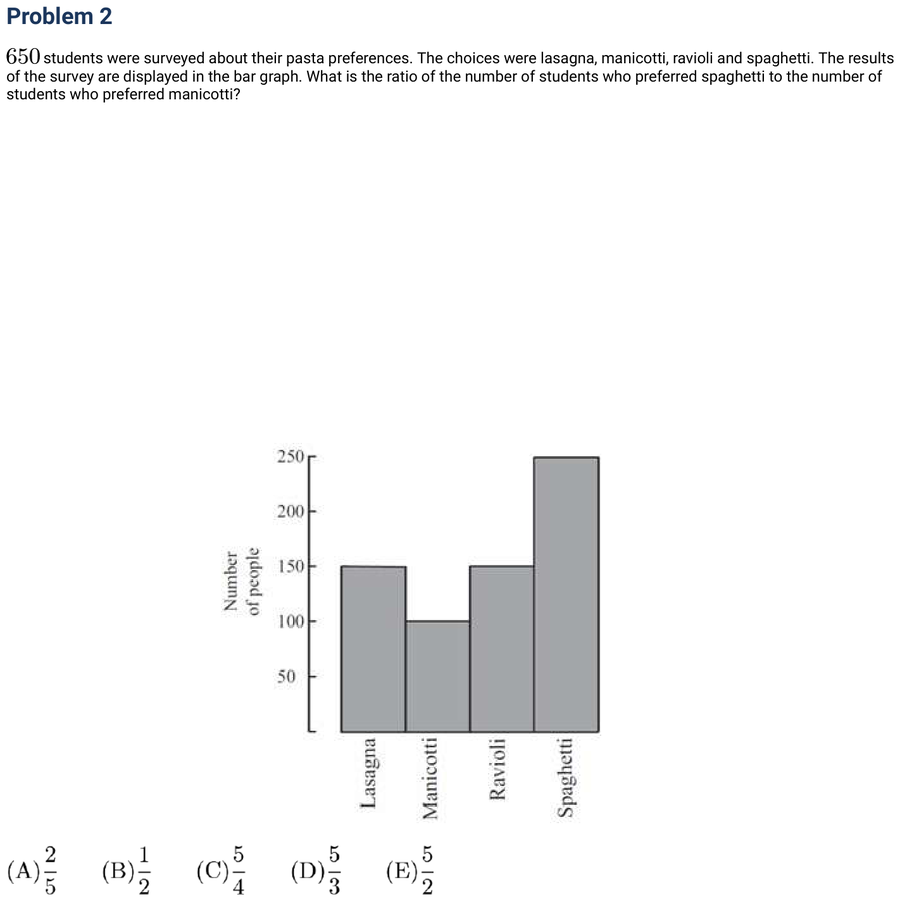
650 students were surveyed about their pasta preferences. The choices were lasagna, manicotti, ravioli and spaghetti. The results of the survey are displayed in the bar graph. What is the ratio of the number of students who preferred spaghetti to the number of students who preferred manicotti?
Show answer
Answer: E — 5/2.
Show hints
Hint 1 of 2
The 650 total and the other two foods are decoys — a ratio only needs the two bars it asks about. Read the height of just the spaghetti and manicotti bars.
Still stuck? Show hint 2 →
Hint 2 of 2
A ratio question is a 'pull out only what's asked' question: ignore every number the comparison doesn't mention.
Show solution
Approach: read the two relevant bars, then reduce
Read only the two bars named: spaghetti = 250, manicotti = 100. (The 650 total and the other foods are scenery.)
Ratio = 250 : 100. Cancel the common 50: that's 5 : 2, i.e. 5/2.
Sanity check: spaghetti is clearly more than double manicotti, and 5/2 = 2.5, so it points the right way.
Chandler wants to buy a 500 dollar mountain bike. For his birthday, his grandparents send him 50 dollars, his aunt sends him 35 dollars and his cousin gives him 15 dollars. He earns 16 dollars per week for his paper route. He will use all of his birthday money and all of the money he earns from his paper route. In how many weeks will he be able to buy the mountain bike?
Show answer
Answer: B — 25 weeks.
Show hints
Hint 1 of 2
The gift money is a head start — subtract it first so only the paper-route money has to close the gap. Don't make the weekly route 'pay' for what's already in hand.
Still stuck? Show hint 2 →
Hint 2 of 2
Gap ÷ rate: figure out how much is still missing, then divide by the per-week amount.
Show solution
Approach: close the remaining gap at the weekly rate
Birthday head start: 50 + 35 + 15 = 100. That shrinks the goal to 500 − 100 = 400 left to earn.
Each week the route adds 16, so weeks = 400 ÷ 16 = 25.
Pattern to keep: 'how long to reach a goal' is almost always (goal − what you already have) ÷ (rate per step). Knock out the head start before dividing.
The average age of 5 people in a room is 30 years. An 18-year-old person leaves the room. What is the average age of the four remaining people?
Show answer
Answer: D — 33.
Show hints
Hint 1 of 2
You can't average ages directly when someone leaves — rebuild the total first. An average is just a total in disguise: 5 people at 30 means 150 years of age in the room.
Still stuck? Show hint 2 →
Hint 2 of 2
Average problems run on the total: convert average→total, adjust the total, then divide by the new count.
Show solution
Approach: work with the total of ages, not the averages
Convert to a total: 5 people averaging 30 means 5 · 30 = 150 years all together.
The 18-year-old walks out, taking 18 with them: 150 − 18 = 132 years among the 4 left.
New average = 132 ÷ 4 = 33.
Intuition check: removing someone younger than average should pull the average up — and 33 > 30, as expected.
Another way — see why it rises by 3:
The leaver was 18 — that's 12 below the old average of 30.
Those 12 'missing low' years get redistributed over the 4 who remain: 12 ÷ 4 = 3 added each, so 30 + 3 = 33.
Mindy made three purchases for $1.98, $5.04, and $9.89. What was her total, to the nearest dollar?
Show answer
Answer: D — $17.
Show hints
Hint 1 of 2
"To the nearest dollar" is permission to throw away the pennies — you don't need an exact total. Each price is already hugging a whole dollar.
Still stuck? Show hint 2 →
Hint 2 of 2
Rounding first, then adding, is far lighter than adding first, then rounding — and here it gives the same answer because each price is so close to a whole number.
Show solution
Approach: round each first, then add
The question only wants the nearest dollar, so round before doing any arithmetic: $1.98 → 2, $5.04 → 5, $9.89 → 10.
2 + 5 + 10 = 17.
Why this is safe: each price is within about 10 cents of a whole dollar, so the rounding errors are tiny and can't push the sum across a dollar boundary. When numbers sit close to round values, round first — you'll see this trick on every "estimate the total" question.
On the AMC 8 contest Billy answers 13 questions correctly, answers 7 questions incorrectly and doesn't answer the last 5. What is his score? (right = +1, wrong or N/A = +0)
Show answer
Answer: C — 13.
Show hints
Hint 1 of 2
Read the scoring rule carefully: wrong and blank both earn the same as each other — zero. So all the "7 wrong" and "5 blank" numbers are decoys.
Still stuck? Show hint 2 →
Hint 2 of 2
When points come only from one category, ignore every other number in the problem. The 7 and the 5 are there to tempt you into subtracting.
Show solution
Approach: ignore the zero-point categories
Wrong = 0 points and blank = 0 points, so only the 13 correct matter.
13 × 1 = 13.
Watch out: the answer choices 6 (13−7) and 1 (13−7−5) are traps for kids who think wrong answers cost points — many contests do penalize, but this one doesn't. Always score by the rule you're actually given.
Connie multiplies a number by 2 and gets 60 as her answer. However, she should have divided the number by 2 to get the correct answer. What is the correct answer?
Show answer
Answer: B — 15.
Show hints
Hint 1 of 2
The 60 isn't the answer — it's a clue about the hidden starting number. What number, doubled, gives 60?
Still stuck? Show hint 2 →
Hint 2 of 2
Two stages: first undo the wrong operation to recover the original, then do the right one. Don't skip straight to the answer.
Show solution
Approach: undo the mistake, then redo correctly
The number 60 is the result of multiplying by 2, so the original number is 60 ÷ 2 = 30. (Undo the wrong step.)
Now do what she should have done to that original: 30 ÷ 2 = 15.
Why this transfers: in any 'someone did the wrong operation' puzzle, run the wrong operation backward to find the true input first — never apply the correct operation to the wrong answer (240 and 120 are the traps for doing exactly that).
Soda is sold in packs of 6, 12 and 24 cans. What is the minimum number of packs needed to buy exactly 90 cans of soda?
Show answer
Answer: B — 5 packs.
Show hints
Hint 1 of 2
Fewest packs means each pack should carry as many cans as possible — so reach for the biggest box first.
Still stuck? Show hint 2 →
Hint 2 of 2
This is the 'greedy' idea: grab the largest unit that still fits, then fill the leftover with the next size down.
Show solution
Approach: greedy — biggest packs first
Start with the 24-packs: three of them give 72 cans, leaving 90 − 72 = 18 to cover.
Fill 18 with the next sizes: one 12-pack and one 6-pack.
Total packs: 3 + 1 + 1 = 5.
Why greedy is safe here: 6, 12, and 24 each divide the next, so loading up on the biggest box never leaves a remainder you can't fill. (With odd sizes like 5 and 7, greedy can fail — worth remembering.)
An athlete's target heart rate, in beats per minute, is 80% of the theoretical maximum heart rate. The maximum heart rate is found by subtracting the athlete's age, in years, from 220. To the nearest whole number, what is the target heart rate of an athlete who is 26 years old?
Show answer
Answer: B — 155 bpm.
Show hints
Hint 1 of 2
Read the recipe in order, and resist the tempting shortcut. The 80% applies to the maximum — which you must build first — not to 220. Doing the steps out of order is the trap the problem is testing.
Still stuck? Show hint 2 →
Hint 2 of 2
The skill is respecting operation order in word problems: build each quantity the sentence describes before combining. 'Percent of (something you compute)' — compute the something first.
Show solution
Approach: build the max, then take 80%
Step 1 — the maximum: 220 − 26 = 194. This must come first; 80% of 194 is a very different number from 80% of 220.
Step 2 — the target: 0.80 × 194 = 155.2, which rounds to 155.
Why eliminate 176? That's 80% of 220 — the classic 'skipped the subtraction' answer the test bakes in to catch the rush.
The average of the five numbers in a list is 54. The average of the first two numbers is 48. What is the average of the last three numbers?
Show answer
Answer: D — 58.
Show hints
Hint 1 of 2
An average hides a total inside it (average × count = sum). Convert each average back into its sum — sums you can add and subtract, averages you cannot.
Still stuck? Show hint 2 →
Hint 2 of 2
The key move is the average ↔ sum conversion: never combine averages directly. Turn them into totals, do the arithmetic, then convert back at the very end.
Show solution
Approach: work in totals, convert back at the end
Recover the totals: all five sum to 5 × 54 = 270; the first two sum to 2 × 48 = 96. This is the whole trick — averages can't be subtracted, but the sums behind them can.
So the last three sum to 270 − 96 = 174, and their average is 174 ÷ 3 = 58.
Sanity check: the first two pulled the average down (48 < 54), so the last three must pull it back up — above 54, and 58 is. Common slip: averaging 54 and 48 gives 51, which is wrong because the groups have different sizes.
Another way — balance around the mean:
The two low numbers each sit 54 − 48 = 6 below the overall mean, a deficit of 2 × 6 = 12.
The three remaining numbers must cover that deficit, so together they sit 12 above the mean, i.e. 12 / 3 = 4 above each. Their average is 54 + 4 = 58.
Handy Aaron helped a neighbor 114 hours on Monday, 50 minutes on Tuesday, from 8:20 to 10:45 on Wednesday morning, and a half-hour on Friday. He is paid $3 per hour. How much did he earn for the week?
Show answer
Answer: E — $15.
Show hints
Hint 1 of 2
Everything is in different units (hours, minutes, a clock span). Pick one currency — minutes — and convert every day into it before adding anything. Mixing units is the only thing that makes this problem hard.
Still stuck? Show hint 2 →
Hint 2 of 2
The discipline is convert to a common unit first: get all times into minutes, total them, convert once to hours, then apply the rate. One conversion at the end beats four fiddly fraction additions.
Show solution
Approach: total the minutes, then pay
Convert each day to minutes: Mon 1¼ hr = 75, Tue = 50, Wed 8:20–10:45 = 2 hr 25 min = 145, Fri ½ hr = 30.
Add: 75 + 50 + 145 + 30 = 300 minutes = exactly 5 hours. Working in minutes keeps everything a whole number — no common denominators needed.
Pay: 5 hr × $3/hr = $15.
Sanity check: the four chunks are each roughly an hour, summing to about 5 hours × $3 ≈ $15 — the largest choice, which fits.
Granny Smith has $63. Elberta has $2 more than Anjou, and Anjou has one-third as much as Granny Smith. How many dollars does Elberta have?
Show answer
Answer: E — $23.
Show hints
Hint 1 of 2
Only one person's amount is given outright (Granny, $63). Start from the one you fully know and let each clue point to the next.
Still stuck? Show hint 2 →
Hint 2 of 2
Anjou is tied to Granny, and Elberta is tied to Anjou — so solve them in that order, not the order the sentence lists them.
Show solution
Approach: follow the chain of clues
Granny's $63 is the only fixed number, so begin there. Anjou has one-third of it: $63 ÷ 3 = $21.
Elberta has $2 more than Anjou: $21 + $2 = $23.
The trap is adding the $2 to Granny's $63; "more than Anjou" means build on Anjou. With a chain of comparisons, find the anchor that's stated directly, then step along the links.
Aunt Anna is 42 years old. Caitlin is 5 years younger than Brianna, and Brianna is half as old as Aunt Anna. How old is Caitlin?
Show answer
Answer: B — 16.
Show hints
Hint 1 of 2
The question asks about Caitlin, but you can't reach her directly — she's defined through Brianna, who's defined through Aunt Anna. Find the one age you CAN pin down first.
Still stuck? Show hint 2 →
Hint 2 of 2
When ages are chained ('A is half of B, C is 5 less than A'), resolve them in the order the clues give you, never the order the question asks for.
Show solution
Approach: resolve the age chain from the known link outward
Only one age is fully known: Aunt Anna's 42. Brianna is the link tied to her — 'half as old' means 42 ÷ 2 = 21.
Now Caitlin is reachable: 5 younger than Brianna, so 21 − 5 = 16.
You'll see it again: word problems often define the thing you want through other things — start at the fully-known value and walk the chain toward the target.
Which of these numbers is less than its reciprocal?
Show answer
Answer: A — −2.
Show hints
Hint 1 of 2
A reciprocal flips a number toward 1. For a positive number bigger than 1, flipping makes it smaller — so the answer must be where flipping makes it *bigger*. Which sign of number does that?
Still stuck? Show hint 2 →
Hint 2 of 2
Flipping (taking 1/x) shrinks numbers far from 0 toward ±1. So a number 'less than its reciprocal' has to be a negative number to the LEFT of −1 — that's the family to look in.
Show solution
Approach: think about which way the flip moves each candidate
Knock out the trick cases instantly: 0 has no reciprocal, and 1 and −1 are their own reciprocals (so they tie, not 'less than').
That leaves 2 and −2. Flipping 2 gives ½, which is smaller — so 2 is *more* than its reciprocal. Flipping −2 gives −½, and −2 < −½, so −2 IS less than its reciprocal. Answer −2.
The intuition: on the number line, taking a reciprocal pulls everything toward ±1. A negative number left of −1 gets pulled rightward (bigger), so it ends up below its reciprocal — that's the only way the inequality can hold.
How many whole numbers lie in the interval between 53 and 2π?
Show answer
Answer: D — 5.
Show hints
Hint 1 of 2
You don't need exact values — you only need to know which two whole numbers the endpoints sit *between*. Turn each messy endpoint into 'the first integer past it.'
Still stuck? Show hint 2 →
Hint 2 of 2
Both endpoints are exclusive, so the count is (largest whole number below the top) − (smallest whole number above the bottom) + 1.
Show solution
Approach: round each endpoint inward, then count
5/3 ≈ 1.67, so the first whole number strictly above it is 2. And 2π ≈ 6.28, so the last whole number strictly below it is 6.
Count from 2 to 6: that's 2, 3, 4, 5, 6 — 5 whole numbers.
Watch the trap: 6 − 2 = 4 is wrong here. Counting endpoints inclusive needs the '+1' (6 − 2 + 1 = 5) — the classic fencepost catch.
(6 ? 3) + 4 − (2 − 1) = 5. To make this statement true, the question mark between the 6 and the 3 should be replaced by
Show answer
Answer: A — ÷ (division).
Show hints
Hint 1 of 2
Don't test all four operations from the front — clean up the part that has no mystery in it first, and see what the 6 ? 3 must equal.
Still stuck? Show hint 2 →
Hint 2 of 2
This is work backward: when one slot is unknown, simplify everything else so the unknown stands alone on one side.
Show solution
Approach: isolate the unknown operation by simplifying the rest
Start with the certain part. 4 − (2 − 1) = 4 − 1 = 3 — no operation choice touches it, so settle it first.
Now the equation reads (6 ? 3) + 3 = 5, so 6 ? 3 must be 2. Only division does that: 6 ÷ 3 = 2, the sign is ÷.
Why this transfers: in any "fill the blank" equation, evaluate every known piece first so the unknown is left alone — then you solve one tiny question instead of testing every option.
Jose, Thuy, and Kareem each start with the number 10. Jose subtracts 1 from 10, doubles his answer, and then adds 2. Thuy doubles 10, subtracts 1 from her answer, and then adds 2. Kareem subtracts 1 from 10, adds 2 to his number, and then doubles the result. Who gets the largest final answer?
Show answer
Answer: C — Kareem.
Show hints
Hint 1 of 2
All three do the same three operations — double, subtract 1, add 2 — just in different orders. Notice WHO doubles last. Doubling magnifies whatever you've built up, so saving it for last should help.
Still stuck? Show hint 2 →
Hint 2 of 2
Multiplying last scales up the full amount you've accumulated; doing it early means the later +2 isn't doubled. So predict the person who multiplies last wins — then just confirm.
Show solution
Approach: spot who doubles last
Doubling is the only operation that scales the running total, so whoever doubles last gets their biggest number doubled. Kareem is the one who multiplies at the very end — so he should win.
Confirm with quick arithmetic: Jose (10 − 1)·2 + 2 = 20, Thuy 10·2 − 1 + 2 = 21, Kareem (10 − 1 + 2)·2 = 22. The largest is Kareem's 22.
Why this transfers: when the same steps run in different orders, ask which step amplifies — a ×2 or +2 done last lands on a bigger base. The order, not the operations, is the whole game.
The 64 whole numbers from 1 through 64 are written, one per square, on a checkerboard (an 8 by 8 array). The first 8 numbers go in order across the first row, the next 8 across the second row, and so on. After all 64 numbers are written, the sum of the numbers in the four corners will be
Show answer
Answer: A — 130.
Show hints
Hint 1 of 2
You don't need to fill in all 64 squares — only the four corners. Figure out which numbers land in the corners of the top row and the bottom row.
Still stuck? Show hint 2 →
Hint 2 of 2
Top row is 1–8 (corners 1 and 8); bottom row is 57–64 (corners 57 and 64). Look for a pairing that lets you add them without four separate additions.
Show solution
Approach: pair the diagonal corners
Top row runs 1–8, so its corners are 1 and 8. The bottom row runs 57–64, so its corners are 57 and 64. Those four are all we need.
Pair the diagonally opposite corners: 1 + 64 = 65 and 8 + 57 = 65. The total is just 2 × 65 = 130.
Why this transfers: the smallest and largest of a balanced grid always pair to the same total — a 'sum from both ends' shortcut you'll reuse for arithmetic-series and symmetric-table problems.
Which pair of numbers does NOT have a product equal to 36?
Show answer
Answer: C — {1/2, −72}.
Show hints
Hint 1 of 2
You don't even have to multiply all of them — scan for anything different first. Four pairs are both-positive or both-negative; one pair has a positive and a negative.
Still stuck? Show hint 2 →
Hint 2 of 2
The sign rule decides it: a positive times a negative is always negative, so that pair can't make +36.
Show solution
Approach: spot the odd sign first, then confirm
Before multiplying, look at signs. A product is positive only when the two numbers have the same sign (both + or both −). Four of the pairs match — but {1/2, −72} is one positive, one negative, so its product must be negative.
Check it: (1/2)(−72) = −36, not 36. The odd pair is {1/2, −72}.
Why this transfers: on a 'which one is different' problem, hunt for the lone exception by a quick property (here, sign) before grinding through every computation — the outlier usually announces itself.
Another way — multiply all five:
(−4)(−9)=36, (−3)(−12)=36, (1)(36)=36, (3/2)(24)=36 — all equal 36, but (1/2)(−72)=−36. The pair that fails is {1/2, −72}.
What is the largest difference that can be formed by subtracting two numbers chosen from the set {−16, −4, 0, 2, 4, 12}?
Show answer
Answer: D — 28.
Show hints
Hint 1 of 3
To make a subtraction a − b as big as possible, where should a sit on the number line, and where should b sit?
Still stuck? Show hint 2 →
Hint 2 of 3
Big difference = pick the largest possible front number and the smallest possible back number. The two extremes of the set do all the work.
Still stuck? Show hint 3 →
Hint 3 of 3
Subtracting a negative is the same as adding its positive — so the −16 actually helps you grow the answer, not shrink it.
Show solution
Approach: largest minus smallest — both extremes pull the gap wide
A difference a − b is largest when a is as big as possible and b as small as possible. The biggest number is 12, the smallest is −16.
So the largest difference is 12 − (−16). Subtracting a negative flips it to addition: 12 + 16 = 28.
Why the negative helps: on the number line, 12 and −16 are the two outermost points, and the "distance" between them is the gap you're maximizing. The minus sign turning into a plus is exactly why reaching for the negative number gives a bigger answer, not a smaller one.
Subtracting from a row of 0's forces borrowing all the way across — twelve times. Is there a nearby number you'd MUCH rather subtract from?
Still stuck? Show hint 2 →
Hint 2 of 3
The number just below, 999,999,999,999, is all 9's: every column subtracts with no borrowing. Solve that easy problem first, then fix up the difference of 1.
Still stuck? Show hint 3 →
Hint 3 of 3
Notice four of the five choices begin with 2's; only the last digit decides between them, so most of the work is just nailing down that ones place.
Show solution
Approach: swap the all-0's number for the all-9's number, then add back the 1
Subtracting from 1,000,000,000,000 means borrowing across every column — slow and error-prone. Instead use the number one less, 999,999,999,999: now every digit is 9, so each column gives 9 − 7 = 2 with no borrowing. That clean subtraction is 222,222,222,222.
We replaced the top number by one that was 1 smaller, so the true difference is 1 bigger: 222,222,222,222 + 1 = 222,222,222,223.
Why this transfers: when subtracting from a power of ten (a 1 followed by 0's), shift to the all-9's number right below it to dodge every borrow, then adjust by 1 at the end. The same trick turns 1000 − 638 into 999 − 638 = 361, then +1 = 362.
Sanity check: 222,222,222,223 + 777,777,777,777 should rebuild the top number — the 2's-and-7's add to 9's and the final 3 + 7 carries up to make 1,000,000,000,000. ✓
Two hundred thousand times two hundred thousand equals
Show answer
Answer: E — forty billion.
Show hints
Hint 1 of 3
Split each big number into a small front number and its trailing zeros. Two hundred thousand = 2 followed by how many zeros?
Still stuck? Show hint 2 →
Hint 2 of 3
Handle the fronts and the zeros separately: multiply the 2 × 2, then just pile ALL the zeros together.
Still stuck? Show hint 3 →
Hint 3 of 3
Five zeros from each factor means ten zeros stack up. What does 4 with ten zeros after it spell out?
Show solution
Approach: separate the front digits from the trailing zeros, then recombine
Write each number as a front digit times its zeros: 200,000 = 2 with five 0's = 2 × 10⁵. Multiplying, the fronts give 2 × 2 = 4 and the zeros simply add up: 5 + 5 = 10 zeros.
So the product is 4 followed by ten zeros = 40,000,000,000 = forty billion.
Why this transfers: when multiplying round numbers, never line them up to multiply digit-by-digit — peel off the trailing zeros, multiply the small leftovers, and re-attach the combined zero count. (300 × 4000 = 12 with 5 zeros = 1,200,000.)
Sanity check on the name: a billion has 9 zeros; 40 billion is 4 followed by 10 zeros, which is exactly what we got. ✓
Don't add straight down each group — look at how the two groups line up term-by-term. What do 1 and 9 have in common? 11 and 19?
Still stuck? Show hint 2 →
Hint 2 of 3
Re-grouping a sum into friendly pairs that each make a round number is far easier than adding ten messy numbers in a row.
Still stuck? Show hint 3 →
Hint 3 of 3
Each matched pair (1+9, 11+19, …) ends in 0, so you only ever add tens.
Show solution
Approach: re-pair into round tens
Notice the two groups are built from the same ten-step pattern, just shifted: 1 pairs with 9, 11 with 19, 21 with 29, and so on. Each pair adds to a number ending in 0 — that's the whole point of pairing instead of adding straight down.
The five pairs give 10 + 30 + 50 + 70 + 90 = 250.
Why this transfers: whenever a sum can be reshuffled so terms combine into round numbers, do the reshuffling first — addition is allowed in any order, and round numbers carry almost no chance of a slip.
Sanity check: ten numbers averaging about 25 should total roughly 250, which matches.
Another way — sum each group separately:
First group: 1+11+21+31+41 = 105 (five terms averaging 21). Second group: 9+19+29+39+49 = 145 (five terms averaging 29).
105 + 145 = 250. The pairing trick just avoids these two intermediate totals.
Don't add ten numbers in a row — notice they're evenly spaced. What does the smallest plus the largest equal, and does that hold for the next pair in?
Still stuck? Show hint 2 →
Hint 2 of 2
In any evenly-spaced list, pairing the ends inward gives equal sums. Count the pairs.
Show solution
Approach: pair from the ends
The ten numbers climb by 2 each time, so pairing ends inward gives a constant total: 81 + 99 = 180, 83 + 97 = 180, and so on. Ten numbers make five pairs, each 180, so the bracket is 5 × 180 = 900.
Then double: 2 × 900 = 1800.
Why this transfers: this is the Gauss trick — any evenly-spaced sum equals (count) × (average of first and last). Here that's 10 × (81+99)/2 = 10 × 90 = 900, the same 900 without listing pairs.
The smallest sum one could get by adding three different numbers from the set {7, 25, −1, 12, −3} is
Show answer
Answer: C — 3.
Show hints
Hint 1 of 2
To make a sum as *small* as possible, you want each piece you add to be as small as possible. So which three numbers should you grab?
Still stuck? Show hint 2 →
Hint 2 of 2
The smallest possible sum uses the three smallest numbers — and don't be fooled, the most negative numbers are the smallest.
Show solution
Approach: smallest sum = three smallest numbers
A sum gets smaller every time you swap in a smaller number, so the smallest total comes from the three smallest numbers in the set.
Order the set: −3, −1, 7, 12, 25. The three smallest are −3, −1, 7, giving −3 + (−1) + 7 = 3.
Watch the trap: −3 by itself is smaller than 3, but the problem forces you to add *three different* numbers — you can't stop at one or two. The smallest two would be −4, but the required third number drags it back up.
The word "closest" is permission to be lazy: you don't need the exact answer, just the right ballpark. What clean numbers are these almost equal to?
Still stuck? Show hint 2 →
Hint 2 of 2
Round each factor to something easy *before* multiplying — the tiny .07 can't matter when the choices are spread out (7, 42, 74, 84, 737).
Show solution
Approach: estimate by rounding the factors first
Because we only need the closest choice, round: 40.3 + .07 ≈ 40, and 1.8 stays. The 0.07 is far too small to move the answer, so don't waste effort on it.
1.8 × 40 = 72, and the nearest choice is 74.
Sanity check using the spread-out choices: 1.8 is between 1 and 2, so the product must be between 40 and 80 — that instantly rules out 7, 42, 84, and 737, leaving only 74.
Don't add left to right. In an evenly-spaced run, pair the smallest with the largest: 90 + 99, 91 + 98, 92 + 97… each pair makes the same total. What is that total, and how many pairs are there?
Still stuck? Show hint 2 →
Hint 2 of 2
Sum of an evenly-spaced run = (first + last)⁄2 × count — the (first+last)⁄2 is just the average, sitting right in the middle. So a long sum becomes one multiplication.
Show solution
Approach: average × count
These ten numbers climb by 1, so their average is the middle value: (90 + 99)⁄2 = 94.5. There are 10 of them.
Sum = 94.5 × 10 = 945 — the average times the count.
Sanity check: all ten numbers are in the 90s, so the total must be between 10×90 = 900 and 10×99 = 990. 945 lands right in the middle, as it should.
Another way — pair from the ends:
Pair 90+99, 91+98, 92+97, 93+96, 94+95 — five pairs, each summing to 189.
A number N is inserted into the list 2, 6, 7, 7, 28. The mean is now twice as great as the median. What is N?
Show answer
Answer: E — 34.
Show hints
Hint 1 of 2
Peek at the answer choices before doing any algebra: every option is at least 7. The sorted list already has 7, 7 sitting dead center — what does inserting a big number do to the median?
Still stuck? Show hint 2 →
Hint 2 of 2
With 6 numbers the median is the average of the middle two, and those stay 7 and 7. So the median is locked at 7 — turn that into the mean and back-solve the sum.
Show solution
Approach: let the answer choices pin the median, then back-solve the mean
Glance at the choices first: all are ≥ 7. The starting list sorts to 2, 6, 7, 7, 28, and inserting any number that big keeps 7 and 7 as the middle two of the six. So the median is locked at 7 — no algebra needed for it.
"Mean is twice the median" then forces mean = 2 × 7 = 14, so the six numbers sum to 6 × 14 = 84.
The original five sum to 2 + 6 + 7 + 7 + 28 = 50, so N = 84 − 50 = 34.
Why this transfers: reading the answer choices can collapse the hard part of a problem — here they guarantee where N lands, freezing the median so you only have to chase the mean.
Two integers are inserted into the list 3, 3, 8, 11, 28 to double its range. The mode and median remain unchanged. What is the maximum possible sum of two additional numbers?
Show answer
Answer: D — 60.
Show hints
Hint 1 of 2
‘Double the range’ just fixes how far apart the new min and max are (50 apart). To make the sum big, don't lower the min — keep it at 3 and shoot the max as high as allowed.
Still stuck? Show hint 2 →
Hint 2 of 2
Keeping min = 3 forces the new max to 3 + 50 = 53 (one insert, used up). Now the second insert should be as big as possible without breaking median = 8 or mode = 3 — so it has to stay below 8.
Show solution
Approach: push max up, then maximize the other insert under the median/mode constraints
Doubling the range only sets the spread between min and max to 50 — it doesn't say which one moves. Since we want a large sum, keep the small end at 3 and stretch the top: the new max must be 3 + 50 = 53. That's one of the two inserts spent.
Now place the second insert x as high as possible. The list has 7 numbers, so the median is the 4th when sorted: 3, 3, 8, 11, 28, 53 already sit there, and median must stay 8.
If x were 8 or more, the 4th spot would no longer be 8 (and x = 8 would also create a second mode). So x ≤ 7 — and x = 7 keeps 3 the unique mode and 8 the median.
Max sum = 53 + 7 = 60. Worth keeping: to maximize a sum under min/max/median/mode rules, fix the cheap constraints first (anchor the min, blow up the max), then push each remaining value to the edge of what the rules allow.
Henry the donkey has a very long piece of pasta. He takes a number of bites of pasta, each time eating 3 inches of pasta from the middle of one piece. In the end, he has 10 pieces of pasta whose total length is 17 inches. How long, in inches, was the piece of pasta he started with?
Show answer
Answer: D — 44 inches.
Show hints
Hint 1 of 2
Each bite takes one piece and leaves two behind — so every bite raises the piece-count by exactly 1. Work backward from 10 pieces to the number of bites.
Still stuck? Show hint 2 →
Hint 2 of 2
Going from 1 piece to 10 takes 9 bites. Each bite removes 3 inches, and the original = what's left + what was eaten.
Show solution
Approach: every bite adds one piece, so pieces − 1 = number of bites
Insight: don't think about lengths yet — count the bites. A bite from the middle splits one piece into two, so each bite raises the piece count by exactly 1. Starting at 1 piece and ending at 10 means 10 − 1 = 9 bites.
Original = what remains + what was eaten = 17 + 27 = 44 inches.
You'll see this again: this is the “fenceposts vs. gaps” idea — cutting a piece into N parts always takes N − 1 cuts. Count the separations, not the parts.
Four numbers are written in a row. The average of the first two is 21, the average of the middle two is 26, and the average of the last two is 30. What is the average of the first and last of the numbers?
Show answer
Answer: B — 25.
Show hints
Hint 1 of 2
You can't pin down the four numbers from three clues — but you don't have to. The question asks only about the combinationa + d, and that one combination is findable. Turn each average into a sum first.
Still stuck? Show hint 2 →
Hint 2 of 2
The pairs are a+b, b+c, c+d. You want a+d — which two should you add, and which should you subtract, so the b's and c's vanish?
Show solution
Approach: combine the pair-sums so the middle terms cancel
Insight: three clues can't fix four numbers, but the target a+d is a special combination that is determined. Turn each average into a sum: a+b = 42, b+c = 52, c+d = 60.
Add the outer two and subtract the inner one — the b and c cancel cleanly: (a+b) + (c+d) − (b+c) = a+d = 42 + 60 − 52 = 50.
Average of first and last = 50 ÷ 2 = 25.
You'll see this again: when a problem gives you sums and asks for a particular combination, don't solve for the individual unknowns — add and subtract the given sums so the unwanted variables cancel.
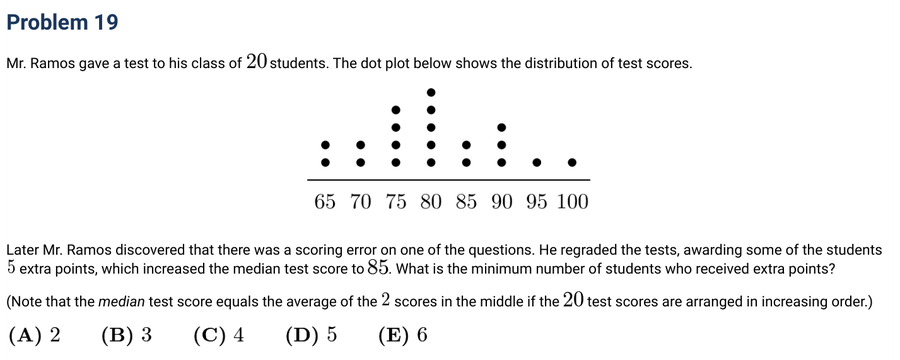
Median isn't about the whole class — with 20 scores it's just the average of the 10th and 11th from the top. So the question really only cares about the scores sitting right at those two middle spots.
Still stuck? Show hint 2 →
Hint 2 of 2
To make that middle average 85, you need the 11th-highest score to reach 85. Count how many already sit at ≥ 85, and the gap up to 11 is how many you must push up.
Show solution
Approach: the median only depends on the 11th-from-top score — push that to 85
Insight: with 20 students the median is the average of the 10th and 11th scores, so forget the rest of the class — the median becomes 85 exactly when the 11th-highest score climbs to 85 (then the 10th, already ≥ that, makes both middles 85).
From the dot plot, 7 students already score ≥ 85 (the 85, 90, 95, 100 columns). Adding 5 points turns an 80 into an 85.
To have 11 students at ≥ 85 (so the 11th-highest is 85), raise 11 − 7 = 4 of the 80-scorers. Fewer than 4 leaves the 11th spot below 85.
You'll see this again: a median is a positional statistic — it depends only on the middle item(s), not on how high or low the extremes are. To move a median, move scores across that middle position.
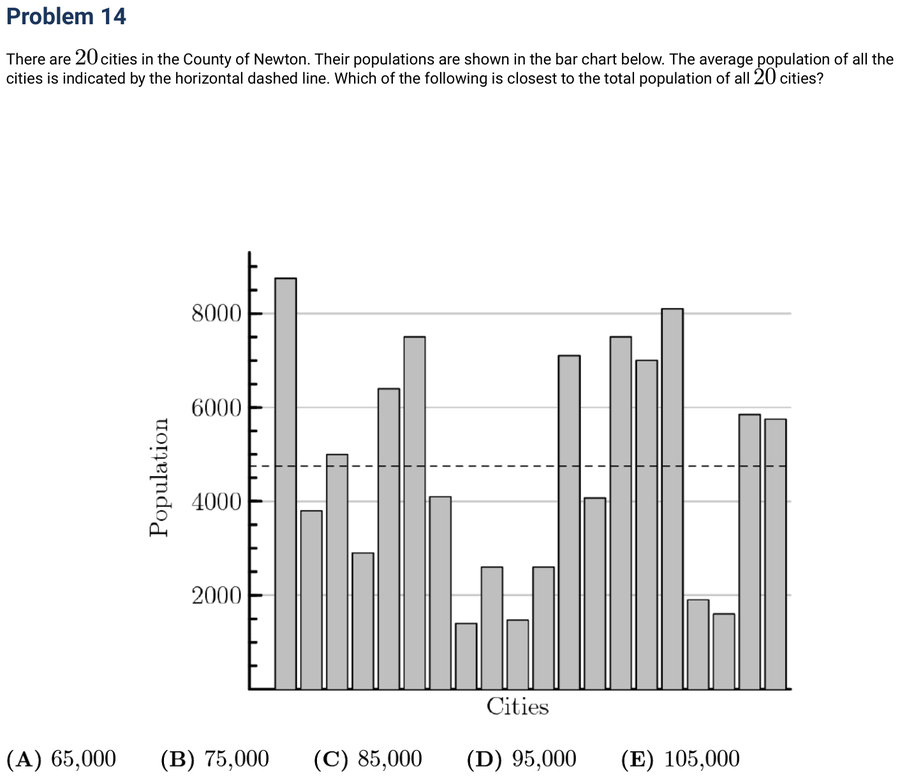
Don't add up 20 bars — the dashed average line already does that work for you. The average is the total spread evenly, so the total is just the average put back across all the cities.
Still stuck? Show hint 2 →
Hint 2 of 2
Read the dashed line (~4,750) and multiply by the 20 cities.
Show solution
Approach: total = average × count (read the line, don't sum the bars)
The definition of average rearranges to total = average × count, so a single read of the dashed line replaces adding 20 bars. The line sits just below 5,000, around 4,750.
Total ≈ 4,750 × 20 = 95,000.
Sanity check: the bars hover roughly in the 4,000–5,000 range, and 5,000 × 20 = 100,000, so an answer near 95,000 is exactly the right size — 65,000 or 105,000 would be too far off.
The sum of 25 consecutive even integers is 10,000. What is the largest of these 25 consecutive integers?
Show answer
Answer: E — 424.
Show hints
Hint 1 of 2
Evenly-spaced numbers are symmetric: every term below the center is balanced by an equal-sized term above it. So the AVERAGE of the whole list sits exactly on the MIDDLE term — you never have to write out all 25 numbers.
Still stuck? Show hint 2 →
Hint 2 of 2
Get the middle term as total ÷ count, then climb from the center to the largest: the top term is 12 steps of 2 above the middle.
Show solution
Approach: the middle term IS the average; then step out to the largest
For 25 evenly-spaced numbers, the average equals the middle (13th) term: 10,000 ÷ 25 = 400.
From the 13th term up to the 25th is 12 steps, each of size 2, so the largest = 400 + 12 × 2 = 424.
Why this transfers: for any arithmetic sequence with an ODD number of terms, average = middle term — turning a sum problem into a one-line lookup. (With an even count, the average lands halfway between the two middle terms.)
Gage skated 1 hr 15 min each day for 5 days and 1 hr 30 min each day for 3 days. How long would he have to skate the ninth day in order to average 85 minutes of skating each day for the entire time?
Show answer
Answer: E — 2 hours.
Show hints
Hint 1 of 2
An average is a target everyone must *balance out* to. So measure each day as how far above or below 85 it lands, not its raw minutes.
Still stuck? Show hint 2 →
Hint 2 of 2
Days below 85 owe minutes; days above 85 pay them back. Net the surplus against the shortfall — day 9 must cover whatever's still owed (on top of its own 85).
Show solution
Approach: measure each day against the 85-minute target
Read every day as a *deviation* from the 85-min target. The 5 days at 75 are each 10 short → −50; the 3 days at 90 are each 5 over → +15.
Running balance: −50 + 15 = −35, a 35-minute shortfall. Day 9 must hit the target *and* erase it: 85 + 35 = 120 min = 2 hours.
*The transferable trick:* to hit a target average, track only the ± gaps from the target — they must cancel to zero. The last value just absorbs the leftover gap, far lighter than summing everything.
Another way — totals:
Skated so far: 5·75 + 3·90 = 645 min. Needed for the average: 9·85 = 765 min.
A set of five positive integers has mean 5, median 5, and 8 as its only mode. What is the difference between the largest and smallest integers in the set?
Show answer
Answer: D — 7.
Show hints
Hint 1 of 2
Each statistic is a clue that PINS DOWN actual numbers. Sort the five into slots ⬚ ⬚ ⬚ ⬚ ⬚ and let mean, median, mode each fill in what they force.
Still stuck? Show hint 2 →
Hint 2 of 2
Convert mean → a fixed total (sum = mean × count); convert 'only mode 8' → at least two 8s; convert median → the middle slot. Then the rest is forced.
Show solution
Approach: translate each statistic into a fixed slot, then solve for the rest
Write the sorted set as a ≤ b ≤ 5 ≤ d ≤ e (median 5 fixes the middle). Mean 5 means the total is 5 × 5 = 25.
'Only mode is 8' forces two 8s, and they must be the two largest: d = e = 8 (16 used). So a + b = 25 − 16 − 5 = 4.
a and b are distinct positive integers summing to 4 (distinct so 8 stays the *only* mode), forcing 1 and 3 → set {1, 3, 5, 8, 8}.
Largest − smallest = 8 − 1 = 7.
You'll see it again: with mean/median/mode puzzles, lay out sorted slots and spend your strongest constraints (total and mode) first — the leftover slots then have only one legal filling.
Median is the MIDDLE value, not the tallest bar. Read carefully: the bar HEIGHT is how many families, and the number you're averaging over is the children-per-family on the bottom axis. First find how many families there are in all.
Still stuck? Show hint 2 →
Hint 2 of 2
Once you know the total count, the median sits at the middle position. You don't need to write every value — just walk along the bars counting until you reach that middle spot.
Show solution
Approach: total the families, then walk the bars to the middle position
Read the bars as counts of families: 2 families have 1 child, 1 has 2, 2 have 3, 2 have 4, 6 have 5 — that's 2 + 1 + 2 + 2 + 6 = 13 families.
With 13 values in order, the median is the 7th one (six below it, six above). Walk the bars: positions 1–2 are '1 child,' position 3 is '2,' positions 4–5 are '3,' positions 6–7 are '4.' The 7th lands in the '4 children' group.
So the median is 4.
The trap this catches: the '5 children' bar is tallest, so it's tempting to answer 5 — but tallest is the MODE, not the median. Median = middle position. Sanity check: the 7th value is 4, comfortably below the popular 5's that pile up at the top end.
You don't need the actual scores — the median is just the middle student when everyone lines up shortest-score to tallest. With 81 students lined up, who's in the exact middle? (Hint: 81 is odd, so there's a single middle person.)
Still stuck? Show hint 2 →
Hint 2 of 2
Don't read the tallest bar — that's the most common score, not the median. Instead walk along the bars from the low end, adding heights, and stop the moment your running count reaches the middle position.
Show solution
Approach: find the middle student's position, then walk the bars
With 81 students, the middle one is the (81+1)/2 = 41st from the bottom. The median is whichever interval that 41st student falls in.
Add bar heights from the lowest interval up: 1, then 1+2=3, +4=7, +5=12, +6=18, +10=28, +14=42. The total first reaches 41 inside the bar of height 14 — the interval labeled 70.
Trap to dodge: the median is a position, not a height. The tallest bar (16, at 75) is the most frequent score, and it's tempting — but the 41st student lands one interval earlier. Counting up to the middle position is what separates median from mode.
If each of the three operation signs +, −, × is used exactly once in one of the blanks in the expression 5 __ 4 __ 6 __ 3, then the value of the result could equal
Show answer
Answer: E — 19.
Show hints
Hint 1 of 2
To reach the largest answer (19), you want multiplication to act on a big chunk — and × beats + and − no matter where it sits, so it runs first. Where should × go to grab the most?
Still stuck? Show hint 2 →
Hint 2 of 2
Put × on the biggest pair, 6 and 3, so multiplication fires first and gives 18. Then the + and − only nudge that 18 a little.
Show solution
Approach: place × to maximize, then let order of operations work
Multiplication always goes first, so think of × as picking which pair gets multiplied. To land near 19, let × hit 6 and 3: 6 × 3 = 18, a big head start.
Now slot the remaining + and − around it: 5 − 4 + 6 × 3 = 5 − 4 + 18 = 19, with each sign used exactly once.
Why this transfers: when signs are yours to place and you want the result big, give the × the largest factors and let it run first — order of operations does the heavy lifting. Want the result small instead? Multiply the smallest pair. Same lever, opposite direction.
Five test scores have a mean of 90, a median of 91, and a mode of 94. The sum of the two lowest test scores is
Show answer
Answer: B — 171.
Show hints
Hint 1 of 3
You don't need each individual low score — only their SUM. What's the fastest route from "mean of all five" to "sum of the bottom two"?
Still stuck? Show hint 2 →
Hint 2 of 3
Mean unlocks the grand total (mean × count); the two lowest are then just total − (the three you can pin down). Find the known three.
Still stuck? Show hint 3 →
Hint 3 of 3
Line the 5 scores up in order. The median is the middle (3rd) one; the mode 94 must appear at least twice, and the only room for two 94's is the 4th and 5th slots (the 3rd is already 91).
Show solution
Approach: turn mean into the total, pin the top three, subtract
Mean 90 over 5 scores means they total 5 × 90 = 450. Write the scores in increasing order; the median is the 3rd = 91.
The mode is 94, so 94 must appear at least twice. The 3rd slot is already 91, so the two 94's have to be the 4th and 5th (the largest). The top three are therefore 91, 94, 94 = 279.
The two lowest are everything else: 450 − 279 = 171.
Why this transfers: when a question asks for a SUM of unknowns, don't solve for each one — get the grand total from the mean and subtract the part you can determine. The individual low scores stay unknown, yet their sum is forced.
Why not ‘not determined’: the median and mode lock all three top scores exactly, so the bottom two have no wiggle room in their total.
The value of (487,000)(12,027,300) + (9,621,001)(487,000)(19,367)(.05) is closest to
Show answer
Answer: D — About 10,000,000,000.
Show hints
Hint 1 of 3
The question says "closest to," and the choices jump by factors of TEN — so don't multiply anything exactly. The size (number of digits) is all that matters. But first, do the two products on top share something you can factor out?
Still stuck? Show hint 2 →
Hint 2 of 3
Both terms on top are (something) × 487,000. Factor out 487,000 so the messy top becomes 487,000 × (one sum). Then round every number to a single digit times a power of ten and just count zeros.
Still stuck? Show hint 3 →
Hint 3 of 3
Round: 487,000 ≈ 5 × 10⁵, the bracket sum ≈ 2 × 10⁷, and on the bottom 19,367 × 0.05 ≈ 10³. Track only the powers of ten.
Show solution
Approach: factor out the shared term, then size everything with powers of ten
Spot the shared factor on top: both products are (…) × 487,000, so the numerator = 487,000 × (12,027,300 + 9,621,001). Factoring first means one rounding instead of two.
Now estimate magnitudes only. 487,000 ≈ 5 × 10⁵; the bracket ≈ 21,648,301 ≈ 2 × 10⁷. Their product ≈ 10 × 10¹² = 10¹³.
Bottom: 19,367 ≈ 2 × 10⁴, and × 0.05 gives ≈ 10³.
So the value ≈ 10¹³ ÷ 10³ = 10¹⁰ = about 10,000,000,000.
Why this transfers: when answers differ by powers of ten and the question says "closest to," estimating is the intended shortcut — round each factor to one significant digit, then just add and subtract exponents. Exact multiplication here would be a waste of time and a chance to slip.
One proposal for new postage rates for a letter was 30 cents for the first ounce and 22 cents for each additional ounce (or fraction of an ounce). The postage for a letter weighing 4.5 ounces was
Show answer
Answer: C — 1.18 dollars.
Show hints
Hint 1 of 2
The sneaky words are 'or fraction of an ounce' — a half-ounce still costs a full extra charge. So you can't just multiply by 4.5; you have to round each leftover bit UP to a whole charge.
Still stuck? Show hint 2 →
Hint 2 of 2
Separate the bill into 'first ounce' (special price) plus 'each additional ounce' (rounded up). This round-up-to-the-next-whole rule is how taxis, parking, and shipping all charge.
Show solution
Approach: first ounce at one rate, the rest rounded up to whole ounces
The pricing has two parts: the first ounce is 30¢, flat. After that, 4.5 − 1 = 3.5 ounces remain.
Here's the trap: 'or fraction of an ounce' means that leftover 0.5 ounce is billed as a *whole* extra ounce. So 3.5 additional ounces round UP to 4 charges of 22¢.
Total = 30 + 4×22 = 30 + 88 = 118¢ = $1.18.
*Worth keeping:* whenever a rate says 'or any part thereof,' round each chunk up to the next whole unit — same idea as parking 'per hour or part of an hour.'
The annual incomes of 1,000 families range from 8200 dollars to 98,000 dollars. In error, the largest income was entered on the computer as 980,000 dollars. The difference between the mean of the incorrect data and the mean of the actual data is
Show answer
Answer: A — 882 dollars.
Show hints
Hint 1 of 2
Don't compute either mean — you can't, you don't know the other 999 incomes! Only ONE number changed, so ask: by how much did the *total* change, and how does that one change ripple into the average?
Still stuck? Show hint 2 →
Hint 2 of 2
The 999 unchanged incomes cancel out completely when you subtract the two means. The mean shifts by (size of the error) spread evenly over all 1000 families.
Show solution
Approach: subtract the means — everything cancels but the one error, spread over 1000
The two data sets differ in *one* entry: 980,000 instead of 98,000. Every other family is identical, so when you subtract (wrong mean) − (right mean), all those matching incomes cancel.
What's left is just the single error spread over everyone: the total was overstated by 980,000 − 98,000 = 882,000.
A mean is total ÷ 1000, so the mean is off by 882,000 ÷ 1000 = $882.
*Why this transfers:* changing one value in a set of n shifts the mean by (the change) ÷ n — you never need the other values, and the giant 'range 8200–98,000' detail is a red herring.
Top and bottom are built from the very same numbers, 16 and 81, just with their roles swapped. That symmetry says: simplify each piece the same way and the answer should be a clean ratio — both are perfect squares and perfect fourth powers.
Still stuck? Show hint 2 →
Hint 2 of 2
Work each square root from the inside out: simplify the inner root, multiply, then take the outer root. Or notice 16 = 2⁴ and 81 = 3⁴ and ride the exponents.
Show solution
Approach: simplify each nested root from the inside out
Start with the innermost roots: √81 = 9 and √16 = 4. Now the insides are plain numbers.
You don't need to know which numbers are paired. The 6 pairs use up all 12 clock numbers, each exactly once — so what are you really averaging?
Still stuck? Show hint 2 →
Hint 2 of 2
Averaging the six pair-averages (each pair the same size) just re-averages all 12 numbers. So the answer is simply the average of 1 through 12.
Show solution
Approach: average of equal-size pair-averages = overall average
Notice the actual pairings (1&2 across from 7&8, etc.) never matter: the six pairs cover all twelve numbers 1–12 exactly once. Averaging six equal-size pair-averages is the same as averaging all twelve numbers at once.
And 1–12 are evenly spaced, so their average is just the midpoint of the ends: (1 + 12)/2 = 6.5.
Why this transfers: averaging the averages of equal-size groups equals the overall average — but only when the groups are the same size. (Unequal groups need a weighted average.) And the mean of any evenly-spaced list is the midpoint of its first and last term.
The digits 2, 0, 2, and 3 are placed in the expression below, one digit per box. What is the maximum possible value of the expression?
×
Show answer
Answer: C — 9.
Show hints
Hint 1 of 2
The 0 is dangerous — as a base or a factor it wipes the product to 0. Where could you hide it so it does no harm?
Still stuck? Show hint 2 →
Hint 2 of 2
Park the 0 in an exponent (anything0 = 1), making that factor 1. Then make the other factor as big as you can from {2, 2, 3} — check both 23 and 32.
Show solution
Approach: place 0 as an exponent, maximize the rest
The 0 is the problem child. As a base or factor it would crush the whole product to 0 — so the move is to defuse it by parking it in an exponent, where anything0 = 1 (harmless).
That turns one factor into 1, and now you just want the other factor as big as possible using the leftover {2, 2, 3}. Compare 23 = 8 and 32 = 9 — a bigger base with a smaller exponent wins here, giving 32 = 9.
Maximum product: 1 × 9 = 9. Worth keeping: a 0 you can't avoid is least damaging as an exponent; and when balancing base vs. exponent for small numbers, the larger base often beats the larger exponent.
Shauna takes five tests, each worth a maximum of 100 points. Her scores on the first three tests are 76, 94, and 87. In order to average 81 for all five tests, what is the lowest score she could earn on one of the other two tests?
Show answer
Answer: A — 48.
Show hints
Hint 1 of 2
The two unknown scores must add to a fixed total. If a fixed amount is split between two scores, making one as small as possible means making the other as large as possible — push the partner to its ceiling of 100.
Still stuck? Show hint 2 →
Hint 2 of 2
Average 81 over 5 tests means the scores total 5 × 81 = 405. Subtract the three known scores to see what the last two must add to, then give one of them the maximum 100.
Show solution
Approach: fixed sum — shove one score to its max so the other is smallest
An average of 81 across 5 tests means a total of 5 × 81 = 405. The first three give 76 + 94 + 87 = 257, so the last two must sum to 405 − 257 = 148.
Those two scores share a fixed 148. To make one as low as possible, make its partner as high as possible: 100 (the test maximum).
Lowest possible = 148 − 100 = 48.
Why this transfers: "minimize one of several things whose total is fixed" is always solved by maxing out everything else — here the cap of 100 is what makes 48 reachable rather than going lower.
You don't need to recompute either statistic from scratch — just track the change. Only one number moved, so what does adding to it do to the average, and where does it land in the sorted order?
Still stuck? Show hint 2 →
Hint 2 of 2
Mean: a bump of +5 spread over 5 days raises the average by 5÷5 = 1. Median: re-sort and watch whether the bumped value jumps past the old middle value.
Show solution
Approach: measure the shift in each statistic, don't recompute
Only Wednesday changes, 16 → 21, so the total goes up by 5. Mean of 5 days rises by 5÷5 = 1 — no need to add the whole column.
For the median, sort instead of recomputing. Originally 12, 16, 20, 24, 26, median 20. Raising 16 to 21 slides that value rightward past 20: new order 12, 20, 21, 24, 26, median 21. Median rises by 1.
So both increase by 1.
Why this transfers: changing one data value shifts the mean by (change ÷ count), but the median only moves if the changed value crosses the old middle — always re-sort to check, since the median can stay put even when the mean jumps.
The big trap: those bars are not seven numbers to average. Each bar's height is how many students reported that many days — so a tall bar should count much more heavily than a short one.
Still stuck? Show hint 2 →
Hint 2 of 2
The technique is a weighted average: total up (day-value × how many students), then divide by the total number of students — never just average the labels 1 through 7.
Show solution
Approach: weighted mean from the bar heights
Read the bar heights as student counts for 1 through 7 days: 1, 3, 2, 6, 8, 3, 2. Add them: 1+3+2+6+8+3+2 = 25 students total.
Mean = 109 ÷ 25 = 4.36. Sanity check: the data piles up around 4–5 days, so an average near 4.4 fits — and the naive (wrong) average of 1–7 would be 4.00, which isn't even an option.
You'll see it again: any "mean from a frequency table or bar graph" is a weighted average — sum of (value × frequency) over total frequency.
The median isn't an average here — it's the value sitting in the MIDDLE position once everything is lined up in order. With 19 names, which single position is the exact middle?
Still stuck? Show hint 2 →
Hint 2 of 2
A bar graph already has the data sorted by length, so just walk the bars left-to-right adding up their heights until your running total reaches that middle position — whatever bar you land on is the answer. You can stop the moment you pass it.
Show solution
Approach: locate the middle position by a running count of the bars
With 19 values, the middle is the 10th one (9 below it, 9 above), so the median is whatever the 10th name's length is.
Walk the bars in order and keep a running total: length 3 holds 7 names (covers positions 1–7); length 4 holds 3 names (covers positions 8, 9, 10).
Position 10 falls inside the length-4 bar, so the median is 4.
Why this transfers: for a median you never need to add the bars on the FAR side — just count inward until the running total reaches the middle position, then stop.
Don't add 50 numbers one by one. The + − + − pattern is begging you to GROUP — bracket each plus-number with the minus-number right after it and watch what each little bracket becomes.
Still stuck? Show hint 2 →
Hint 2 of 2
Each bracket (like 100 − 98) is a pair of evens 2 apart, so every bracket equals 2. Now the only real work is counting how many brackets there are.
Show solution
Approach: group consecutive terms into constant pairs
Bracket the terms: (100 − 98) + (96 − 94) + … + (4 − 2). Each bracket is two consecutive evens, so each one equals 2.
Count the brackets: 100, 98, …, 2 are the 50 even numbers up to 100, and they pair up into 50 ÷ 2 = 25 brackets.
Total = 25 × 2 = 50.
Why this transfers: an alternating +−+− sum almost always collapses when you pair neighbors — the answer becomes (number of pairs) × (constant pair value) instead of a long slog.
Blake and Jenny each took four 100-point tests. Blake averaged 78 on the four tests. Compared with Blake, Jenny scored 10 points higher on the first test, 10 points lower on the second, and 20 points higher on each of the third and fourth. By how much does Jenny's average exceed Blake's on these four tests?
Show answer
Answer: A — 10 points.
Show hints
Hint 1 of 2
The number 78 is a decoy — the question only asks how far apart the two averages are, so work with the gaps, not the actual scores.
Still stuck? Show hint 2 →
Hint 2 of 2
The gap between two averages equals the average of the test-by-test gaps.
Show solution
Approach: average the differences, not the scores
Ignore Blake's 78 — it cancels out of any difference. Just track how far ahead Jenny is each test: +10, −10, +20, +20.
Add the gaps: 10 − 10 + 20 + 20 = +40 total points ahead over four tests. The difference of the averages is the average of those gaps: 40 ÷ 4 = 10 points.
Why this works (and transfers): averages are linear — (Jenny's avg) − (Blake's avg) always equals the average of (Jenny − Blake) per test. Comparing two data sets? Subtract first, average second, and the shared baseline disappears.
Art, Roger, Paul, and Trisha bake cookies that are all the same thickness, in the shapes shown below (dimensions in inches). Each friend uses the same amount of dough, and Art's batch makes exactly 12 cookies.
How many cookies will be in one batch of Trisha's cookies?
Show answer
Answer: E — 24 cookies.
Show hints
Hint 1 of 2
Skip computing the dough total — just compare cookie sizes: Trisha's vs. Art's.
Still stuck? Show hint 2 →
Hint 2 of 2
Half the size means double the count, because the same dough is being split into pieces.
Show solution
Approach: compare Trisha's cookie to Art's directly
Art makes 12 cookies of 12 in² each. Trisha's triangle is ½(3)(4) = 6 in² — exactly half of Art's.
Same dough split into half-size pieces makes twice as many pieces: 12 × 2 = 24.
Worth keeping: for a fixed total, count and size are inversely proportional — halve the size, double the count; third the size, triple the count. Reaching for the "144 in² total" works too, but the size comparison is one step.
Another way — through the dough total:
A batch is 12 of Art's 12 in² cookies = 144 in² of dough.
Juan organizes the stamps in his collection by country and by the decade in which they were issued. He paid these prices at the stamp shop: Brazil and France, 6¢ each; Peru, 4¢ each; and Spain, 5¢ each. (Brazil and Peru are South American countries; France and Spain are European.) The table shows how many stamps he has from each country and decade.
How many of his European stamps were issued in the 1980s?
Number of Stamps by Decade
Country
'50s
'60s
'70s
'80s
Brazil
4
7
12
8
France
8
4
12
15
Peru
6
4
6
10
Spain
3
9
13
9
Show answer
Answer: D — 24.
Show hints
Hint 1 of 2
The prices are a trap here — the question asks *how many* stamps, not their cost. Ignore the cents entirely.
Still stuck? Show hint 2 →
Hint 2 of 2
Pin down the right cells before adding: "European" picks the France and Spain rows, "1980s" picks one column. You only need the two numbers where those meet.
Show solution
Approach: read the European rows in the 1980s column
First filter, then add. "European" = France and Spain rows; "1980s" = the '80s column. That isolates exactly two cells: 15 and 9.
15 + 9 = 24 stamps. (The prices in the problem are bait — a count question never needs them.)
*The habit:* on a table problem, translate each describing word into a row-filter or column-filter *first*, grab only the cells that survive, then compute. It stops you from summing the wrong block.
Juan organizes the stamps in his collection by country and by the decade in which they were issued. He paid these prices at the stamp shop: Brazil and France, 6¢ each; Peru, 4¢ each; and Spain, 5¢ each. (Brazil and Peru are South American countries; France and Spain are European.) The table shows how many stamps he has from each country and decade.
His South American stamps issued before the 1970s cost him how much?
Number of Stamps by Decade
Country
'50s
'60s
'70s
'80s
Brazil
4
7
12
8
France
8
4
12
15
Peru
6
4
6
10
Spain
3
9
13
9
Show answer
Answer: B — $1.06.
Show hints
Hint 1 of 2
Turn each phrase into a filter before touching numbers: "South American" = Brazil & Peru rows; "before the 1970s" = the '50s and '60s columns (the '70s is *not* before itself).
Still stuck? Show hint 2 →
Hint 2 of 2
Brazil and Peru cost *different* amounts, so keep them separate: count each country's stamps, multiply by *its own* price, then add the two costs.
Show solution
Approach: count the right cells, then multiply by price
Filter first: rows Brazil & Peru, columns '50s & '60s. That's a 2-by-2 block of four cells.
*Watch-out worth keeping:* don't add stamp counts across rows that have *different* unit prices — total each price group on its own, then combine. Mixing them is the classic table-problem slip.
Juan organizes the stamps in his collection by country and by the decade in which they were issued. He paid these prices at the stamp shop: Brazil and France, 6¢ each; Peru, 4¢ each; and Spain, 5¢ each. (Brazil and Peru are South American countries; France and Spain are European.) The table shows how many stamps he has from each country and decade.
The average price of his 1970s stamps is closest to which value?
Number of Stamps by Decade
Country
'50s
'60s
'70s
'80s
Brazil
4
7
12
8
France
8
4
12
15
Peru
6
4
6
10
Spain
3
9
13
9
Show answer
Answer: E — About 5.4 cents.
Show hints
Hint 1 of 2
Tempting trap: averaging the four prices (6, 6, 4, 5) gives 5.25 — but that pretends each country sent the same number of stamps. They didn't.
Still stuck? Show hint 2 →
Hint 2 of 2
Real average price = (total money spent on '70s stamps) ÷ (total '70s stamps). The counts *weight* the average, so the prices with more stamps pull harder.
Show solution
Approach: weighted average over the 1970s column
The average price is total cost over total count — *not* the average of the listed prices, because the four countries contribute different numbers of stamps (that's a weighted average).
'70s column: Brazil 12 & France 12 at 6¢, Peru 6 at 4¢, Spain 13 at 5¢. Cost = 12×6 + 12×6 + 6×4 + 13×5 = 72 + 72 + 24 + 65 = 233¢, over 12 + 12 + 6 + 13 = 43 stamps.
233 ÷ 43 ≈ 5.4 cents.
*Sanity check:* most of these stamps cost 5¢ or 6¢ and only a handful cost 4¢, so the average should sit high in that 4-to-6 range — 5.4 fits; a naive 5.25 would have under-counted the many 6¢ stamps.
Six trees are equally spaced along one side of a straight road. The distance from the first tree to the fourth is 60 feet. What is the distance in feet between the first and last trees?
Show answer
Answer: B — 100 feet.
Show hints
Hint 1 of 2
Distance lives in the spaces between trees, not the trees — so don't divide 60 by 4.
Still stuck? Show hint 2 →
Hint 2 of 2
This is the fencepost idea: between n trees there are n − 1 gaps. First-to-fourth = 3 gaps; first-to-last = 5 gaps.
Show solution
Approach: count gaps, not trees
The 60 feet is split among the gaps between tree 1 and tree 4 — and there are 3 gaps, not 4 (the fencepost rule). So each gap = 60 ÷ 3 = 20 feet.
First to last (tree 1 to tree 6) spans 5 gaps: 5 × 20 = 100 feet.
The fencepost principle (n posts → n − 1 gaps) returns everywhere: floors between landings, fence rails, ringing-clock chimes. Always count the spaces.
What is the minimum possible product of three different numbers of the set {−8, −6, −4, 0, 3, 5, 7}?
Show answer
Answer: B — −280.
Show hints
Hint 1 of 2
'Minimum' here means *most negative*, not smallest in size. First ask: which sign-combinations of three numbers even give a negative product?
Still stuck? Show hint 2 →
Hint 2 of 2
Negative product ⇒ an ODD number of negatives: either one negative or all three. To make it as far below zero as possible, you want the product's *size* as large as possible — so pair big numbers with big numbers.
Show solution
Approach: negative-and-large: count signs first, then maximize magnitude
A product of three numbers is negative only with an odd count of negatives — so use exactly one negative, or all three.
All three negatives: (−8)(−6)(−4) = −192. One negative, biggest magnitudes: take the most negative number and the two largest positives, (−8)(7)(5) = −280.
−280 is further below zero, so the minimum is −280. (The 0 in the set would kill the product — never include it when you want a nonzero extreme.)
The principle: for 'most negative product,' handle the SIGN and the SIZE separately — fix an odd number of negatives, then grab the largest-magnitude factors.
Eleven hidden faces is a lot to track — but every face, hidden or not, belongs to a die whose six faces total a *fixed* amount. So compute the grand total and subtract only what you CAN see.
Still stuck? Show hint 2 →
Hint 2 of 2
This is complementary counting: hidden = (everything) − (visible). It's far less error-prone than reasoning about which specific hidden faces are which.
Show solution
Approach: complementary counting — total dots minus visible dots
One die's faces always sum to 1+2+3+4+5+6 = 21, so three dice hold 3 × 21 = 63 dots no matter how they're stacked.
Add up only the seven visible faces: 1 + 1 + 2 + 3 + 4 + 5 + 6 = 22.
Hidden dots = 63 − 22 = 41.
You'll see it again: when the 'unseen' part is messy but the 'whole' is easy and fixed, count the whole and subtract the seen — the hard part cancels out.
Fewer blocks means longer blocks, so you'd love every block to be a 2-footer (50 per row). The only thing stopping you is the rule that joints must stagger — figure out what that forces, row by row.
Still stuck? Show hint 2 →
Hint 2 of 2
A row of fifty 2-ft blocks has its joints at every even foot. The next row must NOT line up with those, so its joints sit at odd feet — which means that row has to start and end with a 1-ft half-block. Count the two row 'types.'
Show solution
Approach: find the two repeating row patterns, then count rows of each
Cheapest row = all 2-ft blocks: 100 ÷ 2 = 50 blocks, with joints at 2, 4, 6, … An identical row directly above would line its joints up — not allowed.
So alternate rows must shift: a 1-ft block at each end, then 49 two-ft blocks fill the middle (1 + 98 + 1 = 100 ft) = 51 blocks. Joints now fall at odd feet, staggered from the rows below.
The 7 rows alternate 50, 51, 50, 51, 50, 51, 50: four rows of 50 and three of 51. Total = 200 + 153 = 353.
You'll see it again: in tiling/bricklaying puzzles, find the small set of repeating patterns the rules allow, count blocks in each, then multiply by how many rows of each — don't try to count the whole wall at once.
The average age of the 40 members of a computer science camp is 17 years. There are 20 girls, 15 boys, and 5 adults. If the average age of the girls is 15 and the average age of the boys is 16, what is the average age of the adults?
Show answer
Answer: C — 28 years.
Show hints
Hint 1 of 2
You can't average the averages — averages of different-sized groups don't combine directly. Convert each average back into a TOTAL (average × count), because totals do add.
Still stuck? Show hint 2 →
Hint 2 of 2
Find the whole camp's total age, subtract the girls' and boys' totals, and what's left is the adults' total. Then divide by 5.
Show solution
Approach: averages → totals (totals are what's allowed to add)
Adults' total age = 680 − 300 − 240 = 140, so their average is 140 ÷ 5 = 28.
Why this transfers: the golden rule for averages is "un-average into totals first." Sums combine and split cleanly; averages don't, because they hide how many people are behind each number.
Another way — balance the deviations from 17:
Measure each group against the overall average of 17. Girls are 2 below (×20 = −40 total), boys are 1 below (×15 = −15), so the camp is 55 'age-years' short of 17-each.
The 5 adults must carry that whole +55 surplus above 17: 55 ÷ 5 = 11 above, so 17 + 11 = 28.
This 'see-saw around the mean' view is fast and shows the adults pulling the average up to balance the younger campers.
Cookies for a Crowd. At a school, 108 students eat an average of 2 cookies apiece. The recipe makes a pan of 15 cookies and uses 2 eggs per pan, and only full recipes are made. Walter buys eggs by the half-dozen. How many half-dozens should he buy to make enough cookies?
Show answer
Answer: C — 5 half-dozens.
Show hints
Hint 1 of 2
Walk the chain of units: cookies needed → pans (round UP, since only whole recipes are baked) → eggs → half-dozens (round up again). The two round-ups are where this kind of problem traps people.
Still stuck? Show hint 2 →
Hint 2 of 2
When a quantity must come in whole units (pans, half-dozens), you always round UP — "enough" means never short, never exactly the leftover.
Show solution
Approach: unit-conversion chain, rounding up at every whole-unit step
Cookies needed: 108 × 2 = 216. Pans: 216 ÷ 15 = 14.4, but you can't bake 0.4 of a pan, so round up to 15 pans.
The reusable rule: whenever you buy/bake in fixed bundles, divide then round UP (ceiling) — rounding down would leave the crowd short. Here 14.4 → 15 pans is the make-or-break step; treating it as 14 undercounts the eggs.
Cookies for a Crowd. The recipe makes a pan of 15 cookies using 3 tablespoons of butter, and only full recipes are made. Walter and Gretel must supply 216 cookies. There are 8 tablespoons in a stick of butter. How many sticks of butter are needed?
Show answer
Answer: B — 6 sticks.
Show hints
Hint 1 of 2
Same chain as before: cookies → pans (round up) → tablespoons → sticks (round up). Two whole-unit steps means two round-ups.
Still stuck? Show hint 2 →
Hint 2 of 2
Don't round the pans down: 216 ÷ 15 isn't a whole number, so it takes 15 full pans — and that drives the butter total.
Show solution
Approach: cookies → pans → tablespoons → sticks, rounding up each whole-unit step
Pans for 216 cookies: 216 ÷ 15 = 14.4 → round up to 15 pans. Butter: 15 × 3 = 45 tablespoons.
Sticks: 45 ÷ 8 = 5.625 → round up to 6 sticks.
The recurring trap: rounding 14.4 down to 14 pans gives 42 tbsp and the wrong stick count. Whole supplies always round UP — and a leftover ⅜ of a stick is fine, the problem even says "some butter may be left over."
The answers are all perfect squares, so don't multiply blindly — the four factors are begging to be paired into two EQUAL numbers. Notice every factor is built from the digits 1998.
Still stuck? Show hint 2 →
Hint 2 of 2
Moving a decimal point is just multiplying or dividing by 10. Slide the points: 100 × 19.98 fattens 19.98 into 1998, and 1.998 × 1000 does the same.
Show solution
Approach: pair the factors so the decimal points cancel into 1998 × 1998
All the choices are squares, which hints the product should split into two identical factors. Pair the factors that 'undo' each other's decimal point: 100 × 19.98 = 1998, and 1.998 × 1000 = 1998.
So the product is 1998 × 1998 = (1998)².
Why this transfers: multiplying by a power of 10 only shuffles the decimal point — count how many places each factor moves the point. Pairing factors to cancel awkward decimals beats slogging through a giant multiplication.
Walter catches the school bus at 7:30 a.m., has 6 classes that last 50 minutes each, has 30 minutes for lunch, and has 2 hours of additional time at school. He takes the bus home and arrives at 4:00 p.m. How many minutes has he spent on the bus?
Show answer
Answer: B — 60 minutes.
Show hints
Hint 1 of 2
You can't time the bus rides directly — but you DO know the whole day and everything that wasn't the bus. The bus is whatever's left over.
Still stuck? Show hint 2 →
Hint 2 of 2
Indirect (complementary) counting: when one piece is hard to measure, find the whole and subtract all the easy pieces.
Show solution
Approach: whole day minus everything that isn't the bus
The full stretch from 7:30 a.m. to 4:00 p.m. is 8½ hours = 510 minutes — this includes the two bus rides plus all of school.
Add up everything that ISN'T the bus: 6 classes × 50 + 30 lunch + 2 hr extra = 300 + 30 + 120 = 450 minutes.
Whatever's left must be the bus: 510 − 450 = 60 minutes (the round trip).
You'll see it again: 'time/space spent doing X' is often easiest as total − (everything else), instead of measuring X head-on.
A common mistake is to 'break a square root apart' over a plus sign: \(\sqrt{a+b}=\sqrt{a}+\sqrt{b}\). Test it with \(a = 9, b = 16\): compute \(\sqrt{9}+\sqrt{16}\). (Compare it to the true value \(\sqrt{9+16}\) to see the rule is false.)
Show answer
Answer: 7 (while the true value is 5, so the rule is false)
Show hints
Hint 1 of 4
A 'rule' that is supposed to always work can be destroyed by a single example where it fails. Pick easy perfect squares so you can compute both sides in your head.
Still stuck? Show hint 2 →
Hint 2 of 4
Work out the RIGHT side: \(\sqrt{9}+\sqrt{16}=3+4\).
Still stuck? Show hint 3 →
Hint 3 of 4
Now the LEFT side: \(9+16=25\), and \(\sqrt{25}=5\). Are they equal?
Show solution
Approach: Disprove a false rule with one numerical counterexample
Compute the right side of the supposed rule: \(\sqrt{9}+\sqrt{16}=3+4=7\).
Compute the true left side: \(\sqrt{9+16}=\sqrt{25}=5\).
Since \(7 \neq 5\), the rule \(\sqrt{a+b}=\sqrt{a}+\sqrt{b}\) is FALSE — one counterexample is enough to kill it.
Same idea checks a claim like \(\sqrt{36}=\sqrt{30}+\sqrt{6}\): \(\sqrt{30} > 5\) and \(\sqrt{6} > 2\), so the right side exceeds \(7\), far more than \(\sqrt{36}=6\). A square root never splits over a plus sign.
On a real national test, more than half of junior-high students missed this question: What is 75% of 12? That is surprising, because the numbers are so friendly! Show how to see the answer with a picture instead of just punching buttons. (Then try the deliberately unfriendly version: what is 74% of 13?)
Show answer
Answer: 9 (and 74% of 13 is about 9.6)
Show hints
Hint 1 of 4
The word 'percent' just means 'out of 100.' Is there a simple fraction that equals 75%?
Still stuck? Show hint 2 →
Hint 2 of 4
Draw 12 little squares. If you split them into 4 equal groups, how many squares are in each group?
Still stuck? Show hint 3 →
Hint 3 of 4
75% is the same as 3 out of every 4, which is the fraction \(\tfrac34\). Take \(\tfrac14\) of 12 first, then take 3 of those groups.
Show solution
Approach: See the percent as a friendly fraction and picture it
The trick is to see 75% as the friendly fraction \(\tfrac34\), not to reach for a percent rule.
Draw 12 squares in a 3-by-4 array and split them into 4 equal columns. Each column has 3 squares, so each column is \(\tfrac14\) of the whole.
\(\tfrac14\) of 12 = 3 squares (one column), so \(\tfrac34\) of 12 = three columns = 3 + 3 + 3 = 9.
So 75% of 12 = \(\tfrac34 \times 12 = 9\).
The unfriendly twin 74% of 13 looks almost the same on paper, but 74% is not a clean fraction and 13 won't split into equal small groups, so there is no neat picture — you would just estimate \(0.74 \times 13 \approx 9.6\). The real lesson: grab the easy picture when the numbers are friendly.
Arithmetic & OperationsLogic & Word Problemsidentifying-relevant-datatranslate-text-into-mathematics
A class from a town of 4,300 people takes a trip to a mountain 120 km away. The class has 500 dollars in its treasury. The whole trip cost 360 dollars. That 360 dollars paid for the bus (110 dollars) plus a rope-walk activity that costs the same amount for each of the 25 students. (a) How much did the rope-walk cost for one student? (b) Which numbers in the problem were NOT needed to answer part (a)?
Show answer
Answer: 10 dollars per student; population, distance, and treasury are not needed
Show hints
Hint 1 of 3
Before you compute, sort the numbers into two piles: ones that change the rope-walk price per student, and ones that are just background story.
Still stuck? Show hint 2 →
Hint 2 of 3
The 360 dollars total is made of two things: the one bus fee (110 dollars) plus the rope-walk paid once for each of the 25 students.
Still stuck? Show hint 3 →
Hint 3 of 3
Subtract the bus fee from the total to get just the rope-walk money. Then split that evenly among the 25 students.
Show solution
Approach: Strip the irrelevant data, then subtract and divide
The 360 dollars is the bus fee plus all the rope-walk fees. Take out the bus fee first: \(360 - 110 = 250\) dollars.
That 250 dollars is shared equally by 25 students, so each student's rope-walk costs \(250 \div 25 = 10\) dollars.
(a) The rope-walk costs 10 dollars per student.
(b) The town's population (4,300), the distance (120 km), and the 500-dollar treasury are never used — they are background story, not needed for part (a).
Reading a fraction as a COUNT of equal pieces, \(\frac{2}{3}\) means '2 thirds.' Using that idea (the bottom is the unit, the top is how many), what is \(\frac{2}{3}+\frac{5}{3}\)? Give your answer as a fraction.
Show answer
Answer: 7/3
Show hints
Hint 1 of 4
Think of '2 thirds' and '5 thirds' like '2 meters' and '5 meters.' When the unit (the bottom number) is the same, you just add how many you have.
Still stuck? Show hint 2 →
Hint 2 of 4
So add the tops and keep the bottom: \(2 + 5\) thirds.
Still stuck? Show hint 3 →
Hint 3 of 4
The fake rule 'add tops, add bottoms' would give \(\frac{1}{2}+\frac{1}{2}=\frac{2}{4}=\frac{1}{2}\), but two halves make a WHOLE — so that rule is wrong.
Show solution
Approach: Read the denominator as a fixed unit; add only the counts
Why you never add the bottoms: the fake rule turns \(\frac{1}{2}+\frac{1}{2}\) into \(\frac{2}{4}=\frac{1}{2}\), but two halves make a whole \(= 1\). So 'add the bottoms' is false.
Read the bottom as the NAME of the piece (the unit) and the top as HOW MANY. So \(\frac{2}{3}\) is '2 thirds' and \(\frac{5}{3}\) is '5 thirds.'
With the same unit, adding is like \(2\text{ m} + 5\text{ m} = 7\text{ m}\): \(2\text{ thirds} + 5\text{ thirds} = 7\text{ thirds}\).
So \(\frac{2}{3}+\frac{5}{3}=\frac{7}{3}\): add the tops, keep the bottom. Adding bottoms would secretly change the slice size mid-count.
A fly and a jogger start 12 km apart. The jogger runs straight toward the fly's starting spot at 4 km per hour. Meanwhile the fly zooms back and forth at 6 km per hour: it flies to the jogger, turns around, flies back, turns around again, and keeps doing this. The fly keeps flying until the jogger reaches the fly's starting spot. How far does the fly travel in total?
Show answer
Answer: 18 km
Show hints
Hint 1 of 4
The fly's back-and-forth path looks scary, but you only need the TOTAL distance it flies. And distance = speed multiplied by time. So the real question is: how long is the fly in the air?
Still stuck? Show hint 2 →
Hint 2 of 4
Stop trying to follow the fly. Watch the jogger instead. The flying stops the exact moment the jogger finishes the 12 km. So all you need is the jogger's travel time.
Still stuck? Show hint 3 →
Hint 3 of 4
How long does the jogger take to go 12 km at 4 km per hour? Divide: 12 divided by 4.
Show solution
Approach: Find the time, not the path
The trap is adding up all the tiny back-and-forth flights. The clever move is to think about TIME, not the fly's messy path.
The fly stops flying when the jogger covers the 12 km. At 4 km/hr that takes \(\dfrac{12}{4}=3\) hours.
The fly was flying that entire 3 hours at 6 km/hr, so it covers \(6\times3=18\) km.
The fly travels 18 km. (Notice the puzzle has to tell us when the flying stops, or the answer wouldn't be clear — spotting that hidden assumption is part of careful problem solving.)
Arithmetic & OperationsLogic & Word ProblemsRatios, Rates & Proportionsidentifying-relevant-datavisual-representationlogical-reasoning
A worker bikes to work. The trip is 3 km and he usually rides at 15 km/h. One day, after going 1 km, he gets a flat tire, so he pushes his bike the rest of the way, arriving 20 minutes late. At work he fixed the tire and rode all the way home as usual. Over the whole round trip (there and back), how many more kilometers did he ride than he walked?
Show answer
Answer: 2 km more by bike
Show hints
Hint 1 of 4
Draw the trip as a straight line: home to work, then work back home. Mark the flat (1 km from home). Shade the parts he rode and the parts he walked.
Still stuck? Show hint 2 →
Hint 2 of 4
Going to work: he rode the first 1 km, then walked the last 2 km. Coming home: he rode all 3 km. Now compare total riding to total walking.
Still stuck? Show hint 3 →
Hint 3 of 4
The 2 km from the flat to work was walked once (going) and ridden once (coming home), so those cancel. What part of the route did he ride but never walk?
Show solution
Approach: Picture the round trip and cancel the matching segments
Picture the round trip: home —(ride 1 km)— flat —(walk 2 km)— work, then work —(ride 3 km)— home.
He rode 1 km going + 3 km coming = 4 km. He walked 2 km. So he rode \(4 - 2 = 2\) km more than he walked.
A neat way to see it: the 2 km from the flat to work was walked once and ridden once, so it cancels. Only the first 1 km was ridden both directions and never walked, counting twice (\(2 \times 1 = 2\) km).
So he rode 2 km more than he walked. (Notice everything except that 1 km — even the speed and lateness — is unnecessary for this question.)
Logic & Word ProblemsArithmetic & Operationswork-backwardlogical-reasoning
You have only a \(5\)-liter bucket and an \(11\)-liter bucket and as much water as you want. How can you end up with exactly \(7\) liters in the big (\(11\)-liter) bucket?
Show answer
Answer: 7 liters (make 1 L, then top off the small bucket to pour off exactly 4 L)
Show hints
Hint 1 of 4
Work backward from the goal. You want \(7\) liters in the \(11\)-liter bucket. How much EMPTY space is left in that bucket when it holds \(7\)? (\(11-7\).)
Still stuck? Show hint 2 →
Hint 2 of 4
There are \(4\) liters of empty space. You could create exactly \(4\) empty liters by pouring from a full \(11\)-liter bucket into the small bucket — but only if the small bucket already had \(1\) liter in it (so it can take just \(4\) more).
Still stuck? Show hint 3 →
Hint 3 of 4
So now you only need to make exactly \(1\) liter. Try filling the big bucket and pouring out \(5\) liters twice: \(11-5-5=1\) liter is left over.
Show solution
Approach: Working backward, then doing the steps forward
Work backward: \(7\) liters in the big bucket leaves \(4\) liters of empty space. To pour off exactly \(4\) liters into the \(5\)-liter bucket, the small bucket must already hold \(1\) liter (so it only has room for \(4\) more). And to get exactly \(1\) liter, notice \(11-5-5=1\).
Now the forward steps. Fill the \(11\)-liter bucket. Pour into the \(5\)-liter bucket and dump it out; do this twice. After pouring out \(5+5=10\), the big bucket holds \(1\) liter.
Pour that \(1\) liter into the empty \(5\)-liter bucket. Fill the \(11\)-liter bucket again (now it holds \(11\)).
Pour from the big bucket to fill the small bucket the rest of the way. The small bucket had \(1\), so it takes \(4\) more. The big bucket now has \(11-4 = 7\) liters. Done!
Arithmetic & OperationsLogic & Word Problemslogical-reasoningwork-backwardidentifying-relevant-data
Mr. Mayer takes the 7:25 bus to his office in the morning, then walks home in the afternoon. The whole day's travel (bus there + walk back) takes 1 hour 10 minutes. If he walked BOTH ways, it would take 1 hour 50 minutes. How long would it take him to take the bus BOTH ways?
Show answer
Answer: 30 minutes by bus both ways
Show hints
Hint 1 of 4
Give names to the two one-way times: let \(W\) = time to walk one way, \(B\) = time to bus one way.
Still stuck? Show hint 2 →
Hint 2 of 4
Walking both ways means \(W + W = 1\) hour 50 minutes. So \(2W = 110\) minutes — find \(W\).
Still stuck? Show hint 3 →
Hint 3 of 4
Bus-then-walk means \(B + W = 1\) hour 10 minutes = 70 minutes. Once you know \(W\), subtract to get \(B\).
Show solution
Approach: Work backward to the one-way times, then double the bus time
Let \(W\) be the one-way walking time and \(B\) the one-way bus time, in minutes.
Walking both ways takes 1 h 50 min = 110 min, and that is \(W + W\): \(2W = 110\), so \(W = 55\) min.
Bus-then-walk takes 1 h 10 min = 70 min, and that is \(B + W\): \(B + 55 = 70\), so \(B = 15\) min.
Both ways by bus takes \(2B = 2 \times 15 = 30\) minutes. (The 7:25 start time is not needed for this; with it, he would arrive at 7:40.)
Logic & Word ProblemsCounting & ProbabilityArithmetic & Operationsaccount-for-all-possibilitiesorganizing-datareduce-and-expandpattern-recognition
A strip of \(15\) unit squares is cut into 'pieces.' Each piece is a run of \(1, 2, 3, 4,\) or \(5\) squares, and we use at most \(5\) pieces. List all the ways to write \(15\) as a sum of pieces under these rules (order of the pieces doesn't matter). Then connect to Gauss: one of the \(5\)-piece answers is \(5 + 4 + 3 + 2 + 1\), the numbers \(1\) through \(5\). Use this to find a quick formula for \(1 + 2 + 3 + \cdots + n\).
Show answer
Answer: 1 way with 3 pieces, 5 with 4 pieces, 12 with 5 pieces; and 1+2+…+n = n(n+1)/2
Show hints
Hint 1 of 4
Each piece is at most \(5\) squares and they must add to \(15\). What is the smallest number of pieces you could possibly use?
Still stuck? Show hint 2 →
Hint 2 of 4
Since \(5 + 5 + 5 = 15\), you can't do it in fewer than \(3\) pieces. So organize your search into \(3\)-piece, \(4\)-piece, and \(5\)-piece cases.
Still stuck? Show hint 3 →
Hint 3 of 4
In each case you're writing \(15\) as a sum of that many numbers, each between \(1\) and \(5\). Always list the biggest part first so you don't miss any or repeat any.
Show solution
Approach: Organized casework on number of pieces, then Gauss pairing
The total is 15, each piece is 1 to 5 squares, at most 5 pieces. Since the biggest piece is 5 and \(5\times3=15\), you need at least 3 pieces.
Gauss: in \(1+2+3+4+5\), pair \(1+5=6\), \(2+4=6\), middle 3; each pair adds to \(n+1\). For \(1+2+\cdots+n\), pairing the ends always gives \(n+1\), so \(1+2+\cdots+n=\dfrac{n(n+1)}{2}\). Check: \(1+2+3+4+5=\dfrac{5\times6}{2}=15\), and \(1+2+\cdots+100=\dfrac{100\times101}{2}=5050\).
Number TheoryArithmetic & Operationsbe-greedywork-in-another-base
In the Unlucky Lottery, every prize is a power of 13 dollars — that is \(1\), \(13\), \(169\), \(2{,}197\) dollars, and so on. The total prize money handed out is exactly \(1{,}000{,}000\) dollars. What is the smallest possible number of prizes?
Show answer
Answer: 16 prizes
Show hints
Hint 1 of 4
To use as few prizes as possible, hand out the biggest prizes you can first. List the powers of 13 that are below a million.
Still stuck? Show hint 2 →
Hint 2 of 4
The powers are \(1\), \(13\), \(169\), \(2{,}197\), \(28{,}561\), and \(371{,}293\) dollars. Start by taking as many \(371{,}293\) prizes as fit, then move down to the next size.
Still stuck? Show hint 3 →
Hint 3 of 4
Keep subtracting and moving to the next-smaller power. Add up how many prizes you used in total.
Show solution
Approach: Greedy largest-first, which is exactly base-13 expansion
To use the fewest prizes, give out the largest prizes first. The powers of 13 up to a million are \(1\), \(13\), \(169\), \(2{,}197\), \(28{,}561\), \(371{,}293\) dollars.
Two \(371{,}293\) prizes use \(742{,}586\), leaving \(257{,}414\). Nine \(28{,}561\) prizes use \(257{,}049\), leaving \(365\). Zero \(2{,}197\) prizes (too big for \(365\)).
Two \(169\) prizes use \(338\), leaving \(27\). Two \(13\) prizes use \(26\), leaving \(1\). One \(1\) prize finishes it.
Total prizes: \(2+9+0+2+2+1=16\).
Shortcut: this is exactly writing \(1{,}000{,}000\) in base thirteen, namely \(290221_{13}\); the digit sum \(2+9+0+2+2+1=16\) is the minimum number of prizes.
Logic & Word ProblemsArithmetic & Operationswork-backwardintelligent-guessing-and-testing
Jim asks a classmate how old she is. She answers, 'I was 14 the day before yesterday, but I'll be 17 next year.' On what day is she talking, and when is her birthday?
Show answer
Answer: She is speaking on January 1, and her birthday is December 31
Show hints
Hint 1 of 4
This sounds impossible, but it isn't! The secret is that a few days near New Year's can touch several different calendar years at once.
Still stuck? Show hint 2 →
Hint 2 of 4
If she was 14 just a couple of days ago but turns 17 'next year,' her age has to climb 14, 15, 16, 17. That's a lot of birthdays squeezed close together — so her birthday must sit right at the edge of the year.
Still stuck? Show hint 3 →
Hint 3 of 4
Try guessing her birthday is December 31. Then try having the conversation on January 1. Walk through the days: the day before yesterday, yesterday, today, the next December 31, and the one after that.
Show solution
Approach: Guess a year-edge birthday, then test the timeline
This only seems like a paradox if you forget that 'next year' on the calendar can be just a day or two away. Let her birthday be December 31 and the conversation happen on January 1.
The day before yesterday = December 30: she hadn't yet had her Dec 31 birthday, so she was 14 (matches 'I was 14 the day before yesterday').
Yesterday = December 31: she turned 15. Today = January 1: she is 15.
This coming December 31 she turns 16; the December 31 after that she turns 17. Since today is January 1, that birthday lands in the NEXT calendar year (matches 'I'll be 17 next year').
Everything fits: she is speaking on January 1, and her birthday is December 31.
Forty-two birds sit on three trees. Then 3 birds fly from tree 1 to tree 2, and 7 birds fly from tree 2 to tree 3. Now there are twice as many birds on tree 2 as on tree 1, and twice as many on tree 3 as on tree 2. How many birds were on each tree at the start?
Show answer
Answer: 9, 16, and 17 birds on trees 1, 2, 3
Show hints
Hint 1 of 4
The nice moment is AFTER the birds move, when the counts come in the ratio 1 : 2 : 4.
Still stuck? Show hint 2 →
Hint 2 of 4
Call the number on tree 1 (after moving) one 'part'. Then tree 2 has 2 parts and tree 3 has 4 parts. How many parts total, and what do they add to?
Still stuck? Show hint 3 →
Hint 3 of 4
\(1 + 2 + 4 = 7\) parts make 42 birds, so one part is \(42 \div 7 = 6\). Now you know all three after-counts.
Show solution
Approach: Solve the easy after-state ratio, then work backward
After the move the three trees are in the ratio 1 : 2 : 4. Think of tree 1's count as one part, so the trees hold \(1 + 2 + 4 = 7\) parts totaling 42 birds: 1 part \(= 42 \div 7 = 6\). So after the move the trees hold 6, 12, and 24 birds.
Rewind: tree 1 lost 3 birds, so it started with \(6 + 3 = 9\). Tree 3 gained 7, so it started with \(24 - 7 = 17\). Tree 2 is the rest: \(42 - 9 - 17 = 16\).
Check: tree 2 received 3 and lost 7, a change of \(-4\), and \(16 - 4 = 12\). Correct!
Originally there were 9, 16, and 17 birds on trees 1, 2, and 3.
Forget the exact values — you only need each expression's SIGN. First read off the signs from the line: P and Q sit left of 0 (negative), while R, S, T sit right of 0 (positive).
Still stuck? Show hint 2 →
Hint 2 of 2
For multiplying and dividing, a result is negative only with an ODD number of negative pieces. For subtracting, P − Q is negative only if P is the smaller (more-left) number. Scan the five choices for the one that lands negative.
Show solution
Approach: track signs, not values
Sort the signs from the line: P, Q are negative; R, S, T are positive. That's all the information we need.
Now count negatives in each choice. (B) P·Q = (−)(−) is positive. (C) (S/Q)·P has two negatives (Q and P) → positive. (D) R/(P·Q): the bottom P·Q is positive, so the whole thing is positive. (E) (S+T)/R is all positives → positive.
Only (A) P − Q is left, and it must be the negative one: P is farther left than Q, so subtracting the larger Q from the smaller P gives a negative (e.g. −2.7 − (−1.3) ≈ −1.4). Answer P − Q.
Why this transfers: for 'which is positive/negative' questions, never compute — just count negative factors (odd = negative) and check direction on subtractions. Sign-tracking beats arithmetic every time.
Find the sum \(7+77+777+7777+77777\) (five terms). Then describe the pattern for the sum of any number of such terms.
Show answer
Answer: 86415
Show hints
Hint 1 of 4
The 7's are awkward. Try the easier cousin first: \(9+99+999+\cdots\). A string of \(k\) nines is just \(10^k-1\) (for example \(999=1000-1\)).
Still stuck? Show hint 2 →
Hint 2 of 4
So \(9+99+999+9999+99999=(10-1)+(100-1)+(1000-1)+(10000-1)+(100000-1)\). Add the round numbers, then subtract the five 1's.
Still stuck? Show hint 3 →
Hint 3 of 4
Every digit 7 is exactly \(\tfrac79\) of a digit 9. So your 7's-sum is \(\tfrac79\) of the 9's-sum.
Show solution
Approach: Do the 9's first, then take 7/9
Start with the easier version using 9's, because a block of \(k\) nines equals \(10^k-1\): \(9+99+999+9999+99999=(10+100+1000+10000+100000)-5\).
The round numbers add to \(111110\), so the nines-sum is \(111110-5=111105\).
Now scale by \(\tfrac79\), since every 7 is \(\tfrac79\) of a 9: \(7+77+777+7777+77777=\tfrac{7}{9}\times111105=7\times12345=86415\).
Direct check by adding: \(7+77=84\), \(+777=861\), \(+7777=8638\), \(+77777=86415\).
Pattern: the sum of the first \(n\) such terms is \(\dfrac{7\,(10^{n+1}-9n-10)}{81}\); a neat fact is that for \(n\le 9\) the answer is \(7\) times \(123\ldots n\) (here \(7\times12345=86415\)).
Arithmetic & OperationsLogic & Word Problemspattern-recognitionconsider-extreme-cases
A truck carries 4,000 crates. At its first stop it drops off half the crates. At the second stop it drops off half of what is left. At the third stop, half of the new remainder. If this pattern keeps going, at which stop will the LAST crate be dropped off?
Show answer
Answer: There is no last stop — half always remains, so the question has no answer (a peek at infinity)
Show hints
Hint 1 of 4
Don't track how many get dropped off. Track how many are still ON the truck after each stop.
Still stuck? Show hint 2 →
Hint 2 of 4
Start halving: 4000, then 2000, then 1000, ... What stays on the truck each time?
Still stuck? Show hint 3 →
Hint 3 of 4
After every single stop, exactly half of the crates remain on the truck. Ask yourself: can the truck ever hit zero this way?
Show solution
Approach: Track what stays, and realize it never reaches zero
Follow the crates left on the truck. Dropping off half means half stay: \(4000\to2000\to1000\to500\to250\to125\to\dots\)
After each stop, half of whatever is on the truck stays on the truck, so no matter how many stops happen, something is always still aboard.
(Once the number gets odd, like 125, you can't literally split it evenly — the problem ignores that on purpose, and arguing about it is part of the fun.)
So there is no last stop: the amount on the truck gets closer and closer to 0 but never reaches it. The 'success' here is realizing there is no answer — a neat doorway to thinking about infinity.
Logic & Word ProblemsCounting & ProbabilityArithmetic & Operationsorganizing-datalogical-reasoning
Six patients A, B, C, D, E, F wait at a dentist. Their treatment times are A = 15 min, B = 30 min, C = 10 min, D = 10 min, E = 20 min, F = 5 min. The dentist wants the total waiting time of all patients added together to be as small as possible. What is that smallest possible total waiting time (in minutes)?
Show answer
Answer: 145 minutes (treat shortest first: F, C, D, A, E, B)
Show hints
Hint 1 of 4
The first patient seen waits 0 minutes. The second waits through the first one's treatment. Everyone waits through everyone seen before them.
Still stuck? Show hint 2 →
Hint 2 of 4
Whoever goes FIRST makes all 5 others wait through their treatment. So a long treatment early on is very costly.
Still stuck? Show hint 3 →
Hint 3 of 4
To keep the total small, put the shortest treatments first and the longest last.
Show solution
Approach: Shortest-job-first scheduling
The first patient's time is waited through by all 5 others, the second's by 4, then 3, 2, 1, 0. To make the total small, the biggest counts should multiply the smallest times — so treat the shortest patient first.
The times in order are 5, 10, 10, 15, 20, 30, which is F, C, D, A, E, B.
Compute \(\dfrac{3}{17} + \dfrac{6}{13}\). First warm up with the easier sum \(\dfrac{1}{2} + \dfrac{1}{3}\), thinking of adding fractions as combining amounts measured in the same unit. Give your answer as a fraction in lowest terms.
Show answer
Answer: 141/221
Show hints
Hint 1 of 4
If the numbers feel scary, do a smaller version first: how do you add \(\frac{1}{2} + \frac{1}{3}\)?
Still stuck? Show hint 2 →
Hint 2 of 4
You can only add when both pieces are measured in the SAME size. For halves and thirds, what size works? (Sixths!) Rewrite both over \(6\).
Still stuck? Show hint 3 →
Hint 3 of 4
For seventeenths and thirteenths, a size that works for both is \(17 \times 13 = 221\). Rewrite each fraction with denominator \(221\).
Show solution
Approach: Solve a simpler analogous problem, then use a common unit (denominator)
Adding fractions just means combining 'so many of one size piece.' Warm-up: for \(\frac{1}{2} + \frac{1}{3}\) use sixths — \(\frac{1}{2} = \frac{3}{6}\) and \(\frac{1}{3} = \frac{2}{6}\), so the sum is \(\frac{5}{6}\).
Same idea, bigger numbers. A common size for seventeenths and thirteenths is \(17 \times 13 = 221\). Then \(\frac{3}{17} = \frac{39}{221}\) and \(\frac{6}{13} = \frac{102}{221}\).
Add the tops: \(\frac{39}{221} + \frac{102}{221} = \frac{141}{221}\).
Since \(221 = 13 \times 17\) and \(141 = 3 \times 47\) share no common factor, \(\frac{141}{221}\) is already in lowest terms.
Logic & Word ProblemsArithmetic & OperationsCounting & Probabilitylogical-reasoningconsidering-extreme-cases
You win a lottery! There are three piles of bills: a 100-dollar pile, a 50-dollar pile, and a 10-dollar pile. You may take 10 bills from one pile, 5 bills from another, and 1 bill from the third (you choose which pile gets which count). Matching the counts to win the most money, how many dollars do you win?
Show answer
Answer: 1260 dollars
Show hints
Hint 1 of 4
This is like the dentist problem flipped: now you want the total to be as BIG as possible.
Still stuck? Show hint 2 →
Hint 2 of 4
Each pile's bill value gets multiplied by one of the counts 10, 5, or 1. Which count do you want on the most valuable bill?
Still stuck? Show hint 3 →
Hint 3 of 4
Put the biggest count on the biggest bill: take 10 bills of 100 dollars, 5 bills of 50 dollars, 1 bill of 10 dollars.
Show solution
Approach: Pair the largest multiplier with the largest value
Your winnings are (some count) times each pile's value, added up. To make that largest, give the largest count to the largest bill.
Take 10 bills from the 100-dollar pile, 5 from the 50-dollar pile, and 1 from the 10-dollar pile.
Points A and B are 10 units apart. Points B and C are 4 units apart. Points C and D are 3 units apart. If A and D are as close as possible, then the number of units between them is
Show answer
Answer: B — 3 units.
Show hints
Hint 1 of 2
Each distance is just a length — the points can sit anywhere on a line as long as the gaps are right. To pull A and D close, walk OUT to B, then turn around and come back toward A as far as the next steps allow.
Still stuck? Show hint 2 →
Hint 2 of 2
Starting 10 away (A to B), the most you can walk back toward A is C then D: 4 + 3 = 7. Subtract that from the 10 you went out.
Show solution
Approach: go out, then backtrack as much as possible
Put A at 0 and B at 10. To shrink the A-to-D gap, point each later hop back toward A: step C back 4 (to 6), then D back another 3 (to 3). So D lands at 10 − 4 − 3 = 3.
Could D reach A at 0? That needs the return trip 4 + 3 = 7 to undo the full 10 — but 7 < 10, so it falls 3 short. The closest possible is 3 units.
Why this transfers: 'how close/far can the ends be' on a line is the triangle inequality in disguise — closest = |big − (sum of the rest)|, farthest = the whole sum added up. Aim the hops to cancel or pile on.
Fuel flows steadily into a tank at \(2{,}000\) liters per hour. The day is split into six \(4\)-hour periods. During those periods the tank uses \(6{,}000\), \(13{,}500\), \(7{,}300\), \(10{,}000\), \(8{,}000\), and \(3{,}200\) liters, in that order. Each day repeats the same pattern. What is the capacity (in liters) of the smallest tank that can always keep at least \(200\) liters of fuel inside?
Show answer
Answer: 7,000 liters
Show hints
Hint 1 of 4
First, how much fuel flows IN during one 4-hour period? It's \(4\times2000=8000\) liters every period.
Still stuck? Show hint 2 →
Hint 2 of 4
For each period, the net change is (inflow \(8000\)) minus (that period's usage). Make a table and keep a running total, starting from some unknown amount \(x\) at the beginning of the day.
Still stuck? Show hint 3 →
Hint 3 of 4
After all six periods, find the lowest running total and the highest running total. The lowest must stay at or above 200; that tells you the smallest starting amount \(x\).
Show solution
Approach: Running-total table, then bound by the lowest and highest levels
Each 4-hour period brings in \(4\times2000=8000\) liters. Let \(x\) be the amount at the start of the day; the net change in a period is \(8000\) minus the usage.
Track the running total:
Period
Usage
Net (8000−usage)
Tank after
1
6000
+2000
x+2000
2
13500
−5500
x−3500
3
7300
+700
x−2800
4
10000
−2000
x−4800
5
8000
0
x−4800
6
3200
+4800
x
The lowest the tank ever gets is \(x-4800\). To keep at least 200 liters: \(x-4800\ge200\Rightarrow x\ge5000\).
Using the smallest allowed start \(x=5000\), the highest the tank ever gets is \(x+2000=7000\). The tank must hold that peak, so the smallest workable capacity is \(7000\) liters.
What number should be removed from the list 1, 2, 3, 4, 5, 6, 7, 8, 9, 10, 11 so that the average of the remaining numbers is 6.1?
Show answer
Answer: B — 5.
Show hints
Hint 1 of 2
An average is just a disguised total: average × count = sum. The removed number is whatever's missing between the original total and the total the survivors must add up to.
Still stuck? Show hint 2 →
Hint 2 of 2
Get the sum of all 11 numbers, then the sum the remaining 10 need (6.1 × 10). The gap between those two sums IS the number you took out.
Show solution
Approach: turn averages back into sums
Convert the target average to a total: the 10 remaining numbers must sum to 6.1 × 10 = 61. All eleven numbers (1 through 11) sum to 66.
Removing a number drops the total from 66 to 61, so the number removed is 66 − 61 = 5.
Why this transfers: almost every 'average changes when you add/remove an item' problem cracks open by rewriting each average as a total (average × count). Compare totals, not averages.
In the same Sierpinski pattern, give the stage-0 triangle an area of 1 and a perimeter of 1. Each stage replaces every triangle with 3 half-size copies. What is the total shaded area at stage 5, as a fraction?
Show answer
Answer: 243/1024 (about 0.24); perimeter is (3/2)^5 = 243/32
Show hints
Hint 1 of 4
Each kept triangle is half as wide and half as tall as its parent. What does cutting the side length in half do to ONE triangle's area? to its perimeter?
Still stuck? Show hint 2 →
Hint 2 of 4
Area: half the side length makes \(\tfrac14\) the area. There are 3 kept triangles, so total area multiplies by \(3 \times \tfrac14 = \tfrac34\) each stage.
Still stuck? Show hint 3 →
Hint 3 of 4
Perimeter: half the side length makes half the perimeter. With 3 triangles, total perimeter multiplies by \(3 \times \tfrac12 = \tfrac32\) each stage.
Show solution
Approach: Track how area and perimeter scale each stage
Halving the side length makes each triangle's area \(\left(\tfrac12\right)^2 = \tfrac14\) as big, and there are 3 copies, so total area multiplies by \(3 \times \tfrac14 = \tfrac34\) every stage: \(\text{Area}(n) = \left(\tfrac34\right)^n\).
Halving the side length makes each perimeter \(\tfrac12\) as big, and there are 3 copies, so total perimeter multiplies by \(3 \times \tfrac12 = \tfrac32\) every stage: \(\text{Perimeter}(n) = \left(\tfrac32\right)^n\).
At stage 5: area \(= \left(\tfrac34\right)^5 = \tfrac{243}{1024} \approx 0.24\); perimeter \(= \left(\tfrac32\right)^5 = \tfrac{243}{32} \approx 7.59\).
So the stage-5 area is \(\tfrac{243}{1024}\). Forever: area shrinks toward 0 while perimeter grows without limit — almost no area but an endlessly long edge.
Number TheoryArithmetic & Operationspattern-recognitiontranslate-text-into-mathematics
Start adding \(1 + 2 + 3 + \cdots\), keeping a running total, until the total is a three-digit number with all three digits the same (like 111, 222, ..., 999). How many numbers do you add?
Show answer
Answer: 36 numbers (the total is 666)
Show hints
Hint 1 of 4
The running total after adding up to \(n\) is \(\tfrac{n(n+1)}{2}\). It has to be at most 999, so \(n\) can't be too big.
Still stuck? Show hint 2 →
Hint 2 of 4
A number 'xxx' (all digits equal) is \(x \times 111\), and \(111 = 3 \times 37\).
Still stuck? Show hint 3 →
Hint 3 of 4
So you need \(\tfrac{n(n+1)}{2}\) to be a multiple of 111, meaning \(n(n+1)\) is a multiple of \(2 \times 3 \times 37\). The prime 37 must divide \(n\) or \(n+1\).
Show solution
Approach: Triangular number must be a repdigit multiple of 111
The running total after \(n\) numbers is \(S = \tfrac{n(n+1)}{2} \le 999\). Since \(\tfrac{44 \times 45}{2} = 990\) and \(\tfrac{45 \times 46}{2} = 1035\), we need \(n \le 44\).
A repdigit 'xxx' equals \(x \times 111 = x \times 3 \times 37\), so \(n(n+1) = 2 \times 3 \times 37 \times x\). The prime 37 must divide \(n\) or \(n+1\), and with \(n \le 44\) the only options are \(n = 37\) or \(n = 36\).
\(n = 37\): \(37 \times 38 = 1406\), not divisible by 3 (digit sum 11), so no. \(n = 36\): \(36 \times 37 = 1332 = 222 \times 6\), so the total is \(666\).
Check: \(1 + 2 + \cdots + 36 = \tfrac{36 \times 37}{2} = 666\). So you add 36 numbers.
A \(16\)-ounce bottle is full of juice. On day \(1\) you drink \(1\) oz, then refill the bottle to the top with water. On day \(2\) you drink \(2\) oz of the mixture and refill with water. On day \(3\) you drink \(3\) oz and refill, and so on, drinking \(1\) more ounce each day, until the bottle is empty. In total, how many ounces of WATER do you drink?
Show answer
Answer: 120 ounces of water
Show hints
Hint 1 of 4
Trying to track the juice-to-water ratio each day is a headache. Ask the complement question instead: how much WATER goes INTO the bottle each day?
Still stuck? Show hint 2 →
Hint 2 of 4
Each day you refill with exactly as much water as you just drank: \(1\) oz on day 1, \(2\) oz on day 2, and so on. Since the bottle ends up empty, every drop of water that ever went in eventually gets drunk.
Still stuck? Show hint 3 →
Hint 3 of 4
Be careful about the last day: when you drink the final \(16\) oz the bottle is empty and you do NOT refill. So water is added only on days \(1\) through \(15\). Add \(1+2+3+\cdots+15\).
Show solution
Approach: Seeking complements — count the water in, not the mixture
Don't track the mixture — ask the complement question: how much water enters the bottle? Each day you replace exactly what you drank, so on day \(k\) you add \(k\) oz of water.
The drinking amounts climb \(1, 2, 3, \ldots\) and reach \(16\) on day \(16\). On that last day you drink the final \(16\) oz and the bottle is empty, so you do NOT refill — no water is added on day \(16\). Water is added only on days \(1\) through \(15\).
Because the bottle ends empty, all the water that went in gets drunk: water drunk \(= 1+2+3+\cdots+15 = \frac{15 \times 16}{2} = 120\) oz.
Check another way: total liquid drunk over all \(16\) days is \(1+2+\cdots+16 = 136\) oz. Of that, only the original \(16\) oz was juice, so the water is \(136 - 16 = 120\) oz. Same answer.
Number TheoryCounting & ProbabilityArithmetic & Operationssymmetryorganizing-datalogical-reasoning
Find the digit-sum of every number from 1 to 999, then add all those digit-sums together. (The digit-sum of 254 is \(2 + 5 + 4 = 11\).) What is the grand total?
Show answer
Answer: 13,500
Show hints
Hint 1 of 4
Don't add number by number. Count how many times each digit 1, 2, ..., 9 appears in total across 1 to 999. (Zeros add nothing.)
Still stuck? Show hint 2 →
Hint 2 of 4
By symmetry, every nonzero digit appears the exact same number of times. So just count how often, say, the digit 3 shows up.
Still stuck? Show hint 3 →
Hint 3 of 4
Count the digit 3 in the ones place, the tens place, and the hundreds place separately. In each place it appears 100 times.
Show solution
Approach: Count digit appearances by symmetry
Adding digit-sums is the same as counting how often each digit appears, weighted by its value. Zeros add nothing, so only digits 1 through 9 matter, and by symmetry each appears equally often.
Count the digit 3 across 1 to 999 (think 000 to 999, three places): ones place 100 times, tens place 100 times, hundreds place 100 times — so 300 times total.
Every nonzero digit likewise appears 300 times, so total \(= 300 (1 + 2 + \cdots + 9) = 300 \times 45 = 13{,}500\).
Two trains are \(200\) miles apart on the same track, heading toward each other. One goes \(60\) mph, the other \(40\) mph. A fly starts on the front of the slower train and flies back and forth between the two trains at \(240\) mph, turning around instantly each time it reaches a train, until the trains crash and squash it. How far does the fly travel in total?
Show answer
Answer: 480 miles
Show hints
Hint 1 of 3
Adding up the fly's endless shrinking back-and-forth trips is a nightmare. Ask the key question: what single thing, times the fly's speed, gives its total distance?
Still stuck? Show hint 2 →
Hint 2 of 3
Distance = speed \(\times\) time, and the fly is flying the WHOLE time until the trains crash. So the real question is: how long until they crash?
Still stuck? Show hint 3 →
Hint 3 of 3
The two trains close the \(200\)-mile gap together at \(60 + 40 = 100\) mph. Find how long that takes, then multiply by the fly's \(240\) mph.
Show solution
Approach: Asking the key question — find the time, not the zig-zags
Don't add up the fly's zig-zags. Ask the key question: how long does the fly fly? Its distance is just speed times time, and it flies until the trains crash.
The trains approach each other at a combined speed of \(60 + 40 = 100\) mph. To close a \(200\)-mile gap at \(100\) mph takes time \(= \frac{200}{100} = 2\) hours.
The fly flies for those whole \(2\) hours at \(240\) mph: \(240 \times 2 = 480\) miles.
How many whole numbers less than 1000 can be made if every digit must come from the set {3, 5, 6, 7, 9}? (Digits may repeat.)
Show answer
Answer: 155 numbers
Show hints
Hint 1 of 3
A number below 1000 has 1, 2, or 3 digits. These are separate cases — an OR (add) process.
Still stuck? Show hint 2 →
Hint 2 of 3
Within each case, choosing the digits is an AND (multiply) process. Repeats are allowed, so each digit slot has all 5 choices.
Still stuck? Show hint 3 →
Hint 3 of 3
1-digit: 5 numbers. 2-digit: \(5 \times 5\). 3-digit: \(5 \times 5 \times 5\). Add the three cases.
Show solution
Approach: OR over lengths, AND within each length
A number under 1000 has 1, 2, or 3 digits — three separate cases (OR, so add). In each case every digit slot is freely chosen from the 5 allowed digits (AND, so multiply), and repeats are allowed.
One digit: 5. Two digits: \(5 \times 5 = 25\). Three digits: \(5 \times 5 \times 5 = 125\).
A store takes \(10\%\) off a price, and then takes another \(8\%\) off the new (already reduced) price. What single discount percentage gives the same final price?
Show answer
Answer: 17.2 percent
Show hints
Hint 1 of 4
The starting price isn't given, so pick an easy one to work with — try \(100\) dollars. (The answer as a percent won't depend on the price.)
Still stuck? Show hint 2 →
Hint 2 of 4
Take \(10\%\) off \(100\) dollars first. What's the new price?
Still stuck? Show hint 3 →
Hint 3 of 4
Now take \(8\%\) off that new price — NOT off the original \(100\). Careful!
Show solution
Approach: Pick a convenient price (specification without loss of generality)
Pick a convenient starting price of \(100\) dollars; the final percent off is the same no matter the price.
After \(10\%\) off: \(100 - 10 = 90\). After \(8\%\) off the \(90\): \(8\%\) of \(90\) is \(7.20\), so \(90 - 7.20 = 82.80\).
The price dropped from \(100\) to \(82.80\), a drop of \(17.20\) out of \(100\), which is \(17.2\%\).
Note the two discounts of \(10\%\) and \(8\%\) do NOT add to \(18\%\): they give \(17.2\%\), because the second discount comes off a smaller amount.
How many whole numbers less than 1000 can be made if every digit must come from a set of 8 different nonzero digits? (Digits may repeat.)
Show answer
Answer: 584 numbers
Show hints
Hint 1 of 3
Same idea as the {3,5,6,7,9} problem, but now there are 8 allowed digits and none of them is 0.
Still stuck? Show hint 2 →
Hint 2 of 3
Cases by length (1, 2, or 3 digits) are an OR process; each case is an AND process with 8 choices per slot.
Still stuck? Show hint 3 →
Hint 3 of 3
Add \(8 + 8^2 + 8^3\).
Show solution
Approach: OR over lengths, AND within each length
Numbers under 1000 have 1, 2, or 3 digits (separate cases, OR), and each digit slot is freely chosen from the 8 nonzero digits (AND, repeats allowed; no leading-zero worry since 0 isn't allowed).
A teacher tells the class: "Think of a number, add 1 to it, and double the result. Give the answer to your partner. Partner, subtract 1 from the number you are given and double the result to get your answer." Ben thinks of 6 and gives his answer to Sue. What should Sue's answer be?
Show answer
Answer: C — 26.
Show hints
Hint 1 of 2
This is a 'machine' problem: a number goes in, gets transformed, and the OUTPUT becomes the input to the next machine. Don't skip ahead — feed Ben's result straight into Sue.
Still stuck? Show hint 2 →
Hint 2 of 2
Each person runs the same kind of step: take a number, add or subtract 1, then double. Do Ben's whole step, get his answer, then start Sue fresh with it.
Show solution
Approach: follow the output of one stage into the next
Treat each person as a little machine. Ben's machine: (number + 1) then double. With 6: (6 + 1) × 2 = 14. That 14 is what Sue receives — Ben's number 6 is gone.
The trap this catches: kids often re-use 6 in Sue's step. The rule is to pass forward only the answer, not the original number — that's how chained operations work.
Each day Maria must work 8 hours. This does not include the 45 minutes she takes for lunch. If she begins working at 7:25 A.M. and takes her lunch break at noon, then her working day will end at
Show answer
Answer: C — 4:10 P.M.
Show hints
Hint 1 of 2
Lunch is unpaid time, so it doesn't count toward her 8 hours — treat it as a gap she just slides past, not as work done.
Still stuck? Show hint 2 →
Hint 2 of 2
Split the 8 working hours at noon: figure out how much she's already worked before lunch, then add the rest after lunch ends.
Show solution
Approach: split the workday around lunch
Morning work: 7:25 to noon. Step to 8:00 (35 min) then 8:00 to 12:00 (4 h) = 4 h 35 min done.
Work still owed: 8 h − 4 h 35 min = 3 h 25 min. The lunch break (45 min) is just dead time, so her clock restarts when lunch ends at 12:45.
From 12:45, add 3 h 25 min: 12:45 → 3:45 (3 h) → 4:10 P.M. (25 more min).
Quick check the other way: she works noon-to-X for 3 h 25 min, plus the 4 h 35 min before, totals exactly 8 h. The trap is forgetting the 45-min lunch and ending at 3:25 instead.
Another way — add the whole span at once:
She is at work from 7:25 until the end. Total time at work = 8 h work + 45 min lunch = 8 h 45 min.
7:25 + 8 h = 3:25 P.M.; + 45 min = 4:10 P.M. This skips the noon split entirely.
Don't multiply left-to-right — rearrange first. Multiplication lets you reorder freely, so pull the 'easy' factors (the powers of ten and the decimal) together and leave the lonely 1993 aside.
Still stuck? Show hint 2 →
Hint 2 of 2
Powers of ten and a decimal undo each other: ×1000 and ×10 push the decimal point right, and 0.1993 moves it back. Watch 0.1993 turn into a whole number.
Show solution
Approach: regroup so the powers of ten cancel the decimal
Reorder: (1000 × 10 × 0.1993) × 1993. The 1000 and 10 multiply 0.1993 by 10000, sliding the decimal point 4 places right: 0.1993 → 1993. So the bracket is just 1993.
That leaves 1993 × 1993 = (1993)².
Intuition: a decimal like 0.1993 is secretly '1993 with the point moved.' Hunting for powers of ten that snap it back to a whole number is the whole trick — and it dodges any messy long multiplication.
'Drop' means the line goes down — so ignore every rising segment entirely. Only the downhill segments are even candidates.
Still stuck? Show hint 2 →
Hint 2 of 2
Of the downhill segments, you want the biggest vertical fall, not the steepest-looking slant. Read each segment's start height minus end height and compare those numbers.
Show solution
Approach: compare only the downhill segments by their vertical fall
First throw out the climbs (Feb→Mar up, Apr→May up). The downhill months are March (4 down to 1.5, a fall of 2.5), May (4.5 down to 3, a fall of 1.5), and June (3 down to 1, a fall of 2).
The largest fall is 2.5, during March.
Why this transfers: on a line graph, the change for a month is the vertical gap between its two endpoints — read off the y-axis, don't eyeball the tilt. A long gentle line can fall less than a short steep one; trust the numbers, not the angle.
The arithmetic mean (average) of four numbers is 85. If the largest of these numbers is 97, then the mean of the remaining three numbers is
Show answer
Answer: A — 81.0.
Show hints
Hint 1 of 2
An average hides a total: if four numbers average 85, you instantly know their sum. Recover the sum first — that's the number you can actually take things away from.
Still stuck? Show hint 2 →
Hint 2 of 2
You can't average the leftover three until you know their total. Take the full total, subtract the 97, then divide by 3.
Show solution
Approach: average → total → adjust → average again
Mean 85 over 4 numbers means the sum is 4 × 85 = 340. (An average is the total shared equally, so total = average × count.)
Drop the largest, 97: the other three sum to 340 − 97 = 243. Their mean is 243 ÷ 3 = 81.0.
Why this transfers: almost every 'average changes when you add/remove a number' problem runs through the total. Convert average→sum, adjust the sum, then convert back. Sanity check: 97 was above the old average of 85, so pulling it out should drag the average down — and 81 < 85. ✓
Before reaching for the long addition, notice the alternating + and − signs. What happens if you group each plus-then-minus into a pair?
Still stuck? Show hint 2 →
Hint 2 of 3
Pairing adjacent terms turns a scary 10-term sum into a count of identical chunks — a trick for any alternating +/− list.
Still stuck? Show hint 3 →
Hint 3 of 3
Each pair like (10 − 9), (8 − 7), … equals exactly 1, so the top is just "how many pairs?"
Show solution
Approach: pair off the alternating signs so each pair collapses to 1
The signs alternate +, −, +, −… so group them: top = (10 − 9) + (8 − 7) + (6 − 5) + (4 − 3) + (2 − 1). Each pair is 1, and there are 5 pairs, so the top is 5.
The bottom starts with a minus: (1 − 2) + (3 − 4) + (5 − 6) + (7 − 8) + 9 = (−1)(4) + 9 = 5.
Both equal 5, so the fraction is 5 ÷ 5 = 1.
Why this transfers: any time terms alternate + and −, pairing neighbours turns the whole sum into "number of pairs × pair-value" — far safer than adding ten signed numbers one at a time.
Sanity check: top and bottom use the same digits 1–9 (the top also has a 10), so it's no surprise they land close; equal-and-equal makes the answer exactly 1, not a messy decimal.
What is the largest quotient that can be formed using two numbers chosen from the set {−24, −3, −2, 1, 2, 8}?
Show answer
Answer: D — 12.
Show hints
Hint 1 of 3
To make a quotient as LARGE as possible you want it positive and big. A division is positive when both numbers share a sign — and the set's two extreme-magnitude numbers (−24 and... ) happen to both be negative. What pairing makes the result both positive and huge?
Still stuck? Show hint 2 →
Hint 2 of 3
Big quotient = big top ÷ small bottom. For a positive answer the two numbers must match signs; the negatives let you do that AND use the biggest magnitude, −24.
Still stuck? Show hint 3 →
Hint 3 of 3
Try −24 divided by a small-magnitude negative. Which negative in the set has the smallest size?
Show solution
Approach: make it positive (matching signs) with the biggest numerator over the smallest denominator
A quotient grows when the top is large and the bottom is small, and it's positive only when the two numbers share a sign. The biggest-magnitude number is −24 (negative), so pair it with another negative to keep the result positive.
The smallest-magnitude negative is −2. Then −24 ÷ −2 = +12 — large top, small bottom, and the two negatives cancel to give a positive.
So the largest quotient is 12.
Trap to dodge: −24 ÷ −3 = 8 is smaller, and 8 ÷ 1 = 8 also loses — the winning move uses BOTH the biggest magnitude on top and a sign match. Reaching for the literal largest number (8) on top is the bait that gives only 8 ÷ ... at best.
Why this transfers: with signed numbers, "largest result" problems split into two decisions — fix the sign first (match signs to go positive), then maximize magnitude (biggest ÷ smallest).
Each side is "(sum of three numbers) ÷ something." The left side divides by 3 and equals the AVERAGE of 2, 3, 4. What's that average — and what does it force the right side to equal?
Still stuck? Show hint 2 →
Hint 2 of 3
Three consecutive numbers average to their middle one, so the left side is just 3. The right side must also equal 3, which pins down what N has to be.
Still stuck? Show hint 3 →
Hint 3 of 3
You can sidestep the big sum: notice the right side looks just like the left — three consecutive numbers over a divisor. For its value to be the middle number, the divisor must match the middle number.
Show solution
Approach: read both sides as averages of consecutive numbers
Left side: 2, 3, 4 are consecutive, so their average is the middle value, 3. (No need to add and divide.)
So the equation becomes (1990 + 1991 + 1992) ÷ N = 3. The three numbers on top are also consecutive with middle 1991, so their sum is 3 × 1991 (three times the middle).
Now 3 × 1991 ÷ N = 3, which forces N = 1991.
Why this transfers: any run of consecutive numbers (or any evenly-spaced run) sums to (count) × (middle term), and averages to the middle term. Spotting that turns "add three four-digit numbers" into a one-line observation.
When three different numbers from the set {−3, −2, −1, 4, 5} are multiplied, the largest possible product is
Show answer
Answer: C — 30.
Show hints
Hint 1 of 2
For the product to be as big as possible it must first be *positive*. With negatives around, what makes a product positive — how many minus signs do you need?
Still stuck? Show hint 2 →
Hint 2 of 2
An even number of negatives gives a positive product. So the play is: grab TWO negatives (to cancel the signs) and make them the biggest negatives you have, then pair with the biggest positive.
Show solution
Approach: even count of negatives for a positive, then maximize size
First make sure you can even be positive. One negative would leave the product negative (a loser); using *two* negatives flips the signs to positive. So pick exactly two of the three negative numbers.
To make the positive product as large as possible, use the two with the biggest size: (−3)(−2) = 6. Then multiply by the largest positive, 5.
6 × 5 = 30. (Check the rivals: 4×5 with one negative is negative; (−3)(−2)(4)=24 < 30.)
*Why this transfers:* in any 'largest product' with negatives, the count of minus signs decides the sign first — settle the sign, *then* chase the biggest absolute values.
Only now does the addition happen. Starting at −15 and adding 18 walks 18 steps up the number line: −15 + 18 = 3.
Trap to avoid: reading left to right would give (−15 + 9) × … and a wrong negative answer like −12. The order of operations, not the reading order, decides what combines first.
What's the same about every gap between neighboring ticks? Use the part you DO know — the stretch from 0 to 20 — to measure one gap.
Still stuck? Show hint 2 →
Hint 2 of 3
On an evenly-spaced line, find one gap's value first, then a point's value is just (number of gaps from 0) × (gap value).
Still stuck? Show hint 3 →
Hint 3 of 3
Count the gaps, not the tick marks: between 0 and 20 there are 5 gaps, and y sits 3 gaps to the right of 0.
Show solution
Approach: measure one gap, then count gaps to y
The known stretch from 0 to 20 is split into 5 equal gaps, so each gap is worth 20 ÷ 5 = 4. This is the key move: use the labeled span to calibrate a single step.
Now count gaps from 0 to y: there are 3 of them, so y = 3 × 4 = 12.
Trap to avoid: count the spaces between ticks, never the ticks themselves. Six tick marks make only 5 gaps — off-by-one here would give a wrong step size and a wrong y.
The answer choices jump by 100s, so you don't need precision — you need a fast, roughly-right estimate. Glance at that sum in parentheses first: 5.17 + 4.829 is almost exactly what nice round number?
Still stuck? Show hint 2 →
Hint 2 of 2
Round every factor to something friendly: 2.46 ≈ 2.5, 8.163 ≈ 8, and the sum ≈ 10.
Show solution
Approach: round each factor to an easy number
Spot the gift: 5.17 + 4.829 ≈ 10. Round the rest too — 2.46 ≈ 2.5 and 8.163 ≈ 8 — so the product ≈ 2.5 × 8 × 10.
2.5 × 8 = 20, then × 10 = 200.
Why this transfers: when answer choices are far apart, estimating beats exact arithmetic. Round each factor to a value you can multiply in your head, and pick numbers (like 2.5 and 8) whose product is clean.
Three terms share the same factor 299 — don't multiply them out separately. What do their multipliers add to?
Still stuck? Show hint 2 →
Hint 2 of 2
Distributive property in reverse: 4(299) + 3(299) + 2(299) = (4 + 3 + 2)(299). Collect the count first.
Show solution
Approach: factor out the shared term, then round
The first three terms all carry 299, so pull it out: (4 + 3 + 2)(299) = 9 × 299.
Use 299 = 300 − 1: 9 × 300 − 9 = 2700 − 9 = 2691. Add the last term: 2691 + 298 = 2989.
Why this transfers: spotting a repeated factor and rounding to a friendly nearby number (299 → 300) turns four multiplications into one easy subtraction.
Another way — count the 299s plus the leftover:
There are 4 + 3 + 2 = 9 copies of 299, and 298 = 299 − 1, so the total is 10 × 299 − 1.
If a = −2, the largest number in the set −3a, 4a, 24⁄a, a², 1 is
Show answer
Answer: A — −3a.
Show hints
Hint 1 of 2
Before plugging in, ask: when a is NEGATIVE, which expressions come out positive? Anything that multiplies or divides a single negative a by a positive stays negative; the ones that flip to positive are your only candidates for 'largest'.
Still stuck? Show hint 2 →
Hint 2 of 2
You don't even need all five values. The biggest must be positive, and only −3a (negative times negative) and a² (a negative squared) can be positive — so just compare those two.
Show solution
Approach: substitute and pick the max
Spot the signs first: with a = −2, the expressions 4a and 24⁄a stay negative, so they can't be the largest. The candidates are −3a and a², both positive.
−3(−2) = 6 versus (−2)² = 4. The largest is 6 = −3a.
Why this transfers: sign-sorting before computing saves work — knowing what's positive, negative, or zero often eliminates most options without a single full calculation.
The mean of a set of five different positive integers is 15. The median is 18. The maximum possible value of the largest of these five integers is
Show answer
Answer: D — 35.
Show hints
Hint 1 of 2
The mean turns into a fixed total: five numbers averaging 15 must sum to 75. That total is a budget shared among all five.
Still stuck? Show hint 2 →
Hint 2 of 2
To make ONE number as big as possible, you have to starve the other four down to the smallest values the rules (distinct, positive, median 18) permit.
Show solution
Approach: fix the total, minimize the others
Convert the mean to a total: the five numbers sum to 5 × 15 = 75. This is the budget — making the largest big means making everyone else small.
Order them a < b < 18 < d < e. Below the median, the smallest distinct positives are b = 2 and a = 1. Just above the median, d must be a distinct integer > 18, so the smallest allowed is d = 19.
Whatever's left of the budget goes to e: e = 75 − 1 − 2 − 18 − 19 = 35. (Check: 1, 2, 18, 19, 35 are five distinct positives, median 18, sum 75. ✓) The strategy — fix the total, then minimize everything except your target — maximizes any single value.
Why must d be 19 and not 18? The integers are different, so d can't tie the median; the next integer up is 19.
There is a list of seven numbers. The average of the first four numbers is 5, and the average of the last four numbers is 8. If the average of all seven numbers is 647, then the number common to both sets of four numbers is
Show answer
Answer: B — 6.
Show hints
Hint 1 of 2
Averages convert to sums (sum = average × count). The first four and last four together name 8 slots — but there are only 7 numbers, so ONE number sits in both groups and gets counted twice.
Still stuck? Show hint 2 →
Hint 2 of 2
If (first four) + (last four) counts the shared number twice and everything else once, then subtracting the honest total of all seven (each once) cancels everything except that one extra copy.
Show solution
Approach: the shared number is the only thing counted twice
Turn averages into sums: first four = 4 · 5 = 20, last four = 4 · 8 = 32. Add: 20 + 32 = 52 — this counts the overlapping middle number twice and the other six once each.
The honest total of all seven is 7 · 6⁴⁄₇ = 7 · (46/7) = 46, counting every number exactly once.
Subtract: 52 − 46 = 6. The subtraction removes one full copy of every number, leaving precisely the extra copy of the shared one.
You'll see it again: this is inclusion–exclusion in miniature — when groups overlap, sum-of-groups minus true-total isolates the overlap. Always start by converting averages to sums so they can be added.
Logic & Word ProblemsCounting & ProbabilityArithmetic & Operationslogical-reasoningorganizing-datapattern-recognition
A senator must meet five groups, one at a time; while a group is being seen, everyone in later groups waits. Group 1 has 4 members and meets 20 min; group 2 has 8 members, 10 min; group 3 has 5 members, 30 min; group 4 has 10 members, 15 min; group 5 has 6 members, 25 min. In what order should he call the groups to make the total waiting time of all people as small as possible?
This is like the dentist problem, but each 'patient' is a whole group of people who all wait together.
Still stuck? Show hint 2 →
Hint 2 of 4
A group that takes a long time but has few people isn't so bad. What matters is the time PER PERSON in the group.
Still stuck? Show hint 3 →
Hint 3 of 4
Compute time divided by members for each group.
Show solution
Approach: Schedule by smallest time-per-member first
A group of \(g\) people meeting for \(t\) minutes acts like \(g\) people who each weigh \(t/g\) minutes. So compare time per member, then go smallest-first.
So the best order is G2, G4, G5, G1, G3. (Swapping any neighbor pair shows the earlier group should have the smaller time-per-person, which forces this whole order.)