Aunt Anna is 42 years old. Caitlin is 5 years younger than Brianna, and Brianna is half as old as Aunt Anna. How old is Caitlin?
Show answer
Answer: B — 16.
Show hints
Hint 1 of 2
The question asks about Caitlin, but you can't reach her directly — she's defined through Brianna, who's defined through Aunt Anna. Find the one age you CAN pin down first.
Still stuck? Show hint 2 →
Hint 2 of 2
When ages are chained ('A is half of B, C is 5 less than A'), resolve them in the order the clues give you, never the order the question asks for.
Show solution
Approach: resolve the age chain from the known link outward
Only one age is fully known: Aunt Anna's 42. Brianna is the link tied to her — 'half as old' means 42 ÷ 2 = 21.
Now Caitlin is reachable: 5 younger than Brianna, so 21 − 5 = 16.
You'll see it again: word problems often define the thing you want through other things — start at the fully-known value and walk the chain toward the target.
Which of these numbers is less than its reciprocal?
Show answer
Answer: A — −2.
Show hints
Hint 1 of 2
A reciprocal flips a number toward 1. For a positive number bigger than 1, flipping makes it smaller — so the answer must be where flipping makes it *bigger*. Which sign of number does that?
Still stuck? Show hint 2 →
Hint 2 of 2
Flipping (taking 1/x) shrinks numbers far from 0 toward ±1. So a number 'less than its reciprocal' has to be a negative number to the LEFT of −1 — that's the family to look in.
Show solution
Approach: think about which way the flip moves each candidate
Knock out the trick cases instantly: 0 has no reciprocal, and 1 and −1 are their own reciprocals (so they tie, not 'less than').
That leaves 2 and −2. Flipping 2 gives ½, which is smaller — so 2 is *more* than its reciprocal. Flipping −2 gives −½, and −2 < −½, so −2 IS less than its reciprocal. Answer −2.
The intuition: on the number line, taking a reciprocal pulls everything toward ±1. A negative number left of −1 gets pulled rightward (bigger), so it ends up below its reciprocal — that's the only way the inequality can hold.
How many whole numbers lie in the interval between 53 and 2π?
Show answer
Answer: D — 5.
Show hints
Hint 1 of 2
You don't need exact values — you only need to know which two whole numbers the endpoints sit *between*. Turn each messy endpoint into 'the first integer past it.'
Still stuck? Show hint 2 →
Hint 2 of 2
Both endpoints are exclusive, so the count is (largest whole number below the top) − (smallest whole number above the bottom) + 1.
Show solution
Approach: round each endpoint inward, then count
5/3 ≈ 1.67, so the first whole number strictly above it is 2. And 2π ≈ 6.28, so the last whole number strictly below it is 6.
Count from 2 to 6: that's 2, 3, 4, 5, 6 — 5 whole numbers.
Watch the trap: 6 − 2 = 4 is wrong here. Counting endpoints inclusive needs the '+1' (6 − 2 + 1 = 5) — the classic fencepost catch.
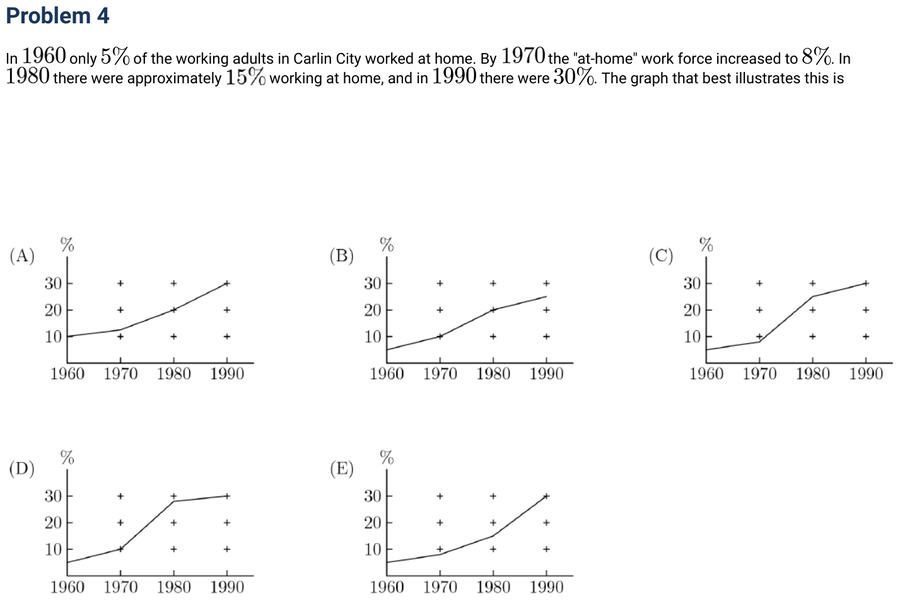
Don't just check that a graph goes up — look at HOW the jumps change: 5→8 is +3, but 8→15 is +7 and 15→30 is +15. Each step is bigger than the last.
Still stuck? Show hint 2 →
Hint 2 of 2
A rise whose jumps keep growing curves *upward* (concave up, accelerating) — not a straight line. Eliminate any graph that climbs steadily or levels off.
Show solution
Approach: read the shape of the change, not just the direction
List the decade jumps: 5→8 (+3), 8→15 (+7), 15→30 (+15). The increases roughly *double* each time, so the curve must get steeper and steeper.
Only graph E both passes through all four heights AND bends upward with that accelerating climb.
You'll see it again: in 'which graph fits' problems, the giveaway is usually the *pattern of change* (steepening, leveling, dipping) — a steady-slope line and an accelerating curve look different even when they share endpoints.
Logic & Word Problemswork-backwardcareful-counting
Each principal of Lincoln High School serves exactly one 3-year term. What is the maximum number of principals this school could have during an 8-year period?
Show answer
Answer: C — 4.
Show hints
Hint 1 of 2
8 ÷ 3 isn't a whole number, so the terms don't line up neatly with the window. The trick to MAXIMIZING is to let the window catch the tail end of one term and the front end of another — waste partial terms at both edges.
Still stuck? Show hint 2 →
Hint 2 of 2
To maximize how many things overlap a fixed window, push a boundary just inside each end. The two end-principals only need to touch the window by a single year.
Show solution
Approach: let partial terms hang over both ends of the window
Imagine year 1 is the *final* year of some principal's term — that principal counts, even though most of their term was before our window.
Their 3-year terms then cover years 2–4 (principal 2) and 5–7 (principal 3). That uses years 2 through 7.
Year 8 is the *first* year of a fourth principal — they count too. Total: 4 principals.
The principle: to fit the most fixed-length blocks into a window, align a block boundary just inside each end so the two end blocks only barely overlap — you gain a partial block at each edge. (Choice E's '8' is the trap: a 3-year term can never be just 1 year.)
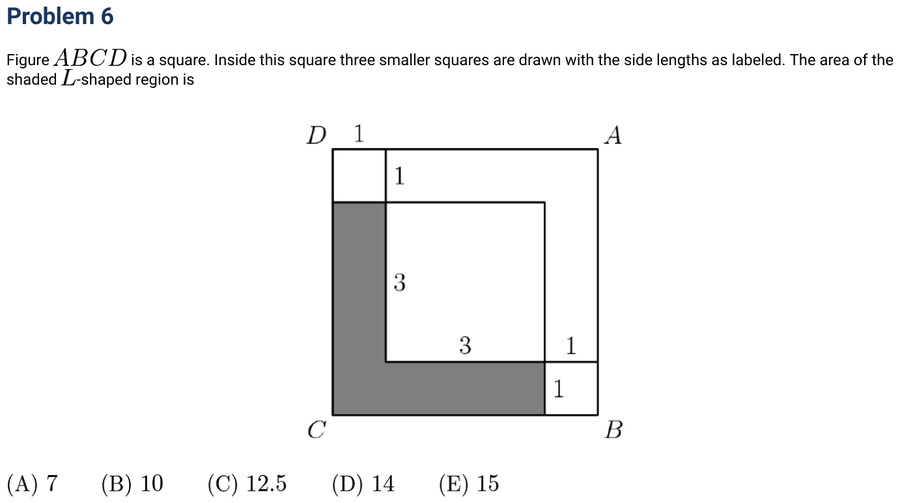
An L-shape is awkward to measure directly — but it's just a big square with bites taken out. Find the big square's side, then subtract the white bites.
Still stuck? Show hint 2 →
Hint 2 of 2
The big square's side isn't labeled directly: read it off the top edge as 1 + 4 = 5. Then it's whole-minus-holes.
Show solution
Approach: fill in the big square, then subtract the white holes
The outer square's side isn't given alone, but the top edge reads 1 + 4 = 5, so the square is 5 × 5 = 25.
The white (non-shaded) pieces are the top 1×1 square, the bottom-right 1×1 square, and the big 4×4 square: 1 + 1 + 16 = 18.
Shaded L = 25 − 18 = 7.
You'll see it again: for any L, staircase, or 'frame' region, don't chop it into thin strips — complete it to a full rectangle and subtract the missing rectangles. Far fewer chances to slip.
What is the minimum possible product of three different numbers of the set {−8, −6, −4, 0, 3, 5, 7}?
Show answer
Answer: B — −280.
Show hints
Hint 1 of 2
'Minimum' here means *most negative*, not smallest in size. First ask: which sign-combinations of three numbers even give a negative product?
Still stuck? Show hint 2 →
Hint 2 of 2
Negative product ⇒ an ODD number of negatives: either one negative or all three. To make it as far below zero as possible, you want the product's *size* as large as possible — so pair big numbers with big numbers.
Show solution
Approach: negative-and-large: count signs first, then maximize magnitude
A product of three numbers is negative only with an odd count of negatives — so use exactly one negative, or all three.
All three negatives: (−8)(−6)(−4) = −192. One negative, biggest magnitudes: take the most negative number and the two largest positives, (−8)(7)(5) = −280.
−280 is further below zero, so the minimum is −280. (The 0 in the set would kill the product — never include it when you want a nonzero extreme.)
The principle: for 'most negative product,' handle the SIGN and the SIZE separately — fix an odd number of negatives, then grab the largest-magnitude factors.
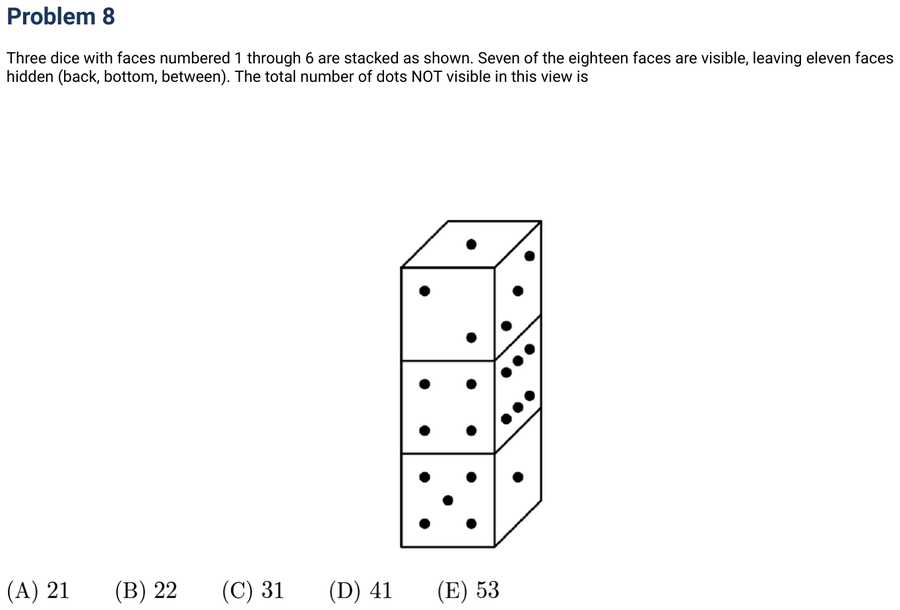
Eleven hidden faces is a lot to track — but every face, hidden or not, belongs to a die whose six faces total a *fixed* amount. So compute the grand total and subtract only what you CAN see.
Still stuck? Show hint 2 →
Hint 2 of 2
This is complementary counting: hidden = (everything) − (visible). It's far less error-prone than reasoning about which specific hidden faces are which.
Show solution
Approach: complementary counting — total dots minus visible dots
One die's faces always sum to 1+2+3+4+5+6 = 21, so three dice hold 3 × 21 = 63 dots no matter how they're stacked.
Add up only the seven visible faces: 1 + 1 + 2 + 3 + 4 + 5 + 6 = 22.
Hidden dots = 63 − 22 = 41.
You'll see it again: when the 'unseen' part is messy but the 'whole' is easy and fixed, count the whole and subtract the seen — the hard part cancels out.
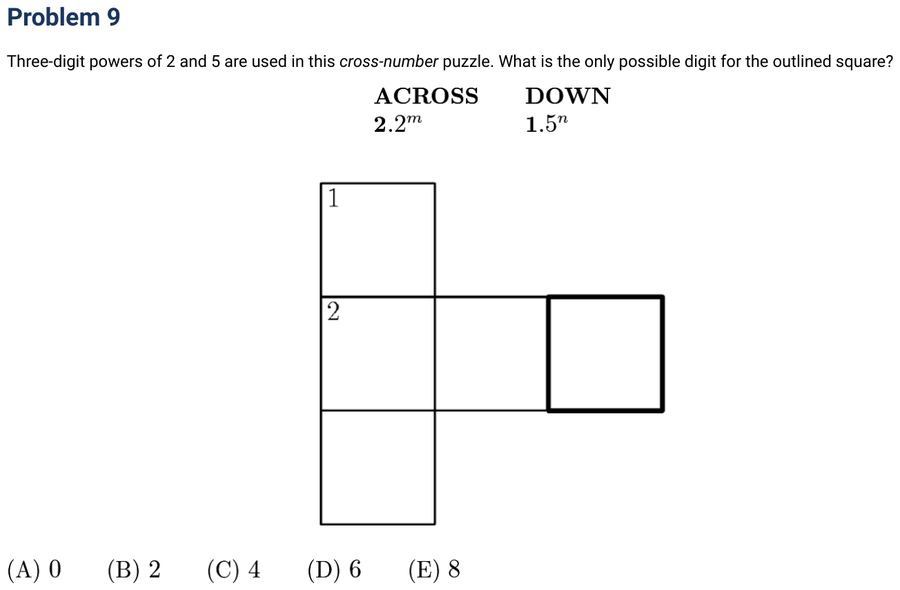
The clue 'three-digit power' is doing the heavy lifting — there are only a handful of those, so list them instead of computing. The two answers must agree at the square where they cross.
Still stuck? Show hint 2 →
Hint 2 of 2
Powers of 5 grow fast: only 125 and 625 have three digits. Powers of 2: only 128, 256, 512. The crossing cell must be a digit that appears in BOTH an answer of one list and an answer of the other.
Show solution
Approach: list the few candidates, then match at the shared cell
Three-digit powers of 5 are just 125 and 625 — both have 2 as their *middle* digit. So the down-answer's middle cell (which is the across-answer's *first* cell) is a 2.
Three-digit powers of 2 are 128, 256, 512. The only one starting with 2 is 256, so the across answer is 256.
The outlined square is the last cell of that across answer: its units digit, 6.
The lesson: 'how many such numbers exist' is often tiny — exponential values thin out fast, so enumerate them rather than search blindly, then let the overlap pin down the rest.
Ara and Shea were once the same height. Since then Shea has grown 20% while Ara has grown half as many inches as Shea. Shea is now 60 inches tall. How tall, in inches, is Ara now?
Show answer
Answer: E — 55 inches.
Show hints
Hint 1 of 2
The 60 inches is Shea's height AFTER a 20% growth — so 60 is 120% of the shared start, not the start itself. Undo the growth to find where they both began.
Still stuck? Show hint 2 →
Hint 2 of 2
Watch the units switch: Ara grew 'half as many *inches*,' not half the percent. Once you know Shea's inches gained, halve THAT number.
Show solution
Approach: undo the percent to find the start, then count inches
60 is 120% of the common starting height, so start = 60 ÷ 1.2 = 50 inches. That means Shea gained 60 − 50 = 10 inches.
Ara grew half as many *inches*: 10 ÷ 2 = 5 inches. Ara is now 50 + 5 = 55 inches.
The habit to build: the two people start equal but the problem mixes a percent (Shea) with raw inches (Ara). Always convert the percent into actual inches before comparing — reasoning in percents would have you compare 20% of one height with an inch count, which aren't the same kind of thing.
The number 64 has the property that it is divisible by its units digit. How many whole numbers between 10 and 50 have this property?
Show answer
Answer: C — 17.
Show hints
Hint 1 of 2
The units digit is what you're dividing BY, so sort the numbers by units digit — each digit becomes its own little test. And some digits are free: ending in 1, 2, or 5 *guarantees* divisibility.
Still stuck? Show hint 2 →
Hint 2 of 2
Why are 1, 2, 5 free? Any number is divisible by 1; any even number (ends in 2) is divisible by 2; any number ending in 5 is divisible by 5. For the remaining digits, you only have a few numbers each to check by hand.
Show solution
Approach: casework on the units digit, banking the 'free' ones first
Free digits: ending in 1, 2, or 5 always divides (rules for 1, 2, 5). In 10–50 each of those digits gives 4 numbers ⇒ 12 winners so far.
Now hand-check the rest. Digit 3: only 33 works (33÷3=11). Digit 4: 24 and 44 work. Digit 6: only 36 works. Digit 8: only 48 works. Digits 0 (can't divide by 0), 7, and 9 give nothing.
Total = 12 + 1 + 2 + 1 + 1 = 17.
Organizing principle: when a property depends on the last digit, splitting into 10 digit-cases turns one big hunt into ten tiny ones — and spotting which cases are automatically true (1, 2, 5) cuts most of the work.
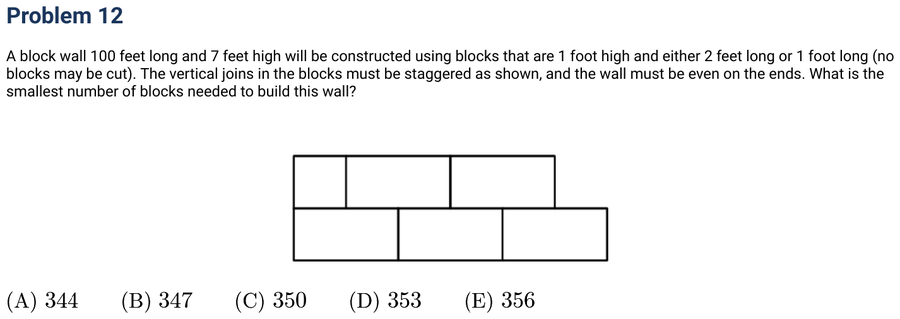
Fewer blocks means longer blocks, so you'd love every block to be a 2-footer (50 per row). The only thing stopping you is the rule that joints must stagger — figure out what that forces, row by row.
Still stuck? Show hint 2 →
Hint 2 of 2
A row of fifty 2-ft blocks has its joints at every even foot. The next row must NOT line up with those, so its joints sit at odd feet — which means that row has to start and end with a 1-ft half-block. Count the two row 'types.'
Show solution
Approach: find the two repeating row patterns, then count rows of each
Cheapest row = all 2-ft blocks: 100 ÷ 2 = 50 blocks, with joints at 2, 4, 6, … An identical row directly above would line its joints up — not allowed.
So alternate rows must shift: a 1-ft block at each end, then 49 two-ft blocks fill the middle (1 + 98 + 1 = 100 ft) = 51 blocks. Joints now fall at odd feet, staggered from the rows below.
The 7 rows alternate 50, 51, 50, 51, 50, 51, 50: four rows of 50 and three of 51. Total = 200 + 153 = 353.
You'll see it again: in tiling/bricklaying puzzles, find the small set of repeating patterns the rules allow, count blocks in each, then multiply by how many rows of each — don't try to count the whole wall at once.
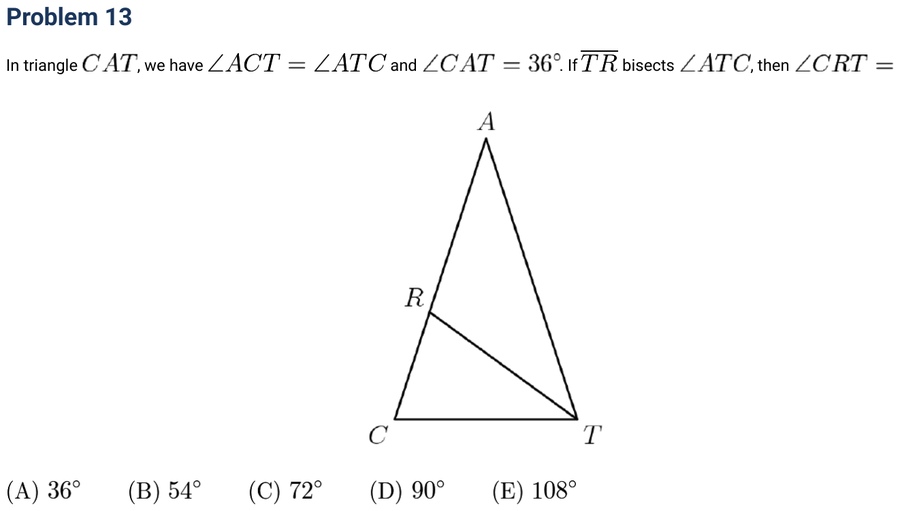
∠ACT = ∠ATC means triangle CAT is isosceles — those two equal base angles plus the 36° apex must total 180°. That single equation unlocks both base angles at once.
Still stuck? Show hint 2 →
Hint 2 of 2
Once you know ∠ATC, the bisector cuts it in half to give ∠RTC. Then triangle CRT is just another 'three angles sum to 180°' — and notice you already know two of them (∠TCR is the same as ∠ACT).
Show solution
Approach: isosceles to get base angles, then a second triangle's angle sum
Triangle CAT is isosceles (∠ACT = ∠ATC), so 36 + 2·(base angle) = 180, giving each base angle = (180 − 36)/2 = 72°. So ∠ATC = ∠ACT = 72°.
The bisector TR halves ∠ATC, so ∠RTC = 72 ÷ 2 = 36°.
In triangle CRT the angles are ∠TCR = 72° (it's the same corner as ∠ACT), ∠RTC = 36°, and ∠CRT. So ∠CRT = 180 − 72 − 36 = 72°.
The reusable move: an angle chase is just a relay — pin down one angle with isosceles/bisector facts, then carry it into the next triangle's 180° sum. Reuse angles you've already found instead of recomputing them.
Don't be scared by the huge exponents — a number's last digit only depends on the last digit of the base. Both 19 and 99 end in 9, so this is really 'what does 9 to a big power end in?'
Still stuck? Show hint 2 →
Hint 2 of 2
List the last digits of 9¹, 9², 9³…: 9, 1, 9, 1, … — a length-2 cycle. So the only thing that matters is whether the exponent is odd or even.
Show solution
Approach: reduce each base to its last digit, then find the power's cycle
Last digit depends only on the base's last digit, so 19¹⁹ matches 9¹⁹ and 99⁹⁹ matches 9⁹⁹.
Powers of 9 end in 9 (odd exponent) or 1 (even exponent). Both exponents 19 and 99 are odd, so each power ends in 9.
9 + 9 = 18, so the sum ends in 8.
You'll see it again: for the last digit of any power, throw away everything but the base's units digit, then find its short repeating cycle (length 1, 2, or 4) and reduce the exponent against that cycle.
Another way — 9 is one less than 10:
Since 9 = 10 − 1, a power of 9 is just a touch off a multiple of 10: 9^odd ends in the same digit as (−1)^odd = −1, i.e. a 9; 9^even ends like +1.
Both exponents are odd, so both powers end in 9, and 9 + 9 = 18 → units digit 8.
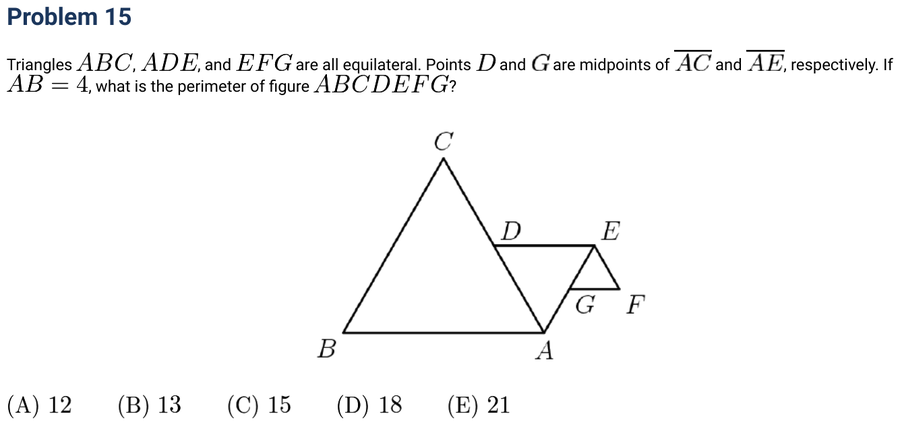
'Midpoint' is the key word: building the next triangle on a midpoint makes its side exactly half. So the sides go 4, 2, 1 — each triangle half the last.
Still stuck? Show hint 2 →
Hint 2 of 2
Perimeter means the OUTSIDE boundary only. Don't add all three full triangles — where one triangle sits on another, that shared edge is interior and gets skipped. Just walk the outline once.
Show solution
Approach: walk the outer boundary, skipping shared edges
Each new triangle is built on a midpoint, so its side is half the previous: 4, then 2, then 1.
Trace the outline A→B→C→D→E→F→G→A and record only edges on the outside. You get 4, 4 (big triangle's two outer sides), 2, 2 (middle), 1, 1, 1 (small), summing to 15.
Sanity check / the principle: if you'd naively added all three perimeters (12 + 6 + 3 = 21, choice E — the trap!), you'd double-count the edges where triangles meet. Perimeter is always the outer boundary, so interior shared segments never count.
In order for Mateen to walk a kilometer (1000 m) in his rectangular backyard, he must walk the length 25 times or walk its perimeter 10 times. What is the area of Mateen's backyard in square meters?
Show answer
Answer: C — 400 square meters.
Show hints
Hint 1 of 2
Each '___ times = 1000 m' is secretly a division: if one length is walked 25 times to reach 1000 m, one length is 1000 ÷ 25. Translate both clues into a single number each.
Still stuck? Show hint 2 →
Hint 2 of 2
Length and perimeter alone don't give area — you need the width. Back it out of perimeter = 2(length + width).
Show solution
Approach: turn each 'walk it N times' clue into one measurement
Length: walked 25 times to cover 1000 m, so one length = 1000 ÷ 25 = 40 m. Perimeter: walked 10 times for 1000 m, so the perimeter = 1000 ÷ 10 = 100 m.
Perimeter = 2(length + width): 100 = 2(40 + W), so 40 + W = 50 and W = 10 m.
Area = length × width = 40 × 10 = 400 m².
The lesson: 'do X to cover a total' clues are just multiplication facts in disguise — divide the total by the count to recover one piece. Then the area needs both dimensions, so use perimeter to fish out the missing one.
The operation ⊗ is defined for all nonzero numbers by a ⊗ b = a2 / b. Determine [(1 ⊗ 2) ⊗ 3] − [1 ⊗ (2 ⊗ 3)].
Show answer
Answer: A — −2/3.
Show hints
Hint 1 of 2
A made-up symbol is just a recipe — obey the brackets exactly, working the innermost operation first. The whole point of the problem is that the brackets are placed *differently* on the two sides.
Still stuck? Show hint 2 →
Hint 2 of 2
This operation is NOT associative: (a⊗b)⊗c and a⊗(b⊗c) genuinely differ. So you can't shuffle the parentheses — compute each side honestly and subtract.
Show solution
Approach: obey the brackets, innermost first, on each side
Left side: 1 ⊗ 2 = 1²/2 = ½, then (½) ⊗ 3 = (½)²/3 = (¼)/3 = 1/12.
Right side: 2 ⊗ 3 = 2²/3 = 4/3, then 1 ⊗ (4/3) = 1²/(4/3) = 3/4.
Difference = 1/12 − 3/4 = 1/12 − 9/12 = −2/3.
You'll see it again: for an unfamiliar operation, treat the definition as a literal substitution recipe and never assume the usual algebra rules (associativity, commutativity) carry over — that the two bracketings disagree is exactly the trap being tested.
Answer: E — Same area, but quadrilateral I has the smaller perimeter.
Show hints
Hint 1 of 2
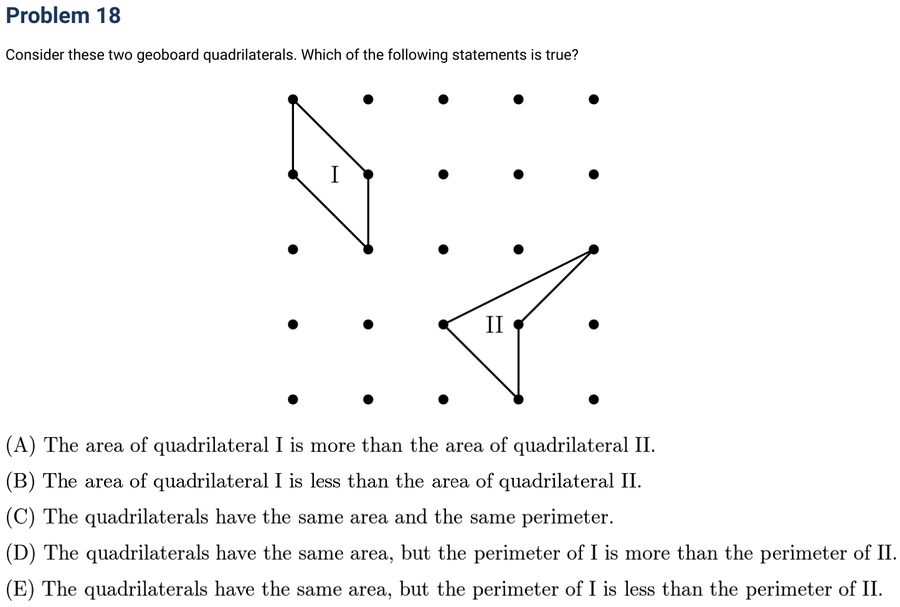
The answer choices split into 'compare area' and 'compare perimeter,' so settle area FIRST — and don't eyeball it. On a geoboard you can find area exactly (slice into triangles, or use base × height).
Still stuck? Show hint 2 →
Hint 2 of 2
Equal area does NOT force equal perimeter — a shape can enclose the same space with more boundary. Once areas tie, compare the sides one by one: the shapes share a pair of equal slants, so look only at the *other* sides.
Show solution
Approach: lock down area exactly, then compare the differing sides
Area first. Region I is a parallelogram of base 1 and height 1, so area = 1. Region II splits into two triangles, each base 1 and height 1, area ½ + ½ = 1. The areas are *equal* — so it's down to perimeter.
Both shapes have a matching pair of slant sides (each spanning 1 across and 1 up, length √2). Their remaining sides differ: region I's other two sides are plain unit segments (length 1 each), while region II's remaining side is a long diagonal clearly stretching more than 1.
So region II carries more boundary — its perimeter is larger, which means region I's perimeter is the *smaller* one: choice E.
The big idea: area and perimeter are independent — same area can hide very different perimeters (a key reason 'compare the figures' problems list both). Pin down the one that's easy to compute exactly, then reason about the other.
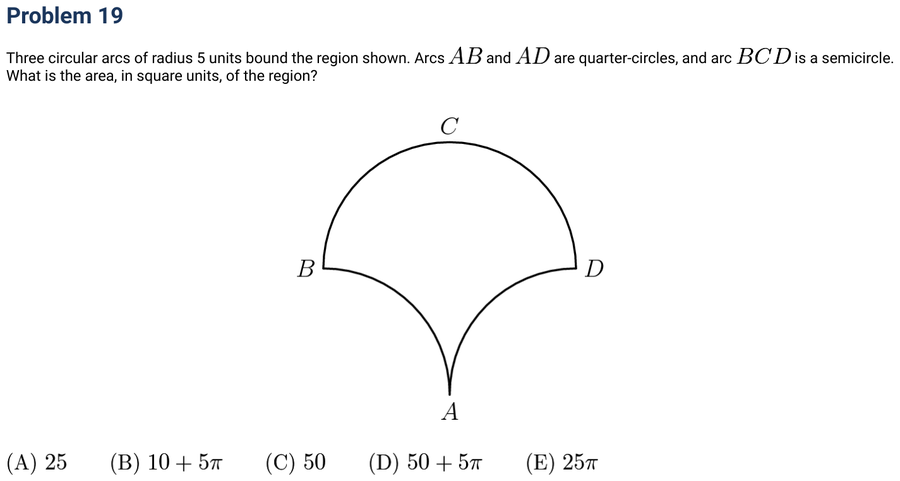
Before reaching for π, notice every arc has the SAME radius 5. The two quarter-circles scooped OUT of the bottom and the semicircle bulging UP on top are built from identical-radius pieces — so the curves might just cancel.
Still stuck? Show hint 2 →
Hint 2 of 2
Two quarter-circles of radius 5 add up to one semicircle of radius 5. That's exactly the area added by the top bump. So removed area = added area, and the region equals a plain rectangle — the π's vanish.
Show solution
Approach: the curves cancel — equal area cut out equals area added
All arcs have radius 5. Frame the figure with the rectangle whose width is the straight chord BD = 2·5 = 10 (B and D sit one radius either side of center) and whose height is 5.
The bottom of the region dips inward along two quarter-circles (arcs AB and AD); together those two quarters make exactly one semicircle of radius 5 of *missing* area. The top of the region bulges out along semicircle BCD — exactly one semicircle of radius 5 of *extra* area.
Missing = extra, so they cancel perfectly: the region has the same area as the 10 × 5 rectangle = 50.
You'll see it again: when curved bites and curved bulges share the same radius, slide the bulge into the bite — equal curves cancel and you're left with straight-sided area. If you ever see π in your answer here, you forgot to cancel (the trap choices 25π, 10+5π are there for exactly that).
You have nine coins: a collection of pennies, nickels, dimes, and quarters having a total value of $1.02, with at least one coin of each type. How many dimes must you have?
Show answer
Answer: A — 1 dime.
Show hints
Hint 1 of 2
'At least one of each' is a gift: spend one of each coin up front (41¢) and the puzzle shrinks to placing the 5 leftover coins. Then look at the LAST digit of what's left.
Still stuck? Show hint 2 →
Hint 2 of 2
The total ends in 2 and only pennies change the units digit. So the number of pennies is forced by the final digit — pin that down before worrying about the bigger coins.
Show solution
Approach: pay one of each first, then let the units digit fix the pennies
Take one of each coin off the top: 1 + 5 + 10 + 25 = 41¢, using 4 of the 9 coins. Remaining: 102 − 41 = 61¢ in 5 more coins.
Units digit move: nickels, dimes, quarters all end in 0 or 5, so only pennies can produce the final '1' in 61. With 5 coins, you can't afford 6 pennies — so exactly 1 more penny. Now 60¢ in 4 coins.
60¢ in 4 coins needs a quarter (four dimes max out at 40¢). Two quarters = 50¢ leaves 10¢ in 2 coins = two nickels. That fills all four with no dime.
So beyond the single starter dime, none are added: 1 dime.
The reusable trick: in coin/total problems, read the *last digit* of the amount — only pennies (the 1¢ pieces) can change it, so the units digit alone often pins the smallest-coin count and collapses the casework.
Keiko tosses one penny and Ephraim tosses two pennies. The probability that Ephraim gets the same number of heads that Keiko gets is
Show answer
Answer: B — 3/8.
Show hints
Hint 1 of 2
Keiko has only one coin, so she can only get 0 or 1 head — that means there are just TWO ways to 'match,' and you only ever have to consider those two head-counts.
Still stuck? Show hint 2 →
Hint 2 of 2
Independent people ⇒ multiply their probabilities within each matching case, then ADD across the cases. So total = P(both 0) + P(both 1).
Show solution
Approach: split into the only two matchable head-counts
Keiko's single coin: 1 head or 0 heads, each probability ½. Ephraim's two coins: 0 heads (TT) with probability ¼, 1 head (HT or TH) with probability ½, 2 heads (HH) with probability ¼. His '2 heads' can never match Keiko, so ignore it.
Match at 1 head: ½ · ½ = ¼. Match at 0 heads: ½ · ¼ = ⅛.
These cases are exclusive, so add: ¼ + ⅛ = ⅜.
The principle: 'same outcome for two players' = sum over each shared value of P(A gets it)·P(B gets it). Limiting to the value the *smaller* experiment can produce keeps the casework tiny.
Another way — count equally-likely outcomes directly:
Keiko has 2 equally likely results (H, T); Ephraim has 4 (HH, HT, TH, TT). Together that's 2 × 4 = 8 equally likely combined outcomes.
Matching ones: Keiko H pairs with Ephraim's 1-head results HT, TH (2 ways); Keiko T pairs with Ephraim's TT (1 way). That's 3 favorable out of 8.
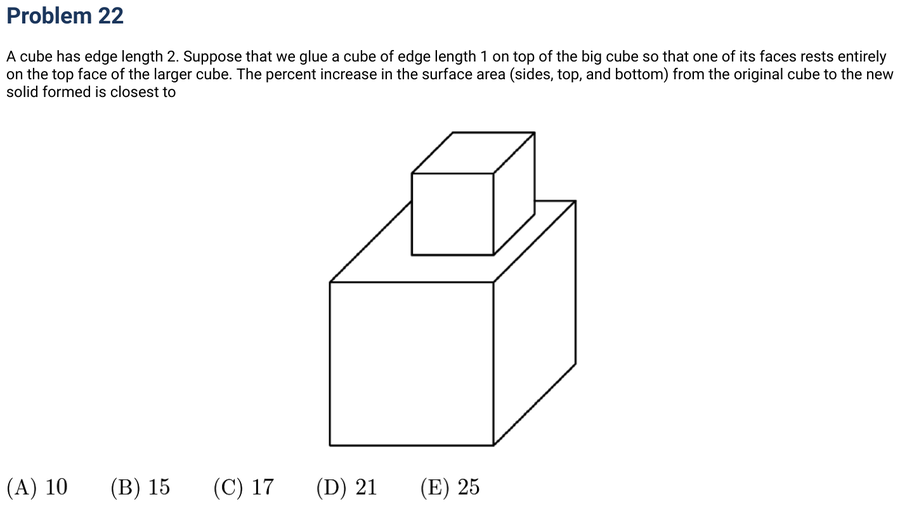
Don't recompute the whole new solid — just ask what surface *changed*. Gluing covers a 1×1 patch of the big top, but the small cube's own top reappears directly above it. So the upward-facing area is exactly the same as before.
Still stuck? Show hint 2 →
Hint 2 of 2
Net new surface = the parts you can newly see minus the parts now hidden. Here the tops trade evenly, leaving only the small cube's 4 side walls as genuinely new area.
Show solution
Approach: count only the faces that actually change
Original surface area: 6 · 2² = 24.
Gluing on the unit cube hides a 1×1 patch of the big top, but the unit cube's top (also 1×1) now sits right above it — so total upward-facing area is unchanged. The glued-down bottom face contributes nothing. The only new surface is the 4 side walls of the small cube: +4.
Increase = 4 / 24 = ⅙ ≈ 16.7%, closest to 17%.
The principle: for 'how much did surface area change,' never re-add everything — track only what got covered vs. newly exposed. A bump glued flat on top trades its footprint for its own top (a wash) and adds only its sides.
There is a list of seven numbers. The average of the first four numbers is 5, and the average of the last four numbers is 8. If the average of all seven numbers is 647, then the number common to both sets of four numbers is
Show answer
Answer: B — 6.
Show hints
Hint 1 of 2
Averages convert to sums (sum = average × count). The first four and last four together name 8 slots — but there are only 7 numbers, so ONE number sits in both groups and gets counted twice.
Still stuck? Show hint 2 →
Hint 2 of 2
If (first four) + (last four) counts the shared number twice and everything else once, then subtracting the honest total of all seven (each once) cancels everything except that one extra copy.
Show solution
Approach: the shared number is the only thing counted twice
Turn averages into sums: first four = 4 · 5 = 20, last four = 4 · 8 = 32. Add: 20 + 32 = 52 — this counts the overlapping middle number twice and the other six once each.
The honest total of all seven is 7 · 6⁴⁄₇ = 7 · (46/7) = 46, counting every number exactly once.
Subtract: 52 − 46 = 6. The subtraction removes one full copy of every number, leaving precisely the extra copy of the shared one.
You'll see it again: this is inclusion–exclusion in miniature — when groups overlap, sum-of-groups minus true-total isolates the overlap. Always start by converting averages to sums so they can be added.
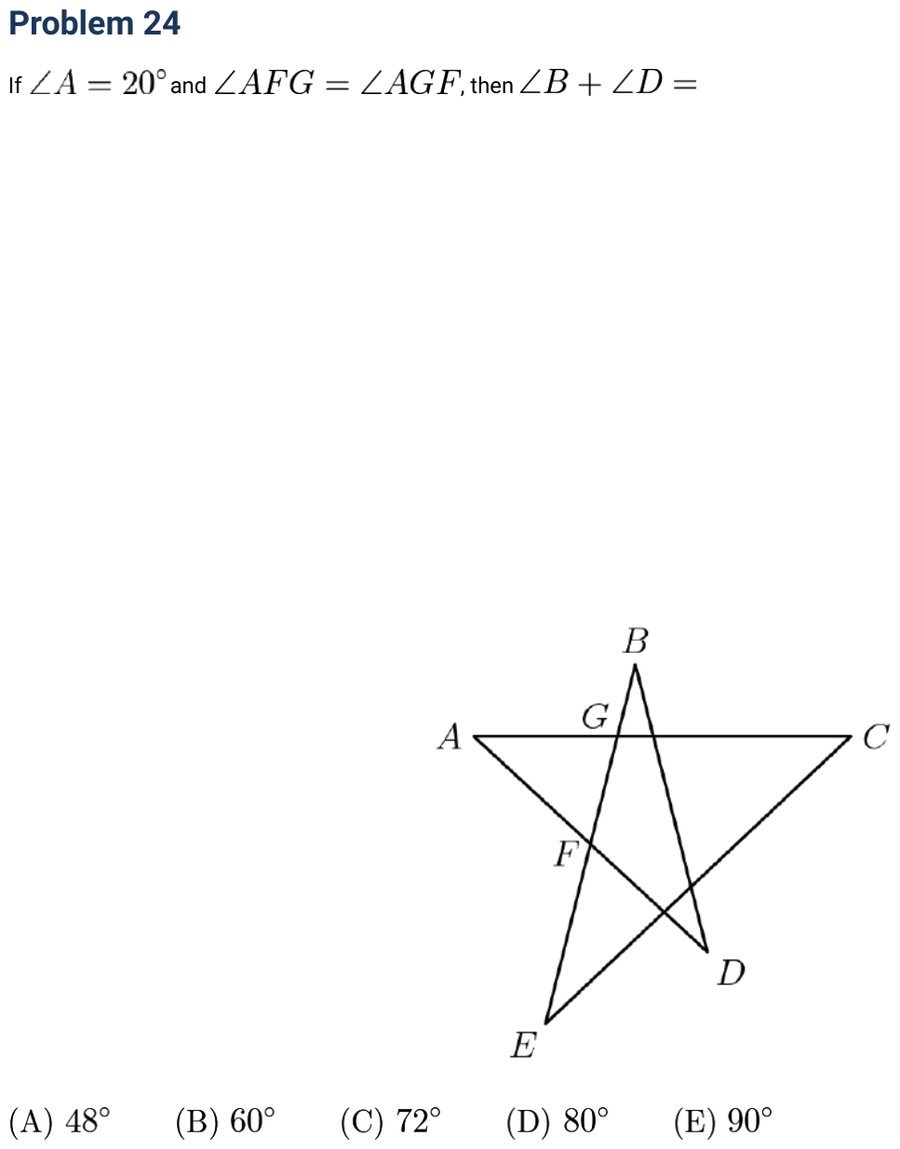
The figure looks like a tangle of lines, but the only thing you're TOLD is ∠AFG = ∠AGF — that quietly says triangle AFG is isosceles, and you know its apex ∠A = 20°. Start there; it hands you the angle at F for free.
Still stuck? Show hint 2 →
Hint 2 of 2
Once you have the angle at F, notice that same angle is the *exterior* angle of triangle BFD at F. The exterior-angle theorem says it equals the two far-off angles added together — and those happen to be exactly ∠B and ∠D, the thing you want.
Show solution
Approach: isosceles triangle to get the angle at F, then exterior-angle theorem
∠AFG = ∠AGF makes triangle AFG isosceles. With apex ∠A = 20°, each base angle is (180° − 20°) / 2 = 80°, so ∠AFG = 80°.
That 80° angle at F is the exterior angle of triangle BFD. The exterior-angle theorem: an exterior angle equals the sum of the two remote interior angles — here those remote angles are exactly ∠B and ∠D.
So ∠B + ∠D = 80°, no need to find B and D separately.
The power move: the exterior-angle theorem lets you grab a SUM of two angles in one shot — perfect when a problem asks for ∠B + ∠D rather than either one alone. Always read whether you're asked for a single angle or a sum; a sum often means 'don't solve them individually.'
Another way — supplement, then angle sum (as MAA presents it):
From the isosceles triangle, ∠AFG = 80°, so the angle inside triangle BFD at F is its supplement, 180° − 80° = 100°.
The angles of triangle BFD sum to 180°, so ∠B + ∠D = 180° − 100° = 80°.
The area of rectangle ABCD is 72. If point A and the midpoints of sides BC and CD are joined to form a triangle, the area of that triangle is
Show answer
Answer: B — 27.
Show hints
Hint 1 of 2
The slanted triangle is hard to measure head-on, but the three corners it leaves behind are clean right triangles. Cut those away from the whole rectangle instead — and you never need the actual dimensions.
Still stuck? Show hint 2 →
Hint 2 of 2
Each corner triangle is ½ · (its two legs), and each leg is either a full side or a half-side of the rectangle — so each corner is a simple fraction (¼ or ⅛) of the rectangle. Add the fractions, subtract from 1.
Show solution
Approach: subtract the corner triangles as fractions of the whole
The target triangle is what's left after slicing off the three right triangles in the corners. Work in fractions of the whole rectangle so the unknown dimensions cancel:
Corner B: legs = full top + half of the right side ⇒ ½ · 1 · ½ = ¼ of the rectangle. Corner D: full left side + half the bottom ⇒ another ¼. Corner C: half-right + half-bottom ⇒ ½ · ½ · ½ = ⅛.
Corners take ¼ + ¼ + ⅛ = ⅝, so the triangle is the remaining ⅜. Area = ⅜ · 72 = 27.
You'll see it again: for a triangle drawn inside a rectangle using corners and midpoints, don't hunt for a base and height — subtract the corner right triangles as fractions of the whole. The area ratio is fixed no matter the rectangle's actual shape.
Another way — drop in coordinates:
Pick easy dimensions with area 72, say width 12 and height 6: A(0,6), B(12,6), C(12,0), D(0,0). Midpoint of BC is M(12,3); midpoint of CD is N(6,0).