Problem 25 · 1999 AMC 8
Stretch
Geometry & Measurement
geometric-seriesself-similarity
Show answer
Answer: A — About 6.
Show hints
Hint 1 of 2
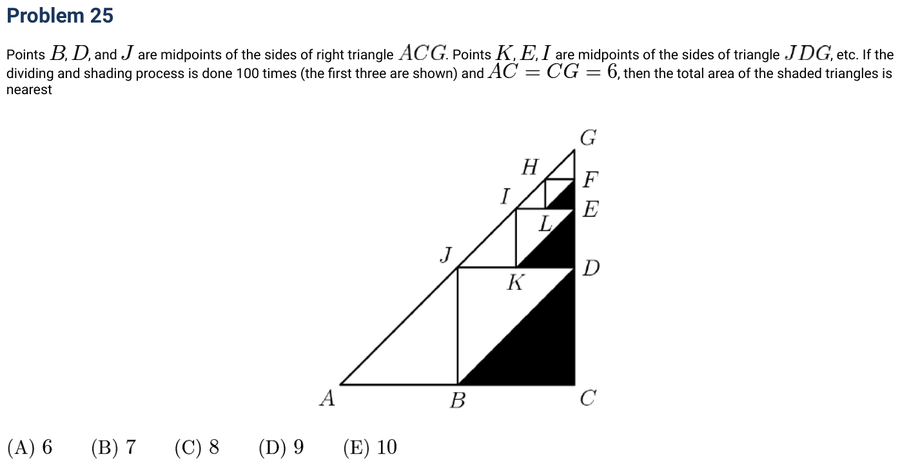
Each step takes midpoints, so every new triangle is a half-scale copy of the last one — and halving the sides quarters the area. The shaded triangles therefore shrink by a factor of ¼ each time: it's a geometric series.
Still stuck? Show hint 2 →
Hint 2 of 2
When the ratio is less than 1 and you're adding 100 terms, the tail is microscopic — treat it as the full infinite sum: first term ÷ (1 − ratio).
Show solution
Approach: self-similar figure → geometric series with ratio ¼
- The whole right triangle ACG has legs 6, area ½·6·6 = 18. The midpoint construction makes each stage a half-size copy of the previous, and half the side length means one-quarter the area — so the shaded pieces run 9/2, 9/8, 9/32, …, each ¼ of the one before.
- Sum the geometric series: first term ÷ (1 − ratio) = (9/2) ÷ (1 − ¼) = (9/2) ÷ (¾) = 6. Doing it 100 times instead of forever changes this by far less than the gap between answer choices.
- So the total shaded area is nearest 6. The big idea: self-similar (midpoint/fractal) figures generate geometric series, and once the ratio < 1, a long-but-finite count is safely the infinite sum a/(1−r).
Another way — trap it between an under- and over-estimate:
- If you don't trust the infinite-sum leap, bound it. The first three shaded triangles already total 9/2 + 9/8 + 9/32 ≈ 5.9, an underestimate.
- All the remaining tiny triangles fit inside one small triangle of area 9/32 ≈ 0.28, so the true total is below 5.9 + 0.3 ≈ 6.2.
- The answer is squeezed between 5.9 and 6.2, so it's nearest 6 — a rigorous check that doesn't assume the series is exactly infinite.
Mark:
· log in to save