Problem 22 · 1992 AJHSME
Stretch
Geometry & Measurement
perimeter-changeparity
Show answer
Answer: C — 18.
Show hints
Hint 1 of 3
Don't recount the whole perimeter for every placement — ask instead: when I snap on ONE tile, how does the boundary CHANGE? What's the most it can grow by?
Still stuck? Show hint 2 →
Hint 2 of 3
A tile has 4 edges. Sharing one edge with the figure hides that edge AND covers an edge of the figure, so each tile that touches at exactly one edge nets +2 to the perimeter; touching more edges adds even less. Track the change, not the total.
Still stuck? Show hint 3 →
Hint 3 of 3
To make the perimeter as large as possible, let each new tile touch the figure along just a single edge, and keep the two new tiles from touching each other.
Show solution
Approach: track each tile's change to the perimeter; maximize by touching minimally
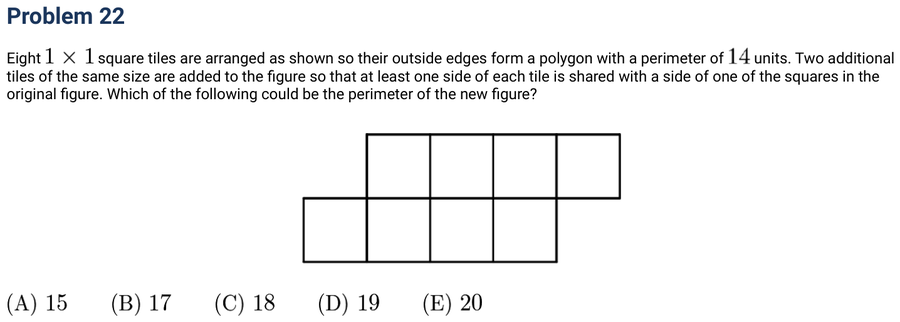
- Start from perimeter 14. Snap on one tile: it brings 4 edges, but the edge it shares is now internal (hidden) and it covers one edge of the old figure too. Net change = +3 − 1 = +2 — and that's the MOST a single tile can add (sharing more edges adds even less). The change is always even.
- Two tiles, each touching at just one edge and not touching each other, add +2 each: 14 + 2 + 2 = 18. That's the largest reachable perimeter, and it's actually achievable.
- Why this transfers: for tiling/perimeter problems, reason about the CHANGE one piece makes, not the full recount. Sharing an edge always removes 2 from the boundary (one from each tile), so more sharing means a smaller perimeter — minimal contact maximizes perimeter.
- Why the bigger choices are impossible: 19 is odd (each tile changes perimeter by an even amount, so 14 stays even), and 20 would need each tile to add +3, more than a tile can ever contribute.
Mark:
· log in to save