Problem 15 · 1991 AJHSME
Hard
Geometry & Measurement
surface-areainvariance
Show answer
Answer: C — the same.
Show hints
Hint 1 of 3
Don't compute the whole surface area before and after — just track what CHANGES at the corner. Removing the little cube takes away some surface squares but opens up a notch with new walls. Compare those two amounts.
Still stuck? Show hint 2 →
Hint 2 of 3
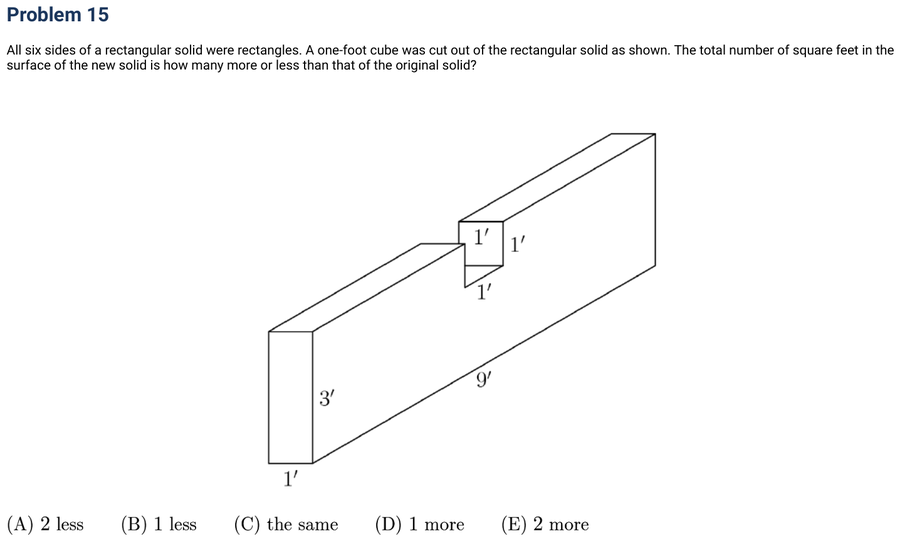
The cut-out cube sat at a corner, so exactly 3 of its faces were on the outside (now gone). The notch it leaves behind exposes 3 fresh inside faces. Are those numbers the same?
Still stuck? Show hint 3 →
Hint 3 of 3
Picture biting one cube out of a corner: 3 squares disappear from the outside, 3 brand-new squares appear inside. The trade is even.
Show solution
Approach: compare only the squares removed vs. the squares newly exposed
- Total surface area barely matters — only the corner changes, so just weigh what's lost against what's gained there.
- The unit cube was at a corner, so 3 of its faces were part of the outer surface; removing it erases those 3 unit squares.
- But the empty notch now shows 3 new inside faces (the walls of the bite), adding 3 unit squares back.
- 3 removed, 3 revealed — they cancel exactly, so the surface area is the same.
- Why this transfers: for any "before vs. after" question, don't recompute the whole thing — track only the difference. And a corner notch always trades 3 outer faces for 3 inner faces (an edge notch trades 2 for 4, growing the area), so the geometry of where you cut decides the outcome.
Mark:
· log in to save