Problem 15 · 2026 AMC 8
Hard
Geometry & Measurement
spatial-reasoning
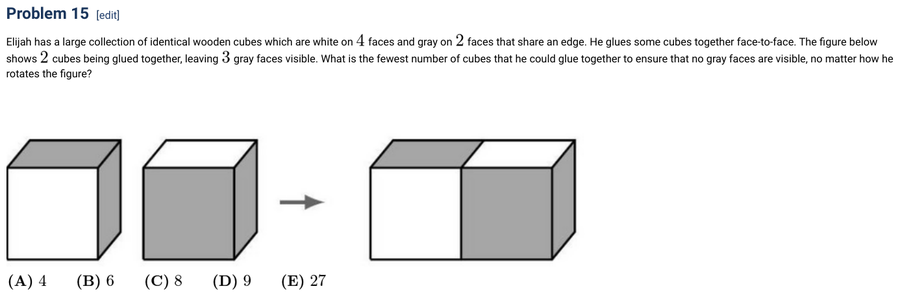
Show answer
Answer: A — 4 cubes.
Show hints
Hint 1 of 2
Focus on what one cube needs. Its two gray faces meet at an edge (they're adjacent, not opposite). To bury both, the cube must be glued on two faces that also meet at an edge.
Still stuck? Show hint 2 →
Hint 2 of 2
So a straight line of cubes can't work — the inside cubes are only glued on opposite faces. Every cube needs two glued faces sharing a corner. What's the smallest cluster where every cube gets that?
Show solution
Approach: each cube must be glued on two faces that share an edge
- Zoom in on a single cube. Its two gray faces are adjacent (they share an edge), so to hide both, the cube has to touch neighbors on two faces that share an edge — an ‘L’ of contact, not a straight-through pair.
- That rules out a straight row: an end cube is glued on only one face, and a middle cube is glued on two opposite faces — either way a gray face is left showing. You need the cubes to turn a corner.
- Arrange four cubes in a 2 × 2 square. Every cube then touches two neighbors on faces that meet at an edge, so its gray pair can point into that corner and stay hidden. Three or fewer cubes can't give all of them an L of contacts.
- The fewest is 4.
- Why this transfers: ‘hide adjacent faces’ problems hinge on which faces get covered, not just how many — opposite-face contact (a straight line) and edge-sharing contact (a corner) are very different, and the gray-face geometry tells you which you need.
Mark:
· log in to save