Problem 10 · 1991 AJHSME
Medium
Geometry & Measurement
base-height
Show answer
Answer: B — 8.
Show hints
Hint 1 of 3
A parallelogram's area is base × height — and "height" means the straight-up gap between the two parallel sides, NOT the length of the slanted side. The top and bottom sides here are both horizontal; pick one as the base.
Still stuck? Show hint 2 →
Hint 2 of 3
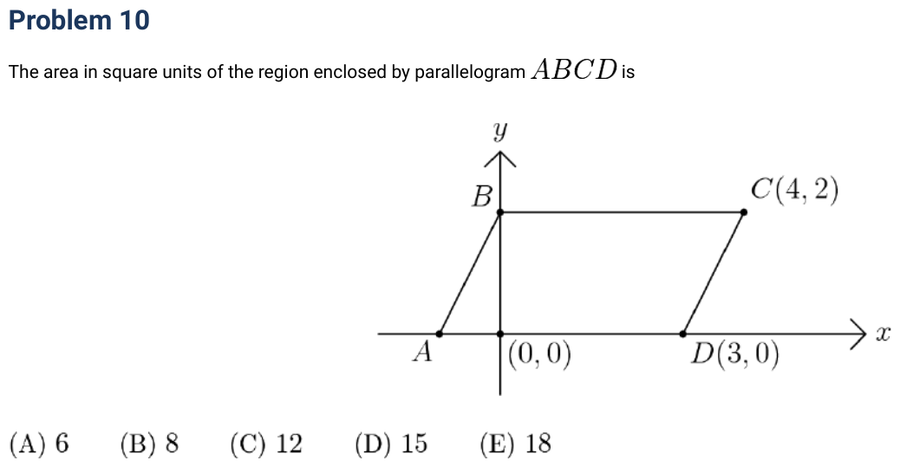
The top side B–C is horizontal: read off its length straight from the coordinates. Then the height is just how far apart the top row and the bottom row sit vertically.
Still stuck? Show hint 3 →
Hint 3 of 3
Slanting a parallelogram side-to-side doesn't change its area — only the base and the perpendicular height matter. Don't let the tilt tempt you into using the diagonal.
Show solution
Approach: area = base × perpendicular height (the slant doesn't count)
- Use the horizontal top side as the base. B = (0, 2) and C = (4, 2) sit at the same height, so the base length is just 4 − 0 = 4.
- The height is the vertical distance between the parallel top and bottom sides: the top is at y = 2 and the bottom (through D = (3,0)) is at y = 0, a gap of 2.
- Area = base × height = 4 × 2 = 8.
- Why this transfers: a parallelogram is a "sheared" rectangle — push the top sideways and the area stays the same, because area depends only on base and the perpendicular height. The slanted edge length is a decoy; never multiply by it.
Mark:
· log in to save