Problem 25 · 1989 AJHSME
Stretch
Counting & Probability
parityindependent-events
Show answer
Answer: C — 1⁄2.
Show hints
Hint 1 of 3
The exact numbers don't matter for an even sum — only whether each is even or odd. A sum is even exactly when the two numbers MATCH in parity: both even, or both odd.
Still stuck? Show hint 2 →
Hint 2 of 3
Strip each wheel down to its even/odd chances, then combine: P(match) = P(both even) + P(both odd).
Still stuck? Show hint 3 →
Hint 3 of 3
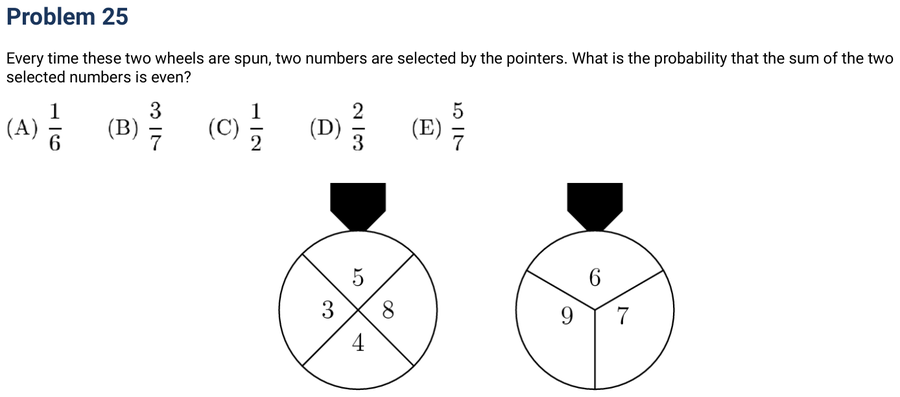
Wheel 1's four equal sectors {5, 3, 8, 4} are half even, half odd. Wheel 2's three equal sectors {6, 9, 7} are one even, two odd.
Show solution
Approach: reduce each wheel to even/odd, then match parities
- An even sum needs the two numbers to share parity (even + even or odd + odd), so the actual values are irrelevant — only even-vs-odd counts. Reduce each wheel: Wheel 1 {5, 3, 8, 4} has 2 evens and 2 odds → P(even) = ½, P(odd) = ½. Wheel 2 {6, 9, 7} has 1 even and 2 odds → P(even) = ⅓, P(odd) = ⅔.
- Since the wheels are independent, multiply within each case and add the two winning cases: P(both even) + P(both odd) = (½·⅓) + (½·⅔) = 1⁄6 + 2⁄6 = 1⁄2.
- Why this transfers: for sum-parity questions, throw away the numbers and keep only even/odd labels — it shrinks a messy spinner into a tiny 'do the parities match?' calculation.
Another way — count all 12 equally-likely outcomes:
- There are 4 × 3 = 12 equally likely (wheel1, wheel2) pairs. The sum is even when parities match.
- Wheel 1 evens {8,4} pair with Wheel 2 even {6}: 2 × 1 = 2 outcomes. Wheel 1 odds {5,3} pair with Wheel 2 odds {9,7}: 2 × 2 = 4 outcomes. Total even-sum outcomes = 2 + 4 = 6.
- Probability = 6⁄12 = 1⁄2, confirming the parity shortcut.
Mark:
· log in to save