Problem 24 · 1989 AJHSME
Stretch
Geometry & Measurement
fold-and-cutperimeter-ratio
Show answer
Answer: E — 5⁄6.
Show hints
Hint 1 of 3
No numbers are given, so invent a friendly side length — pick 4 — so the folded and cut pieces all have whole-number sides.
Still stuck? Show hint 2 →
Hint 2 of 3
The big question is why ONE piece is large and TWO are small. Think about the layers: at the folded crease the paper is connected, but on the open edge the two layers are separate sheets.
Still stuck? Show hint 3 →
Hint 3 of 3
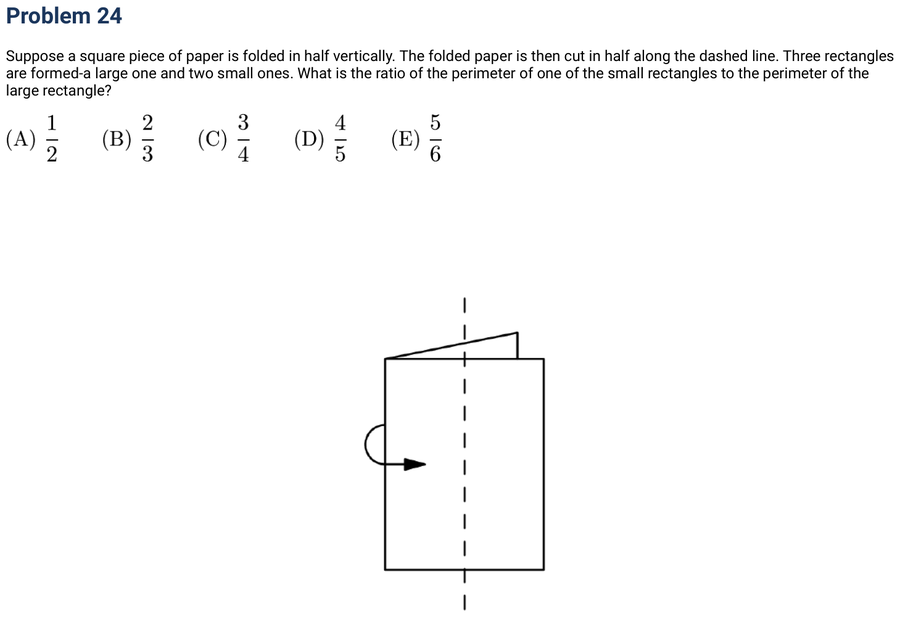
Fold makes a 2-wide, 4-tall double stack; cutting it in half puts the cut 1 unit from the fold. Whatever includes the fold opens into one piece; whatever is on the open side is really two loose layers.
Show solution
Approach: assign side 4, then track folded layers
- Let the square be 4 × 4. Folding in half makes a double-thick stack 2 wide and 4 tall. Cutting this stack in half parallel to the fold puts the cut 1 unit from the fold, splitting it into a fold-side strip and an open-side strip, each 1 × 4 in the folded view.
- Now unfold. The fold-side strip straddles the crease, so its two layers are joined — it opens into one 2 × 4 large rectangle. The open-side strip's two layers were never connected, so they fall apart into two separate 1 × 4 small rectangles. That's why there are three pieces: one big, two small.
- Perimeters: small = 2(1 + 4) = 10, large = 2(2 + 4) = 12. Ratio small : large = 10 : 12 = 5⁄6.
- Why this transfers: in fold-and-cut puzzles, a cut across the fold keeps a piece joined while a cut on the open side doubles into two. Picking a concrete size turns an abstract ratio into countable rectangles.
Mark:
· log in to save