Problem 20 · 1989 AJHSME
Hard
Geometry & Measurement
cube-netopposite-faces
Show answer
Answer: D — 14.
Show hints
Hint 1 of 3
Don't fold the whole cube in your head — just find which faces end up OPPOSITE each other, because opposite faces can never touch at a corner.
Still stuck? Show hint 2 →
Hint 2 of 3
Every corner is where three faces meet, and those three are exactly one from each opposite pair. So to make a corner sum biggest, grab the larger number from each pair.
Still stuck? Show hint 3 →
Hint 3 of 3
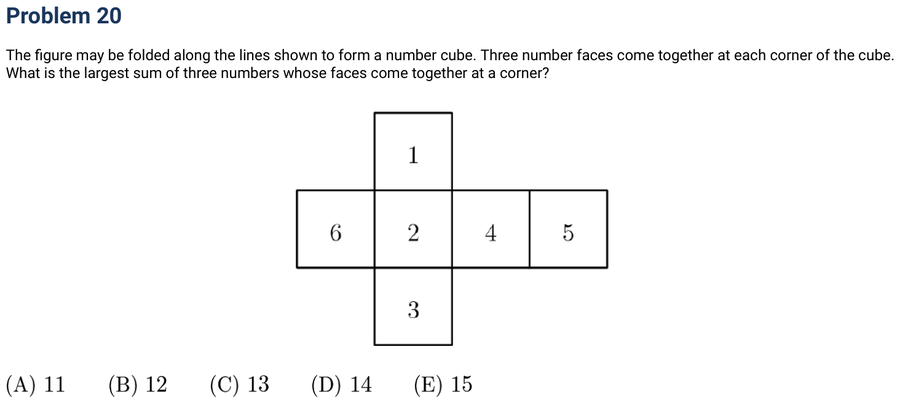
In a straight row of the net, faces two apart are opposite. The row 6, 2, 4, 5 gives 6↔4 and 2↔5; the up-down arm gives 1↔3.
Show solution
Approach: find the three opposite pairs, take the larger of each
- First pair off opposite faces. In the horizontal strip 6 – 2 – 4 – 5, faces two apart fold to opposite sides: 6↔4 and 2↔5. The vertical arm 1 – 2 – 3 gives 1↔3. So the three opposite pairs are {6, 4}, {2, 5}, {1, 3}.
- A corner is made of three faces, one drawn from each opposite pair (two opposite faces can't share a corner). To maximize, take the bigger of each pair: 6, 5, and 3.
- Largest corner sum = 6 + 5 + 3 = 14. And such a corner really exists, since picking one face from each pair always meets at a single vertex.
- Why this transfers: cube-net problems become easy once you stop folding and instead identify the three opposite pairs — faces two apart in a row, or the ends of a T/L bend, are opposite.
Mark:
· log in to save