Problem 20 · 2018 AMC 8
Hard
Geometry & Measurement
area-fractionarea-decomposition
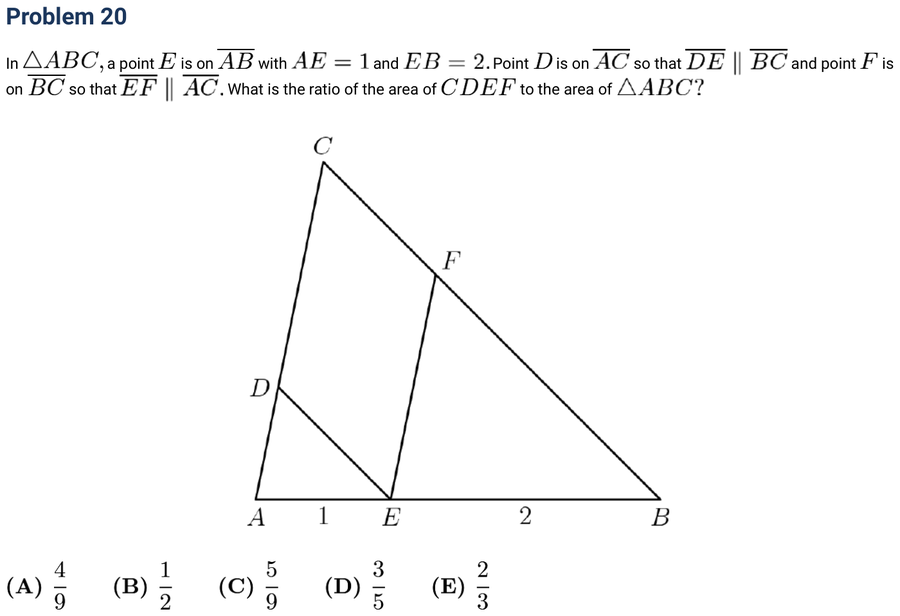
Show answer
Answer: A — 4/9.
Show hints
Hint 1 of 2
A line parallel to a side of a triangle slices off a smaller triangle that's a scaled copy of the whole. Each parallel cut here (DE and EF) does exactly that, lopping off a similar triangle at a corner. The quadrilateral is just what's left.
Still stuck? Show hint 2 →
Hint 2 of 2
The technique: similar-triangle area scales as the square of the side ratio. AE : AB = 1 : 3, so ▵ADE is 1/9 of the whole; EB : AB = 2 : 3, so ▵EFB is 4/9. Subtract both from 1.
Show solution
Approach: carve away two similar triangles
- Set the whole ▵ABC = 1. Because DE ∥ BC, ▵ADE is a shrunken copy of ▵ABC with ratio AE/AB = 1/3 — so its area is (1/3)2 = 1/9.
- Because EF ∥ AC, ▵EFB is a copy with ratio EB/AB = 2/3, area (2/3)2 = 4/9.
- Those two triangles sit at corners A and B and don't overlap, so the leftover quadrilateral CDEF = 1 − 1/9 − 4/9 = 4/9.
- You'll see it again: "line parallel to a side" instantly gives a similar triangle, and area ratio = (side ratio)2 — the squaring is the part people forget.
Another way — recognize CDEF as a parallelogram:
- Since DE ∥ CB (i.e. ∥ CF) and EF ∥ AC (i.e. ∥ DC), quadrilateral DCFE has both pairs of opposite sides parallel — it's a parallelogram.
- Its area can be read as base × height directly, or just confirmed by the subtraction above; either way the ratio to ▵ABC is 4/9. Spotting the parallelogram also explains why the two carved triangles exactly fill the rest.
Mark:
· log in to save