Problem 4 · 1985 AJHSME
Medium
Geometry & Measurement
bounding-rect-minus-notch
Show answer
Answer: C — 46.
Show hints
Hint 1 of 2
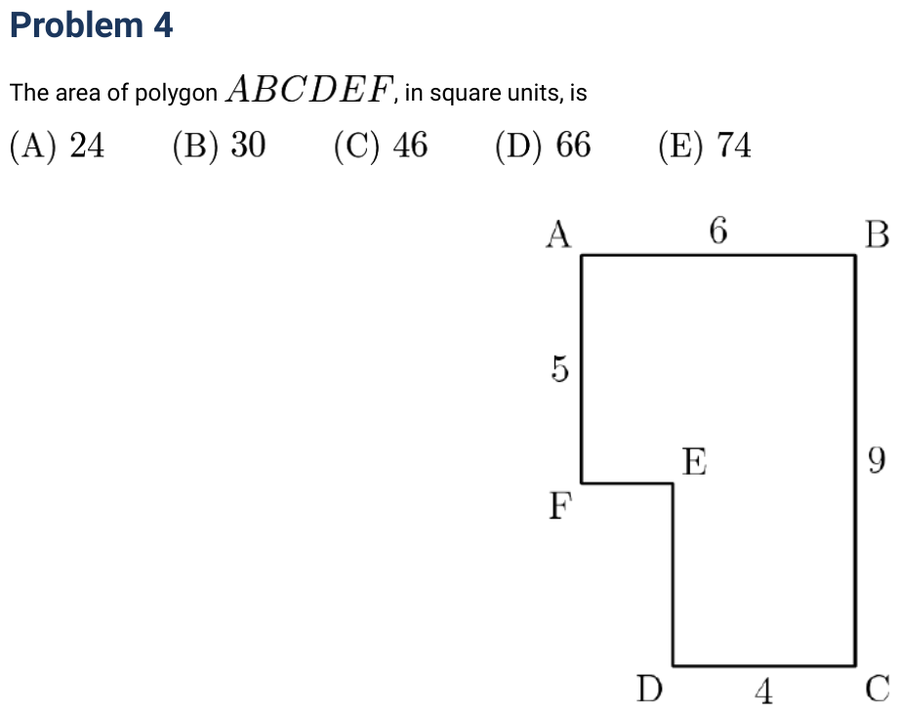
The shape has one corner pushed IN (the bite near E and F). Instead of chopping it into pieces, imagine filling that bite to make a full rectangle — then take the bite back out. What is the full rectangle?
Still stuck? Show hint 2 →
Hint 2 of 2
This is the bounding-box trick: enclose any rectilinear shape in the smallest rectangle that contains it, then subtract the rectangular pieces that aren't part of the shape. One subtraction beats slicing into several rectangles.
Show solution
Approach: bounding rectangle minus the notch
- Fill the bite to complete the full rectangle: it is 6 wide (the top AB) by 9 tall (the right side BC), so its area is 6 × 9 = 54.
- The bite that was removed is itself a small rectangle. Its width is 6 − 4 = 2 (top width minus bottom width DC) and its height is 9 − 5 = 4 (right side minus left side AF), so its area is 2 × 4 = 8.
- Polygon = full rectangle − bite = 54 − 8 = 46.
- Why this transfers: any L-shape, T-shape, or staircase is just a rectangle with rectangular bites taken out — find the missing side lengths by subtracting the parts you know, then subtract areas.
Another way — split into two rectangles:
- Cut horizontally at the level of F/E. Top piece: 6 wide × 5 tall = 30. Bottom piece: 4 wide × (9 − 5) = 4 × 4 = 16.
- 30 + 16 = 46 — same answer, built up instead of cut down.
Mark:
· log in to save