Problem 4 · 2022 AMC 8
Medium
Geometry & Measurement
reflectiontransformationscomposition
Show answer
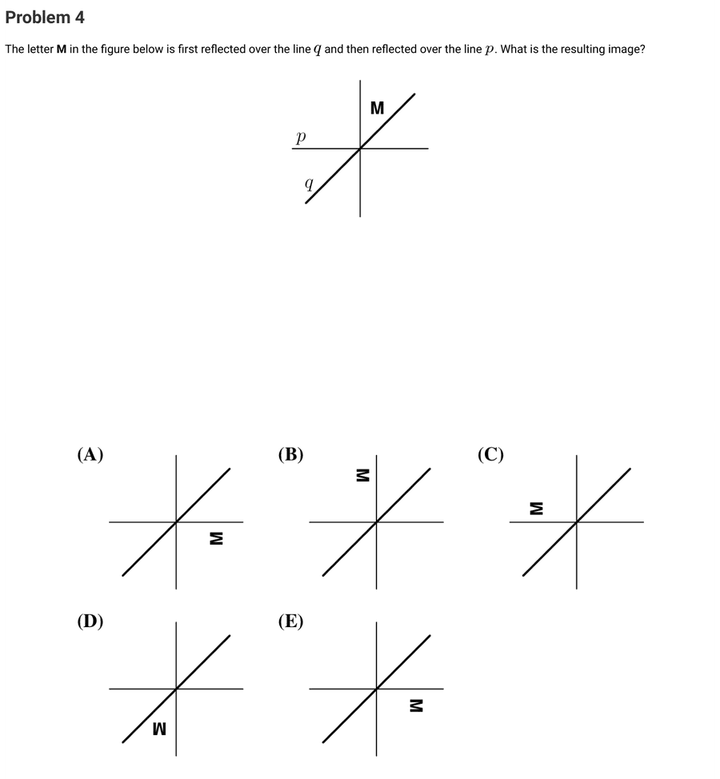
Answer: E — It matches figure (E).
Show hints
Hint 1 of 2
Don't trace the M through each flip separately — ask what single, simpler motion the two flips add up to.
Still stuck? Show hint 2 →
Hint 2 of 2
Two reflections across lines that cross equal one rotation about the crossing point (by twice the angle between the lines). Spin the M instead of flipping it twice.
Show solution
Approach: two reflections across crossing lines = one rotation
- Insight: doing two flips in a row feels fiddly, but the combined effect is one clean motion. Reflecting across two lines that cross at a point is exactly a rotation about that point.
- The rotation angle is twice the angle between the lines, in the direction from the first line (q) toward the second (p). So instead of tracking each flip, just spin the M about the crossing point.
- Carrying M through both flips lands it in the position shown in figure (E).
- You'll see this again: two reflections always collapse into a single motion — a rotation if the mirror lines cross, or a translation if they're parallel. Spotting that turns a two-step transformation into one.
Another way — just do the two reflections in order (MAA):
- Reflect M over line q: the M flips across that line, landing in its mirror image position.
- Reflect that result over line p: a second flip across the other line.
- The final position matches choice (E).
Mark:
· log in to save