Problem 13 · 2024 Math Kangaroo
Hard
Geometry & Measurement
pythagorean-triplearea-decomposition
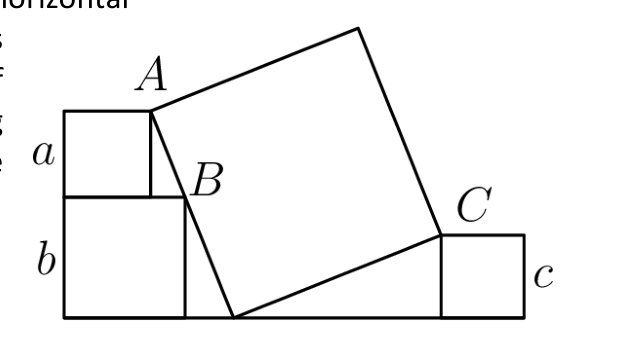
The diagram shows four squares with the entire configuration resting on a horizontal straight line. The smaller squares have side lengths a, b and c. The vertices A and C of two small squares coincide with diagonally opposite vertices of the big square. The vertex B of the third small square lies on a side of the big square. Which of the following expressions is equal to the side length of the big square?
Show answer
Answer: C — \(\sqrt{(a+b)^2+c^2}\)
Show hints
Hint 1 of 3
The tilted square's side is the hypotenuse of a right triangle whose legs you can read off from the small squares.
Still stuck? Show hint 2 →
Hint 2 of 3
Drop a horizontal and a vertical from one corner of the big square to the next; the legs are built from a, b and c.
Still stuck? Show hint 3 →
Hint 3 of 3
Find the horizontal run and the vertical rise of one side of the big square, then apply the Pythagorean theorem.
Show solution
Approach: the tilted side is a right-triangle hypotenuse
- A and C of two small squares sit at diagonally opposite corners of the big square, with B on a side, so the big square is tilted.
- Take one side of the big square and form the right triangle with horizontal and vertical legs: the horizontal leg adds the two small-square widths to give \(a+b\), and the vertical leg is \(c\).
- By the Pythagorean theorem the side length is \(\sqrt{(a+b)^2+c^2}\).
- So the answer is \(\sqrt{(a+b)^2+c^2}\) (answer C).
Mark:
· log in to save