Problem 18 · 2024 Math Kangaroo
Hard
Geometry & Measurement
area
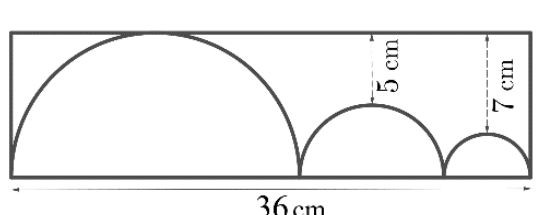
The diagram shows three semicircles inside a rectangle. The middle semicircle touches the other two, which each touch a short side of the rectangle. The biggest semicircle also touches the upper long side of the rectangle. The shortest distances from that side of the rectangle to the two other semicircles are 5 cm and 7 cm, respectively (see diagram). How big is the perimeter of the rectangle, in cm?
Show answer
Answer: B — 92
Show hints
Hint 1 of 3
All three semicircles have their flat sides on the bottom long side; the big one reaches the top, so the rectangle's height equals the big radius.
Still stuck? Show hint 2 →
Hint 2 of 3
The top of a small semicircle is its radius above the bottom, so the gap from the top side down to it is (height) − (its radius).
Still stuck? Show hint 3 →
Hint 3 of 3
Turn the 5 cm and 7 cm gaps into the two small radii, then read the width as the three diameters laid side by side.
Show solution
Approach: convert the top gaps into radii, then add diameters for the width
- The big semicircle touches the top long side, so the height of the rectangle equals its radius R = 10 cm.
- A small semicircle rises only its own radius above the bottom, so height − radius equals the listed gap: 10 − r = 5 gives r = 5 cm, and 10 − r = 7 gives r = 3 cm.
- The three semicircles sit side by side along the bottom, so the width is the sum of their diameters: 2(5) + 2(10) + 2(3) = 36 cm.
- Perimeter = 2 × (36 + 10) = 92 cm.
Mark:
· log in to save