Problem 8 · 2024 Math Kangaroo
Medium
Spatial & Visual Reasoning
cube-views
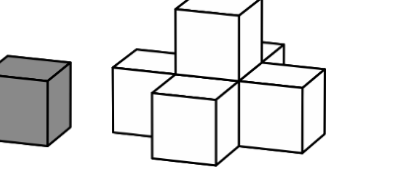
John has many equally sized light and dark cubes. He puts one dark cube on the table, leaving five faces visible. Next he covers all five visible faces with five light cubes, as shown. Now he wants to add dark cubes so that no light face is visible at all. What is the smallest number of dark cubes he needs?
Show answer
Answer: D — 13
Show hints
Hint 1 of 2
After the five light cubes are added you have a 3-D plus (cross); the dark cube underneath is already hidden, so only the light faces are the problem.
Still stuck? Show hint 2 →
Hint 2 of 2
One dark cube can hide more than one light face at a time when it sits in a notch where two light cubes meet, so look for those shared notches.
Show solution
Approach: wrap the light cross with dark cubes, reusing the notches
- The light cubes form a plus shape (one on top, four on the sides) around the dark centre, leaving many light faces showing.
- A dark cube placed in a notch between two neighbouring light arms covers a light face on each of them, so each notch is worth two faces.
- Filling all the notches and the remaining flat light faces with the fewest cubes, the smallest number of dark cubes needed is 13, answer D.
Mark:
· log in to save