Problem 3 · 2024 Math Kangaroo
Medium
Spatial & Visual Reasoning
dice-facescube-views
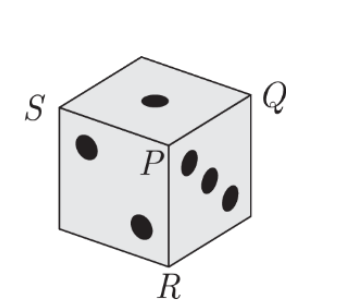
On a standard die opposite faces always show points adding to 7. The vertex sum at a corner is the sum of the points on the three faces meeting there. (For example, the faces showing 1, 2 and 3 meet at P, so the vertex sum at P is 1 + 2 + 3 = 6.) Which of the following is the biggest vertex sum among the vertices Q, R and S?
Show answer
Answer: D — 11
Show hints
Hint 1 of 2
Opposite faces add to 7, so the three faces meeting at a vertex are never an opposite pair; the bigger faces (5, 6) want to be together.
Still stuck? Show hint 2 →
Hint 2 of 2
A vertex sum is biggest when it uses the three largest faces that can actually meet, so look for the corner near the high-numbered hidden faces.
Show solution
Approach: find the three faces at each vertex and add them
- From the picture the three visible faces show 1 (top), 2 (front-left) and 3 (front-right), and they meet at P, giving 1 + 2 + 3 = 6.
- The hidden faces are the opposites: 6 (bottom), 5 (opposite the 2) and 4 (opposite the 3); each corner mixes visible and hidden faces.
- Corner R (bottom-front) uses the two largest faces 2, 3 plus the hidden bottom 6, giving 2 + 3 + 6 = 11, larger than Q = 1 + 3 + 5 = 9 and S = 1 + 2 + 4 = 7.
- So the biggest vertex sum is 11, answer D.
Mark:
· log in to save