Problem 29 · 2023 Math Kangaroo
Stretch
Logic & Word Problems
Arithmetic & Operations
sum-constraintwork-backward
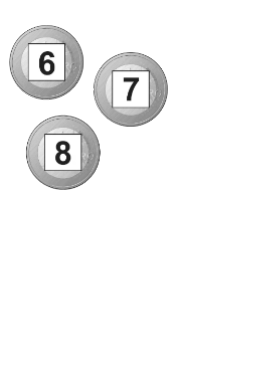
Jakob wrote six consecutive numbers on six little pieces of white paper, one number per piece. He stuck the six pieces on the front and back of three coins. Then he threw the coins three times. After the first throw the numbers 6, 7, 8 were on top (see diagram), which Jakob then coloured red. After the second throw the sum of the numbers on top was 23, and after the third throw the sum was 17. How big is the sum of the numbers on the three white pieces of paper?
Show answer
Answer: A — 18
Show hints
Hint 1 of 2
The six consecutive numbers are paired front/back on three coins, so the two faces of one coin are a fixed-difference pair.
Still stuck? Show hint 2 →
Hint 2 of 2
Use the three throw-sums (the first is 6+7+8) to deduce the hidden faces and then the unseen white totals.
Show solution
Approach: pair the faces by the coins and use the three sums
- The first throw shows 6, 7, 8, so those three reds sum to 21; each later throw replaces some reds by their white partners, changing the sum by white − red on the flipped coins.
- From 21 the sums become 23 (a change of +2) and 17 (a change of −4); the total change if all three were flipped is (white total) − 21.
- The six numbers are consecutive and include 6, 7, 8; the only set making the throws consistent is 4,5,6,7,8,9, so the whites are 4, 5, 9.
- Their sum is 4 + 5 + 9 = 18, option A.
Mark:
· log in to save