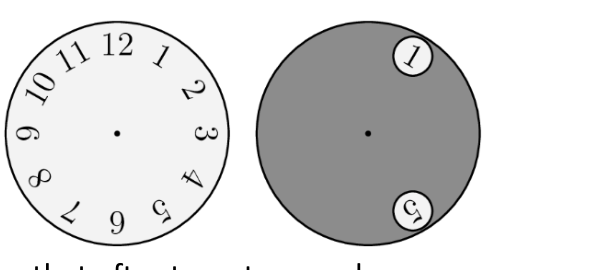
A dark disc with two holes is placed on the dial of a watch as shown in the diagram. The dark disc is now rotated so that the number 10 can be seen through one of the two holes. Which of the numbers could one see through the other hole now?
Show answer
Answer: A — 2 and 6
Show hints
Hint 1 of 2
The two holes stay a fixed angular distance apart no matter how the disc turns.
Still stuck? Show hint 2 →
Hint 2 of 2
Find the gap (in hours) between the two holes from the starting picture, then apply it to the 10.
Show solution
Approach: use the fixed angular spacing between the two holes
In the starting position the two holes reveal numbers a fixed number of hours apart on the dial.
That same gap is preserved after any rotation of the disc.
When one hole shows 10, applying the gap lands the other hole on the numbers 2 and 6.
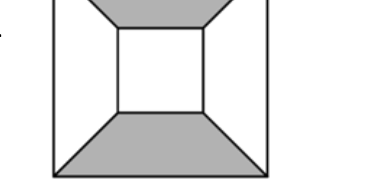
A small square with side length 4 cm is drawn within a big square with side length 10 cm; their sides are parallel to each other (see diagram). What percentage of the figure is shaded?
Show answer
Answer: D — 42 %
Show hints
Hint 1 of 2
The shaded parts are the top and bottom trapezoids between the two squares.
Still stuck? Show hint 2 →
Hint 2 of 2
Each trapezoid has parallel sides 10 and 4; find its height from the leftover border.
Show solution
Approach: area of two trapezoids as a fraction of the big square
The big square has area 10·10 = 100 cm².
The shaded top and bottom pieces are trapezoids with parallel sides 10 and 4 and height (10−4)/2 = 3.
Each trapezoid area = (10+4)/2 · 3 = 21 cm², so two of them give 42 cm².
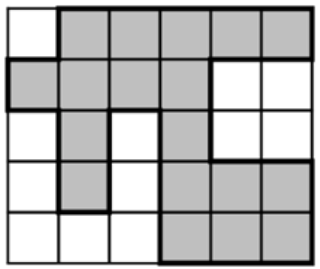
The big rectangle shown is divided into 30 equally big squares. The perimeter of the area shaded in grey is 240 cm. How big is the area of the big rectangle?
Show answer
Answer: D — 1920 cm\(^2\)
Show hints
Hint 1 of 2
The grey region's boundary is made of edges of the small squares; count how many such edges it has.
Still stuck? Show hint 2 →
Hint 2 of 2
Find the side of one small square first, then the whole rectangle's area is 30 of those squares.
Show solution
Approach: find the unit side from the shaded perimeter, then total area
The grey region's outline runs along edges of the small squares; tracing it counts 30 such edges.
So 30·s = 240 cm, meaning each small square has side s = 8 cm.
The big rectangle is 30 small squares, each of area 8·8 = 64 cm².
If one adds the ages of all members of a family of five together, one gets 80. The two youngest children are 6 and 8 years old. What was the sum of the ages of the family members 7 years ago?
Show answer
Answer: D — 46
Show hints
Hint 1 of 2
Seven years ago, was the youngest child even born yet?
Still stuck? Show hint 2 →
Hint 2 of 2
Only count the people who existed seven years ago, and subtract 7 from each of their current ages.
Show solution
Approach: work backward in time, counting who was alive
Now the five ages total 80; the youngest two are 6 and 8.
Seven years ago the 6-year-old was not yet born, so only 4 people existed.
Remove the 6-year-old: the other four total 80 − 6 = 74 now.
Seven years ago those four were each 7 younger: 74 − 4·7 = 46.
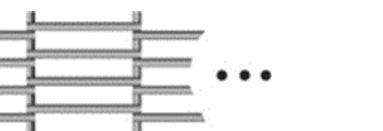
A straight wooden fence is made up of vertical beams stuck in the ground which are each connected to the next beam by 4 horizontal beams. The fence begins and ends with a vertical beam. Out of how many beams could such a fence be made?
Show answer
Answer: B — 96
Show hints
Hint 1 of 2
With v vertical beams there are v−1 gaps, each holding 4 horizontal beams.
Still stuck? Show hint 2 →
Hint 2 of 2
Write the total as a formula in v and see which option it can equal.
Show solution
Approach: set up a formula for the beam count
v vertical beams create v−1 gaps; each gap has 4 horizontals.
Total beams = v + 4(v−1) = 5v − 4.
This must equal one of the options: 5v−4 = 96 gives v = 20, a whole number.
The other options give non-integer v, so the answer is 96.
After playing 200 games of chess, Beth’s winning rate is exactly 49 %. What is the minimum number of games she has to still play to increase her winning rate to 50 %?
Show answer
Answer: D — 4
Show hints
Hint 1 of 2
She has 98 wins out of 200; adding x more wins makes it (98+x)/(200+x).
Still stuck? Show hint 2 →
Hint 2 of 2
Set that fraction to at least 1/2 and solve for the smallest whole x.
Show solution
Approach: set up the win-rate inequality
49% of 200 is 98 wins.
Winning the next x games gives rate (98+x)/(200+x).
Require (98+x)/(200+x) ≥ 1/2: 196+2x ≥ 200+x, so x ≥ 4.
Jennifer wants to save water. She reduces the water pressure and thus reduces the water usage by one quarter. Furthermore, she reduces the time she takes a shower by one quarter. By which fraction in total does she reduce the water usage for her shower?
Show answer
Answer: E — by \(\frac{7}{16}\)
Show hints
Hint 1 of 2
Water used = pressure × time; cutting each by a quarter multiplies each factor by 3/4.
Still stuck? Show hint 2 →
Hint 2 of 2
Multiply the two reduction factors and compare with the original.
Show solution
Approach: multiply the two scaling factors
Reducing by a quarter leaves 3/4 of the pressure and 3/4 of the time.
A rope with length 95 m is cut into three pieces so that each piece is half as long again as the respective previous piece. How long is the longest of the three pieces?
Show answer
Answer: C — 45 m
Show hints
Hint 1 of 2
“Half as long again” means each piece is 1.5 times the previous one.
Still stuck? Show hint 2 →
Hint 2 of 2
Write the three pieces as x, 1.5x, 2.25x and add them to 95.
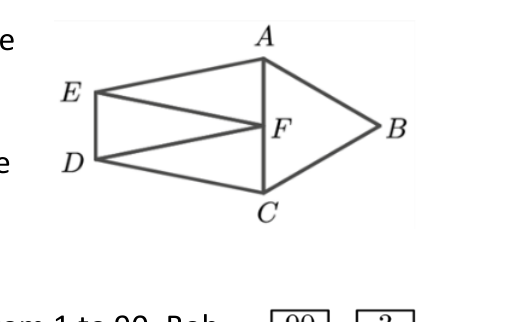
The pentagon ABCDE is split into four triangles that all have the same perimeter (see diagram). Triangle ABC is equilateral and the triangles AEF, DFE and CDF are congruent isosceles triangles. How big is the ratio of the perimeter of the pentagon ABCDE to the perimeter of the triangle ABC?
Show answer
Answer: D — \(\frac{5}{3}\)
Show hints
Hint 1 of 2
All four triangles share the same perimeter; let the equilateral side be the unit.
Still stuck? Show hint 2 →
Hint 2 of 2
Express the outer sides CD, DE, EA of the pentagon using the equal-perimeter condition.
Show solution
Approach: compare the pentagon's outer sides to the equilateral side using equal perimeters
Let the equilateral triangle ABC have side \(s\); its perimeter is \(3s\), and \(AB=BC=s\) are two of the pentagon's sides.
The pentagon's other three sides are CD, DE, EA, which are the outer edges of the three congruent isosceles triangles; the rest of each of those triangles is made of interior segments shared with a neighbour.
Because the three isosceles triangles are congruent and each also has perimeter \(3s\), the equal-perimeter bookkeeping forces the three outer sides CD, DE, EA to add up to \(3s\) (each equal to \(s\)).
Then the pentagon's perimeter is \(AB+BC+CD+DE+EA = s+s+s+s+s = 5s\), so the ratio to the triangle's \(3s\) is \(\frac{5s}{3s}=\frac{5}{3}\) (choice D).
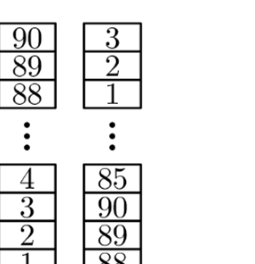
A tower consists of blocks that are labelled from bottom to top with the numbers from 1 to 90. Bob uses these blocks to build a new tower. For each step he takes the top three blocks from the old tower and places them on the new tower without changing their order (see diagram). How many blocks are there in the new tower between the blocks with the numbers 39 and 40?
Show answer
Answer: E — 4
Show hints
Hint 1 of 2
Blocks move in groups of three (the top three each step), and higher old numbers end up lower in the new tower.
Still stuck? Show hint 2 →
Hint 2 of 2
Find the group containing 39 and the group containing 40, then count what lies between them.
Show solution
Approach: track the blocks in groups of three
Each step moves a block of three with their order kept: ..., (37,38,39), (40,41,42), ...
Higher-numbered groups are placed first, so going up the new tower we see 40,41,42 then 37,38,39.
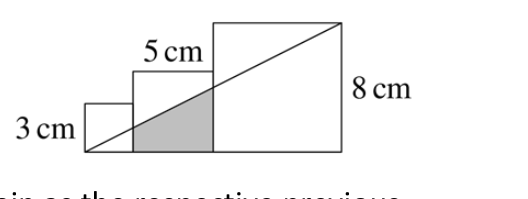
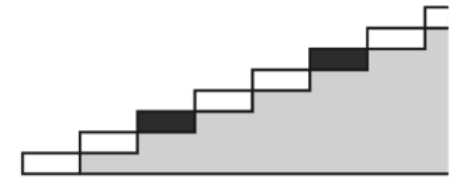
A staircase has 2023 steps. Every third step is coloured black. The first seven steps of this staircase can be fully seen in the diagram. Anita walks up the staircase and steps on each step exactly once. She can start with either the right or the left foot and then alternates her right and left foot. What is the minimum number of black steps she sets her right foot on?
Show answer
Answer: D — 337
Show hints
Hint 1 of 2
Number the steps; the black ones are the multiples of 3: 3, 6, 9, …, 2022.
Still stuck? Show hint 2 →
Hint 2 of 2
Alternating feet means a step's foot depends only on whether its number is odd or even — so the two feet take the odd-numbered and the even-numbered black steps.
Show solution
Approach: split the black steps by parity
The black steps are 3, 6, 9, …, 2022, that is 3·1 up to 3·674, so there are 674 of them.
Feet alternate, so odd-numbered steps all use one foot and even-numbered steps the other.
Among the black steps, the odd ones are 3·1, 3·3, …, 3·673 (337 of them) and the even ones are 3·2, 3·4, …, 3·674 (also 337).
Either starting foot makes the right foot land on one of these groups, so the minimum is 337.
We call a positive integer powerfree if none of its digits can be written as a power of an integer with an exponent bigger than 1. For example, the number 53 is powerfree, but the number 54 is not powerfree since \(4 = 2^2\). Which one of the following numbers is the difference between the biggest and the smallest two-digit powerfree numbers?
Show answer
Answer: B — 55
Show hints
Hint 1 of 2
A digit is “bad” if it is a perfect power: 0, 1, 4, 8, 9.
Still stuck? Show hint 2 →
Hint 2 of 2
Find the largest and smallest two-digit numbers whose digits are all allowed, then subtract.
Show solution
Approach: restrict to allowed digits
Digits that are powers (exponent>1) are 0=0², 1=1², 4=2², 8=2³, 9=3².
Allowed digits are 2, 3, 5, 6, 7.
The biggest two-digit powerfree number is 77 and the smallest is 22.
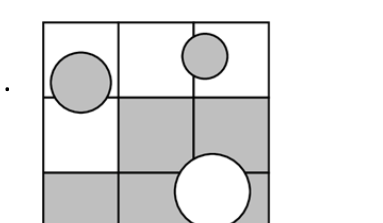
A square with side length 30 cm is split into 9 squares. The big square contains three circles with radii 5 cm (bottom right), 4 cm (top left) as well as 3 cm (top right) as seen in the diagram. How many cm\(^2\) are shaded in grey?
Show answer
Answer: B — \(500\)
Show hints
Hint 1 of 2
The 30 cm square splits into nine 10 cm squares; work out which of those are shaded grey.
Still stuck? Show hint 2 →
Hint 2 of 2
Add up the grey square areas and account for the circle pieces that fall in them.
Show solution
Approach: pair each circular piece with an equal opposite piece so the \(\pi\) terms cancel
The 30 cm square (area 900) is cut into nine 10×10 cells, each of area 100.
The shading takes some whole cells and then swaps circle pieces in and out: for each circle, the grey part removed from one cell is matched by an equal circular part added in an adjacent cell.
Because every circle contributes the same amount of grey as it removes, all the \(\pi\) terms cancel and the grey area is a whole number of square cells.
Adding up the net grey cells gives 500 cm² (choice B); the \(\pi\)-containing options are traps for anyone who forgets the pieces cancel.
The numbers from 1 to 9 should be distributed among the 9 squares in the diagram according to the following rules: there should be one number in each square, and the sum of three adjacent numbers is always a multiple of 3. The numbers 3 and 1 are already placed. How many ways are there to place the remaining numbers?
Show answer
Answer: E — 24
Show hints
Hint 1 of 2
Three numbers in a row summing to a multiple of 3 forces a repeating pattern of residues mod 3.
Still stuck? Show hint 2 →
Hint 2 of 2
Group the nine positions by position mod 3; each group must hold one residue class, and the fixed 3 and 1 pin down two of the groups.
Show solution
Approach: use residues mod 3 across the strip
Three adjacent numbers summing to a multiple of 3 forces position \(i\) and \(i+3\) to have the same residue mod 3, so the nine positions split into three groups of three by index mod 3.
The numbers 1–9 also split by residue into \(\{3,6,9\}\equiv0\), \(\{1,4,7\}\equiv1\), \(\{2,5,8\}\equiv2\); each position-group must get one whole residue-group.
The placed 3 (residue 0) and 1 (residue 1) pin which residue-group goes to their two position-groups, so the third assignment is forced too.
Now arrange within groups: the group with no fixed number can be ordered \(3!=6\) ways, and each of the two groups with a fixed number has its other two numbers free (\(2!=2\) ways each), giving \(6\cdot2\cdot2=\) 24 ways (choice E).
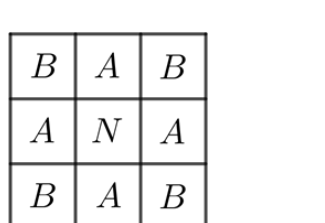
How many different ways are there to read the word BANANA in the following table if we can only cross to a field that shares an edge with the current field and we can use fields several times?
Show answer
Answer: E — 128
Show hints
Hint 1 of 2
Start on a corner B and spell B-A-N-A-N-A, stepping only to edge-adjacent cells (reuse allowed).
Still stuck? Show hint 2 →
Hint 2 of 2
Count routes by multiplying the choices at each letter; symmetry across the four corners helps.
Show solution
Approach: multiply the branching choices, letter by letter
A path spells B-A-N-A-N-A, moving each step to an edge-adjacent cell, and cells may be reused.
Start from a B and count how many neighbours carry the next needed letter at each move; the number of full paths is the product of those branch counts along the route.
Because the grid is symmetric, every starting B contributes the same number of paths, so multiply one B's count by the number of B's.
Carrying out this branch-multiplication over the whole grid totals 128 ways (choice E).
Starting with the four numbers 2, 0, 2, 3 the kangaroo-machine creates numbers according to the following rule: the next number is always the smallest non-negative integer that is different from the four directly previous numbers. Which number is in position 2023?
Show answer
Answer: C — 2
Show hints
Hint 1 of 2
Generate a few terms: the next number is the smallest non-negative integer not among the last four.
Still stuck? Show hint 2 →
Hint 2 of 2
After a short start the sequence becomes periodic — find the period and reduce 2023.
A circle with midpoint \((75\,|\,30)\) and radius 10 is cut from a rectangle with vertices \((0\,|\,0)\), \((100\,|\,0)\), \((100\,|\,50)\) and \((0\,|\,50)\). What is the gradient of the straight line that goes through the point \((75\,|\,30)\) and divides the remaining part of the rectangle into two parts with equal area?
Show answer
Answer: A — \(\frac{1}{5}\)
Show hints
Hint 1 of 2
A line through the centre of a circle always halves that circle's area.
Still stuck? Show hint 2 →
Hint 2 of 2
So the line only needs to bisect the rectangle — which means passing through the rectangle's centre too.
Show solution
Approach: a center line bisects both shapes
Any line through the hole's centre (75,30) splits the circular hole into two equal halves.
To split the rest equally, the line must also bisect the rectangle, i.e. pass through its centre (50,25).
The line through (75,30) and (50,25) has slope (30−25)/(75−50) = 5/25 = 1/5.
When Matilda’s smartphone is fully charged it has a battery life of 32 hours if she phones continuously, 20 hours if she surfs the internet continuously, and 80 hours if she does not use it at all. Matilda boards a train with a half-full battery. During her time on board she spends the same amount of time each on phoning, surfing the internet, and not using the phone at all. Just when she arrives at her destination the battery is empty. How many hours did the train ride take?
Show answer
Answer: D — 16
Show hints
Hint 1 of 2
Convert each usage into a fraction of the battery drained per hour.
Still stuck? Show hint 2 →
Hint 2 of 2
With equal time on each activity, set the total drain equal to half a battery.
Show solution
Approach: add the drain rates over equal time shares
Drain rates are 1/32, 1/20, 1/80 of the battery per hour.
Over a ride of length T with T/3 on each: (T/3)(1/32+1/20+1/80) = 1/2.
The bracket is 15/160 = 3/32, so (T/3)(3/32) = T/32 = 1/2.
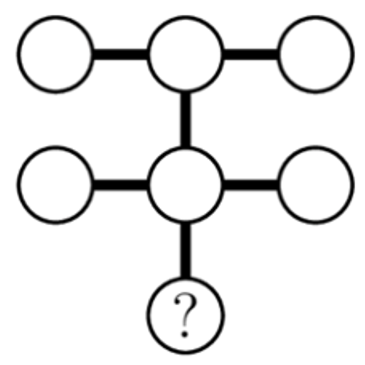
Seven pairwise different single-digit numbers are distributed among the circles shown so that the product of the three numbers that are connected by a straight line is the same in all three cases. Which number is written in the circle with the question mark?
Show answer
Answer: A — 2
Show hints
Hint 1 of 2
The centre number is in all three products, so the two outer numbers on each line have equal products.
Still stuck? Show hint 2 →
Hint 2 of 2
Find three disjoint pairs of distinct digits with the same product, and see which centre value makes it work.
Show solution
Approach: equal products force matching pairs
All seven digits must be different and non-zero (a zero would force every product to be 0).
Trying the common product 72 = 8·9·1 = 6·4·3, the two horizontal lines can use {8,9,1} and {6,4,3}.
The vertical line shares the two centres (9 and 4 in one valid layout), so its third number is 72 ÷ (9·4) = 2.
Checking all arrangements, the question-mark circle always holds 2.
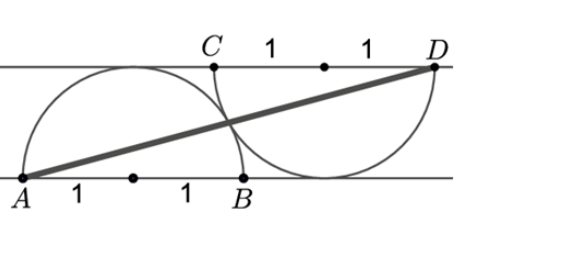
Consider the two touching semicircles with radius 1 and their diameters AB and CD respectively that are parallel to each other. The extensions of the two diameters are also tangents to the respective other semicircle (see diagram). How big is the square of the length AD?
Show answer
Answer: B — \(8 + 4\sqrt{3}\)
Show hints
Hint 1 of 2
Set coordinates: A and B on the lower line, C and D on the upper line, each diameter of length 2.
Still stuck? Show hint 2 →
Hint 2 of 2
Use that each diameter's extension is tangent to the other semicircle to fix the offset, then apply the distance formula for AD.
Show solution
Approach: coordinates and the tangency condition
Each line is tangent to the other semicircle, so the distance between the two parallel lines equals the radius: the vertical gap is 1.
The semicircles touch, so the distance between their centres is 1 + 1 = 2; with a vertical gap of 1, the horizontal offset of the centres is √(2² − 1²) = √3.
Put A = (−1, 0) and the far end D = (√3 + 1, 1); then AD² = (√3 + 2)² + 1² = 3 + 4√3 + 4 + 1.
Several points are marked on a straight line. Renate marks another point between each pair of adjacent points. She repeats this process three more times. Now there are 225 points marked on this straight line. How many points were marked to start with?
Show answer
Answer: A — 15
Show hints
Hint 1 of 2
Adding a point between every adjacent pair turns n points into 2n−1.
Still stuck? Show hint 2 →
Hint 2 of 2
Apply that step four times and set the result to 225.
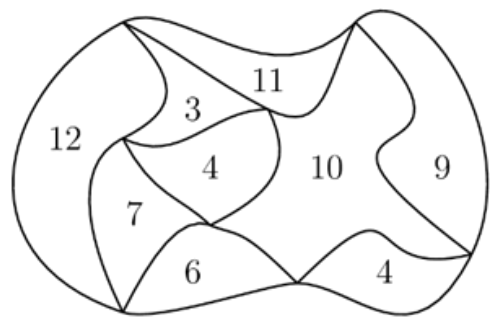
The diagram shows the map of a big park. The park is split into several sections and the number in each section states its perimeter in km. How big is the perimeter of the entire park in km?
Show answer
Answer: C — 26
Show hints
Hint 1 of 2
The sum of all the section perimeters counts every internal wall twice and the outer boundary once.
Still stuck? Show hint 2 →
Hint 2 of 2
Outer perimeter = (sum of all section perimeters) − 2×(total internal wall length).
Show solution
Approach: the shared interior walls get counted twice
Add up the perimeter labels of all the sections.
In that total, every wall on the park's outer edge is counted once, but every wall shared between two sections is counted twice (once by each section).
So the park's true perimeter equals the sum of all section perimeters minus twice the total length of the interior dividing walls.
Carrying out that subtraction with the figure's lengths leaves 26 km (choice C).