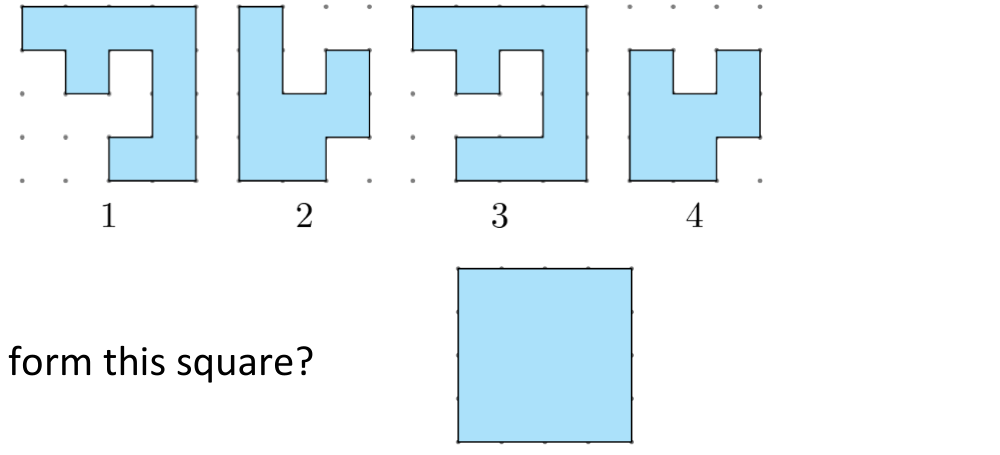
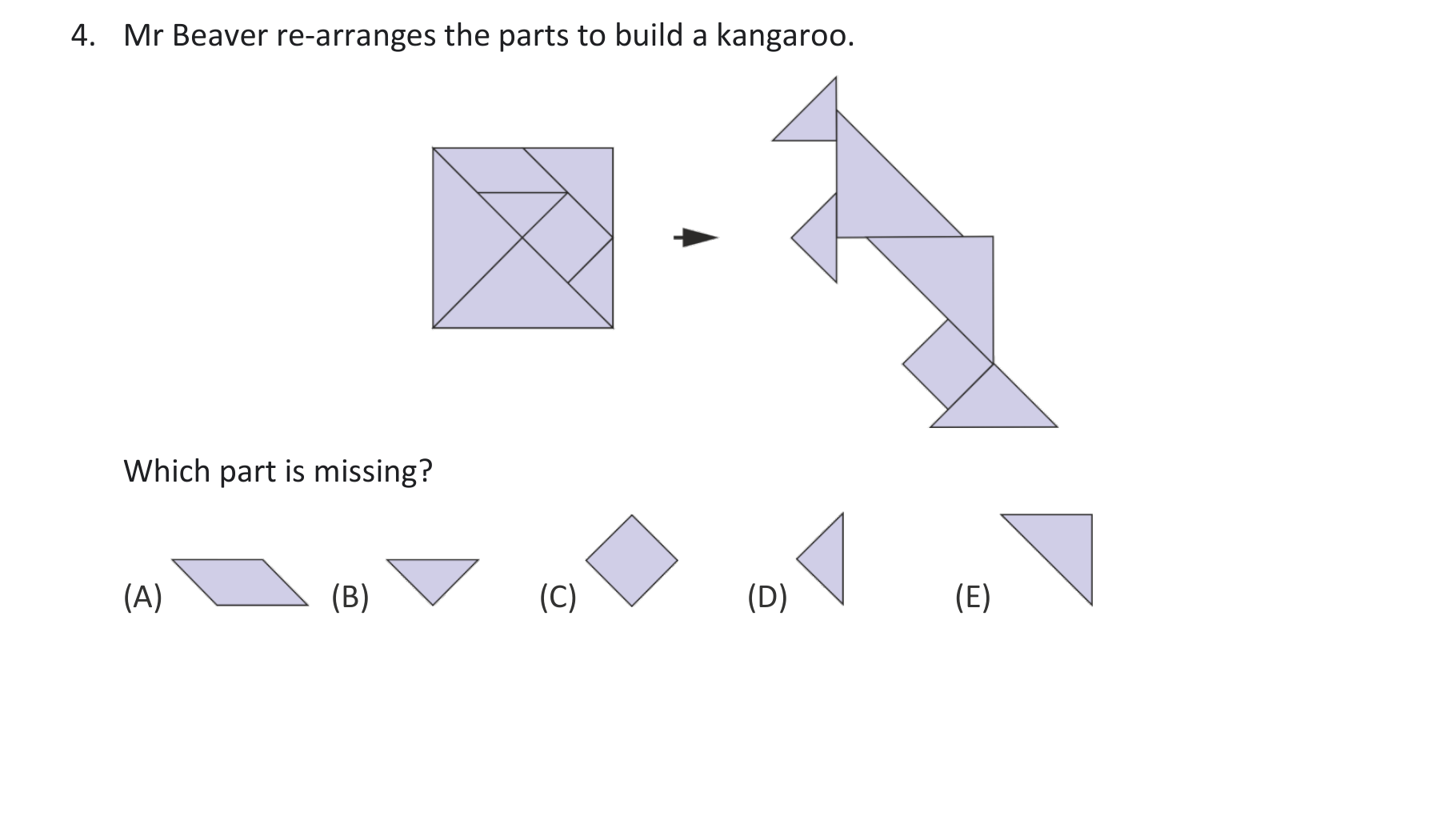
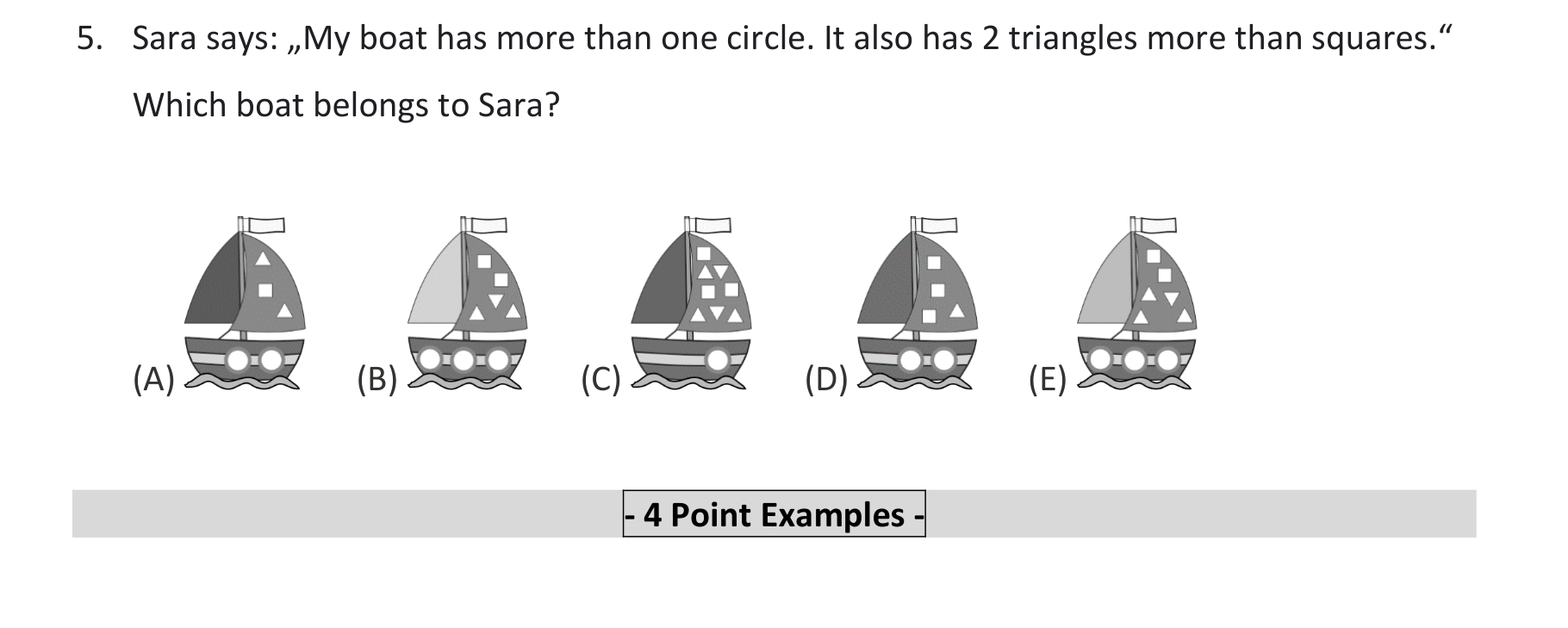
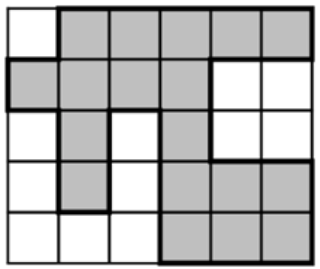
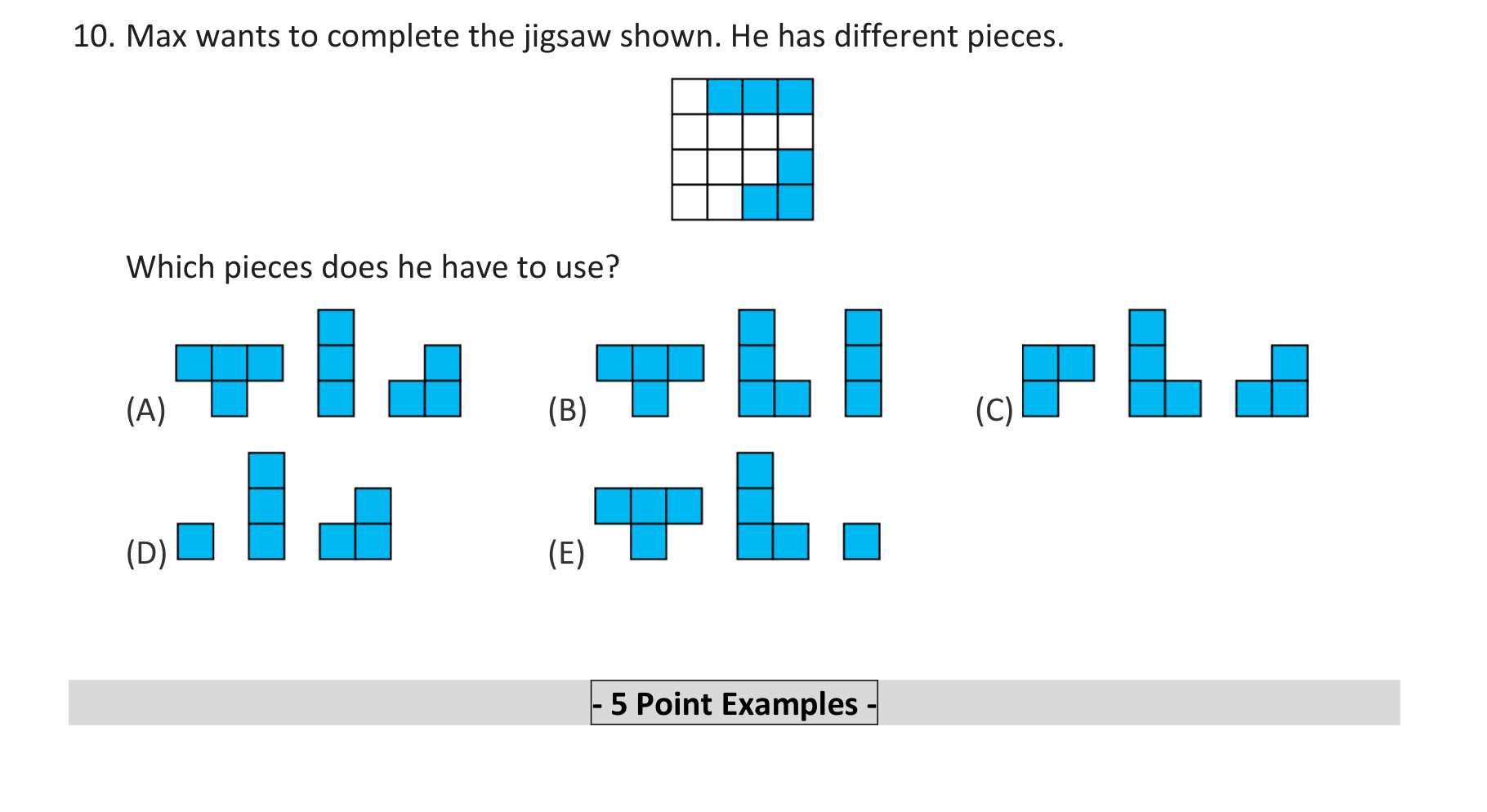
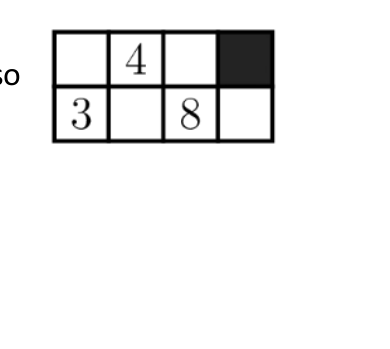
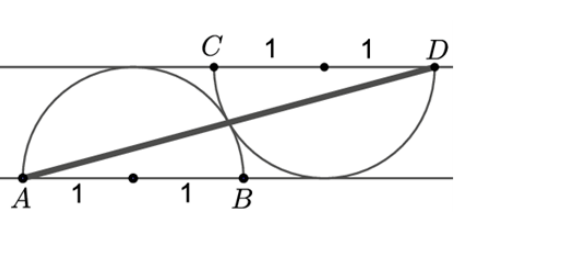
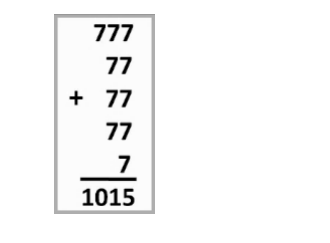
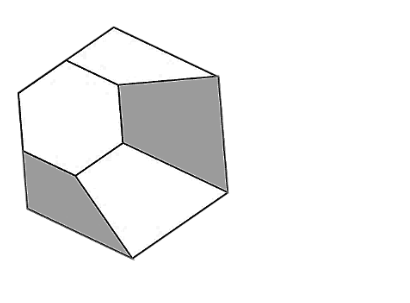
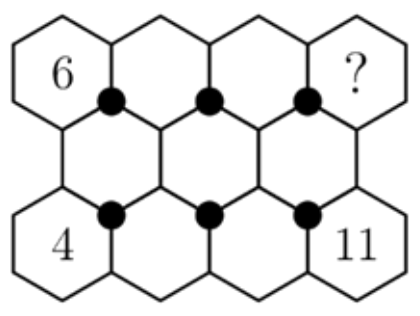
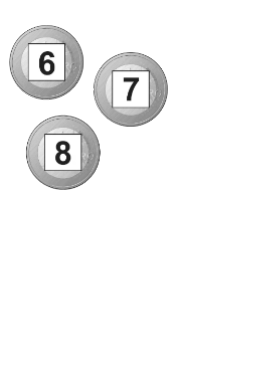
Holger writes the numbers up to 40 into the table in the same way as shown. Which of the pieces A to E can he then cut out from the table?
Show answer
Answer: C
Show hints
Hint 1 of 2
The numbers fill the table eight to a row: 1-8, then 9-16, then 17-24, and so on.
Still stuck? Show hint 2 →
Hint 2 of 2
Pin down where 12 sits, then check that the two cells just below it really hold 20 and 21, and that the cell hanging beneath them matches the piece's shape.
Show solution
Approach: locate the cells by their row-of-eight positions and match the exact shape
Each row holds eight numbers, so 12 sits in the second row, fourth column.
Directly under 12 are 20 then 21 (third row), and beneath 21 sits 29 (fourth row).
The piece whose three cells read 12 on top, 20 and 21 in the middle, and 29 hanging under the 21 is the only one whose outline matches these real positions.
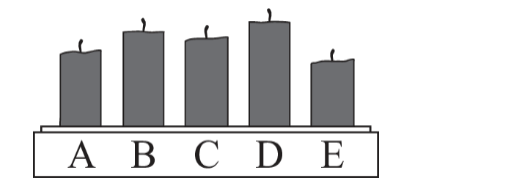
Five children each light a candle at the same time. Lisa blows out the candles at different times. Now they look as shown in the picture. Which candle did Lisa blow out first?
Show answer
Answer: D — D
Show hints
Hint 1 of 2
A candle that was blown out earlier has had more time to burn down, so it is shorter now.
Still stuck? Show hint 2 →
Hint 2 of 2
Find the shortest candle — that is the one extinguished first.
Show solution
Approach: compare burn lengths: longest burning means shortest now
All five candles were lit at the same moment.
The one blown out first kept burning the longest, so it is the shortest stub in the picture.
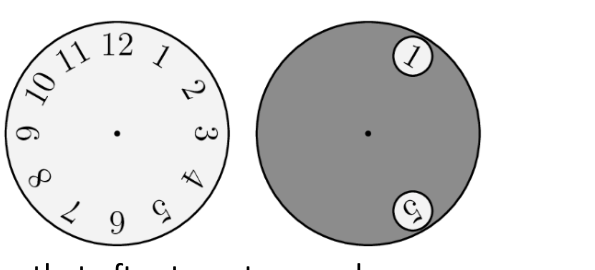
A dark disc with two holes is placed on the dial of a watch as shown in the diagram. The dark disc is now rotated so that the number 10 can be seen through one of the two holes. Which of the numbers could one see through the other hole now?
Show answer
Answer: A — 2 and 6
Show hints
Hint 1 of 2
The two holes stay a fixed angular distance apart no matter how the disc turns.
Still stuck? Show hint 2 →
Hint 2 of 2
Find the gap (in hours) between the two holes from the starting picture, then apply it to the 10.
Show solution
Approach: use the fixed angular spacing between the two holes
In the starting position the two holes reveal numbers a fixed number of hours apart on the dial.
That same gap is preserved after any rotation of the disc.
When one hole shows 10, applying the gap lands the other hole on the numbers 2 and 6.
Matchsticks are arranged to form digits, as shown. For example, the number 15 needs 7 matchsticks, and so does the number 8. What is the biggest number you can build using exactly 7 matchsticks?
Show answer
Answer: D — 711
Show hints
Hint 1 of 2
Count the matchsticks each digit uses from the picture, then add up the sticks in each answer.
Still stuck? Show hint 2 →
Hint 2 of 2
Keep only the answers that use exactly 7 matchsticks, then take the largest of those.
Show solution
Approach: count sticks per digit, keep the total of 7, choose the biggest
From the picture, the digit 7 uses 3 sticks and the digit 1 uses 2 sticks.
So 711 uses 3 + 2 + 2 = 7 sticks; 31, 51 and 74 also each use 7 sticks, but 800 needs far more.
Among the numbers built from exactly 7 matchsticks, the largest is 711.
The two markers with a question mark have the same value: \(20 + 10 + 10 + ? + ? + 1 = 51\). Which value do you have to use instead of the question mark so that the calculation is correct?
Show answer
Answer: C — 5
Show hints
Hint 1 of 2
Add up the numbers you can already read.
Still stuck? Show hint 2 →
Hint 2 of 2
Subtract that running total from 51, then split the leftover between the two equal markers.
Show solution
Approach: fill the known values, then split the remainder
The known markers add to 20 + 10 + 10 + 1 = 41.
The two equal question marks must make up 51 − 41 = 10.
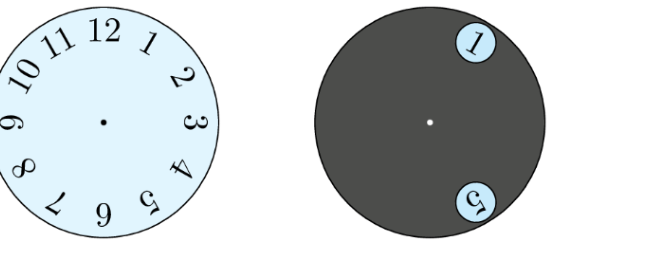
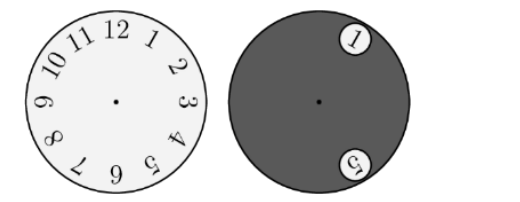
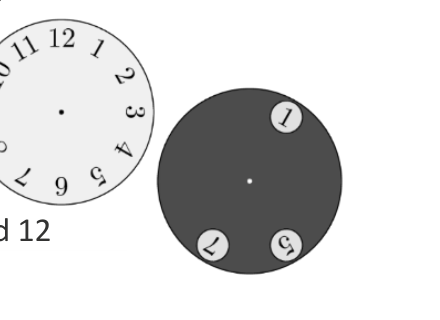
A dark disc with two holes is placed on top of the dial of a watch, as shown. The dark disc is now rotated so that the number 8 can be seen through one of the holes. Which numbers could one see through the other hole now?
Show answer
Answer: A — 4 and 12
Show hints
Hint 1 of 2
The two holes keep a fixed angular gap as the whole disc turns.
Still stuck? Show hint 2 →
Hint 2 of 2
Find which two clock numbers sit the same angular distance apart as the two holes.
Show solution
Approach: use the fixed angular spacing between the two holes
In the picture the two holes sit over the 1 and the 5, so they are a fixed 4 hours apart on the disc.
If 8 shows in the hole that was over the 1, the disc turned 7 hours, so the other hole (was over 5) now shows 5 + 7 = 12.
If 8 shows in the hole that was over the 5, the disc turned 3 hours, so the other hole (was over 1) now shows 1 + 3 = 4.
So the other hole shows 4 or 12, which is option A.
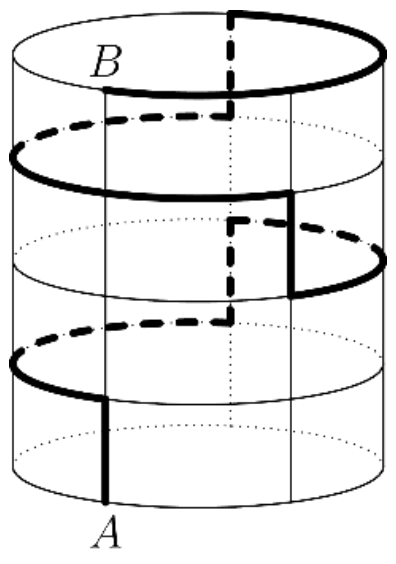
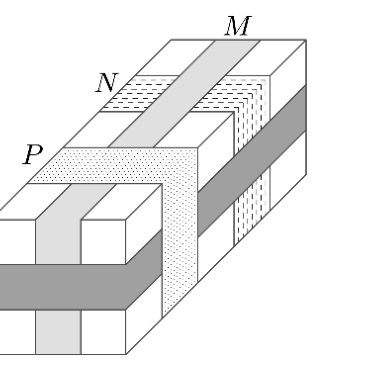
A cylindrical tin is 15 cm high. The circumference of the base circle is 30 cm. An ant walks from point A at the base to point B at the top. Its path is partly vertically upwards and partly along horizontal circular arcs. Its path is drawn in bold on the diagram (with a solid line on the front and a dashed line at the back). How long is the total distance covered by the ant?
Show answer
Answer: E — 75 cm
Show hints
Hint 1 of 2
The bold path is made only of straight vertical pieces and horizontal arc pieces.
Still stuck? Show hint 2 →
Hint 2 of 2
Add up all the vertical climbs (they total the height) and all the horizontal arcs (each is part of the 30 cm circumference) separately.
Show solution
Approach: separate the path into vertical rises and horizontal arc lengths
Every vertical piece of the path together climbs the full height of 15 cm.
The horizontal arcs each cover part of the 30 cm circumference; following the drawn path they sum to 60 cm.
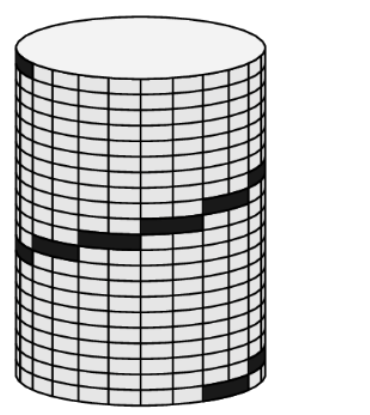
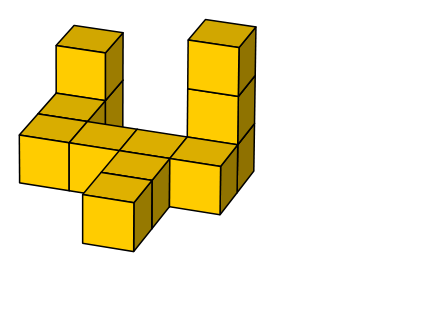
Nine steps of a staircase winding around a cylinder can be seen, starting at the bottom and leading all the way to the top. All the steps are equally high. How many steps cannot be seen?
Show answer
Answer: D — 12
Show hints
Hint 1 of 3
From the front you only see the steps facing you; the rest of the staircase keeps winding around the hidden back of the cylinder.
Still stuck? Show hint 2 →
Hint 2 of 3
The picture shows the front-facing steps spiralling up; figure out how high the whole tower climbs, then take away the nine you can already see.
Still stuck? Show hint 3 →
Hint 3 of 3
Each level of the spiral has steps on both the front and the back, so the hidden back steps roughly mirror the visible front ones, plus a few more for the extra height.
Show solution
Approach: see that the spiral has front and back steps at each level, then count the hidden ones
The nine steps you can see are the ones facing you as the staircase spirals up the front of the cylinder.
As the spiral turns, the same number of steps run around the hidden back at each level, and the tower keeps climbing past where the front steps stop.
Counting the back steps level by level all the way to the top gives twelve steps that are turned away and cannot be seen.
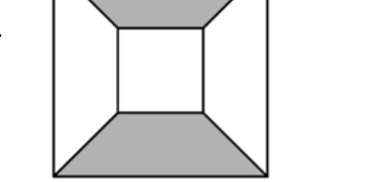
A small square with side length 4 cm is drawn within a big square with side length 10 cm; their sides are parallel to each other (see diagram). What percentage of the figure is shaded?
Show answer
Answer: D — 42 %
Show hints
Hint 1 of 2
The shaded parts are the top and bottom trapezoids between the two squares.
Still stuck? Show hint 2 →
Hint 2 of 2
Each trapezoid has parallel sides 10 and 4; find its height from the leftover border.
Show solution
Approach: area of two trapezoids as a fraction of the big square
The big square has area 10·10 = 100 cm².
The shaded top and bottom pieces are trapezoids with parallel sides 10 and 4 and height (10−4)/2 = 3.
Each trapezoid area = (10+4)/2 · 3 = 21 cm², so two of them give 42 cm².
John throws 150 coins onto a table. 60 of them show “heads”, the others show “tails”. He wants the same number of coins to show heads as tails. How many coins that show heads does he have to turn over?
Show answer
Answer: B — 15
Show hints
Hint 1 of 2
First work out how many coins currently show tails.
Still stuck? Show hint 2 →
Hint 2 of 2
Each coin you flip changes the head-count by one; aim for an equal split of 75 and 75.
Show solution
Approach: balance the two counts with single flips
There are 150 coins: 60 heads and 150 − 60 = 90 tails.
For an even split he needs 75 heads and 75 tails.
He must move 15 coins from the larger pile to the smaller, i.e. flip 15 coins.
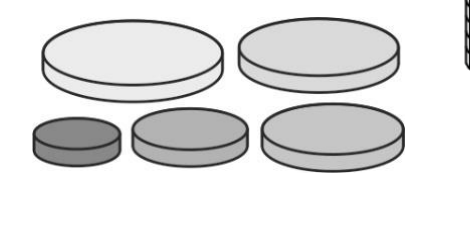
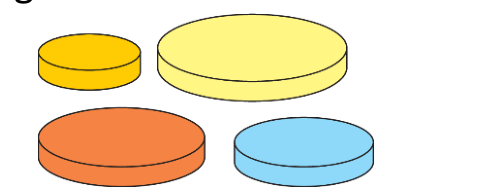
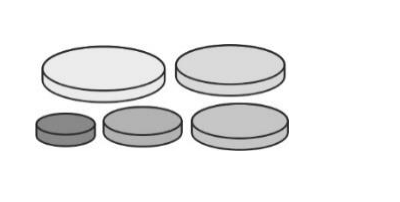
Anna has five discs of different sizes. She wants to use 4 of them to build a tower, always placing a smaller disc on top of a bigger one. In how many ways can Anna build the tower?
Show answer
Answer: B — 5
Show hints
Hint 1 of 2
Once you pick which four discs to use, the order is forced: biggest at the bottom up to smallest.
Still stuck? Show hint 2 →
Hint 2 of 2
So really you are just counting how many ways there are to leave out one disc.
Show solution
Approach: each tower is just a choice of which disc to leave out
A valid tower must go from largest at the bottom to smallest at the top, so a set of four discs can be stacked in only one way.
Building a tower therefore means choosing which 4 of the 5 discs to use, i.e. which single disc to leave out.
There are 5 discs, so there are 5 ways to leave one out.
Maria switches the lights on and off according to the given plan (the bars show when each of Light 1, Light 2 and Light 3 is on, in minutes). For how many minutes in total are there exactly two lights on at the same time?
Show answer
Answer: C — 8
Show hints
Hint 1 of 2
Go minute by minute and count how many lights are on.
Still stuck? Show hint 2 →
Hint 2 of 2
Mark only the minutes where the count is exactly two.
Show solution
Approach: scan each minute and tally when exactly two bars overlap
Read each light's on-intervals from the chart and check every one-minute slot.
Counting the slots where precisely two of the three bars are present gives 8 such minutes.
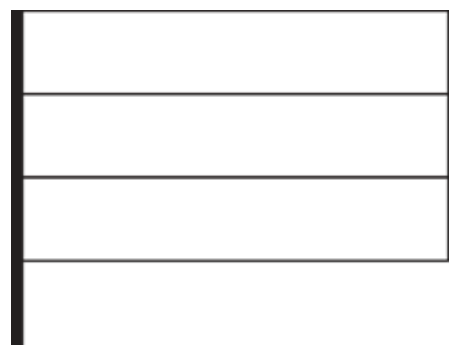
Emma should colour in the three strips of the flag shown. She has four colours available. She can only use one colour for each strip and immediately adjacent strips are not to be of the same colour. How many different ways are there for her to colour in the flag?
Show answer
Answer: D — 36
Show hints
Hint 1 of 2
Colour the strips one at a time and count the choices for each.
Still stuck? Show hint 2 →
Hint 2 of 2
The first strip is free; each later strip just avoids its neighbour's colour.
Show solution
Approach: multiply the independent choices strip by strip
The first strip can be any of 4 colours.
The second strip must differ from the first: 3 choices. The third must differ from the second: 3 choices.
The big rectangle shown is divided into 30 equally big squares. The perimeter of the area shaded in grey is 240 cm. How big is the area of the big rectangle?
Show answer
Answer: D — 1920 cm\(^2\)
Show hints
Hint 1 of 2
The grey region's boundary is made of edges of the small squares; count how many such edges it has.
Still stuck? Show hint 2 →
Hint 2 of 2
Find the side of one small square first, then the whole rectangle's area is 30 of those squares.
Show solution
Approach: find the unit side from the shaded perimeter, then total area
The grey region's outline runs along edges of the small squares; tracing it counts 30 such edges.
So 30·s = 240 cm, meaning each small square has side s = 8 cm.
The big rectangle is 30 small squares, each of area 8·8 = 64 cm².
A grid should be cut along the black lines into several identical shapes, with no piece left over. Into which of the following shapes is it not possible to cut this grid in this way?
Show answer
Answer: D
Show hints
Hint 1 of 2
Count the cells of the grid; the number of cells in one tile must divide that total exactly.
Still stuck? Show hint 2 →
Hint 2 of 2
Even when the count divides evenly, also try to actually fit copies of the tile — the one that always leaves an unfillable gap is the answer.
Show solution
Approach: test which shape can tile the whole grid with no leftover
First check the cell count: the number of cells in one tile must divide the total number of cells in the grid.
For the shapes that pass that check, try fitting copies into the grid; most can be arranged to cover it exactly.
The shape in option D can never be placed to cover the grid with no piece left over.
We call a positive integer ntwoprime if it has exactly three different positive factors, namely 1, 2 and the number n itself. How many twoprime numbers are there?
Show answer
Answer: B — 1
Show hints
Hint 1 of 2
A number with exactly three divisors must be the square of a prime.
Still stuck? Show hint 2 →
Hint 2 of 2
Here the three divisors have to be exactly 1, 2 and n — so 2 must be the prime.
Show solution
Approach: a number with exactly three factors is a prime squared
Exactly three positive factors means n = p2 for a prime p, with factors 1, p, p2.
The factors must be 1, 2 and n, so p = 2 and n = 4 (factors 1, 2, 4).
Anna has four discs of different sizes. She wants to build a tower using 3 discs. A smaller disc always has to lie on top of a bigger disc. How many ways are there for Anna to build this tower?
Show answer
Answer: C — 4
Show hints
Hint 1 of 2
A tower uses 3 of the 4 discs, and the sizes force their order.
Still stuck? Show hint 2 →
Hint 2 of 2
So really you are just choosing which one disc to leave out.
Show solution
Approach: each choice of 3 discs has exactly one legal stacking
Once three discs are chosen, they must go largest-on-bottom, so the order is fixed.
Thus the number of towers equals the number of ways to pick 3 discs from 4.
That is the same as choosing which disc to omit: 4 ways, so the answer is 4.
If one adds the ages of all members of a family of five together, one gets 80. The two youngest children are 6 and 8 years old. What was the sum of the ages of the family members 7 years ago?
Show answer
Answer: D — 46
Show hints
Hint 1 of 2
Seven years ago, was the youngest child even born yet?
Still stuck? Show hint 2 →
Hint 2 of 2
Only count the people who existed seven years ago, and subtract 7 from each of their current ages.
Show solution
Approach: work backward in time, counting who was alive
Now the five ages total 80; the youngest two are 6 and 8.
Seven years ago the 6-year-old was not yet born, so only 4 people existed.
Remove the 6-year-old: the other four total 80 − 6 = 74 now.
Seven years ago those four were each 7 younger: 74 − 4·7 = 46.
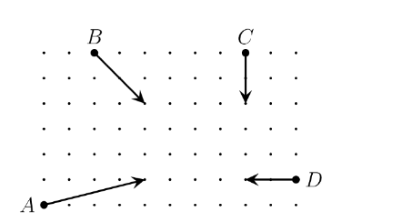
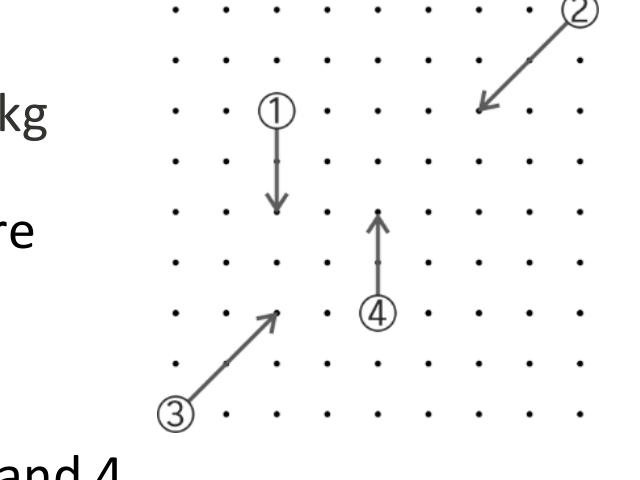
The diagram shows the starting position, the direction and the distance covered within 5 seconds by four bumper cars. Which two cars will first crash into each other?
Show answer
Answer: B — A and C
Show hints
Hint 1 of 2
Mark where each car ends up after its arrow's full length.
Still stuck? Show hint 2 →
Hint 2 of 2
The first crash is between the two cars whose paths meet soonest, not just whose endpoints are near.
Show solution
Approach: track each car's motion on the grid and find the earliest collision
Each arrow gives a car's direction and the distance it covers in the 5 seconds.
Following the paths, cars A and C are heading onto the same point first.
Their tracks intersect before any other pair's, so the first crash is A and C (B).
A dark disc with three holes is placed on top of the dial of a watch (see picture). The disc is then rotated about its centre. Which three numbers can be seen through the holes at the same time?
Show answer
Answer: A — 4, 6 and 12
Show hints
Hint 1 of 2
Rotating the disc keeps the three holes the same distances apart around the circle.
Still stuck? Show hint 2 →
Hint 2 of 2
Compare the gaps between the three holes with the gaps between the numbers in each answer; only a matching gap pattern can appear.
Show solution
Approach: match the angular gaps of the three holes to the gaps between the numbers
The three holes sit at fixed clock-positions, so the gaps between them (measured in hours) stay the same no matter how you turn the disc: the gaps are 2, 4 and 6 hours.
Check the gaps for each answer: 4, 6 and 12 are spaced 2, 4 and 6 hours apart — the same pattern.
None of the other answers has gaps 2, 4, 6, so only this triple can show through the holes at once.
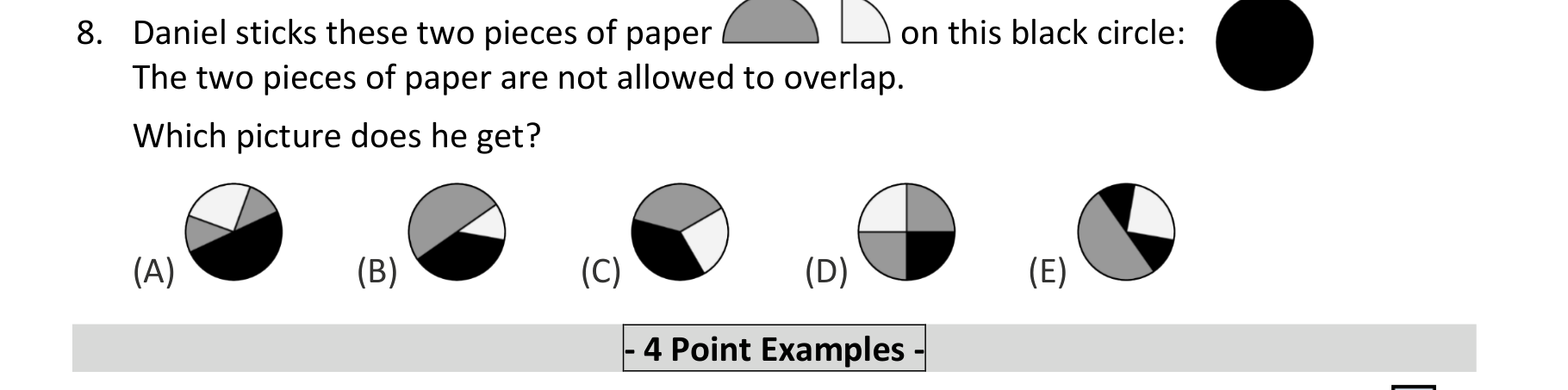
Daniel sticks these two pieces of paper onto a black circle. The two pieces of paper are not allowed to overlap. Which picture does he get? (Choose from pictures A–E.)
Show answer
Answer: E
Show hints
Hint 1 of 2
A half-circle covers half the black disc; a quarter-circle covers a quarter.
Still stuck? Show hint 2 →
Hint 2 of 2
Together they leave one quarter of the black circle still showing.
Show solution
Approach: cover a half and a quarter, leaving one black quarter
The grey half-piece hides one half of the black circle.
The white quarter-piece hides another quarter, and the pieces may not overlap.
That leaves exactly one quarter black, matching picture E.
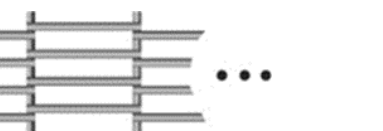
A straight wooden fence is made up of vertical beams stuck in the ground which are each connected to the next beam by 4 horizontal beams. The fence begins and ends with a vertical beam. Out of how many beams could such a fence be made?
Show answer
Answer: B — 96
Show hints
Hint 1 of 2
With v vertical beams there are v−1 gaps, each holding 4 horizontal beams.
Still stuck? Show hint 2 →
Hint 2 of 2
Write the total as a formula in v and see which option it can equal.
Show solution
Approach: set up a formula for the beam count
v vertical beams create v−1 gaps; each gap has 4 horizontals.
Total beams = v + 4(v−1) = 5v − 4.
This must equal one of the options: 5v−4 = 96 gives v = 20, a whole number.
The other options give non-integer v, so the answer is 96.
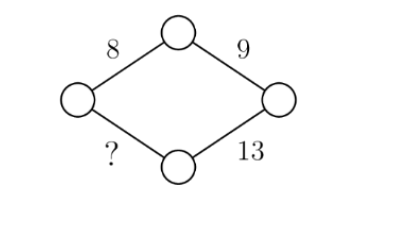
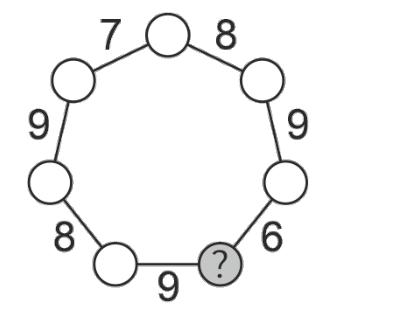
Werner wants to label each side and each corner point of the rhombus shown with exactly one number. He wants the number on each side to be equal to the sum of the numbers at the two corner points of that side. Which number is he going to write in place of the question mark?
Show answer
Answer: B — 12
Show hints
Hint 1 of 2
Each side label equals the sum of the two corner numbers at its ends; write those four relations.
Still stuck? Show hint 2 →
Hint 2 of 2
Add opposite sides: the two pairs of opposite sides have the same total, since both use all four corners.
Show solution
Approach: opposite sides of the rhombus share the same corner-sum total
Each side equals the sum of its two corner numbers, and the four corners are split the same way by the two pairs of opposite sides.
The two markers with a question mark have the same number. Which number do you have to put instead of the question mark so that the calculation is correct?
Show answer
Answer: C — 3
Show hints
Hint 1 of 3
Both question marks hide the very same number, so whatever you try, use it in both spots.
Still stuck? Show hint 2 →
Hint 2 of 3
You can just try the answers: put 1 in both marks, then 2, then 3, and check the sum each time.
Still stuck? Show hint 3 →
Hint 3 of 3
Keep trying numbers until the calculation comes out right.
Show solution
Approach: try the same number in both marks until the sum works
Remember both marks are the same number, so pick a number and use it in both spots.
Try the choices in turn and add up: too small a number makes the total too low, too big makes it too high.
The number that makes the calculation come out exactly right is 3, so the answer is C.
Anna has five circular discs that are all of different sizes. She wants to build a tower using three discs, where a smaller disc always has to lie on top of a bigger disc. How many ways are there for Anna to build the tower?
Show answer
Answer: D — 10
Show hints
Hint 1 of 2
Once three discs are chosen, how many valid stacking orders are there?
Still stuck? Show hint 2 →
Hint 2 of 2
Since sizes are all different, the order is forced, so just count the choices of three discs.
Show solution
Approach: count the ways to choose three discs (order is forced)
For any three chosen discs, the smaller-on-bigger rule fixes exactly one stacking order.
So the number of towers equals the number of ways to choose 3 discs from 5.
23 animals are sitting in the first row of a cinema. Each animal is either a beaver or a kangaroo. Each animal has at least one kangaroo next to it. What is the maximum amount of beavers in the row?
Show answer
Answer: D — 11
Show hints
Hint 1 of 2
Every animal — including each kangaroo — needs a kangaroo as a neighbour.
Still stuck? Show hint 2 →
Hint 2 of 2
So kangaroos can't sit alone; they must come in adjacent pairs, and at most two beavers can sit between groups.
Show solution
Approach: kangaroos must be paired; pack beavers between pairs
A lone kangaroo would have no kangaroo neighbour, so kangaroos occur in adjacent pairs.
Between two such pairs at most two beavers fit (a third would be too far from any kangaroo).
The tightest packing of 23 seats uses 12 kangaroos, leaving a maximum of 11 beavers.
Franziska writes down three consecutive two-digit numbers, in increasing order. Instead of the digits she uses symbols and writes □◊, ♡△, ♡□. What does Franziska’s next number look like?
Show answer
Answer: C — ♡♡
Show hints
Hint 1 of 2
The last two numbers share the same first symbol, so they have the same tens digit, while the first number's tens symbol is different.
Still stuck? Show hint 2 →
Hint 2 of 2
That means the jump from the first to the second number crosses into a new ten, so the numbers are like 19, 20, 21.
Show solution
Approach: decode each symbol by matching to three consecutive numbers
The 2nd and 3rd numbers start with the same heart symbol, so they share a tens digit, but the 1st number starts with a different symbol, so the first step crosses a ten.
Three consecutive numbers doing that look like 19, 20, 21: so the symbols decode to square=1, diamond=9, heart=2, triangle=0 (19=square diamond, 20=heart triangle, 21=heart square).
Her next number is 22, which uses heart for both digits.
The six weights of a scale weigh 1 kg, 2 kg, 3 kg, 4 kg, 5 kg and 6 kg. Rosi places five weights on the two scale pans so that they are balanced. The sixth weight is left aside. Which weight is left aside?
Show answer
Answer: A — 1 kg
Show hints
Hint 1 of 2
Add up all six weights first, then notice the five used ones split into two equal piles.
Still stuck? Show hint 2 →
Hint 2 of 2
For the two piles to be equal, the weight left aside must make the rest share out evenly.
Show solution
Approach: the leftover weight must leave an amount you can split into two equal piles
Count all six weights together: 1 + 2 + 3 + 4 + 5 + 6 = 21 kg.
The five weights on the scale make two equal piles, so the leftover must leave an amount you can split in half evenly.
Leaving the 1 kg aside leaves 20 kg, which shares out as 6 + 4 on one pan and 5 + 3 + 2 on the other — both 10 kg — so the leftover weight is 1 kg.
After playing 200 games of chess, Beth’s winning rate is exactly 49 %. What is the minimum number of games she has to still play to increase her winning rate to 50 %?
Show answer
Answer: D — 4
Show hints
Hint 1 of 2
She has 98 wins out of 200; adding x more wins makes it (98+x)/(200+x).
Still stuck? Show hint 2 →
Hint 2 of 2
Set that fraction to at least 1/2 and solve for the smallest whole x.
Show solution
Approach: set up the win-rate inequality
49% of 200 is 98 wins.
Winning the next x games gives rate (98+x)/(200+x).
Require (98+x)/(200+x) ≥ 1/2: 196+2x ≥ 200+x, so x ≥ 4.
Logic & Word ProblemsArithmetic & Operationssum-constraintcasework
Evita wants to write the numbers from 1 to 8, with one number in each field. The sum of the numbers in each row should be equal. The sum of the numbers in each of the four columns should also be the same. She has already written in the numbers 3, 4 and 8 (see diagram). Which number does she have to write in the dark field?
Show answer
Answer: E — 7
Show hints
Hint 1 of 2
The numbers 1..8 add to 36; use that to find each row sum and each column sum.
Still stuck? Show hint 2 →
Hint 2 of 2
Fit the remaining numbers around the given 3, 4 and 8 so every row and every column hits its target.
Show solution
Approach: use the fixed total to pin row/column sums, then place numbers
1 + 2 + ... + 8 = 36; with two equal rows each row sums to 18, and with four equal columns each column sums to 9.
Place the remaining numbers so each column totals 9 and each row totals 18, respecting the given 3, 4 and 8.
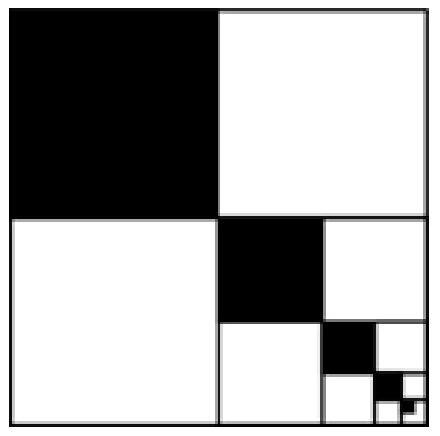
A square with area 84 is split into four squares. The upper left square is coloured in black. The lower right square is again split into four squares and so on. The process is repeated infinitely many times. How big is the area coloured in black?
Show answer
Answer: B — 28
Show hints
Hint 1 of 2
Each step blackens one quarter of the square that is still being divided.
Still stuck? Show hint 2 →
Hint 2 of 2
The black areas form a geometric series with ratio 1/4.
Show solution
Approach: sum the geometric series of black quarters
At each stage the black piece is 1/4 of the current square, and the next stage works on another 1/4.
Black fraction = 1/4 + (1/4)(1/4) + ... = (1/4)/(1−1/4) = 1/3 of the whole.
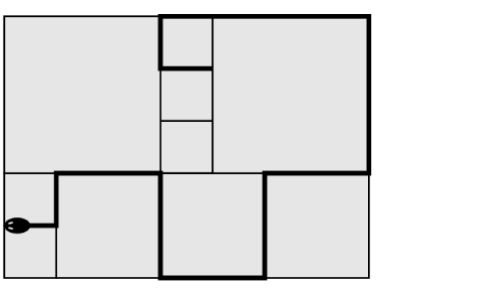
A terrace is covered with square tiles of different sizes. The smallest tile has a perimeter of 80 cm. A snake lies along the edges of the tiles (see picture). How long is the snake?
Show answer
Answer: C — 420 cm
Show hints
Hint 1 of 3
A square's perimeter is four equal sides, so first turn the 80 cm into the length of one small-tile side.
Still stuck? Show hint 2 →
Hint 2 of 3
Use that small side as your ruler and walk along the snake, counting how many small sides fit into each straight stretch.
Still stuck? Show hint 3 →
Hint 3 of 3
Add up all the little side-lengths the snake covers, then multiply by the length of one side.
Show solution
Approach: find the small-tile side, then count how many of those lengths the snake covers
The smallest tile is a square with perimeter 80 cm, so each of its sides is 80 / 4 = 20 cm.
Reading the snake's path along the tile edges, it stretches across 21 of these small side-lengths.
Jennifer wants to save water. She reduces the water pressure and thus reduces the water usage by one quarter. Furthermore, she reduces the time she takes a shower by one quarter. By which fraction in total does she reduce the water usage for her shower?
Show answer
Answer: E — by \(\frac{7}{16}\)
Show hints
Hint 1 of 2
Water used = pressure × time; cutting each by a quarter multiplies each factor by 3/4.
Still stuck? Show hint 2 →
Hint 2 of 2
Multiply the two reduction factors and compare with the original.
Show solution
Approach: multiply the two scaling factors
Reducing by a quarter leaves 3/4 of the pressure and 3/4 of the time.
Number TheoryLogic & Word Problemsplace-valuenumber-systems
Dorli writes down three consecutive natural numbers in increasing order. She replaces the digits with symbols and gets: □♦♦, ♡△△, ♡△□. What would be the next bigger number in this notation?
Show answer
Answer: E — ♡△♡
Show hints
Hint 1 of 3
Each symbol is one fixed digit, and the three codes are consecutive numbers, so the jump from the first to the second is just adding 1.
Still stuck? Show hint 2 →
Hint 2 of 3
Notice the hundreds symbol changes between the first and second number — that signals a roll-over like 199 → 200.
Still stuck? Show hint 3 →
Hint 3 of 3
Once you know what each symbol stands for, write the third number, add 1 more, and re-encode it.
Show solution
Approach: decode the symbols using the roll-over, then add one more
From the second to the third number only the last digit changes (♡△△ → ♡△□), so adding 1 turns △ into □, meaning □ = △ + 1 with no carry.
From the first to the second number the hundreds digit changes (□♦♦ → ♡△△), which only happens on a roll-over like 199 → 200: so ♦ = 9, △ = 0, □ = 1 and ♡ = 2.
The three numbers are 199, 200, 201, and the next bigger one is 202.
Re-encoding 202 with 2 = ♡ and 0 = △ gives ♡△♡, option E.
The numbers from 1 to 9 are to be distributed to the nine squares in the diagram according to the following rules: There is to be one number in each square. The sum of three adjacent numbers is always a multiple of 3. The numbers 7 and 9 are already written in. How many ways are there to insert the remaining numbers?
Show answer
Answer: E — 24
Show hints
Hint 1 of 3
Sort 1–9 by remainder mod 3: \(\{3,6,9\}\) give 0, \(\{1,4,7\}\) give 1, \(\{2,5,8\}\) give 2.
Still stuck? Show hint 2 →
Hint 2 of 3
Comparing two overlapping triples shows the remainders must repeat every third square.
Still stuck? Show hint 3 →
Hint 3 of 3
Use the fixed 7 and 9 to decide which remainder class goes in which of the three position-classes.
Show solution
Approach: the mod-3 remainders repeat with period 3, then count
If squares \(i,i+1,i+2\) and \(i+1,i+2,i+3\) both sum to a multiple of 3, subtracting shows square \(i\) and square \(i+3\) have the same remainder, so the remainders repeat in a period-3 pattern across the nine squares.
Thus one remainder class (three numbers) fills positions \(1,4,7\), another fills \(2,5,8\), the third fills \(3,6,9\); the placed 7 (remainder 1) and 9 (remainder 0) lock those two classes onto their position groups, leaving the remainder-2 class for the third group.
Each of the three classes can be arranged inside its three positions in \(3! = 6\) ways, but the 7 and 9 are fixed, so the count is \(2 \cdot 2 \cdot 6 = \mathbf{24}\) ways.
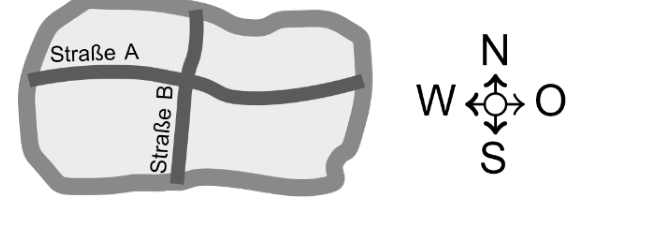
North of street A there are 7 houses. East of street B there are 8 houses. South of street A there are 5 houses. How many houses are there west of street B?
Show answer
Answer: A — 4
Show hints
Hint 1 of 2
Every house is either north or south of street A, so those two counts give the grand total.
Still stuck? Show hint 2 →
Hint 2 of 2
The grand total also splits into east and west of street B.
Show solution
Approach: total from the A split, then subtract the east count
North of A there are 7 houses and south of A there are 5, so there are 7 + 5 = 12 houses in all.
All 12 are also split by street B into east and west.
With 8 east of B, the west side has 12 − 8 = 4 houses.
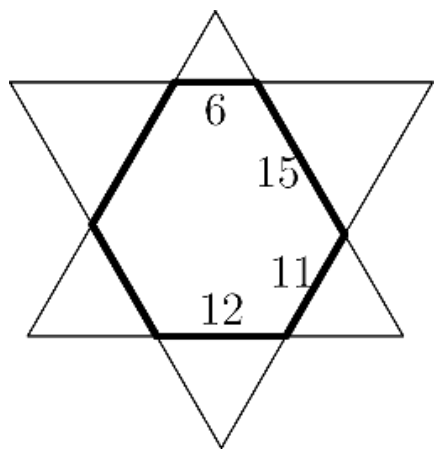
Two equilateral triangles of different sizes are placed on top of each other so that a hexagon is formed on the inside whose opposite sides are parallel. Four of the side lengths of the hexagon are stated in the diagram. How big is the perimeter of the hexagon?
Show answer
Answer: D — 70
Show hints
Hint 1 of 2
Two equilateral triangles overlapping make a hexagon whose every interior angle is 120°.
Still stuck? Show hint 2 →
Hint 2 of 2
In an equiangular hexagon the differences of opposite sides are all equal.
Show solution
Approach: use the equiangular-hexagon side relation
Because the hexagon is formed by two equilateral triangles, all six angles are 120°.
For an equiangular hexagon with sides in order, opposite-side differences are all equal; the known sides 6, 15, 11, 12 then give the missing sides 9 and 17.
Maria, Peter, Richard and Tina were playing football in the classroom when a window pane broke. The head teacher asked who did it and got these answers. Maria: “It was Peter.” Peter: “It was Richard.” Richard: “It wasn’t me.” Tina: “It wasn’t me.” It later turned out that only one child told the truth. Who broke the window pane?
Show answer
Answer: B — Tina
Show hints
Hint 1 of 2
Try assuming each child is the culprit in turn and see how many of the four statements come out true.
Still stuck? Show hint 2 →
Hint 2 of 2
Only the case with exactly one true statement can be correct.
Show solution
Approach: test each suspect and count how many statements are true
Suppose Tina broke it. Then Maria's “it was Peter” is false, Peter's “it was Richard” is false, Richard's “it wasn't me” is true, and Tina's “it wasn't me” is false.
That gives exactly one true statement, matching the rule that only one child told the truth.
Testing the other suspects gives either zero or more than one true statement, so they fail.
In a queue in front of a ferry there are 8 cars with 19 people in total. There are either 2 or 3 people in each car. How many cars are there with exactly 2 people?
Show answer
Answer: D — 5
Show hints
Hint 1 of 2
If every car held 2 people there would be only 16; you need 3 more.
Still stuck? Show hint 2 →
Hint 2 of 2
Each car upgraded from 2 to 3 people adds exactly one person.
Show solution
Approach: start from all-twos and account for the extra people
Eight cars with 2 people each would carry 16 people, but there are 19.
The 3 extra people come from 3 cars holding 3 instead of 2.
Logic & Word Problemswork-backwardcareful-counting
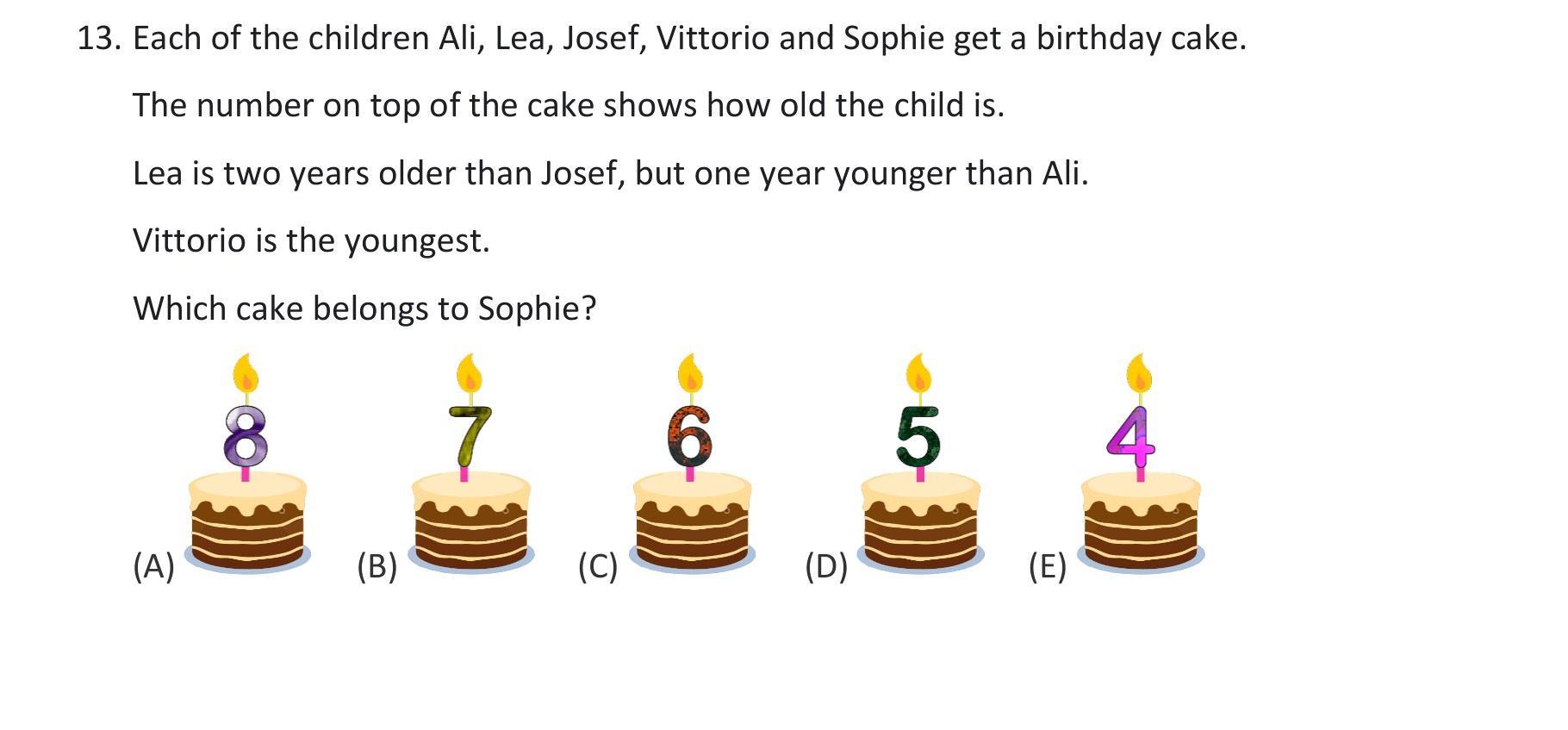
Each of the children Ali, Lea, Josef, Vittorio and Sophie gets a birthday cake. The number on top of the cake shows how old the child is. Lea is two years older than Josef, but one year younger than Ali. Vittorio is the youngest. Which cake belongs to Sophie?
Show answer
Answer: C
Show hints
Hint 1 of 3
There are five cakes with five ages on them — match a child to each one.
Still stuck? Show hint 2 →
Hint 2 of 3
Use the clues to label the easy children first, and give the smallest cake to Vittorio.
Still stuck? Show hint 3 →
Hint 3 of 3
Sophie gets the one cake that is left over after everyone else is matched.
Show solution
Approach: match the easy children first; Sophie gets the leftover cake
Josef, then Lea (2 older than Josef), then Ali (1 older than Lea) line up in a row of ages.
Vittorio is the youngest, so he takes the smallest-numbered cake.
Four children are now placed, so the one cake left over is Sophie's: the cake showing 6, option C.
A rope with length 95 m is cut into three pieces so that each piece is half as long again as the respective previous piece. How long is the longest of the three pieces?
Show answer
Answer: C — 45 m
Show hints
Hint 1 of 2
“Half as long again” means each piece is 1.5 times the previous one.
Still stuck? Show hint 2 →
Hint 2 of 2
Write the three pieces as x, 1.5x, 2.25x and add them to 95.
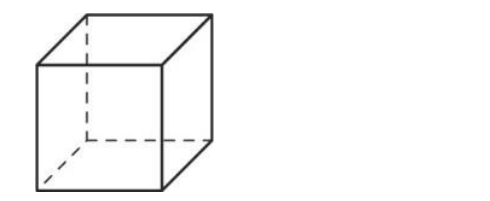
Some edges of a cube are coloured red so that each face of the cube has at least one red edge. What is the minimum number of red edges that the cube must have?
Show answer
Answer: B — 3
Show hints
Hint 1 of 2
A cube has 6 faces and 12 edges; each edge borders 2 faces, so one red edge can cover 2 faces.
Still stuck? Show hint 2 →
Hint 2 of 2
Try to cover all 6 faces with as few edges as possible — can 3 well-chosen edges touch every face?
Show solution
Approach: cover all six faces using each edge's two adjacent faces
Each edge lies on exactly two faces, so k red edges can touch at most 2k faces.
To cover all 6 faces you need at least 3 edges.
Three suitably placed edges (one near each of three corners) do touch all six faces.
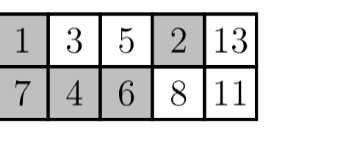
The sum of the numbers in the white fields should equal the sum of the numbers in the grey fields. Which two numbers have to be swapped so that the two sums become equal?
Show answer
Answer: A — 1 and 11
Show hints
Hint 1 of 2
Add up the grey numbers and the white numbers separately to see the gap between them.
Still stuck? Show hint 2 →
Hint 2 of 2
A swap moves one number out of each group; close exactly half the gap by picking the right pair.
Show solution
Approach: balance the two totals by closing half the gap
The grey fields total 1 + 2 + 7 + 4 + 6 = 20 and the white fields total 3 + 5 + 13 + 8 + 11 = 40, so the whole grid sums to 60 and each side should reach 30.
Swapping a grey number g for a white number w changes the grey total by (w − g); to go from 20 to 30 we need w − g = 10.
Swapping grey 1 with white 11 gives w − g = 10, making both sides 30.
6 beavers and 2 kangaroos are standing on the fields 1 to 8 in a row. Of any three animals in a row there is always exactly one kangaroo. On which of these numbers stands a kangaroo?
Show answer
Answer: C — 3
Show hints
Hint 1 of 2
Split the eight fields into the blocks 1-2-3, 4-5-6 and note each must hold one kangaroo.
Still stuck? Show hint 2 →
Hint 2 of 2
Test where the two kangaroos can sit so every three-in-a-row has exactly one.
Show solution
Approach: place the two kangaroos so each consecutive triple has exactly one
Fields 1-2-3 must contain one kangaroo and fields 4-5-6 another, using both kangaroos.
Checking every window of three forces the kangaroos onto fields 3 and 6.
Among the offered choices, a kangaroo stands on field 3.
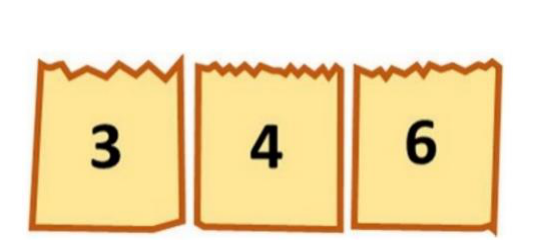
Maria has a total of 19 apples in 3 bags. She takes the same amount of apples from each bag. Then there are 3, 4 and 6 apples in the bags. How many apples did Maria take from each bag?
Show answer
Answer: B — 2
Show hints
Hint 1 of 3
First add up how many apples are still left in all three bags.
Still stuck? Show hint 2 →
Hint 2 of 3
Maria started with 19, so the apples she took are the 19 minus the ones still left.
Still stuck? Show hint 3 →
Hint 3 of 3
She took the same number from each bag, so share the taken apples equally among 3 bags.
Show solution
Approach: find how many were taken in all, then share among 3 bags
Count the apples still in the bags: 3 and 4 and 6 make 13.
Maria began with 19, so the apples she took away are 19 take away 13, which is 6.
She took the same from each of the 3 bags, so share 6 into 3 equal groups: 2 from each bag, option B.
The digits 0 to 9 can be formed using matchsticks (see diagram). How many different positive whole numbers can be formed this way with exactly 6 matchsticks?
Show answer
Answer: C — 6
Show hints
Hint 1 of 2
First note how many matchsticks each digit 0..9 needs.
Still stuck? Show hint 2 →
Hint 2 of 2
List all numbers (one or more digits) whose matchstick counts add to exactly 6, ignoring leading zeros.
Show solution
Approach: count matchsticks per digit, then list totals equal to 6
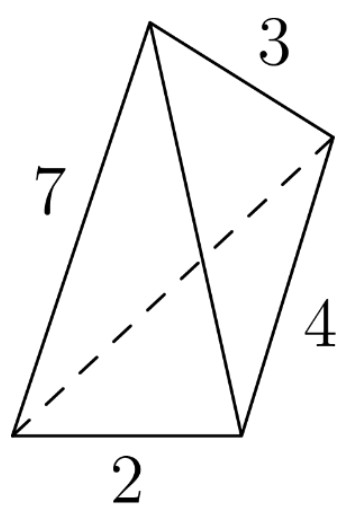
In a three-sided pyramid all side lengths are integers. Four of the side lengths can be seen in the diagram. What is the sum of the two remaining side lengths?
Show answer
Answer: C — 11
Show hints
Hint 1 of 3
Each of the four triangular faces must obey the triangle inequality with whole-number sides.
Still stuck? Show hint 2 →
Hint 2 of 3
The two unknown edges each sit in two faces; intersect the allowed ranges from those faces.
Still stuck? Show hint 3 →
Hint 3 of 3
The two visible edges of a face squeeze the third edge into a narrow whole-number window.
Show solution
Approach: intersect the triangle-inequality ranges for each missing edge
The shown edges are 7 and 2 on one face and 3 and 4 on another; the two missing edges close up the remaining faces.
The missing edge in the 7-2 region must satisfy \(5 < e < 9\), and the same edge in the 3-4 region must satisfy \(1 < e < 7\), forcing it to be 6.
The other missing edge must satisfy \(4 < e < 10\) and \(2 < e < 6\), forcing it to be 5, so the two missing edges sum to \(6 + 5 = \mathbf{11}\).
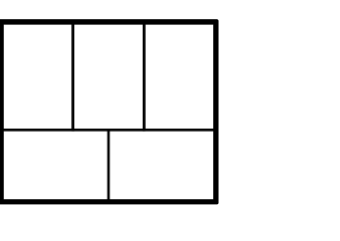
A big rectangle is made up of five small rectangles (see picture). Lukas wants to colour the small rectangles red, blue and yellow so that any two rectangles sharing a side have different colours. In how many ways can he do this?
Show answer
Answer: D — 6
Show hints
Hint 1 of 3
Start by colouring one rectangle, then move to a neighbour and count how many of the three colours are still allowed.
Still stuck? Show hint 2 →
Hint 2 of 3
Multiply the number of free choices as you colour the rectangles one by one.
Still stuck? Show hint 3 →
Hint 3 of 3
Be extra careful at a rectangle that touches two already-coloured neighbours, since it may have fewer choices left.
Show solution
Approach: colour the rectangles in order, counting choices for each
Colour the three top rectangles left to right: the first has 3 choices, each next one must differ from its neighbour.
The bottom rectangles must differ from the top rectangles they touch and from each other, which limits the remaining choices.
Carefully multiplying the allowed choices through the whole arrangement gives 6 valid colourings.
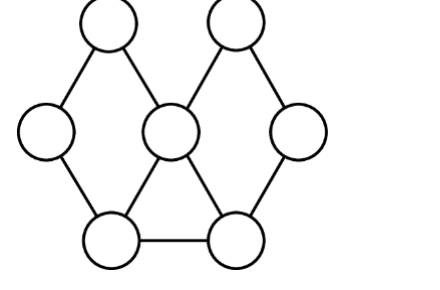
Hanni wants to colour in the circles in the diagram. When two circles are connected by a line they should have different colours. What is the minimum number of colours she needs?
Show answer
Answer: B — 3
Show hints
Hint 1 of 2
Two circles joined by a line must differ in colour.
Still stuck? Show hint 2 →
Hint 2 of 2
If three circles are all linked to each other, they need three different colours.
Show solution
Approach: find a triangle (forces 3) then show 3 colours suffice
The diagram contains three circles that are all connected to one another, so they need three distinct colours.
Trying to colour the whole diagram with just those three colours succeeds.
Logic & Word Problemswork-backwardcareful-counting
Three frogs live in a pond. Each night only one of the frogs sings a song. After 9 nights the first frog has sung 2 times. The second frog has listened to 5 songs. How many songs did the third frog listen to?
Show answer
Answer: B — 6
Show hints
Hint 1 of 3
There are 9 nights and one song each night, so the three frogs together sang 9 songs.
Still stuck? Show hint 2 →
Hint 2 of 3
On any night, a frog is either singing or listening — so a frog listens on every night it did not sing.
Still stuck? Show hint 3 →
Hint 3 of 3
If the second frog listened to 5 songs, that tells you how many nights it sang instead.
Show solution
Approach: 9 songs in all; a frog listens on every night it does not sing
There are 9 nights with one song each, so 9 songs were sung in all. Frog 1 sang 2 of them.
Frog 2 listened to 5 songs, so out of 9 nights it sang on the other 4 nights.
That leaves Frog 3 singing 9 take away 2 take away 4, which is 3 nights, so it listened on the other 6 nights: 6, option B.
The pentagon ABCDE is split into four triangles that all have the same perimeter (see diagram). Triangle ABC is equilateral and the triangles AEF, DFE and CDF are congruent isosceles triangles. How big is the ratio of the perimeter of the pentagon ABCDE to the perimeter of the triangle ABC?
Show answer
Answer: D — \(\frac{5}{3}\)
Show hints
Hint 1 of 2
All four triangles share the same perimeter; let the equilateral side be the unit.
Still stuck? Show hint 2 →
Hint 2 of 2
Express the outer sides CD, DE, EA of the pentagon using the equal-perimeter condition.
Show solution
Approach: compare the pentagon's outer sides to the equilateral side using equal perimeters
Let the equilateral triangle ABC have side \(s\); its perimeter is \(3s\), and \(AB=BC=s\) are two of the pentagon's sides.
The pentagon's other three sides are CD, DE, EA, which are the outer edges of the three congruent isosceles triangles; the rest of each of those triangles is made of interior segments shared with a neighbour.
Because the three isosceles triangles are congruent and each also has perimeter \(3s\), the equal-perimeter bookkeeping forces the three outer sides CD, DE, EA to add up to \(3s\) (each equal to \(s\)).
Then the pentagon's perimeter is \(AB+BC+CD+DE+EA = s+s+s+s+s = 5s\), so the ratio to the triangle's \(3s\) is \(\frac{5s}{3s}=\frac{5}{3}\) (choice D).
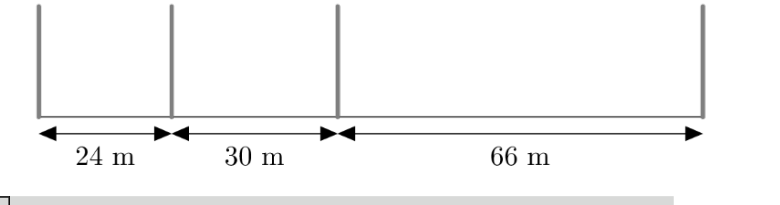
Four posts are placed along a 120 m long running track at the distances shown. How many more posts must be added so that the track is divided into sections that are all the same length?
Show answer
Answer: C — 17
Show hints
Hint 1 of 2
The existing posts sit at distances 24 m, 54 m and 120 m from the start; the equal sections must line up with all of them.
Still stuck? Show hint 2 →
Hint 2 of 2
Find the largest length that divides all those distances, then count how many posts that many sections need.
Show solution
Approach: use the greatest common divisor of the existing post positions
Measured from the start, the four posts are at 0, 24, 54 and 120 metres.
Equal sections must reach each existing post, so the section length must divide 24, 54 and 120; the largest such length is their greatest common divisor, 6 m.
That makes 120 / 6 = 20 sections, which need 21 posts in all.
Since 4 posts are already there, 21 − 4 = 17 more are needed, answer C.
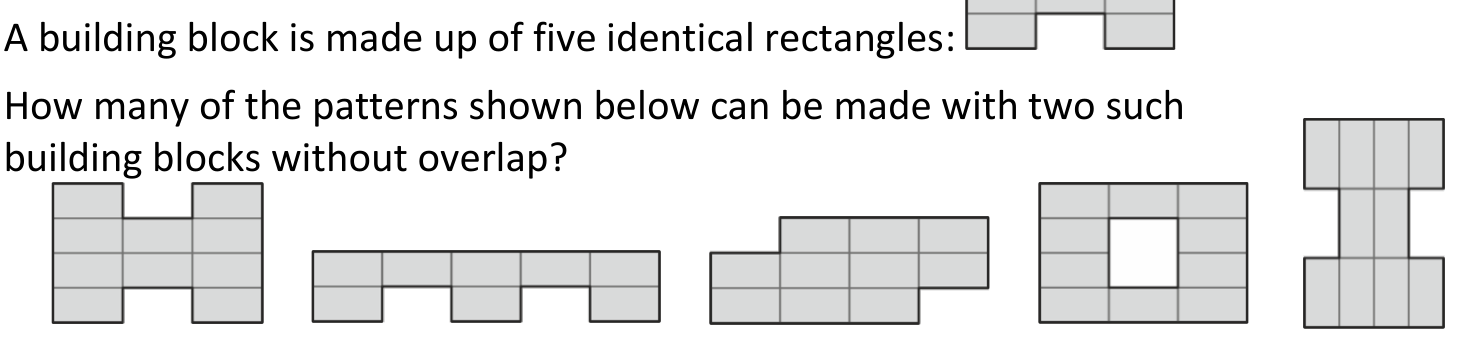
A building block is made up of five identical rectangles (shown). How many of the patterns shown below can be made with two such building blocks without overlap?
Show answer
Answer: D — 4
Show hints
Hint 1 of 2
Two blocks cover 5 + 5 = 10 small rectangles, so only patterns with 10 cells are possible.
Still stuck? Show hint 2 →
Hint 2 of 2
For the right-sized patterns, try to split them into two of the given S-shaped blocks.
Show solution
Approach: check cell count, then attempt a two-block tiling of each pattern
Each building block is 5 cells, so two of them cover 10 cells — only patterns with 10 cells can work.
Testing those patterns, exactly four of the five can be split into two of the S-shaped blocks without overlap.
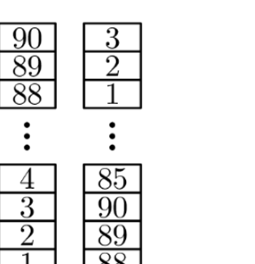
A tower consists of blocks that are labelled from bottom to top with the numbers from 1 to 90. Bob uses these blocks to build a new tower. For each step he takes the top three blocks from the old tower and places them on the new tower without changing their order (see diagram). How many blocks are there in the new tower between the blocks with the numbers 39 and 40?
Show answer
Answer: E — 4
Show hints
Hint 1 of 2
Blocks move in groups of three (the top three each step), and higher old numbers end up lower in the new tower.
Still stuck? Show hint 2 →
Hint 2 of 2
Find the group containing 39 and the group containing 40, then count what lies between them.
Show solution
Approach: track the blocks in groups of three
Each step moves a block of three with their order kept: ..., (37,38,39), (40,41,42), ...
Higher-numbered groups are placed first, so going up the new tower we see 40,41,42 then 37,38,39.
Logic & Word ProblemsCounting & Probabilitycareful-countingcasework
Some kangaroos and three beavers are standing in a circle. No beaver stands directly next to another beaver. There are exactly three kangaroos that are standing next to another kangaroo. What is the biggest possible number of kangaroos in the circle?
Show answer
Answer: B — 5
Show hints
Hint 1 of 3
The 3 beavers split the circle into 3 blocks of kangaroos, and none of those blocks can be empty since no two beavers may touch.
Still stuck? Show hint 2 →
Hint 2 of 3
A kangaroo has a kangaroo neighbour exactly when it sits in a block of 2 or more; count how many such kangaroos a block of each size produces.
Still stuck? Show hint 3 →
Hint 3 of 3
You are allowed only 3 kangaroos-with-a-kangaroo-neighbour total, so spend that budget on one block and keep the rest as singles.
Show solution
Approach: beavers cut the circle into blocks; count kangaroos that touch a kangaroo
The 3 beavers (no two adjacent) cut the circle into 3 non-empty blocks of kangaroos.
In a block of size 1 the lone kangaroo touches only beavers, but every kangaroo in a block of size 2 or more touches another kangaroo, so a block of size k≥2 uses up k of the allowed 3.
To keep the count at exactly 3, make one block of size 3 and the other two blocks size 1: arrangement B·KKK·B·K·B·K uses 3 + 1 + 1 = 5 kangaroos, and only the three in the KKK block touch a kangaroo.
Any sixth kangaroo would enlarge another block to size 2+, pushing the touching-count above 3, so the maximum is 5 (B).
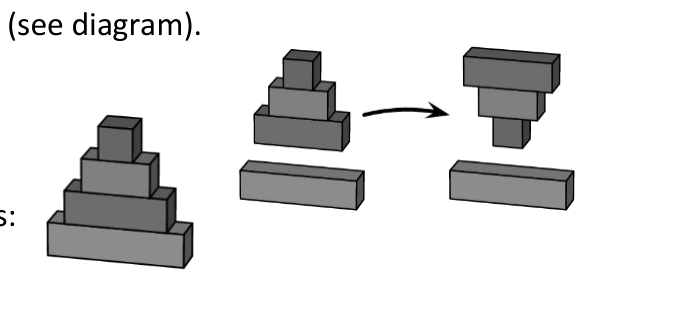
In one move you may take some (or all) of the building blocks from the top of a stack, turn that group upside down, and put it back in the same place (see picture). Goran starts with the stack on the left and wants to end up with all the blocks ordered by size, as shown on the right. What is the smallest number of moves Goran needs?
Show answer
Answer: B — 3
Show hints
Hint 1 of 3
A move can only lift a group off the top and turn that whole group over, so the bottom blocks stay put unless you lift everything above them.
Still stuck? Show hint 2 →
Hint 2 of 3
Look at which blocks are already in the right size order and which clumps are reversed or out of place.
Still stuck? Show hint 3 →
Hint 3 of 3
Try to undo the disorder one reversed clump at a time, counting how few flips can finish the job.
Show solution
Approach: find the smallest set of top-flips that reorders the blocks
A move lifts some blocks off the top, turns that chunk over, and puts it back, so one move can reverse a top group.
Comparing the starting stack with the target size order shows which groups are out of place.
Carrying out the reorder with the fewest such flips takes 3 moves.
Logic & Word Problemsperiodic-patterncareful-counting
An underground line has the six stations A, B, C, D, E and F. The train stops at every station. After reaching the end of the line (A or F) the train continues in the opposite direction. The train conductor starts his journey in station B. His first stop is in station C. In which station will be his 46th stop?
Show answer
Answer: D — D
Show hints
Hint 1 of 2
List the stops in order; the train bounces off the ends A and F.
Still stuck? Show hint 2 →
Hint 2 of 2
The sequence of stops repeats, so find the cycle length and use the remainder.
Show solution
Approach: list the bouncing sequence, find its period, take 46 mod period
Starting at B and first stopping at C, the stops run C,D,E,F,E,D,C,B,A,B and then repeat with period 10.
Since 46 = 4×10 + 6, the 46th stop matches the 6th stop in the cycle.
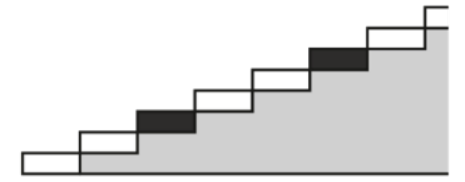
A staircase has 2023 steps. Every third step is coloured black. The first seven steps of this staircase can be fully seen in the diagram. Anita walks up the staircase and steps on each step exactly once. She can start with either the right or the left foot and then alternates her right and left foot. What is the minimum number of black steps she sets her right foot on?
Show answer
Answer: D — 337
Show hints
Hint 1 of 2
Number the steps; the black ones are the multiples of 3: 3, 6, 9, …, 2022.
Still stuck? Show hint 2 →
Hint 2 of 2
Alternating feet means a step's foot depends only on whether its number is odd or even — so the two feet take the odd-numbered and the even-numbered black steps.
Show solution
Approach: split the black steps by parity
The black steps are 3, 6, 9, …, 2022, that is 3·1 up to 3·674, so there are 674 of them.
Feet alternate, so odd-numbered steps all use one foot and even-numbered steps the other.
Among the black steps, the odd ones are 3·1, 3·3, …, 3·673 (337 of them) and the even ones are 3·2, 3·4, …, 3·674 (also 337).
Either starting foot makes the right foot land on one of these groups, so the minimum is 337.
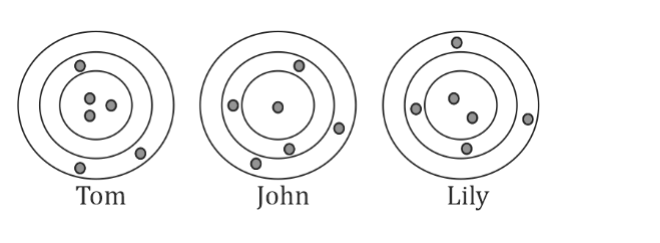
Tom, John and Lily have each shot 6 arrows at a disc with three sections (see diagram). The number of points for a hit depends on the section that has been hit. Tom has 46 points and John has 34 points. How many points did Lily get?
Show answer
Answer: D — 40
Show hints
Hint 1 of 2
Let the three ring values be the unknowns and read off how many arrows landed in each ring for Tom and John.
Still stuck? Show hint 2 →
Hint 2 of 2
Two equations fix enough about the ring values to total Lily's hits.
Show solution
Approach: set up the ring point-values from Tom and John, then total Lily
Let the outer, middle and inner rings be worth fixed point values; each player threw 6 arrows.
Tom's hits give 46 points and John's give 34 points, which pin down the ring values (each is consistent with 6 arrows).
Applying those values to Lily's six hits totals 40.
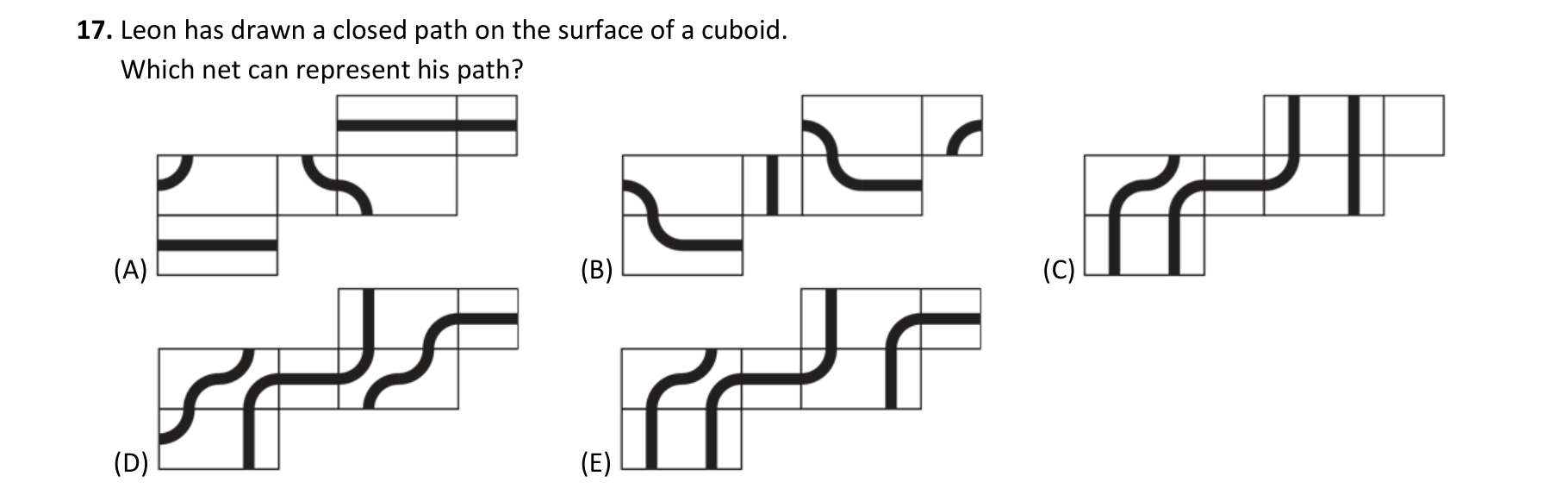
Leon has drawn a closed path on the surface of a cuboid. Which net (shown below) can represent his path?
Show answer
Answer: D
Show hints
Hint 1 of 3
On the real cuboid the path is one continuous loop, so on every fold edge the line must continue across without a gap.
Still stuck? Show hint 2 →
Hint 2 of 3
Walk along the path in each net and check that it leaves a face exactly where it re-enters the neighbouring face when folded.
Still stuck? Show hint 3 →
Hint 3 of 3
Reject any net where a path end stops at an edge with no matching segment on the face it glues to.
Show solution
Approach: match path crossings across every glued edge of the folded net
A closed path on the cuboid is one loop, so where it crosses an edge of the net the two faces that join along that edge must each carry the line at the same point.
In options A, B, C and E at least one path segment runs off an edge with no matching line on the face it folds against, breaking the loop.
Only the segments in option D line up at every shared edge and close into a single continuous loop.
Robert and Sonja play a game. Taking turns, each player removes 1, 2, 3, 4 or 5 cards from the pile. Whoever takes the last card loses. There are 10 cards on the pile and it is Robert’s turn. How many cards should he leave for Sonja so that he is certain to win?
Show answer
Answer: C — 7
Show hints
Hint 1 of 2
Since taking the last card loses, you want to leave your opponent stuck taking it.
Still stuck? Show hint 2 →
Hint 2 of 2
Work backwards: leaving 1 card is a loss for the other player, and so is any number that is one more than a multiple of 6.
Show solution
Approach: find the losing positions and leave the opponent on one
Whoever is forced to take the very last card loses, so leaving exactly 1 card hands the loss to your opponent.
Because each turn removes 1 to 5 cards, you can always reply to keep the pile at the next “bad” number, which are 1, 7, 13, … (one more than a multiple of 6).
From 10 cards Robert takes 3, leaving 7 — a losing position for Sonja, whatever she does next.
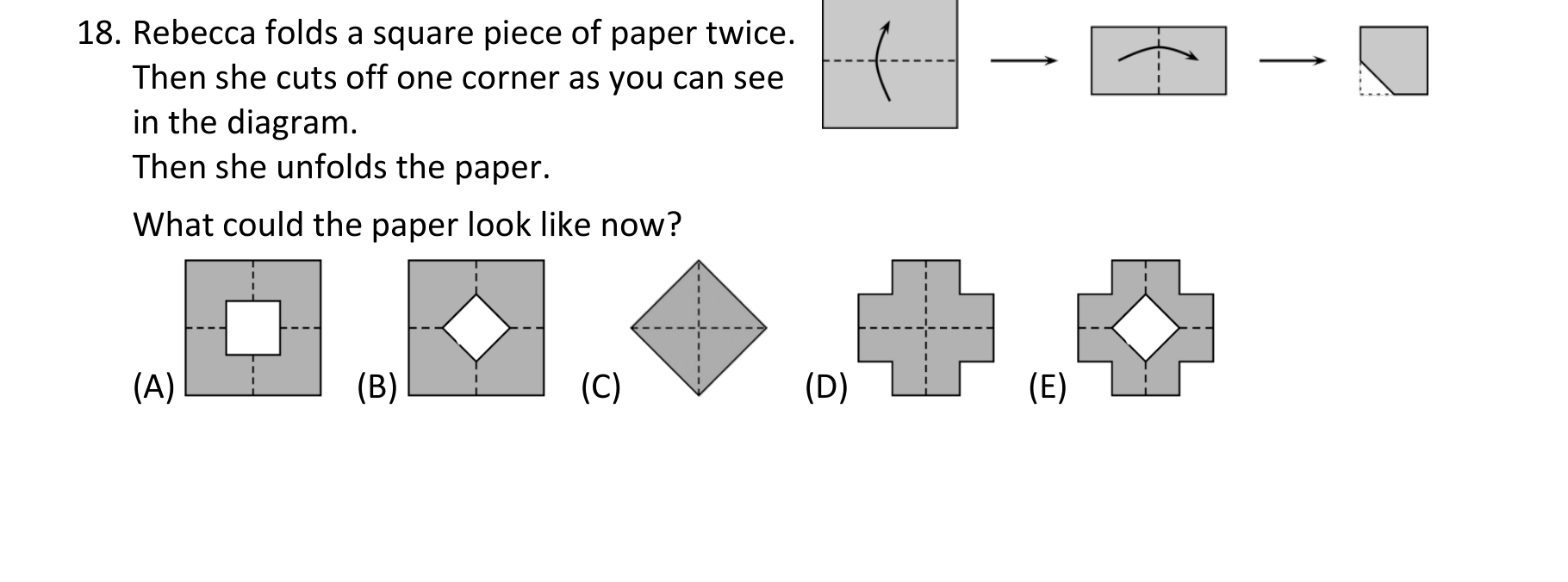
Rebecca folds a square piece of paper twice. Then she cuts off one corner as shown in the diagram. Then she unfolds the paper. What could the paper look like now? (Choose from pictures A–E.)
Show answer
Answer: B
Show hints
Hint 1 of 2
Folding twice stacks four layers; the single cut goes through all of them.
Still stuck? Show hint 2 →
Hint 2 of 2
The cut corner sits at the folded centre, so unfolding makes a hole in the middle.
Show solution
Approach: unfold the cut by reflecting it across both fold lines
Two folds bring all four corners together at the centre of the square.
Cutting that folded corner removes a piece from the very middle of the paper.
Unfolded, the paper is a full square with a small square hole in the centre, which is option B.
We call a positive integer powerfree if none of its digits can be written as a power of an integer with an exponent bigger than 1. For example, the number 53 is powerfree, but the number 54 is not powerfree since \(4 = 2^2\). Which one of the following numbers is the difference between the biggest and the smallest two-digit powerfree numbers?
Show answer
Answer: B — 55
Show hints
Hint 1 of 2
A digit is “bad” if it is a perfect power: 0, 1, 4, 8, 9.
Still stuck? Show hint 2 →
Hint 2 of 2
Find the largest and smallest two-digit numbers whose digits are all allowed, then subtract.
Show solution
Approach: restrict to allowed digits
Digits that are powers (exponent>1) are 0=0², 1=1², 4=2², 8=2³, 9=3².
Allowed digits are 2, 3, 5, 6, 7.
The biggest two-digit powerfree number is 77 and the smallest is 22.
Logic & Word ProblemsNumber Theorywork-backwardsum-constraint
Max and two of his friends are standing in a line. The number of people in the line is a multiple of 3. He notices that there are the same number of people in front of him as there are behind him. Both of his friends are behind him: one is in position 19, the other in position 28 of the line. In which position of the line is Max?
Show answer
Answer: D — 17
Show hints
Hint 1 of 2
Equal numbers in front and behind means Max is exactly in the middle, so the line length is odd.
Still stuck? Show hint 2 →
Hint 2 of 2
The length is a multiple of 3 and at least 28; the smallest odd multiple of 3 that is ≥ 28 fixes everything.
Show solution
Approach: use the middle position and the multiple-of-3, length-≥28 conditions
Equal people in front and behind put Max in the middle, so the total number is odd.
The total is a multiple of 3 and must be at least 28 (a friend stands at position 28), so the smallest such odd value is 33.
Max's middle position in a line of 33 is position (33+1)/2 = 17.
For each positive integer n the number \(n!\) is defined as the product of all numbers from 1 to n. For example, \(4! = 4 \cdot 3 \cdot 2 \cdot 1 = 24\). For a certain N the formula \(N! = 6! \cdot 7!\) holds. How big is the sum of the digits of N?
Show answer
Answer: A — 1
Show hints
Hint 1 of 2
Try to write 6!·7! as a single factorial.
Still stuck? Show hint 2 →
Hint 2 of 2
Notice 7! = 7·6!, and look for a factorial equal to 6!·7!.
Show solution
Approach: recognise 6!·7! as 10!
Since 7! = 7·6!, the product 6!·7! equals 3 628 800.
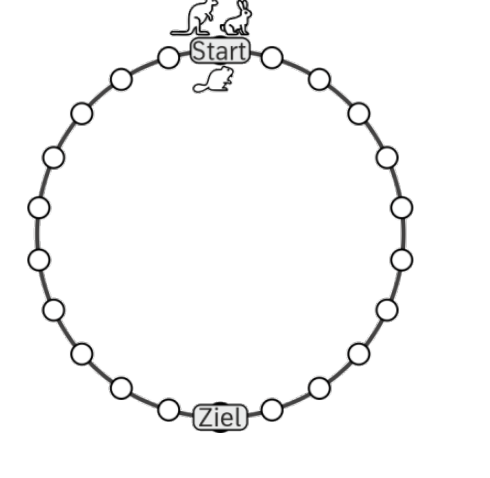
A rabbit, a beaver and a kangaroo have a race. They all start at the same time from “Start” and hop in the same direction around the loop. With each jump the beaver moves forward 1 position, the rabbit moves forward 2 positions, and the kangaroo moves forward 3 positions. Whoever needs the fewest jumps to land exactly on the position marked “Ziel” wins. Who wins the race?
Show answer
Answer: E — Kangaroo and beaver
Show hints
Hint 1 of 2
Ziel sits exactly opposite Start, so its distance from Start is half the number of positions around the loop.
Still stuck? Show hint 2 →
Hint 2 of 2
Check whether each animal's jump size can ever add up exactly to that distance, and compare how many jumps it takes.
Show solution
Approach: compare each step size against the half-way distance to Ziel
Ziel is directly opposite Start, so reaching it means covering exactly half the loop, an odd number of positions.
The rabbit moves 2 at a time, so its total is always even and it can never land exactly on the odd-distance Ziel.
The beaver (step 1) and the kangaroo (step 3) both reach Ziel, and they need the same number of jumps to first land there.
Tied for the fewest jumps are the kangaroo and the beaver, answer E.
Three boys enter a room one after the other. Hermann is not the first. Felix is not the second. Clemens is not the third. How many different orders are there for the boys to enter the room?
Show answer
Answer: B — 2
Show hints
Hint 1 of 2
List all six orders of the three boys and cross out the forbidden ones.
Still stuck? Show hint 2 →
Hint 2 of 2
Hermann cannot be 1st, Felix cannot be 2nd, Clemens cannot be 3rd.
Show solution
Approach: enumerate the orders and discard those breaking a rule
There are 6 possible orders of three boys.
Keeping only those with Hermann not first, Felix not second, and Clemens not third leaves Felix-Clemens-Hermann and Clemens-Hermann-Felix.
A square with side length 30 cm is split into 9 squares. The big square contains three circles with radii 5 cm (bottom right), 4 cm (top left) as well as 3 cm (top right) as seen in the diagram. How many cm\(^2\) are shaded in grey?
Show answer
Answer: B — \(500\)
Show hints
Hint 1 of 2
The 30 cm square splits into nine 10 cm squares; work out which of those are shaded grey.
Still stuck? Show hint 2 →
Hint 2 of 2
Add up the grey square areas and account for the circle pieces that fall in them.
Show solution
Approach: pair each circular piece with an equal opposite piece so the \(\pi\) terms cancel
The 30 cm square (area 900) is cut into nine 10×10 cells, each of area 100.
The shading takes some whole cells and then swaps circle pieces in and out: for each circle, the grey part removed from one cell is matched by an equal circular part added in an adjacent cell.
Because every circle contributes the same amount of grey as it removes, all the \(\pi\) terms cancel and the grey area is a whole number of square cells.
Adding up the net grey cells gives 500 cm² (choice B); the \(\pi\)-containing options are traps for anyone who forgets the pieces cancel.
Two rays starting at S form a right angle. More rays starting at S are drawn inside the right angle so that each of the angles 10°, 20°, 30°, 40°, 50°, 60°, 70° and 80° is enclosed by two of the rays. What is the minimum number of rays that have to be drawn inside?
Show answer
Answer: B — 3
Show hints
Hint 1 of 2
The two arms of the right angle are already drawn; you only add rays inside.
Still stuck? Show hint 2 →
Hint 2 of 2
Pick a few interior rays so that every listed angle is the gap between two of all the drawn rays.
Show solution
Approach: choose interior rays so each required angle is spanned
The arms at 0° and 90° already exist; the angle between any two rays is the difference of their directions.
Drawing interior rays at 10°, 40° and 70° gives ray directions 0, 10, 40, 70, 90.
Their pairwise differences are 10, 20, 30, 40, 50, 60, 70 and 80 — every required angle appears.
Two interior rays give only a few differences and cannot reach all eight, so the minimum is 3 (B).
The graphs of the functions \(y = x^3 + 3x^2 + ax + 2a + 4\) all pass through a common point independent of the choice of a. How big is the sum of the co-ordinates of this common point?
Show answer
Answer: E — another number
Show hints
Hint 1 of 2
Group the terms that contain a together.
Still stuck? Show hint 2 →
Hint 2 of 2
The point must work for every a, so the coefficient of a has to vanish.
Show solution
Approach: make the coefficient of the parameter zero
Write y = (x3+3x2+4) + a(x+2); for this to be independent of a, set x+2 = 0, so x = −2.
Then y = (−8 + 12 + 4) = 8, giving the fixed point (−2, 8).
Sum of coordinates = −2 + 8 = 6, which is not among the first four options, so the answer is another number.
Tina draws shapes into each field of the pyramid. Each field in the second and third rows contains exactly the shapes of the two fields directly below it. Some fields are already filled in. Which shapes does she draw into the empty field of the bottom row?
Show answer
Answer: D
Show hints
Hint 1 of 3
A filled field is just the two fields below it combined, so a field above tells you the total of the pair underneath.
Still stuck? Show hint 2 →
Hint 2 of 3
Find a field whose value you know that sits right above the empty one, then subtract the shapes you can already see.
Still stuck? Show hint 3 →
Hint 3 of 3
Whatever shapes are missing after that subtraction must belong in the empty bottom field.
Show solution
Approach: use the rule that each field is the combination of the two below it
Each field equals the shapes of the two fields beneath it, so a middle field is the sum of its two bottom fields, and the top field is the sum of all three bottom fields (with the middle one counted twice).
Filling in the fields that are already given, subtract the known bottom fields from the totals to isolate the missing bottom field.
The shapes left over for the empty bottom field are one circle and one triangle.
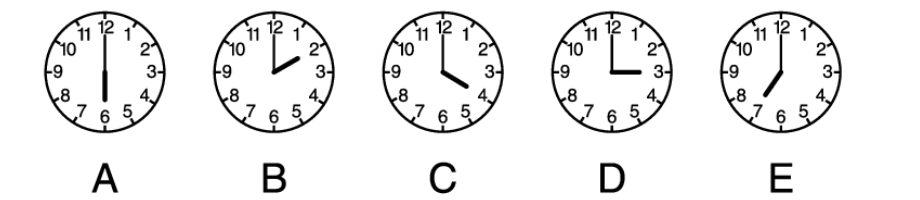
Five clocks are hanging on the wall. One clock is one hour ahead. Another one is one hour late and one is correct. Two clocks have stopped working. Which clock shows the correct time?
Show answer
Answer: D — D
Show hints
Hint 1 of 2
The fast, slow and correct clocks differ by exactly one hour from each other in a chain.
Still stuck? Show hint 2 →
Hint 2 of 2
Find three clocks whose times are consecutive hours; the middle one is correct.
Show solution
Approach: locate the +1, correct and -1 trio of consecutive-hour clocks
The accurate clock, the one an hour fast, and the one an hour slow show three times spaced one hour apart.
Only one set of three clock faces forms such a consecutive-hour chain.
The middle time of that chain is the correct clock, shown in D.
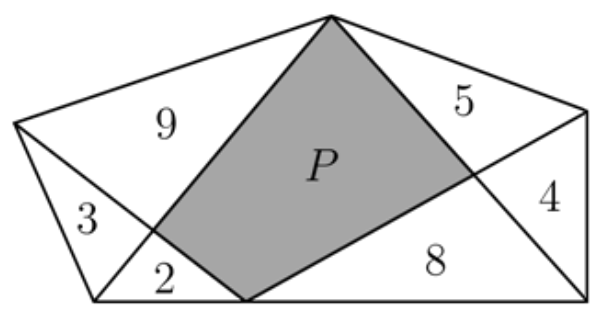
A pentagon is cut into smaller parts as shown in the diagram. The numbers in the triangles state the area of the according triangle. How big is the area P of the grey quadrilateral?
Show answer
Answer: C — 16
Show hints
Hint 1 of 2
Triangles that share the same height have areas in the ratio of their bases.
Still stuck? Show hint 2 →
Hint 2 of 2
Use those base ratios to chase the unknown areas around the figure until the grey piece is forced.
Show solution
Approach: propagate area ratios through shared-height triangles
The labelled triangle areas fix the ratios in which the diagonals cut each other, via equal-height comparisons.
Carrying those ratios through the figure determines every sub-area, and hence the grey quadrilateral.
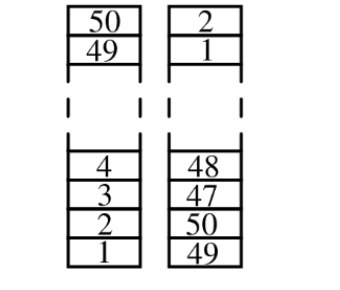
A tower is built from bricks labelled 1 to 50, from bottom to top. Bob builds a new tower: each time he takes the top two bricks off the old tower (keeping their order) and places them on top of the new tower (see picture). When he is finished, which two bricks lie directly on top of each other?
Show answer
Answer: E — 27 and 30
Show hints
Hint 1 of 2
Each move peels the top two bricks (keeping their order) and drops them on the new tower, so the new tower forms in pairs.
Still stuck? Show hint 2 →
Hint 2 of 2
Track the new stack pair by pair and look for which two of the listed bricks end up directly one above the other.
Show solution
Approach: simulate the pair-by-pair transfer onto the new tower
The old tower has 50 on top of 49 on top of 48 … down to 1; each move lifts the top two as a pair and stacks them on the new tower.
So the new tower is built bottom-up as 49,50, then 47,48, then 45,46, and so on, in steps of two.
Following this all the way down, the pair 30 then 27 lands one directly above the other in the finished new tower.
So the two bricks on top of each other are 27 and 30, answer E.
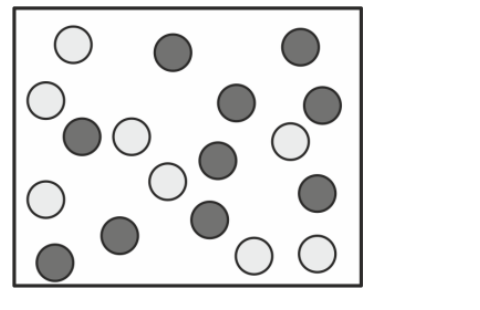
Adam has 9 marbles and Brenda also has 9 marbles. Together they have 8 white and 10 black marbles. Brenda has twice as many black marbles as white marbles. How many black marbles does Adam have?
Show answer
Answer: B — 4
Show hints
Hint 1 of 2
Brenda has 9 marbles, and her black pile is twice as big as her white pile.
Still stuck? Show hint 2 →
Hint 2 of 2
Once you know how many black marbles Brenda has, the rest of the 10 black ones must be Adam's.
Show solution
Approach: split Brenda's 9 into equal groups, then give the rest of the black marbles to Adam
Brenda's black pile is twice her white pile, so think of 1 white group and 2 matching black groups: that is 3 equal groups making 9, so each group is 3.
Brenda then has 3 white and 6 black marbles.
There are 10 black marbles altogether, so Adam has the leftover 10 − 6 = 4 black marbles.
The numbers from 1 to 9 should be distributed among the 9 squares in the diagram according to the following rules: there should be one number in each square, and the sum of three adjacent numbers is always a multiple of 3. The numbers 3 and 1 are already placed. How many ways are there to place the remaining numbers?
Show answer
Answer: E — 24
Show hints
Hint 1 of 2
Three numbers in a row summing to a multiple of 3 forces a repeating pattern of residues mod 3.
Still stuck? Show hint 2 →
Hint 2 of 2
Group the nine positions by position mod 3; each group must hold one residue class, and the fixed 3 and 1 pin down two of the groups.
Show solution
Approach: use residues mod 3 across the strip
Three adjacent numbers summing to a multiple of 3 forces position \(i\) and \(i+3\) to have the same residue mod 3, so the nine positions split into three groups of three by index mod 3.
The numbers 1–9 also split by residue into \(\{3,6,9\}\equiv0\), \(\{1,4,7\}\equiv1\), \(\{2,5,8\}\equiv2\); each position-group must get one whole residue-group.
The placed 3 (residue 0) and 1 (residue 1) pin which residue-group goes to their two position-groups, so the third assignment is forced too.
Now arrange within groups: the group with no fixed number can be ordered \(3!=6\) ways, and each of the two groups with a fixed number has its other two numbers free (\(2!=2\) ways each), giving \(6\cdot2\cdot2=\) 24 ways (choice E).
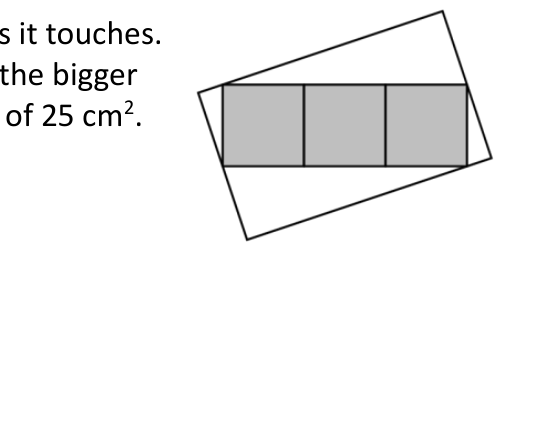
The diagram shows a grey rectangle that lies within a bigger rectangle, touching its sides. Two corner points of the grey rectangle are the midpoints of the shorter sides of the bigger rectangle. The grey rectangle is made up of three squares that each have an area of 25 cm². How big is the area of the bigger rectangle, in cm²?
Show answer
Answer: D — 150
Show hints
Hint 1 of 2
Each small square has area 25, so its side is 5 and the grey rectangle is 15 by 5, area 75.
Still stuck? Show hint 2 →
Hint 2 of 2
A rectangle whose two opposite corners are midpoints of the big rectangle's sides covers exactly half of it.
Show solution
Approach: grey is an inscribed rectangle covering half the big rectangle's area
Each square has side √25 = 5, so the grey rectangle is 15 by 5 with area 75 cm².
Two opposite grey corners are midpoints of the big rectangle's short sides, and the other two lie on its long sides.
Such an inscribed rectangle always encloses exactly half of the outer rectangle, so the big area is 2 × 75 = 150 cm².
The diagram shows a spiral of consecutive numbers starting with 1. In which order will the numbers 625, 626 and 627 appear in the spiral? (Choose the matching arrangement A–E shown below.)
Show answer
Answer: B
Show hints
Hint 1 of 3
Perfect squares sit at the corners of a square spiral, so note that \(625 = 25^2\).
Still stuck? Show hint 2 →
Hint 2 of 3
Decide which side of the spiral the run 625–627 lies on, and exactly where the spiral turns its next corner.
Still stuck? Show hint 3 →
Hint 3 of 3
Find whether 625 to 626 is a straight step and where the right-angle turn to 627 happens.
Show solution
Approach: use that 625 is a perfect square sitting just before a corner
Since \(625 = 25^2\), it lands on a straight arm of the spiral with a corner just ahead.
Following the winding, 625 and 626 line up along that arm (626 directly past 625), and the spiral then turns a right angle so 627 steps off perpendicular to the 625–626 segment.
That straight pair plus a perpendicular third number is exactly the arrangement in option B.
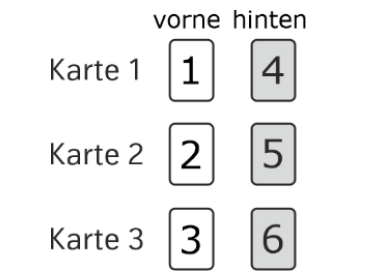
Martin has three cards, each labelled with a number on both sides (see picture: front and back). He places the three cards on the table without paying attention to which side is up, and adds the three numbers he can see. How many different sums can Martin get this way?
Show answer
Answer: E — A different amount.
Show hints
Hint 1 of 2
Each card shows one of its two numbers, so there are a few possible visible triples to add up.
Still stuck? Show hint 2 →
Hint 2 of 2
List every possible sum, then count how many different totals there really are and compare with the choices.
Show solution
Approach: list all visible triples and count the distinct sums
Each card shows either its front or back number: card 1 shows 1 or 4, card 2 shows 2 or 5, card 3 shows 3 or 6.
Notice each card's two numbers differ by 3, so the sum changes by 3 each time a card is flipped; the possible sums are 6, 9, 12 and 15.
That is 4 different sums.
Since 4 is not among the listed choices, the answer is E, a different amount.
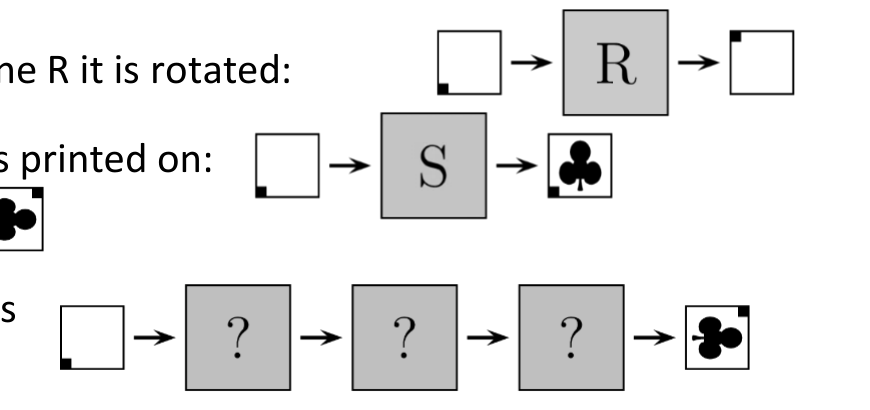
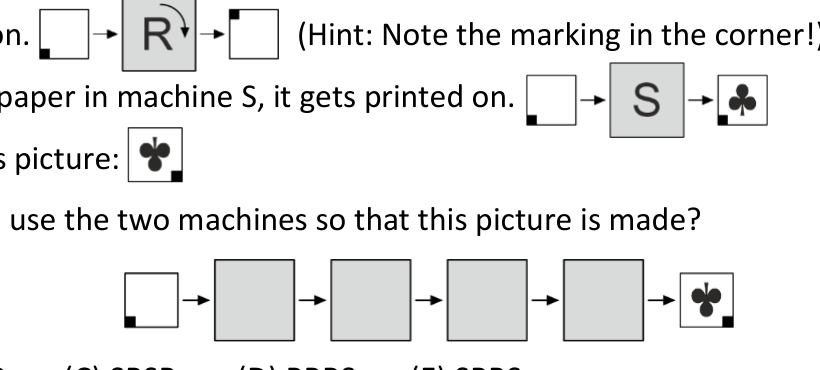
Else has two machines R and S. If she puts a square piece of paper into machine R it is rotated. If she puts the piece of paper into machine S a club symbol is printed on it. She wants to produce the picture shown. In which order does Else use the two machines so that she gets this picture?
Show answer
Answer: B — RSR
Show hints
Hint 1 of 2
Machine R rotates the square; machine S stamps the club symbol in a corner.
Still stuck? Show hint 2 →
Hint 2 of 2
Work backwards from the finished picture to decide the order of the three steps.
Show solution
Approach: track the corner mark through each machine to match the target
Machine S prints the club in a fixed corner and machine R rotates the square.
Following the corner mark through the three machines, the order that lands the club in the correct final corner is R, then S, then R.
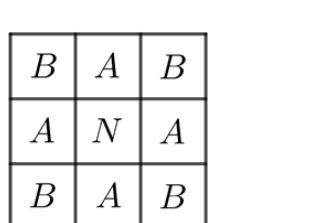
How many different ways are there to read the word BANANA in the following table if we can only cross to a field that shares an edge with the current field and we can use fields several times?
Show answer
Answer: E — 128
Show hints
Hint 1 of 2
Start on a corner B and spell B-A-N-A-N-A, stepping only to edge-adjacent cells (reuse allowed).
Still stuck? Show hint 2 →
Hint 2 of 2
Count routes by multiplying the choices at each letter; symmetry across the four corners helps.
Show solution
Approach: multiply the branching choices, letter by letter
A path spells B-A-N-A-N-A, moving each step to an edge-adjacent cell, and cells may be reused.
Start from a B and count how many neighbours carry the next needed letter at each move; the number of full paths is the product of those branch counts along the route.
Because the grid is symmetric, every starting B contributes the same number of paths, so multiply one B's count by the number of B's.
Carrying out this branch-multiplication over the whole grid totals 128 ways (choice E).
Counting & ProbabilityLogic & Word Problemscareful-countingcasework
Snow White organises a chess tournament for the seven dwarfs, lasting several days. Every dwarf has to play every other dwarf exactly once. On Monday Grumpy plays 1 game, Sneezy plays 2, Sleepy 3, Bashful 4, Happy 5 and Doc 6 games. How many games does Dopey, the 7th dwarf, play on Monday?
Show answer
Answer: C — 3
Show hints
Hint 1 of 3
Each dwarf can play at most the other six, and the given counts 1, 2, 3, 4, 5, 6 are all different.
Still stuck? Show hint 2 →
Hint 2 of 3
Start from the extremes: the one who played 6 games played everybody, while the one who played only 1 must have played that same dwarf.
Still stuck? Show hint 3 →
Hint 3 of 3
Keep pairing the highest remaining count with the lowest, peeling off the players whose schedule is now complete.
Show solution
Approach: pair the largest count with the smallest, working inward
Doc played 6 games, so he played everyone — including Grumpy, whose single game must therefore be against Doc only.
Happy played 5: everyone except Grumpy (Grumpy is already finished), so Happy played the other five, including Dopey; Sneezy's 2 games are then Doc and Happy.
Bashful played 4: he must be Doc, Happy, Sleepy and Dopey; Sleepy's 3 are Doc, Happy and Bashful.
So Dopey was played by Doc, Happy and Bashful only — that is 3 games, option C.
Anna has two machines R and S. Machine R rotates a square piece of paper 90° clockwise (watch the marking in the corner). Machine S prints a club onto the paper. Anna wants to produce the picture shown. In which order does she use the two machines?
Show answer
Answer: B — RSRR
Show hints
Hint 1 of 3
Machine R only spins the paper a quarter-turn, while machine S stamps the club at whatever angle the paper is in right now.
Still stuck? Show hint 2 →
Hint 2 of 3
Keep your eye on the little corner marking and follow where it travels after each R turn.
Still stuck? Show hint 3 →
Hint 3 of 3
Read the orders one letter at a time, checking that the club gets stamped at the right moment so it ends up tilted the way the target shows.
Show solution
Approach: track the corner mark and the club's orientation through the machines
Follow the position of the corner marking as R turns the square 90° clockwise each time and S prints the club at the current orientation.
The target shows both the corner mark and the club in particular positions, so the printing must happen at the right stage and the later turns must carry both into place.
Testing the orders, R then S then R then R lands the marking and the club exactly as the target requires.
A teacher wants to write the numbers from 1 to 7 into the circles, exactly one number in each circle. When he adds up the two numbers of circles that are next to each other, he gets the number written between those two circles. Which number does he write in the circle with the question mark?
Show answer
Answer: D — 4
Show hints
Hint 1 of 2
The number sitting between two circles is just those two circles added together.
Still stuck? Show hint 2 →
Hint 2 of 2
Start with a gap whose two circles you can guess, then fill the circles one at a time like a chain.
Show solution
Approach: treat each in-between number as the sum of its two circles and fill the chain step by step
Each number written between two circles is the sum of the two circles next to it, and the seven circles use 1 through 7 once each.
Begin at a gap where only one pair of circle numbers can add up to it, write those in, then move along filling each next circle so its new gap matches.
When the chain is complete, the circle with the question mark holds 4.
Starting with the four numbers 2, 0, 2, 3 the kangaroo-machine creates numbers according to the following rule: the next number is always the smallest non-negative integer that is different from the four directly previous numbers. Which number is in position 2023?
Show answer
Answer: C — 2
Show hints
Hint 1 of 2
Generate a few terms: the next number is the smallest non-negative integer not among the last four.
Still stuck? Show hint 2 →
Hint 2 of 2
After a short start the sequence becomes periodic — find the period and reduce 2023.
13 athletes took part in a three-part climbing competition. There are no draws in any part. The final rank of each athlete is determined by arranging the products of the ranks in each of the three parts: if an athlete for example comes 4th once, 3rd once and 6th once, he has \(4 \cdot 3 \cdot 6 = 72\) points. The higher the number of points, the worse the final rank. What is the worst possible final rank Hans can get to if he was 1st in two of the parts?
Show answer
Answer: B — 3.
Show hints
Hint 1 of 3
Hans being 1st in two parts makes his score just his rank \(r\) in the third part, so a large \(r\) gives others more room.
Still stuck? Show hint 2 →
Hint 2 of 3
Other athletes never get rank 1 in the two parts Hans won, so their two factors there are at least 2 each.
Still stuck? Show hint 3 →
Hint 3 of 3
Count how many athletes can be arranged to have a product strictly below Hans's score.
Show solution
Approach: let Hans take the worst third-part rank, then squeeze others below him
With two firsts Hans scores \(1 \cdot 1 \cdot r = r\); pick the largest helpful \(r = 10\) to leave room beneath him.
Every other athlete has factors \(\ge 2\) in the two parts Hans won, so the smallest products come from athletes using the ranks 2 and 3 there: e.g. \(2\cdot 2\cdot 2 = 8\) and \(3\cdot 3\cdot 1 = 9\), both below 10, while no third athlete can be pushed under 10.
So at most two athletes beat him, putting Hans at worst in final rank 3.
Monika wants to find a path through the maze from “Start” to “Ziel”. She may only move horizontally or vertically. She must enter every white circle exactly once and may not enter any black circle. In which direction must Monika move when she reaches the circle marked with x?
Show answer
Answer: A — ↓
Show hints
Hint 1 of 3
A circle in a corner or with black circles around it usually has only one open neighbour, so its move is forced.
Still stuck? Show hint 2 →
Hint 2 of 3
Start filling in those forced moves first, because each one locks in the next.
Still stuck? Show hint 3 →
Hint 3 of 3
By the time the forced path reaches x, only one direction keeps every remaining white circle reachable exactly once.
Show solution
Approach: use the must-visit-each-white-circle-once rule to force the path at x
Monika moves only horizontally and vertically, must enter every white circle exactly once, and cannot enter a black circle.
Near corners and beside black circles, several moves are forced because there is only one legal way through.
Tracing these forced moves up to the circle marked x leaves exactly one direction that still lets the path reach every remaining white circle: downward.
Maria colours exactly 5 cells of this grid in grey. Then she has her 5 friends guess which cells she has coloured in, and their answers are the five patterns A, B, C, D and E. Maria looks at the patterns and says: „One of you is right. The others have each guessed exactly four cells correctly.“ Which pattern did Maria paint? (Choose from pictures A–E.)
Show answer
Answer: E
Show hints
Hint 1 of 2
Each friend's guess is a set of 5 cells; one matches all 5, the others match exactly 4.
Still stuck? Show hint 2 →
Hint 2 of 2
Find the pattern that differs from each of the four near-miss guesses in just one cell.
Show solution
Approach: find the true pattern consistent with one exact and four near-misses
The correct answer shares all 5 cells with one guess and exactly 4 cells with each of the other four.
So Maria's pattern must overlap four of the diagrams in 4 cells and one in all 5.
A circle with midpoint \((75\,|\,30)\) and radius 10 is cut from a rectangle with vertices \((0\,|\,0)\), \((100\,|\,0)\), \((100\,|\,50)\) and \((0\,|\,50)\). What is the gradient of the straight line that goes through the point \((75\,|\,30)\) and divides the remaining part of the rectangle into two parts with equal area?
Show answer
Answer: A — \(\frac{1}{5}\)
Show hints
Hint 1 of 2
A line through the centre of a circle always halves that circle's area.
Still stuck? Show hint 2 →
Hint 2 of 2
So the line only needs to bisect the rectangle — which means passing through the rectangle's centre too.
Show solution
Approach: a center line bisects both shapes
Any line through the hole's centre (75,30) splits the circular hole into two equal halves.
To split the rest equally, the line must also bisect the rectangle, i.e. pass through its centre (50,25).
The line through (75,30) and (50,25) has slope (30−25)/(75−50) = 5/25 = 1/5.
An ant walks along the sides of an equilateral triangle (see diagram). Its speed is 5 cm/min along the first side, 15 cm/min along the second and 20 cm/min along the third. What is the average speed, in cm/min, at which the ant walks once around the whole triangle?
Show answer
Answer: C — 18019
Show hints
Hint 1 of 2
Average speed is total distance divided by total time, not the average of the three speeds.
Still stuck? Show hint 2 →
Hint 2 of 2
Let each side be length L; add the three times L/5, L/15, L/20 and divide 3L by that.
Show solution
Approach: average speed = total distance / total time
Let each side have length L; the times on the sides are L/5, L/15 and L/20.
Total time = L(1/5 + 1/15 + 1/20) = L(12+4+3)/60 = 19L/60.
A game marker in the shape of a regular tetrahedron has one marked face. That face is placed on the triangle marked START. The marker is then moved within the diagram always to the next adjacent triangle by rolling it around an edge. On which triangle is the marker when it is on the marked side again for the first time?
Show answer
Answer: E — E
Show hints
Hint 1 of 2
Roll the tetrahedron one edge at a time and track which face is touching the table.
Still stuck? Show hint 2 →
Hint 2 of 2
Follow the marked face until that same face lands face-down again, and read where the marker sits on the net.
Show solution
Approach: simulate the tetrahedron rolling across the net
Place the marked face on START and roll the marker from triangle to triangle over shared edges.
Tracking the orientation, the marked face first returns to the table after the marker has travelled around the net.
When Matilda’s smartphone is fully charged it has a battery life of 32 hours if she phones continuously, 20 hours if she surfs the internet continuously, and 80 hours if she does not use it at all. Matilda boards a train with a half-full battery. During her time on board she spends the same amount of time each on phoning, surfing the internet, and not using the phone at all. Just when she arrives at her destination the battery is empty. How many hours did the train ride take?
Show answer
Answer: D — 16
Show hints
Hint 1 of 2
Convert each usage into a fraction of the battery drained per hour.
Still stuck? Show hint 2 →
Hint 2 of 2
With equal time on each activity, set the total drain equal to half a battery.
Show solution
Approach: add the drain rates over equal time shares
Drain rates are 1/32, 1/20, 1/80 of the battery per hour.
Over a ride of length T with T/3 on each: (T/3)(1/32+1/20+1/80) = 1/2.
The bracket is 15/160 = 3/32, so (T/3)(3/32) = T/32 = 1/2.
Counting & ProbabilityLogic & Word Problemscareful-countingcasework
Elisabeth wants to write the numbers 1 to 9 in the fields of the diagram shown so that the product of the numbers in any two fields next to each other is no greater than 15. Two fields are called “next to each other” if they share a common edge. How many ways are there for Elisabeth to label the fields?
Show answer
Answer: C — 16
Show hints
Hint 1 of 2
The big numbers (7, 8, 9) are very restricted: their neighbours' products must stay ≤ 15.
Still stuck? Show hint 2 →
Hint 2 of 2
Place 9, 8, 7 first into spots with few neighbours or small neighbours, then count the freedom that remains.
Show solution
Approach: place the large numbers under the product constraint, then multiply free choices
For adjacent products ≤ 15, the largest numbers (9, 8, 7) can only sit next to very small numbers (mostly 1 and 2).
This pins those big numbers to specific low-degree fields and forces small neighbours around them.
Counting the independent choices that remain gives 16 labelings.
A part of a polynomial of degree five is illegible due to an ink stain (see diagram). It is known that all zeros of the polynomial are integers. What is the highest power of \(x - 1\) that divides this polynomial?
Show answer
Answer: D — \((x-1)^4\)
Show hints
Hint 1 of 2
Vieta's formulas link the visible coefficients to the sum and product of the roots.
Still stuck? Show hint 2 →
Hint 2 of 2
All roots are integers, the product is 7 and the sum is 11 — that pins them down.
Show solution
Approach: recover the integer roots with Vieta's formulas
For x5 − 11x4 + ... − 7, the integer roots have product 7 and sum 11.
The only integer multiset is 7, 1, 1, 1, 1 (product 7, sum 11).
So (x−1) appears four times, and the highest power dividing it is (x−1)4.
Seven pairwise different single-digit numbers are distributed among the circles shown so that the product of the three numbers that are connected by a straight line is the same in all three cases. Which number is written in the circle with the question mark?
Show answer
Answer: A — 2
Show hints
Hint 1 of 2
The centre number is in all three products, so the two outer numbers on each line have equal products.
Still stuck? Show hint 2 →
Hint 2 of 2
Find three disjoint pairs of distinct digits with the same product, and see which centre value makes it work.
Show solution
Approach: equal products force matching pairs
All seven digits must be different and non-zero (a zero would force every product to be 0).
Trying the common product 72 = 8·9·1 = 6·4·3, the two horizontal lines can use {8,9,1} and {6,4,3}.
The vertical line shares the two centres (9 and 4 in one valid layout), so its third number is 72 ÷ (9·4) = 2.
Checking all arrangements, the question-mark circle always holds 2.
Logic & Word ProblemsArithmetic & Operationswork-backwardsum-constraint
Several mice live in three houses. Last night every mouse left its house and moved directly to one of the other two houses. The diagram shows how many mice were in each house yesterday (“gestern”) and today (“heute”). How many mice used the path indicated by the arrow?
Show answer
Answer: B — 11
Show hints
Hint 1 of 2
Every mouse leaves its own house, so each house's outgoing mice split between the other two.
Still stuck? Show hint 2 →
Hint 2 of 2
Set up the flows between the three houses from yesterday's and today's counts; the arrow is one of those flows.
Show solution
Approach: balance the mouse flows between the three houses
Yesterday the houses held 8, 7, 5 and today they hold 6, 10, 4; every mouse moved to a different house.
Writing the six directed flows and using that each house empties out gives equations linking them.
The big square shown is split into four small squares. The circle touches the right side of the square in its midpoint. How big is the side length of the big square? (Hint: the diagram is not drawn to scale.)
Show answer
Answer: A — 18 cm
Show hints
Hint 1 of 3
Tangency at the midpoint of the right side puts the circle's centre on the horizontal midline, a radius in from that side.
Still stuck? Show hint 2 →
Hint 2 of 3
Read the 8 cm and 6 cm marks as the gaps from the square's edges to where the circle crosses the two midlines.
Still stuck? Show hint 3 →
Hint 3 of 3
Set side \(s\) and radius \(r\); the two marks give two equations to solve together.
Show solution
Approach: place coordinates and turn the two marks into equations in side and radius
Put the origin at the square's centre; tangency at the right side's midpoint puts the circle's centre at \((\tfrac{s}{2}-r,\,0)\) with radius \(r\).
The 8 cm mark is the stretch of the horizontal midline from the left edge to the circle, so \(s - 2r = 8\); the 6 cm mark is the drop on the vertical midline from the top edge to the circle, so \(\tfrac{s}{2} - \sqrt{r^2-(\tfrac{s}{2}-r)^2} = 6\).
Solving the pair gives \(r = 5\) and \(s = \mathbf{18}\) cm.
Consider the two touching semicircles with radius 1 and their diameters AB and CD respectively that are parallel to each other. The extensions of the two diameters are also tangents to the respective other semicircle (see diagram). How big is the square of the length AD?
Show answer
Answer: B — \(8 + 4\sqrt{3}\)
Show hints
Hint 1 of 2
Set coordinates: A and B on the lower line, C and D on the upper line, each diameter of length 2.
Still stuck? Show hint 2 →
Hint 2 of 2
Use that each diameter's extension is tangent to the other semicircle to fix the offset, then apply the distance formula for AD.
Show solution
Approach: coordinates and the tangency condition
Each line is tangent to the other semicircle, so the distance between the two parallel lines equals the radius: the vertical gap is 1.
The semicircles touch, so the distance between their centres is 1 + 1 = 2; with a vertical gap of 1, the horizontal offset of the centres is √(2² − 1²) = √3.
Put A = (−1, 0) and the far end D = (√3 + 1, 1); then AD² = (√3 + 2)² + 1² = 3 + 4√3 + 4 + 1.
Number TheoryArithmetic & Operationsdigit-sumcasework
Bart wrote the number 1015 as a sum of numbers that are made up of only the digit 7. In total he used the digit 7 ten times (see diagram). Now he wants to write the number 2023 as a sum of numbers made up of only the digit 7, using the digit 7 nineteen times in total. How many times does he have to use the number 77?
Show answer
Answer: E — 6
Show hints
Hint 1 of 2
Numbers made only of 7s are 7, 77, 777, ... each contributing several 7s to the digit-count.
Still stuck? Show hint 2 →
Hint 2 of 2
Match the value 2023 and the total of 19 sevens together; that pins how many 77s appear.
Show solution
Approach: balance the value 2023 and the count of 19 sevens
Let there be a parts equal to 7, b equal to 77 and c equal to 777 (777 × 3 > 2023, so no bigger parts).
Value: 7a + 77b + 777c = 2023, i.e. a + 11b + 111c = 289 (dividing by 7). Digit count: a + 2b + 3c = 19.
Subtracting gives 9b + 108c = 270, so b + 12c = 30; the only choice keeping a ≥ 0 is c = 2, b = 6 (then a = 1).
Check: 7 + 6×77 + 2×777 = 7 + 462 + 1554 = 2023, using 1 + 12 + 6 = 19 sevens. So 77 is used 6 times, option E.
A regular hexagon is split into four quadrilaterals and a smaller regular hexagon. The ratio area of the dark sectionsarea of the small hexagon = 43. How big is the ratio area of the small hexagonarea of the big hexagon?
Show answer
Answer: A — 311
Show hints
Hint 1 of 2
Call the small hexagon's area S; then the dark sections total (4/3)S.
Still stuck? Show hint 2 →
Hint 2 of 2
The big hexagon = small hexagon + four quadrilaterals; express the quadrilaterals using the dark/light split.
Show solution
Approach: write all areas in terms of the small hexagon's area
Let the small hexagon have area S. By symmetry the four quadrilaterals are equal; two of them are dark, two light.
Dark = 2 quadrilaterals = (4/3)S, so one quadrilateral = (2/3)S and all four total (8/3)S.
Big hexagon = small hexagon + four quadrilaterals = S + (8/3)S = (11/3)S.
The numbers from 1 to 11 are written in the empty hexagons. The sums of the three numbers in three hexagons with a common bold point are always equal. Three of the eleven numbers are already written in (see diagram). Which number is written in the hexagon with the question mark?
Show answer
Answer: E — 9
Show hints
Hint 1 of 2
Each bold point ties three hexagons to a common sum.
Still stuck? Show hint 2 →
Hint 2 of 2
Chain those equal-sum conditions across the honeycomb, using the three given numbers.
Show solution
Approach: propagate the equal-triple-sum conditions
Every bold point forces its three surrounding hexagons to share one common sum value.
Linking these conditions with the placed numbers 6, 4 and 11 and the requirement that 1–11 each appear once determines the value at the marked hexagon.
Several points are marked on a straight line. Renate marks another point between each pair of adjacent points. She repeats this process three more times. Now there are 225 points marked on this straight line. How many points were marked to start with?
Show answer
Answer: A — 15
Show hints
Hint 1 of 2
Adding a point between every adjacent pair turns n points into 2n−1.
Still stuck? Show hint 2 →
Hint 2 of 2
Apply that step four times and set the result to 225.
Logic & Word ProblemsArithmetic & Operationssum-constraintwork-backward
Jakob wrote six consecutive numbers on six little pieces of white paper, one number per piece. He stuck the six pieces on the front and back of three coins. Then he threw the coins three times. After the first throw the numbers 6, 7, 8 were on top (see diagram), which Jakob then coloured red. After the second throw the sum of the numbers on top was 23, and after the third throw the sum was 17. How big is the sum of the numbers on the three white pieces of paper?
Show answer
Answer: A — 18
Show hints
Hint 1 of 2
The six consecutive numbers are paired front/back on three coins, so the two faces of one coin are a fixed-difference pair.
Still stuck? Show hint 2 →
Hint 2 of 2
Use the three throw-sums (the first is 6+7+8) to deduce the hidden faces and then the unseen white totals.
Show solution
Approach: pair the faces by the coins and use the three sums
The first throw shows 6, 7, 8, so those three reds sum to 21; each later throw replaces some reds by their white partners, changing the sum by white − red on the flipped coins.
From 21 the sums become 23 (a change of +2) and 17 (a change of −4); the total change if all three were flipped is (white total) − 21.
The six numbers are consecutive and include 6, 7, 8; the only set making the throws consistent is 4,5,6,7,8,9, so the whites are 4, 5, 9.
Two identical cylindrical glasses contain the same amount of water. The left glass is upright, while the right one rests against the other one at a slant. The water level in both glasses is at the same height. The water level in the leaning glass touches its bottom in exactly one point (see diagram). The bases of both glasses have an area of \(3\pi\) cm². How much water is in each glass?
Show answer
Answer: A — \(9\pi\) cm³
Show hints
Hint 1 of 2
The leaning glass holds a wedge of water whose surface passes through the single bottom contact point.
Still stuck? Show hint 2 →
Hint 2 of 2
Compare that wedge to the upright cylinder of the same equal water height.
Show solution
Approach: equate the wedge volume to the upright cylinder volume
The base area is 3π, so the radius squared is 3. The water heights are equal in both glasses.
The wedge in the tilted glass, with its surface through the lone bottom point, has the same volume as a cylinder of that height on the 3π base.
The diagram shows the map of a big park. The park is split into several sections and the number in each section states its perimeter in km. How big is the perimeter of the entire park in km?
Show answer
Answer: C — 26
Show hints
Hint 1 of 2
The sum of all the section perimeters counts every internal wall twice and the outer boundary once.
Still stuck? Show hint 2 →
Hint 2 of 2
Outer perimeter = (sum of all section perimeters) − 2×(total internal wall length).
Show solution
Approach: the shared interior walls get counted twice
Add up the perimeter labels of all the sections.
In that total, every wall on the park's outer edge is counted once, but every wall shared between two sections is counted twice (once by each section).
So the park's true perimeter equals the sum of all section perimeters minus twice the total length of the interior dividing walls.
Carrying out that subtraction with the figure's lengths leaves 26 km (choice C).
A rugby team scored 24, 17 and 25 points in their 7th, 8th and 9th game of the previous season. The average number of points per game was higher after 9 games than after their first 6 games. Their average after 10 games was more than 22 points. What is the minimum number of points they could have scored in their 10th game?
Show answer
Answer: C — 24
Show hints
Hint 1 of 2
Turn each 'average' statement into a statement about total points using the number of games.
Still stuck? Show hint 2 →
Hint 2 of 2
Combine the inequality after 9 games with the 'more than 22 after 10 games' condition to bound the 10th score from below.
Show solution
Approach: convert averages to total-point inequalities and minimise
Let the first-6-game total be T; games 7–9 add 24+17+25 = 66, so the 9-game total is T + 66.
'Higher average after 9 than after 6' gives \(\frac{T+66}{9} > \frac{T}{6}\); clearing denominators, \(6(T+66) > 9T\), so \(396 > 3T\) and \(T < 132\).
'More than 22 after 10 games' gives \(T + 66 + g > 220\), so \(g > 154 - T\); to make the 10th score \(g\) as small as possible, take \(T\) as large as allowed, \(T = 131\).
Then \(g > 154 - 131 = 23\), so the smallest whole-number score is 24, option C.
The product of six consecutive numbers is a 12-digit number of the form abb cdd cdd abb, where the digits a, b, c and d are also consecutive numbers in any order. What is the value of the digit d?
Show answer
Answer: C — 3
Show hints
Hint 1 of 2
The product of six consecutive numbers is a 12-digit number, which narrows the starting value a lot.
Still stuck? Show hint 2 →
Hint 2 of 2
Search near that range and match the repeating abb cdd cdd abb digit pattern.
Show solution
Approach: bound the starting value, then match the digit pattern
A 12-digit product of six consecutive integers forces the run to start in the mid-70s.
Testing those, 74·75·76·77·78·79 = 200 133 133 200, of the form abb cdd cdd abb with a=2, b=0, c=1, d=3.