Problem 23 · 2022 Math Kangaroo
Stretch
Geometry & Measurement
proportionperimeter
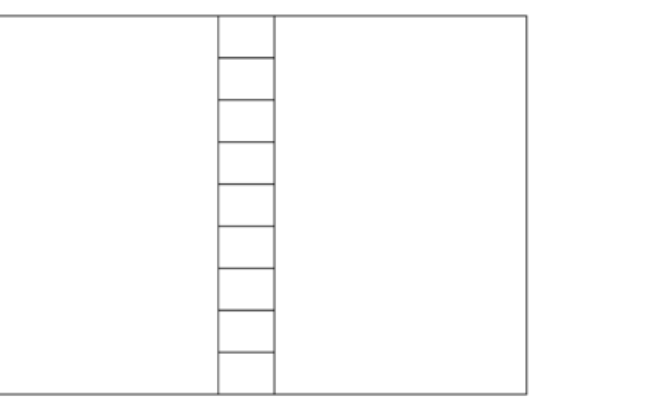
A rectangle is split into 11 smaller rectangles as shown. All 11 small rectangles are similar to the initial rectangle. The smallest rectangles are aligned like the original rectangle (see diagram). The lower sides of the smallest rectangles have length 1. How big is the perimeter of the big rectangle?
Show answer
Answer: D — 30
Show hints
Hint 1 of 2
All 11 pieces are similar to the whole, so their side ratio is the same as the big rectangle's.
Still stuck? Show hint 2 →
Hint 2 of 2
Use the smallest rectangles' base of 1 to pin down the common ratio, then the big dimensions.
Show solution
Approach: every piece keeps the same shape, so one similarity ratio chains all the sides together
- All 11 pieces (and the big rectangle) are the same shape, so they share one length-to-width ratio \(r\); call the smallest rectangle \(1\times r\) since its lower side is 1.
- Reading across the diagram, the next-size rectangles and then the big one are obtained by scaling by \(r\) each time, so widths run \(1, r, r^2,\dots\) and they must add up consistently along each side.
- Matching the rows and columns of the tiling forces \(r=\tfrac32\), giving big-rectangle sides \(9\) and \(6\).
- Perimeter \(=2(9+6)=\mathbf{30}\), choice D.
Mark:
· log in to save