Problem 29 · 2020 Math Kangaroo
Stretch
Number Theory
careful-counting
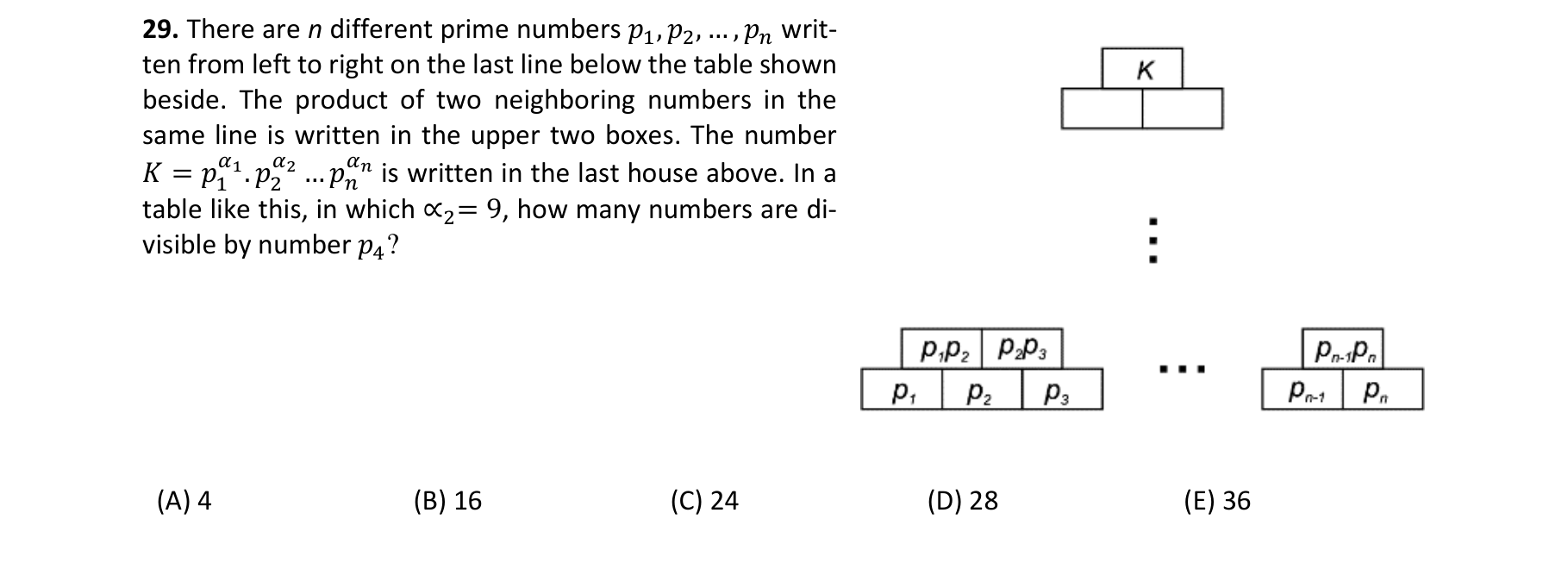
There are n different prime numbers \(p_1, p_2, \ldots, p_n\) written from left to right on the bottom row of the table shown. The product of two neighbouring numbers in a row is written in the box above them. The number \(K = p_1^{\alpha_1} \cdot p_2^{\alpha_2} \cdots p_n^{\alpha_n}\) is written in the single box at the top. In such a table, where \(\alpha_2 = 9\), how many of the numbers are divisible by \(p_4\)?
Show answer
Answer: D — 28
Show hints
Hint 1 of 2
The exponent of each prime at the top follows Pascal's triangle; the second exponent being 9 fixes how many primes there are.
Still stuck? Show hint 2 →
Hint 2 of 2
A cell is divisible by the fourth prime exactly when its block of bottom primes includes position 4.
Show solution
Approach: Pascal's triangle for n, then count blocks containing position 4
- The exponent of the second prime at the apex is C(n−1, 1) = n−1 = 9, so there are n = 10 primes.
- Each cell is the product of a contiguous block of bottom primes, and it is divisible by the fourth prime iff its block contains position 4.
- The number of such blocks is 4·(10−4+1) = 28.
Mark:
· log in to save