Problem 27 · 2019 Math Kangaroo
Stretch
Geometry & Measurement
pythagorean-triplearea-decomposition
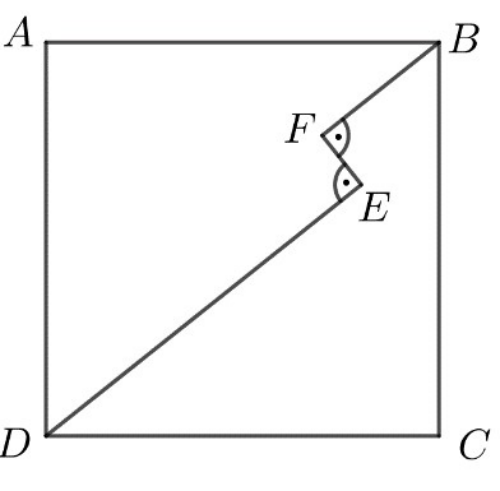
A path \(DEFB\) with \(DE \perp EF\) and \(EF \perp FB\) lies inside the square \(ABCD\), as shown. We know that \(DE = 5\), \(EF = 1\) and \(FB = 2\). What is the side length of the square?
Show answer
Answer: E — another value
Show hints
Hint 1 of 2
Since \(DE \perp EF\) and \(EF \perp FB\), the legs \(DE\) and \(FB\) are parallel; put \(D\) and \(B\) at opposite corners and use coordinates.
Still stuck? Show hint 2 →
Hint 2 of 2
Add the path vectors \(D\to E\to F\to B\) and force the result to land on the opposite corner \((s,s)\).
Show solution
Approach: add the path vectors and land on the opposite corner
- Put \(D = (0,0)\) and \(B = (s,s)\). Let \(DE\) point along \((\cos\theta, \sin\theta)\); then \(EF\) along \((-\sin\theta, \cos\theta)\) and \(FB\) along \((\cos\theta, \sin\theta)\) again.
- Adding: \(B = (5+2)(\cos\theta, \sin\theta) + 1\cdot(-\sin\theta, \cos\theta) = (7\cos\theta - \sin\theta,\ 7\sin\theta + \cos\theta)\).
- Both coordinates equal \(s\), so \(7\cos\theta - \sin\theta = 7\sin\theta + \cos\theta\), giving \(\tan\theta = \tfrac{3}{4}\), hence \(\cos\theta = \tfrac{4}{5}\), \(\sin\theta = \tfrac{3}{5}\).
- Then \(s = 7\cdot\tfrac{4}{5} - \tfrac{3}{5} = 5\), which is none of options A–D, so the answer is (E) another value.
Mark:
· log in to save