Problem 21 · 2018 Math Kangaroo
Stretch
Algebra & Patterns
sum-constraintcasework
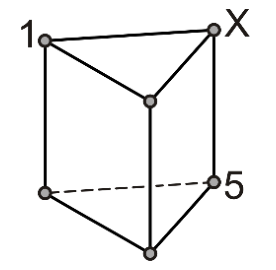
The faces of the prism shown are made up of two triangles and three squares. The six vertices are labelled using the numbers 1 to 6. The sum of the four numbers around each square is always the same. The numbers 1 and 5 are given in the diagram. Which number is written at vertex X?
Show answer
Answer: A — 2
Show hints
Hint 1 of 3
Add up all six labels, and use that each vertex sits on exactly two of the three square faces.
Still stuck? Show hint 2 →
Hint 2 of 3
That forces each pair of vertices joined by a vertical edge to add to the same total.
Still stuck? Show hint 3 →
Hint 3 of 3
Find that common edge-sum, then look at the edge through vertex 5.
Show solution
Approach: double counting forces each vertical edge of the prism to have the same vertex-sum
- The labels 1–6 total 21. Each vertex lies on exactly two of the three square faces, so the three equal square sums total 2·21 = 42, giving each square sum 14.
- Each square face is built from two vertical edges, and comparing the three faces shows the two endpoints of every vertical edge must add to the same value; with total 21 over three edges that value is 21/3 = 7.
- So the vertical edges pair the numbers as (1,6), (2,5), (3,4); in the picture X sits directly above 5 on one vertical edge, so X + 5 = 7.
- Hence X = 2, answer (A).
Mark:
· log in to save