Problem 21 · 2014 Math Kangaroo
Stretch
Logic & Word Problems
caseworksum-constraint
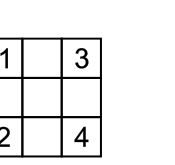
Andy fills a \(3\times 3\) table with the digits 1 to 9 so that each cell contains exactly one digit. He has already placed the digits 1, 2, 3 and 4 as shown in the diagram. Two numbers are ‘neighbouring’ when the cells they are in share one side. After finishing the table he noticed that the sum of the numbers neighbouring 9 equals 15. What is the sum of the numbers neighbouring 8?
Show answer
Answer: E — 27
Show hints
Hint 1 of 2
The corners already hold 1, 2, 3, 4, so 5, 6, 7, 8, 9 fill the four edge cells and the centre.
Still stuck? Show hint 2 →
Hint 2 of 2
An edge cell touches its two corner digits plus the centre, so test where 9 can sit to make its neighbours add to 15.
Show solution
Approach: place 9 from its neighbour-sum, then total the neighbours of 8
- The corners are 1, 3 (top) and 2, 4 (bottom); 5–9 fill the four edge cells and the centre.
- An edge cell's neighbours are its two adjacent corners plus the centre. For the neighbours of 9 to total 15, the only fit is 9 on the right edge (3 + 4 + centre = 15), forcing the centre to be 8.
- The neighbours of the centre 8 are all four edge cells, which hold 9 and the three remaining digits 5, 6, 7.
- Their sum is 9 + 5 + 6 + 7 = 27.
Mark:
· log in to save