About this topic
Close your eyes. Can you picture your own bedroom? The bed, the window, the door?
That little movie in your head is your superpower for these puzzles.
Some puzzles give you a picture and ask you to change it in your mind. Fold a flat shape into a box. Peek at a block tower from the top. Flip a picture like a mirror. Trace a path with your finger.
You can do all of this. The one big secret: go slow, and watch one little piece at a time.
Fold the flat shape into a box
Take a paper box and snip the edges so it falls open flat. What do you get? Six squares, all stuck together!
That flat shape is called a net. Fold it back up and each square swings into one side of the box.
Now here is the pattern to notice. Look at a straight strip of three squares in a row. When you fold them, they wrap around the box like a belt.
The two ends of the belt meet on opposite sides. So in a strip of three, the two end squares end up across from each other — with one square sitting between them.
THE MOVE: find the straight strip of three squares. The two ends of that strip are opposite faces. Two squares with one square between them sit across from each other on the box.
Six squares is not always enough! Some shapes made of 6 squares still will not fold into a box. So fold them in your head to be sure — do not trust the count alone.
Julia folds the paper net pictured on the right into a cube. Which number is on the face that is opposite to the face with the number 3?
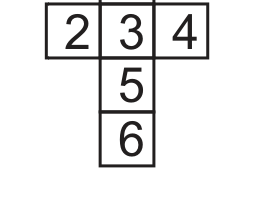
Julia's net folds into a cube. We want the number that lands across from the 3.
First, find the 3 in the picture. Now look for the straight strip of three squares it sits in: that strip holds 3, then 5, then 6 in a line.
Fold that strip into a belt. The 5 in the middle wraps around the box. The two ends, 3 and 6, meet on opposite sides.
So the face opposite the 3 is the 6. That is choice E.
First, find the 3 in the picture. Now look for the straight strip of three squares it sits in: that strip holds 3, then 5, then 6 in a line.
Fold that strip into a belt. The 5 in the middle wraps around the box. The two ends, 3 and 6, meet on opposite sides.
So the face opposite the 3 is the 6. That is choice E.
Opposite faces never touch. In the net, they are the two ends of a strip of three.
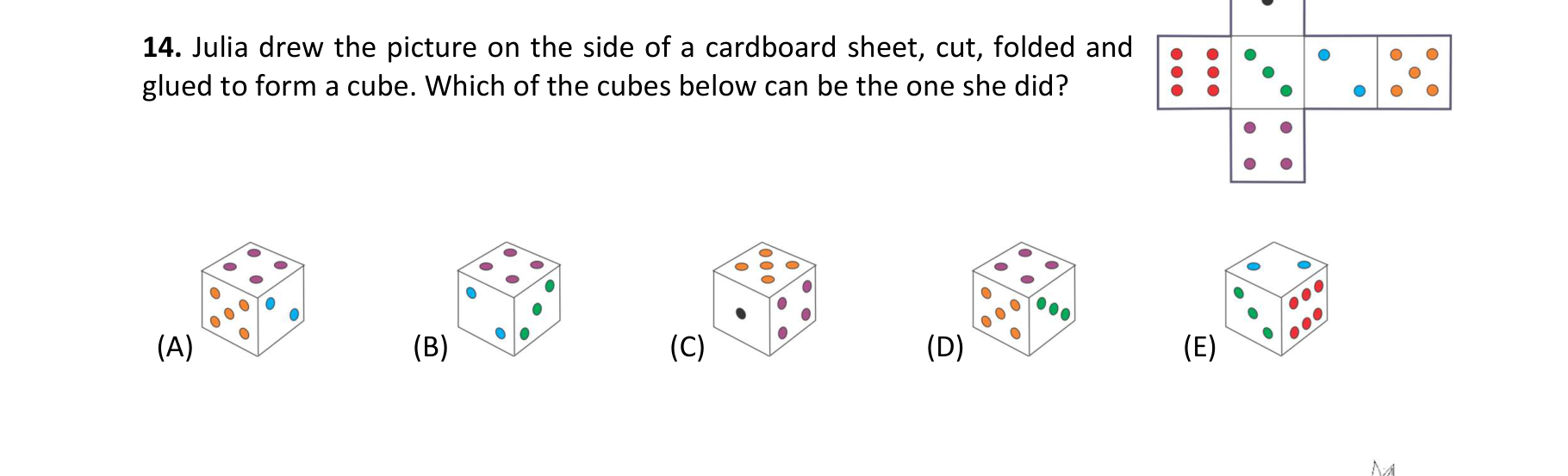
2020 · #14 (figure problem)
Show answer
Show hints
Still stuck? Show hint 2 →
Show solution
- Folding the cross-shaped net fixes which faces are opposite and which share a corner.
- Only die A shows three faces that can meet at one corner consistently with the net.
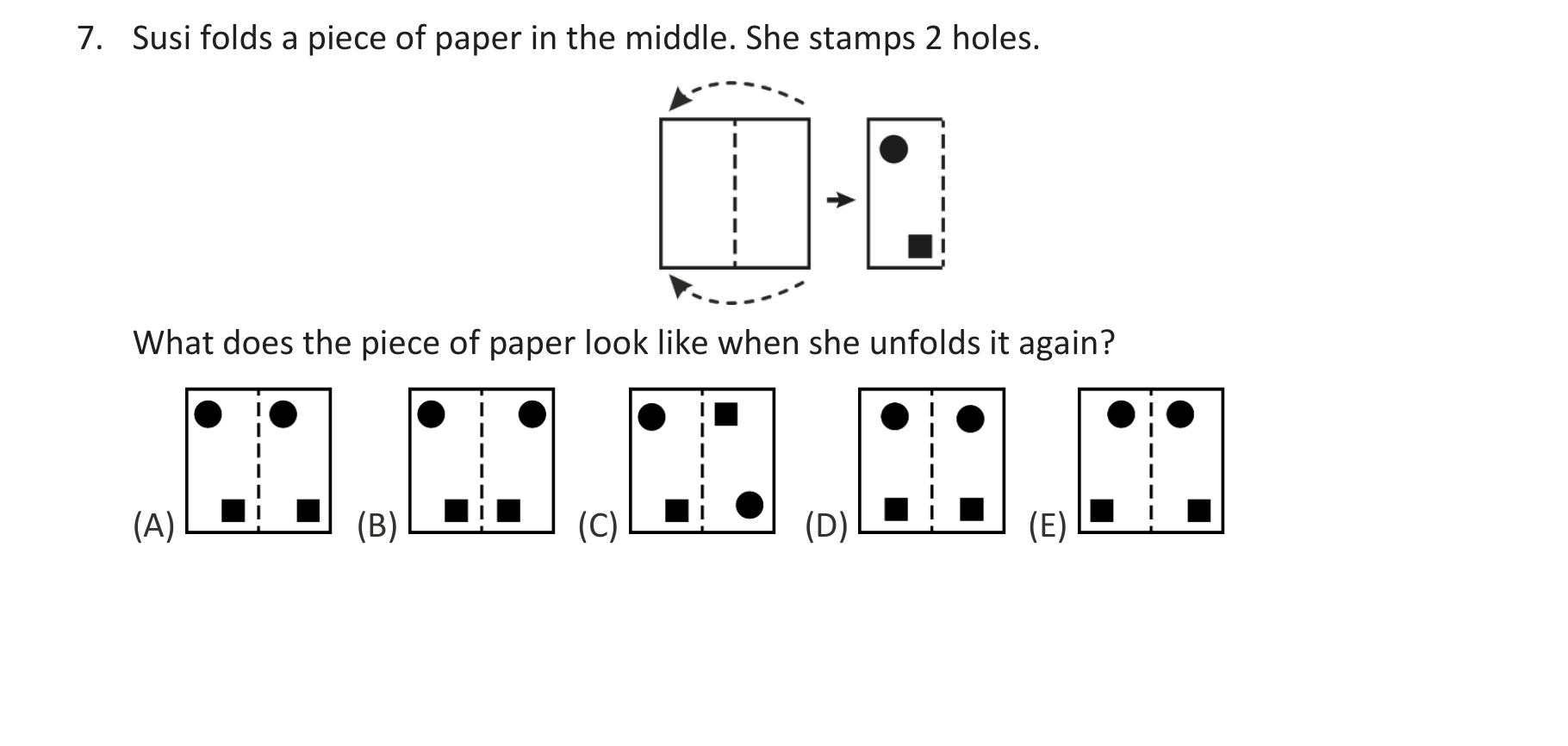
2023 · #7 Susi folds a piece of paper in the middle. She stamps 2 holes. What does the piece of paper look like when she unfolds it again?
Susi folds a piece of paper in the middle. She stamps 2 holes. What does the piece of paper look like when she unfolds it again?
Show answer
Show hints
Still stuck? Show hint 2 →
Still stuck? Show hint 3 →
Show solution
- Because the paper is folded, the punch cuts through both halves at once.
- So when Susi opens it, each of the 2 holes has a matching twin mirrored across the fold line.
- That gives 4 holes in mirror-image positions, which is the picture in option B.
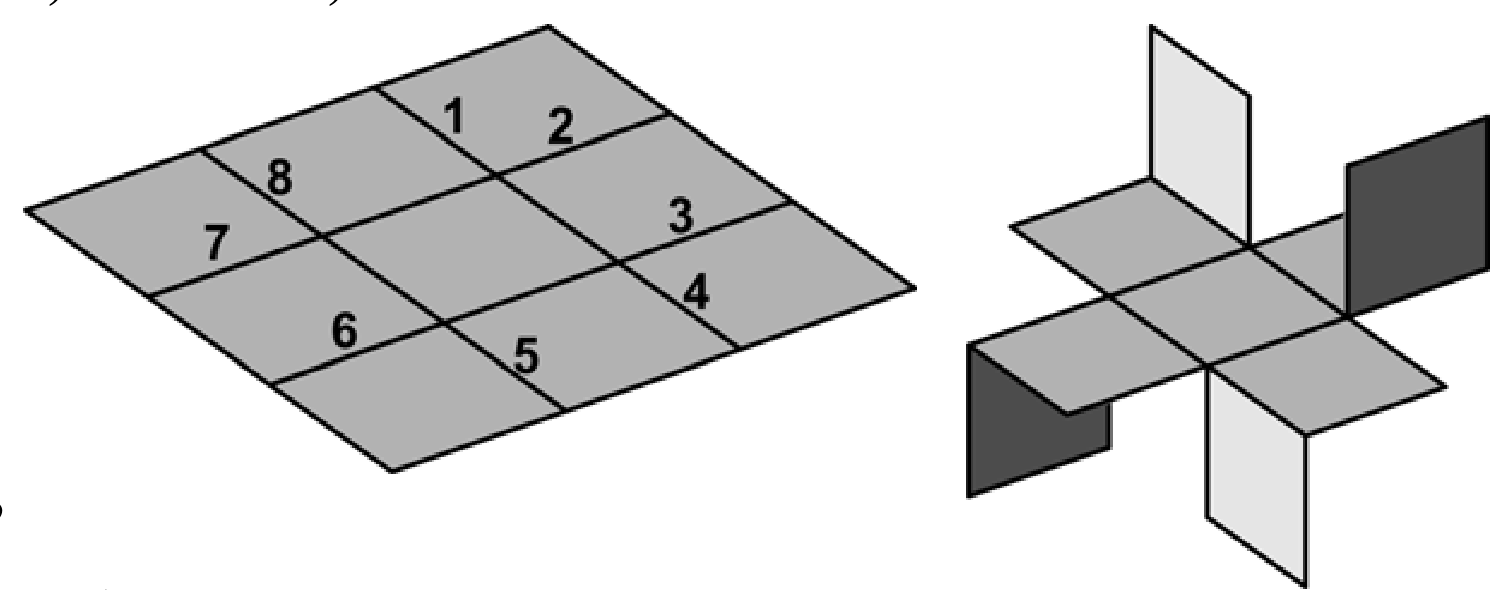
2010 · #22 Lines are drawn on a piece of paper and some of the lines are numbered. The paper is cut along some of these lines and then folded as...
Lines are drawn on a piece of paper and some of the lines are numbered. The paper is cut along some of these lines and then folded as shown in the picture. What is the total of the numbers on the lines that were cut?
Show answer
Show hints
Still stuck? Show hint 2 →
Show solution
- Match the folded result to the flat sheet to see which lines were creases and which were cut.
- Add the numbers on the lines that were cut.
- That total is 20.
Peek from the top
Imagine you are a tiny bird hovering right above a block tower, looking straight down.
From way up there, you cannot tell how tall the tower is! A tower 5 blocks high and a tower 1 block high look exactly the same: a single square.
See the pattern? Tall and short look the same from above. The height vanishes.
So the top view is really just the footprint — the floor spots that have a block on them. It is like the tower's shadow on the floor.
THE MOVE: from the top, count floor spots, not heights. A tall stack and a short stack both look like one square from above.
Do not count a stack more times because it is tall. Looking down, you cannot even see how tall it is — one stack is one square.
Theodor has built this tower out of discs. He looks at the tower from above. How many discs does he see?
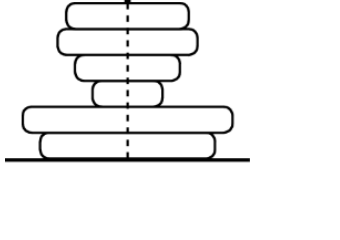
Theodor stacks round discs and looks down from above. We count how many discs he can see.
From straight up top, a disc shows only if its rim pokes out past the disc sitting on top of it. So hunt for the edges that stick out.
Start at the top and work down. The top disc shows. Below it, one wider disc has a rim peeking out. Below that, one more rim pokes out. That makes 3 rims you can see.
So Theodor sees 3 discs. That is choice C.
From straight up top, a disc shows only if its rim pokes out past the disc sitting on top of it. So hunt for the edges that stick out.
Start at the top and work down. The top disc shows. Below it, one wider disc has a rim peeking out. Below that, one more rim pokes out. That makes 3 rims you can see.
So Theodor sees 3 discs. That is choice C.
Top view = the shadow on the floor. Heights vanish; only the footprint stays.
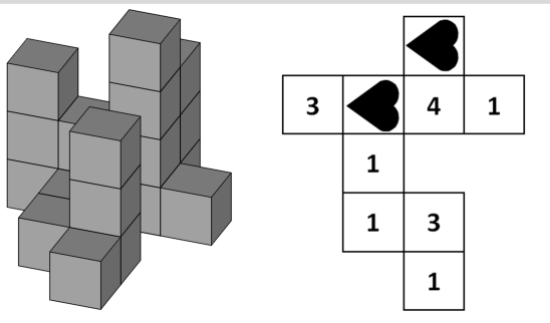
2017 · #17 Max builds this construction using some small equally big cubes. If he looks at his construction from above, the plan on the right tells...
Max builds this construction using some small equally big cubes. If he looks at his construction from above, the plan on the right tells the number of cubes in every tower. How big is the sum of the numbers covered by the two hearts?
Show answer
Show hints
Still stuck? Show hint 2 →
Show solution
- Each square of the plan shows how many cubes are stacked there.
- The two hearts cover two of these tower heights.
- Reading those two towers from the picture and adding gives the total.
- Their sum is 5.
2020 · #9 (figure problem)
Show answer
Show hints
Still stuck? Show hint 2 →
Show solution
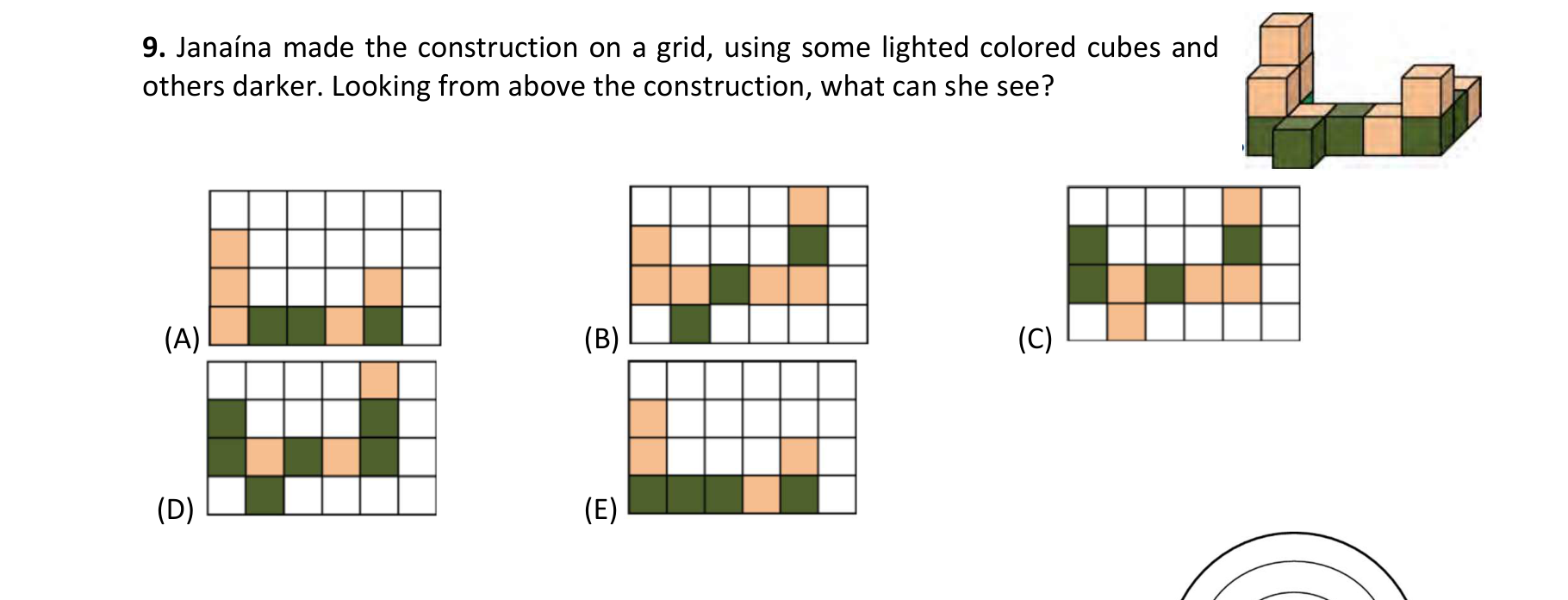
- From above you see one square per stack, colored by the top cube (light or dark).
- The footprint shape and the light/dark squares match option B.
Fold and peek-from-above check
One folding puzzle and one block tower. Go slow and watch one piece.
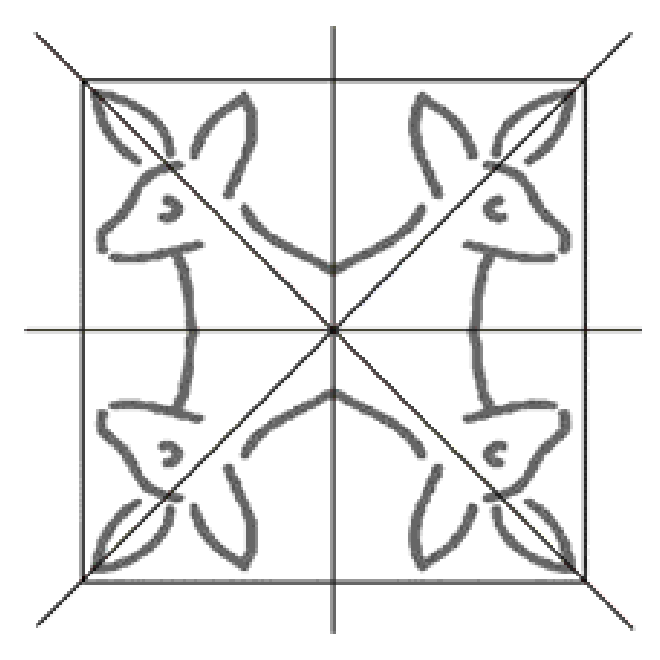
2010 · #10 Maria folds a square piece of paper so that the two kangaroos land exactly on top of each other. Along how many of the lines shown is...
Maria folds a square piece of paper so that the two kangaroos land exactly on top of each other. Along how many of the lines shown is this possible?
Show answer
Show hints
Still stuck? Show hint 2 →
Show solution
- A fold makes the kangaroos overlap exactly only along a line of symmetry.
- Test the drawn lines: only two of them reflect the figure onto itself.
- So the answer is 2 lines.
2018 · #5 Theodor has built this tower out of discs. He looks at the tower from above. How many discs does he see?
Theodor has built this tower out of discs. He looks at the tower from above. How many discs does he see?
Show answer
Show hints
Still stuck? Show hint 2 →
Still stuck? Show hint 3 →
Show solution
- Looking straight down, a disc is hidden if a wider disc sits on top of it.
- Starting from the top, you can see the top disc, plus each lower disc whose edge sticks out beyond everything above it.
- Exactly three rims poke out, so from above Theodor sees 3 discs.
Mirrors and flips
Hold your left hand up to a mirror. Look! The hand in the mirror looks like a right hand.
A mirror does one funny thing: it swaps left and right. That swap is called a flip.
Now how do you tell a flip from a plain turn? Watch one part — like which way a foot or a hook points.
If that part points the other way in the twin, it is a mirror flip. If it points the same way after you spin it, it was only turned.
THE MOVE: to spot a mirror, watch which way one part points. A mirror points it the other way. A plain turn keeps it the same.
A flip is not the same as a turn. Turning a shape keeps left on the left. A mirror swaps left and right. Do not call them the same thing.
How many of the hands in the picture show a right hand?
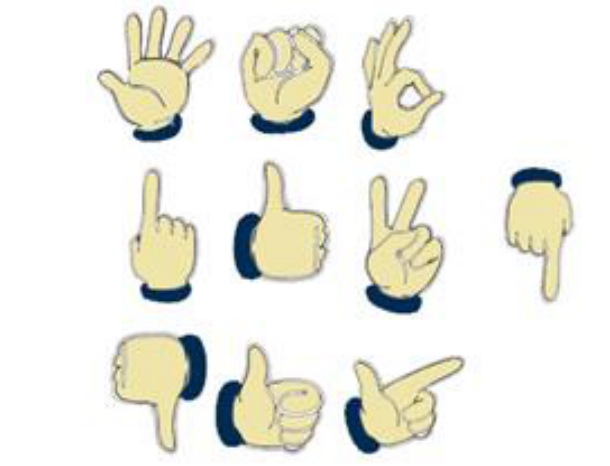
Some hands in the picture are right hands, some are left. We count the right hands.
Use your own right hand as a checker. Try to turn it so it looks the same as a hand in the picture. If you can match it with only turning, that one is a right hand.
If you would have to flip it like a mirror to match, then it is a left hand. Go around the picture and tally just the right ones.
You find 5 right hands. So the answer is 5, which is choice C.
Use your own right hand as a checker. Try to turn it so it looks the same as a hand in the picture. If you can match it with only turning, that one is a right hand.
If you would have to flip it like a mirror to match, then it is a left hand. Go around the picture and tally just the right ones.
You find 5 right hands. So the answer is 5, which is choice C.
Mirror = left and right trade places. Turn = nothing trades, the whole thing just spins.
2016 · #4 (figure problem)
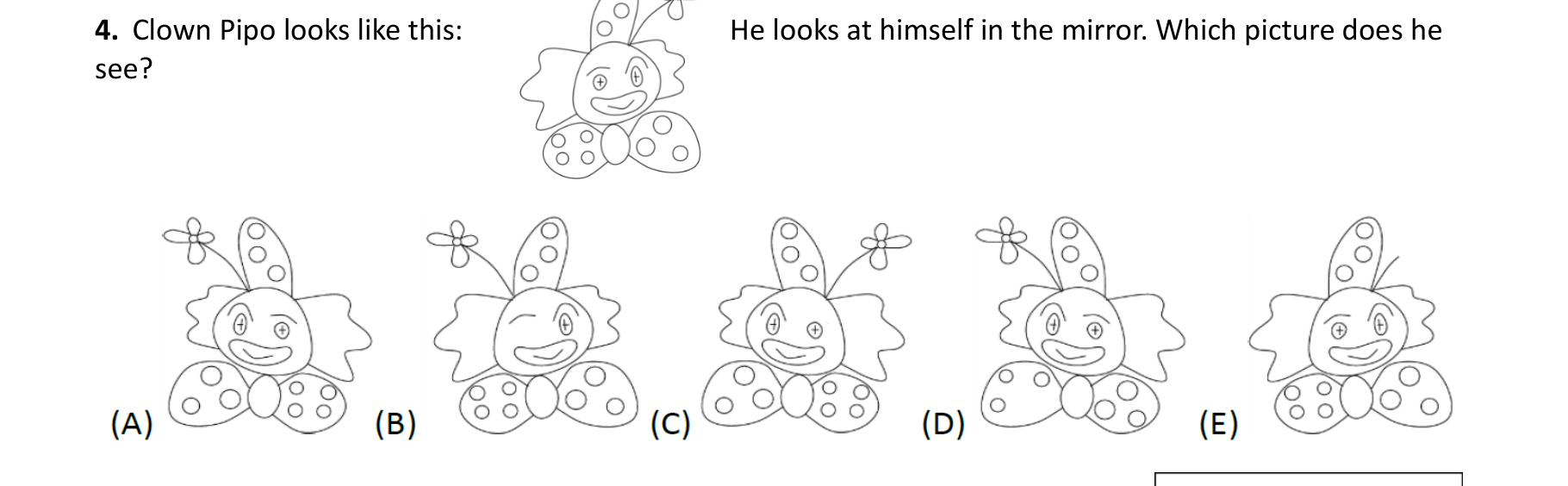
Show answer
Show hints
Still stuck? Show hint 2 →
Show solution
- In a mirror, everything on the clown's left moves to the right and vice versa.
- Up and down stay the same.
- The picture that is the exact left-right flip of the original is option A.
2023 · #6 Christoph folds a see-through piece of foil along the dashed line. What can he then see? (Choose from pictures A–E.)
Christoph folds a see-through piece of foil along the dashed line. What can he then see? (Choose from pictures A–E.)

Show answer
Show hints
Still stuck? Show hint 2 →
Show solution
- Folding the transparent foil mirrors the drawing over the dashed line.
- Each mark lands on its mirror image, turning the shapes into readable digits.
- The reflected result reads the pattern shown in option A.
Find the SAME shape (turning is allowed)
Here is a sticker shaped like an L. Spin it around on the table. Is it still the same sticker?
Yes! Turning a shape does not change what it is. It is the same shape facing a new way.
So when a puzzle asks which shapes are the same, do this: tilt your head, or turn the page in your mind, so the two shapes face the same way. Then check if they match.
But careful — a turn keeps it the same, a mirror flip makes a different shape. Turning is allowed; flipping is not.
THE MOVE: turn the page in your head until the two shapes face the same way, then compare. If they match after only turning, they are the same shape.
Same color and same size is not enough. A mirror flip can look almost right. The bumps must match after only turning — no flipping allowed.
For which houses were exactly the same building blocks used?
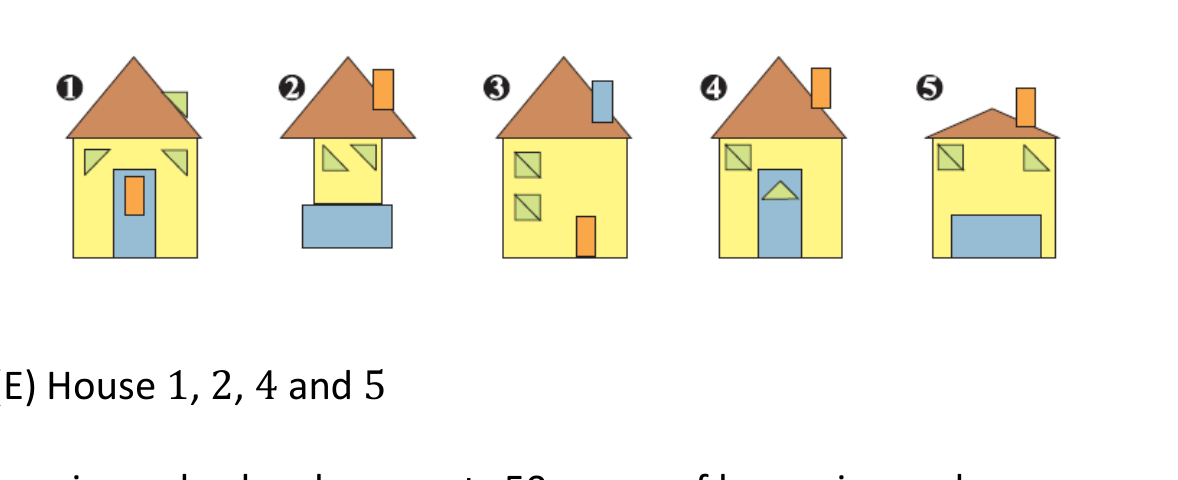
Some toy houses are built from the exact same set of blocks. We find which houses match.
Pick one house and make a little list of its blocks: the roof, the squares, the door. Now do the same for each other house.
Look for two houses with the very same list — same pieces, even if stacked a bit differently. House 1 and House 4 use the same blocks.
So the answer is House 1 and 4, which is choice A.
Pick one house and make a little list of its blocks: the roof, the squares, the door. Now do the same for each other house.
Look for two houses with the very same list — same pieces, even if stacked a bit differently. House 1 and House 4 use the same blocks.
So the answer is House 1 and 4, which is choice A.
Same after a turn = same shape. Same only after a flip = a different shape.
2017 · #4 The left picture is rotated, and the right picture shows the new position after the rotation. Which footprints are missing after the rotation?
The left picture is rotated, and the right picture shows the new position after the rotation. Which footprints are missing after the rotation?
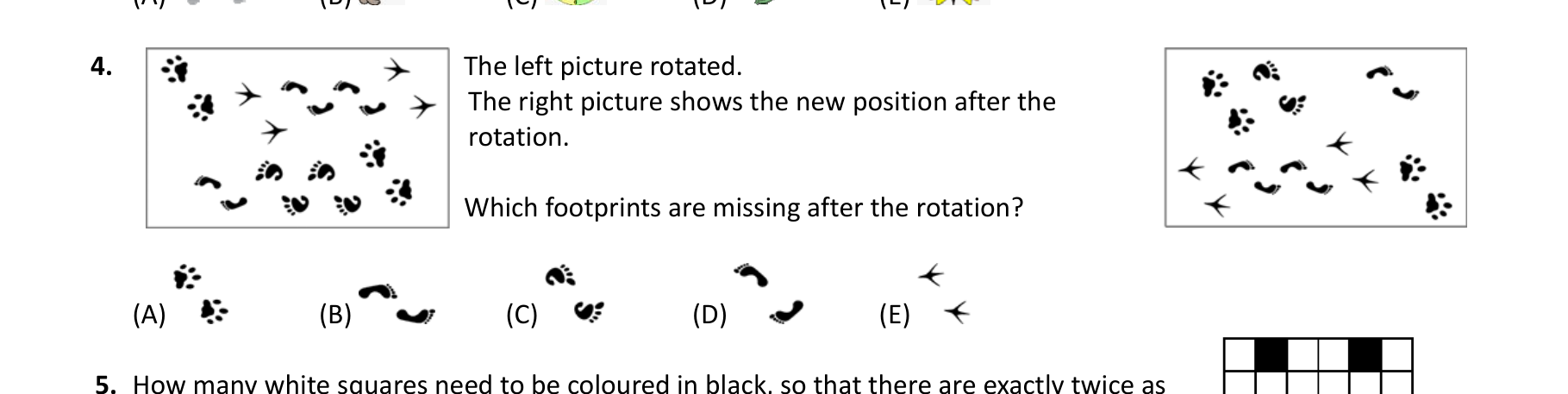
Show answer
Show hints
Still stuck? Show hint 2 →
Show solution
- Rotating does not change which footprints exist, only where they sit.
- Match each print in the right picture to one in the left.
- One footprint from the left has no partner in the right picture.
- That missing footprint is the one shown in C.
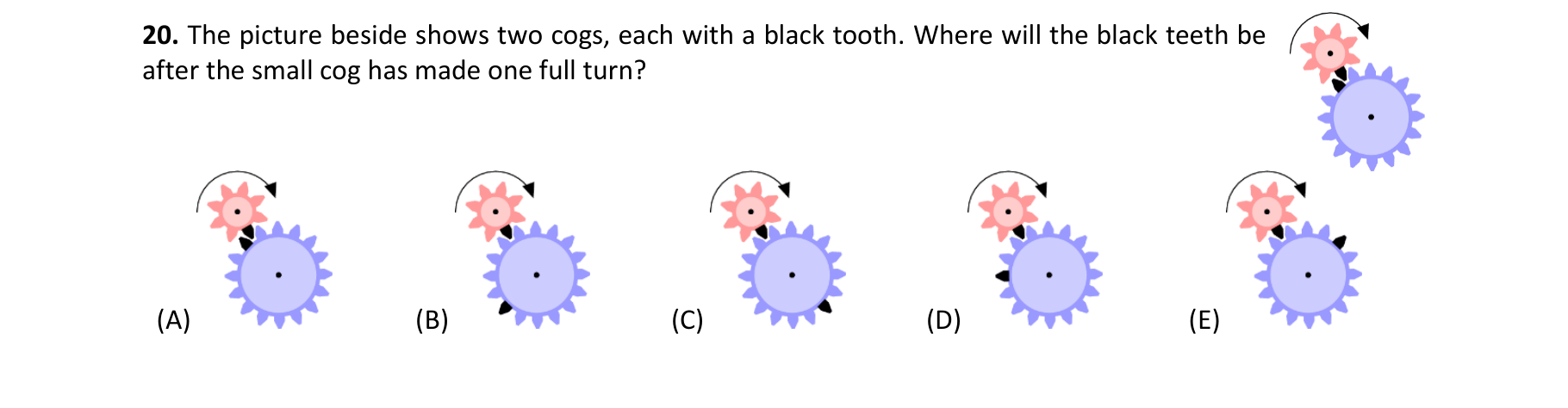
2021 · #20 The picture beside shows two cogs, each with a black tooth. Where will the black teeth be after the small cog has made one full turn?
The picture beside shows two cogs, each with a black tooth. Where will the black teeth be after the small cog has made one full turn?
Show answer
Show hints
Still stuck? Show hint 2 →
Still stuck? Show hint 3 →
Show solution
- One full turn of the small cog brings its black tooth back to its starting spot.
- The big cog is pushed the same number of teeth, but since it has more teeth it turns only part way.
- Putting both black teeth in their new spots matches option C.
Fit the pieces together
A jigsaw piece clicks in when its bumps fill the gap's dents, and its dents make room for the gap's bumps. Bump meets dent, dent meets bump.
When there is one extra piece, do not test every piece by guessing. Look at each gap and find the one piece that fills it. Fill all the gaps.
The piece that no gap needs is the leftover. That is your answer.
THE MOVE: match each gap to the piece that fills it. The piece nobody needs is the leftover.
Do not pick a piece just because it looks nice. Check that its bumps really meet the gap's dents. A near-fit is still a no-fit.
Lisa needs exactly 3 pieces to complete her jigsaw. Which of the 4 pieces is left over?
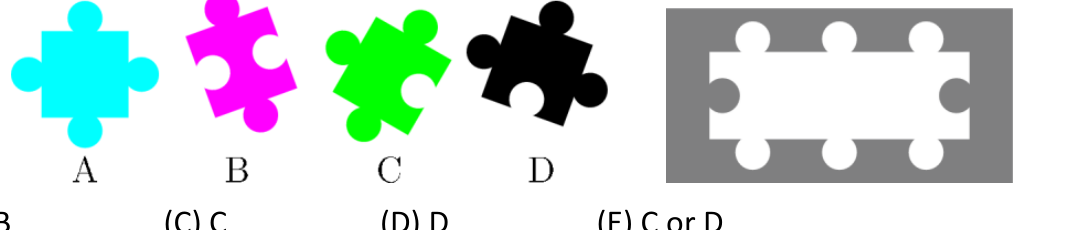
Lisa needs 3 pieces to finish her jigsaw, but the box has 4. We find the one left over.
Look at the empty frame and what shape each gap needs. Now match the pieces one by one. Three pieces have bumps and dents that fit a gap just right — they each find a home.
One piece has bumps poking out on every side, so it cannot slide into any gap. That is piece A.
So piece A is the leftover — choice A.
Look at the empty frame and what shape each gap needs. Now match the pieces one by one. Three pieces have bumps and dents that fit a gap just right — they each find a home.
One piece has bumps poking out on every side, so it cannot slide into any gap. That is piece A.
So piece A is the leftover — choice A.
Fill the gaps first. The piece with no gap to fill is your answer.
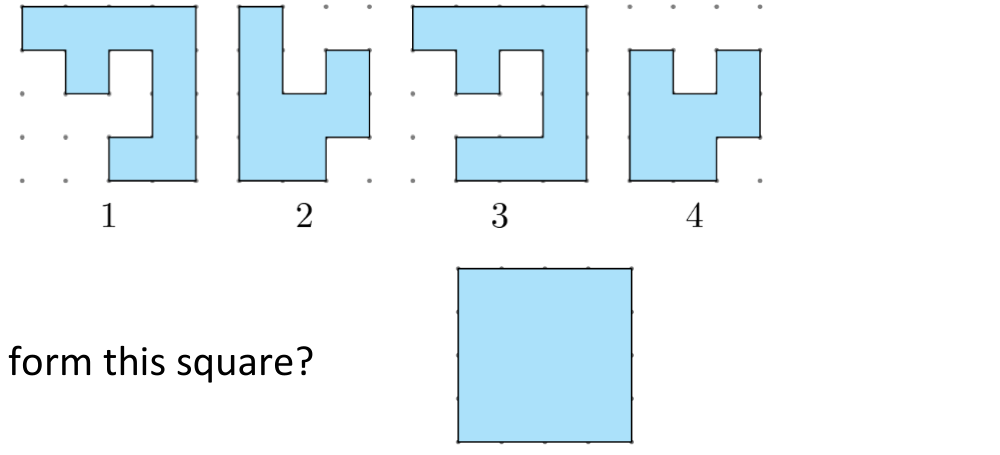
2023 · #4 Alice has the four jigsaw pieces 1, 2, 3 and 4 shown. Which two can she put together to form the square shown?
Alice has the four jigsaw pieces 1, 2, 3 and 4 shown. Which two can she put together to form the square shown?
Show answer
Show hints
Still stuck? Show hint 2 →
Show solution
- The target square must be filled by the two chosen pieces with no overlap and no gap.
- Pieces 1 and 4 have matching step-shaped edges that fit exactly together.
- Together they form the full square, so the answer is 1 and 4.
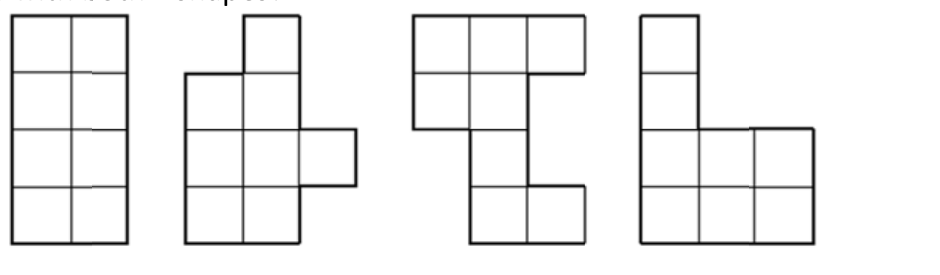
2012 · #9 Anna has made two L-shapes, each out of 4 squares (8 squares in all). How many of the following 4 shapes can she make using both L-shapes?
Anna has made two L-shapes, each out of 4 squares (8 squares in all). How many of the following 4 shapes can she make using both L-shapes?
Show answer
Show hints
Still stuck? Show hint 2 →
Show solution
- Each L-piece covers 4 squares, and every shape shown has 8 squares, so a fit is at least possible by area.
- Trying the two L-pieces (rotated or flipped) on each shape, every one of the four can be built.
- So Anna can make all of them.
- The answer is 4.
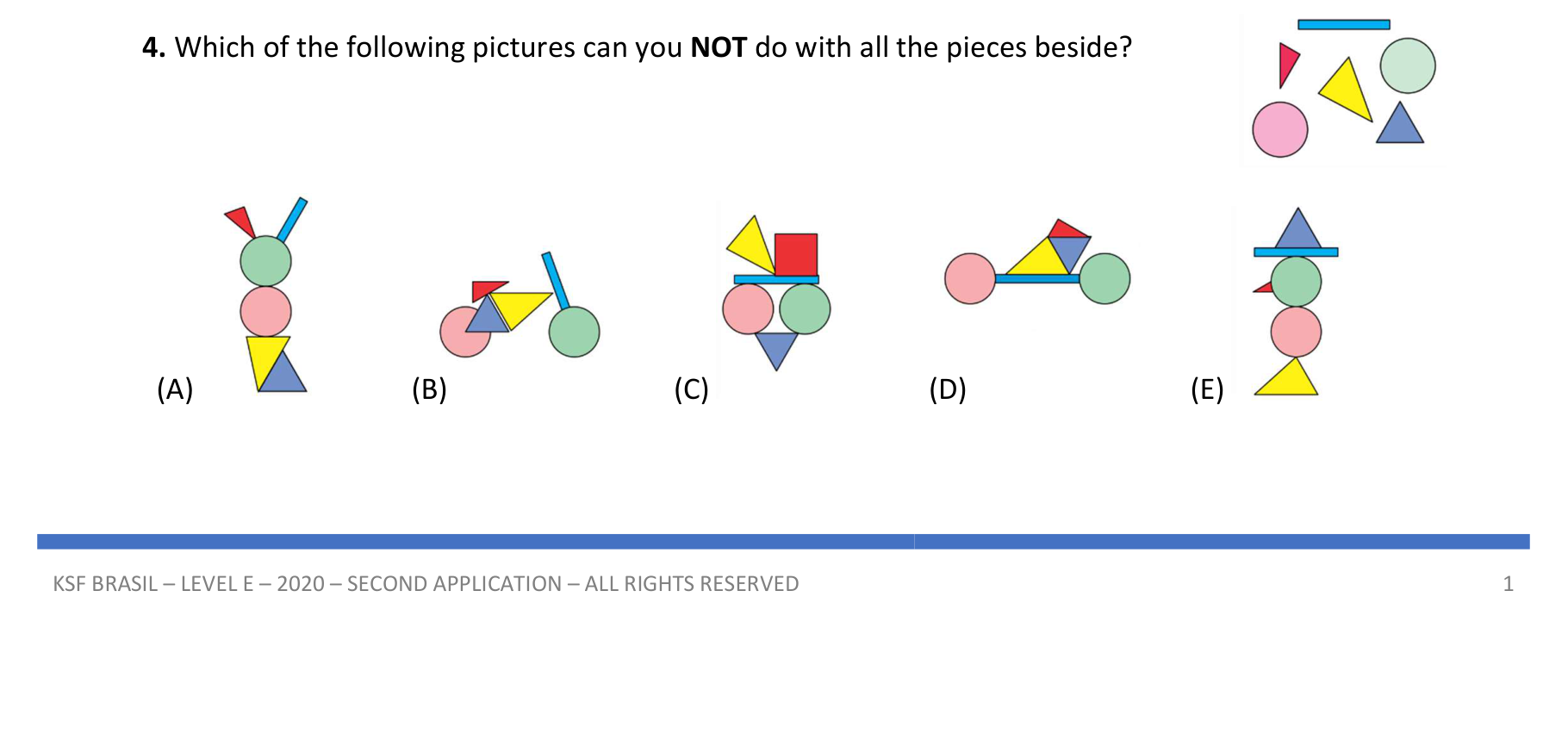
2020 · #4 (figure problem)
Show answer
Show hints
Still stuck? Show hint 2 →
Show solution
- Four of the pictures can be assembled using exactly the given pieces, each used once.
- Picture C cannot be made from that set of pieces, so it is the answer.
Flip, match, and fit check
A mirror puzzle, a same-shape puzzle, and a jigsaw piece. Watch the flip; match the gap.
2023 · #4 Alice has the four jigsaw pieces 1, 2, 3 and 4 shown. Which two can she put together to form the square shown?
Alice has the four jigsaw pieces 1, 2, 3 and 4 shown. Which two can she put together to form the square shown?
Show answer
Show hints
Still stuck? Show hint 2 →
Show solution
- The target square must be filled by the two chosen pieces with no overlap and no gap.
- Pieces 1 and 4 have matching step-shaped edges that fit exactly together.
- Together they form the full square, so the answer is 1 and 4.
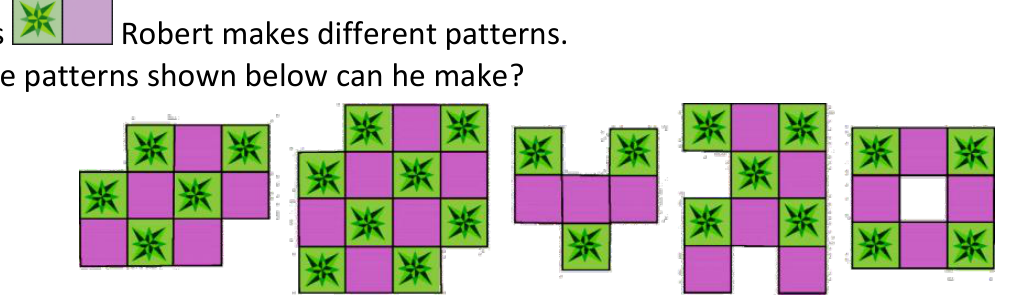
2018 · #8 Using the two tiles shown, Robert makes different patterns. How many of the patterns shown below can he make?
Using the two tiles shown, Robert makes different patterns. How many of the patterns shown below can he make?
Show answer
Show hints
Still stuck? Show hint 2 →
Show solution
- Take the two tile shapes and imagine laying copies of them (turned any way) onto each pattern.
- A pattern is buildable only if the tiles fill it exactly — no empty squares and no overlaps.
- Four of the five patterns can be made this way, so the answer is 4, choice D.
2016 · #4 (figure problem)
Show answer
Show hints
Still stuck? Show hint 2 →
Show solution
- In a mirror, everything on the clown's left moves to the right and vice versa.
- Up and down stay the same.
- The picture that is the exact left-right flip of the original is option A.
Count the blocks you cannot see
Here is a sneaky thing about a pile of blocks: some blocks hide behind and under the others. If you count only the ones you can see, you will count too few.
The safe way: count layer by layer. Do the bottom floor first. Then the next floor up. Add them together.
On each floor, count every spot, even the hidden ones at the back. Ask yourself: what is holding up the blocks I can see? Those hidden helpers count too.
THE MOVE: count one floor at a time, then add the floors. On each floor, count the hidden back blocks too.
The blocks at the back and underneath are easy to forget. They are not visible, but they are still there. Ask what is holding the visible blocks up.
Thomas has made a table out of small cubes. How many small cubes did he use?
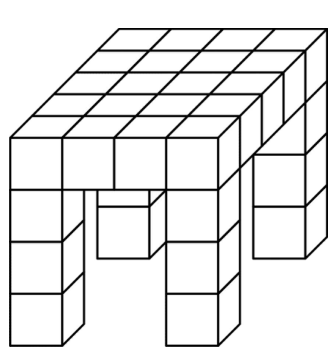
Thomas builds a little table out of small cubes. We count them all — including the hidden ones. (This is a tricky one, so go slow.)
Split the table into two easy parts: the flat top, and the four legs.
The top is a flat slab, 4 cubes long and 4 cubes wide. That is 4 × 4 = 16 cubes, counting the hidden ones at the back.
Now the legs. There are 4 legs, one in each corner, and each leg is a stack of 4 cubes. So 4 legs × 4 cubes = 16 cubes.
Add the parts: 16 in the top + 16 in the legs = 32 cubes. That is choice D.
Split the table into two easy parts: the flat top, and the four legs.
The top is a flat slab, 4 cubes long and 4 cubes wide. That is 4 × 4 = 16 cubes, counting the hidden ones at the back.
Now the legs. There are 4 legs, one in each corner, and each leg is a stack of 4 cubes. So 4 legs × 4 cubes = 16 cubes.
Add the parts: 16 in the top + 16 in the legs = 32 cubes. That is choice D.
Floors add up. Always include the blocks you cannot see — they are still holding the pile up.
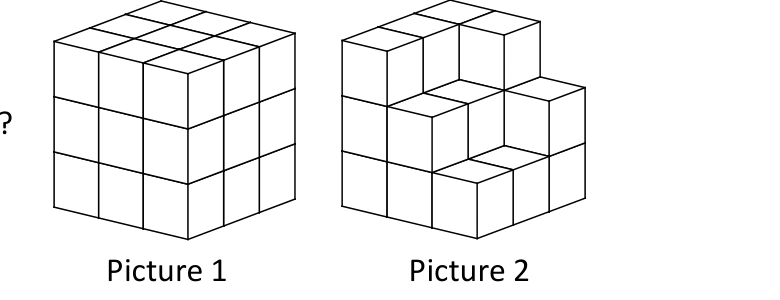
2013 · #7 Nathalie wanted to build a large cube out of lots of small cubes, just like in Picture 1. How many cubes are missing from Picture 2 that...
Nathalie wanted to build a large cube out of lots of small cubes, just like in Picture 1. How many cubes are missing from Picture 2 that would be needed to build the large cube?
Show answer
Show hints
Still stuck? Show hint 2 →
Still stuck? Show hint 3 →
Show solution
- A complete large cube is 3 × 3 × 3 = 27 small cubes.
- Counting the cubes in picture 2 layer by layer gives 20 cubes.
- So 27 − 20 = 7 cubes are missing.
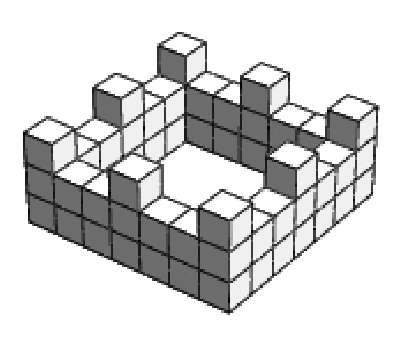
2011 · #22 The picture shows a fortress made from cubes. How many cubes were used to make it?
The picture shows a fortress made from cubes. How many cubes were used to make it?
Show answer
Show hints
Still stuck? Show hint 2 →
Show solution
- The base is a 5×5 ring of cubes plus its floor, and the wall rises with battlements on top.
- Adding the floor, the surrounding wall cubes and the raised corner/battlement cubes gives a total of 56 cubes.
Trace the path with your finger
Pretend your finger is a little bug. Put it on the START and let it walk along the line, never lifting up.
Watch what the bug bumps into, in order. First this, then that. Do not jump ahead and do not skip!
This trick works for mazes, roads, and lines too. In a maze, follow only the open gaps and never cross a wall.
On a grid: count right and down
Sometimes the path lives on a grid — a board of little squares. To go from a start spot to an end spot, count how many squares right and how many squares down.
From start to end here, you go 2 squares right and 2 squares down. Match those moves to the arrows. Count the squares; do not jump.
THE MOVE: put your finger on the start and walk the line slowly, naming each thing you meet. On a grid, count the right-moves and down-moves you need.
Do not lift your finger and guess where the line ends up. Lines love to curve back. Slide your finger the whole way, every wiggle.
Theresa moves a pencil along the line. She starts at the arrow shown. In which order will she go past the shapes?
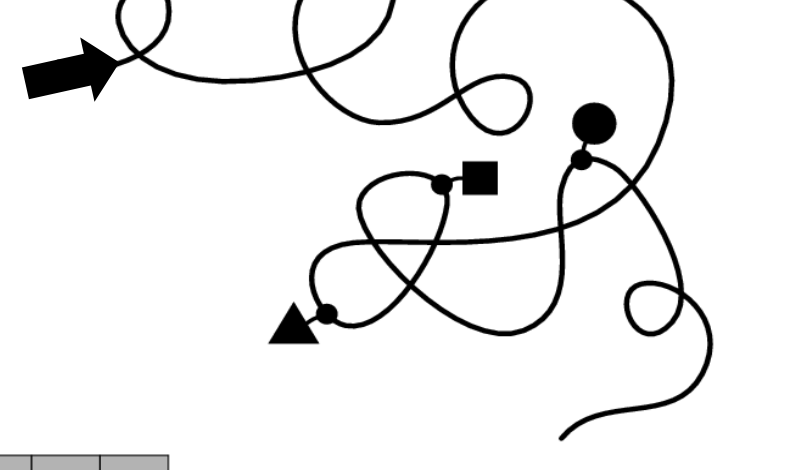
Theresa drags a pencil along a line from the arrow. We list the shapes in the order she passes them.
Put your finger on the arrow — that is where the trip starts. Now slide it along the line without lifting it.
The first shape the line runs into is the triangle. Keep going: next comes the square. Last is the circle.
So the order is triangle, square, circle — choice A.
Put your finger on the arrow — that is where the trip starts. Now slide it along the line without lifting it.
The first shape the line runs into is the triangle. Keep going: next comes the square. Last is the circle.
So the order is triangle, square, circle — choice A.
Slow finger, no lifting. Meet the shapes one at a time, in order.
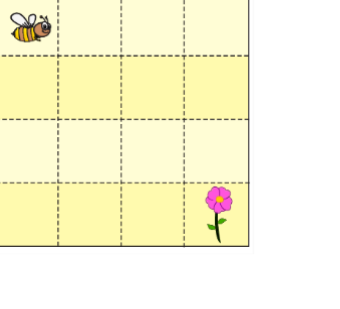
2022 · #1 The bee wants to get to the flower. Each arrow shows a move to one neighbouring square. Which path can the bee fly to reach the flower?
The bee wants to get to the flower. Each arrow shows a move to one neighbouring square. Which path can the bee fly to reach the flower?
Show answer
Show hints
Still stuck? Show hint 2 →
Show solution
- The bee must move several squares to the right and several squares down to reach the flower.
- Count the squares: the flower is the same number of steps right and down from the bee.
- Only one arrow sequence keeps the bee on the board and uses exactly those right and down moves.
- That sequence is E.
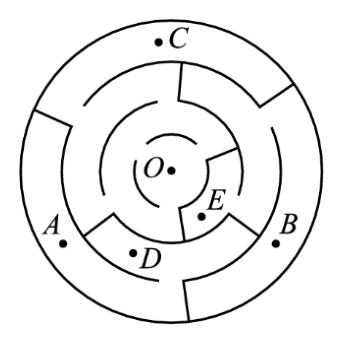
2016 · #3 Which point in the labyrinth can we get to, starting at point O?
Which point in the labyrinth can we get to, starting at point O?
Show answer
Show hints
Still stuck? Show hint 2 →
Show solution
- Starting at O, move only through the openings, never crossing a drawn wall.
- The corridor from O leads outward to exactly one labelled point.
- That reachable point is C.
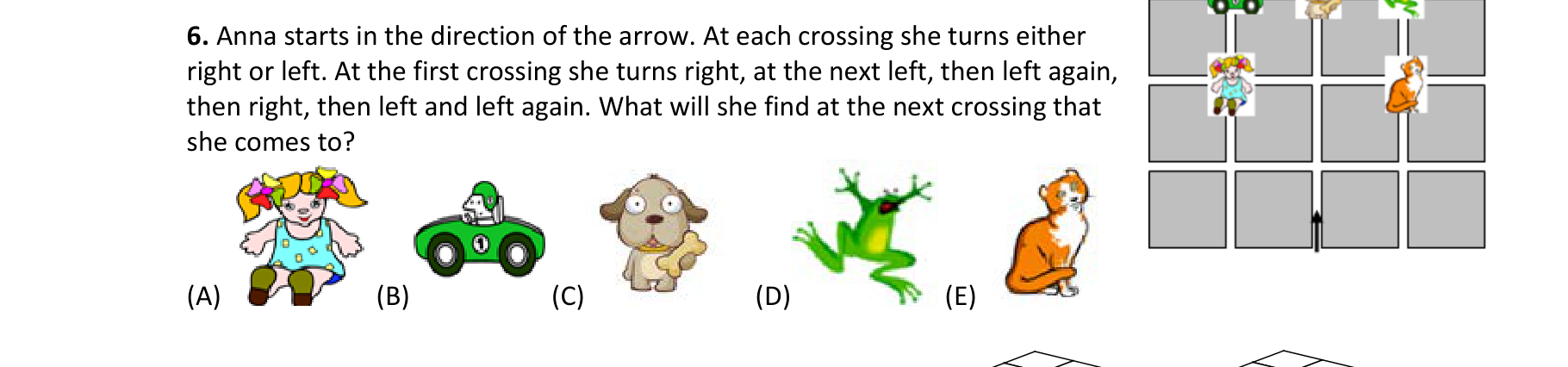
2013 · #6 Anna starts walking in the direction of the arrow. At each crossing she turns either right or left. She turns right, then left, then...
Anna starts walking in the direction of the arrow. At each crossing she turns either right or left. She turns right, then left, then left again, then right, then left, then left again. What will she find at the next crossing she reaches?
Show answer
Show hints
Still stuck? Show hint 2 →
Still stuck? Show hint 3 →
Show solution
- Start at the arrow and trace the path, turning right, left, left, right, left, then left.
- Keep your finger moving along the streets so you do not skip a crossing.
- The item waiting at the next crossing is the one shown in option A.
What comes next in the pattern?
Look at a row of pictures where each one is a tiny bit different from the one before. Like a flip-book that grows.
Your job: find what changes each step. Then you can draw the next picture, or count what is in it.
See it? Each step adds one more dot. So the next picture has 4 dots.
The big trick is to look at two pictures sitting next to each other and ask: what is new? A new dot? A bigger shape? A turn? Then keep doing that one change.
THE MOVE: compare two pictures that touch. Find the one thing that changes. Do that change once more to get the next picture.
Do not guess from a single picture. You need at least two side by side to see what is changing.
A mushroom grows a little bigger every day. Over five days Maria took a photo of this mushroom, but she put the photos in the wrong order (see picture). Which order of the photos shows the mushroom growing, from left to right?
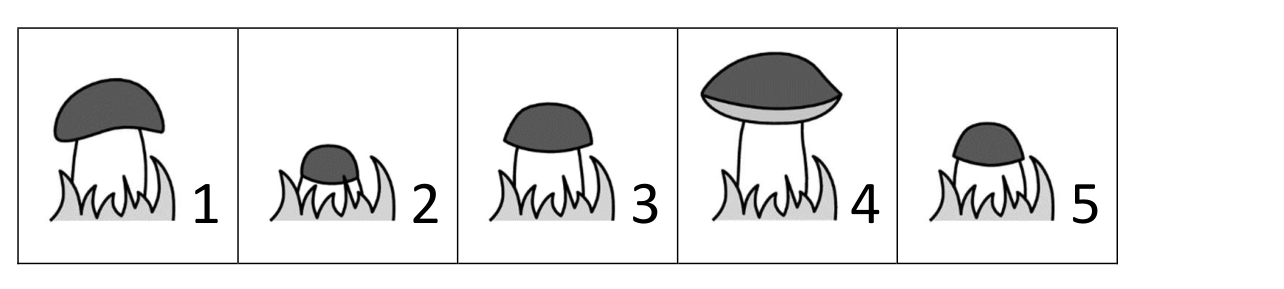
Five photos of a mushroom got mixed up. A mushroom only ever grows bigger. We put the photos in order from smallest to biggest.
The change is simple: every day the mushroom is a little taller, with a wider cap. So the right order goes from the tiniest cap to the biggest cap.
Hunt for the smallest mushroom — that photo goes first. Then the next-smallest, and so on, reading the photo numbers as the mushroom grows.
Smallest to biggest gives the order 2-5-3-1-4. That is choice A.
The change is simple: every day the mushroom is a little taller, with a wider cap. So the right order goes from the tiniest cap to the biggest cap.
Hunt for the smallest mushroom — that photo goes first. Then the next-smallest, and so on, reading the photo numbers as the mushroom grows.
Smallest to biggest gives the order 2-5-3-1-4. That is choice A.
Find what changes each step. Then keep that change going.
2018 · #4 Peter has drawn this pattern. He draws exactly the same pattern once more, right after it. Which point is on his drawing?
Peter has drawn this pattern. He draws exactly the same pattern once more, right after it. Which point is on his drawing?

Show answer
Show hints
Still stuck? Show hint 2 →
Still stuck? Show hint 3 →
Show solution
- The new copy begins where the first pattern stops and uses the same grid squares.
- Redraw the same zig-zag, going up and down by the same number of squares as before.
- The corner of the repeated pattern lands exactly on point D.
2012 · #1 (figure problem)

Show answer
Show hints
Still stuck? Show hint 2 →
Show solution
- In four of the squares the grey and white parts each make up exactly half.
- In one square a corner-to-corner diagonal plus a centre line leave only two small grey triangles, each a quarter of a half — grey is just one quarter.
- There the white part is three quarters, which is bigger than the grey.
- That picture is D.
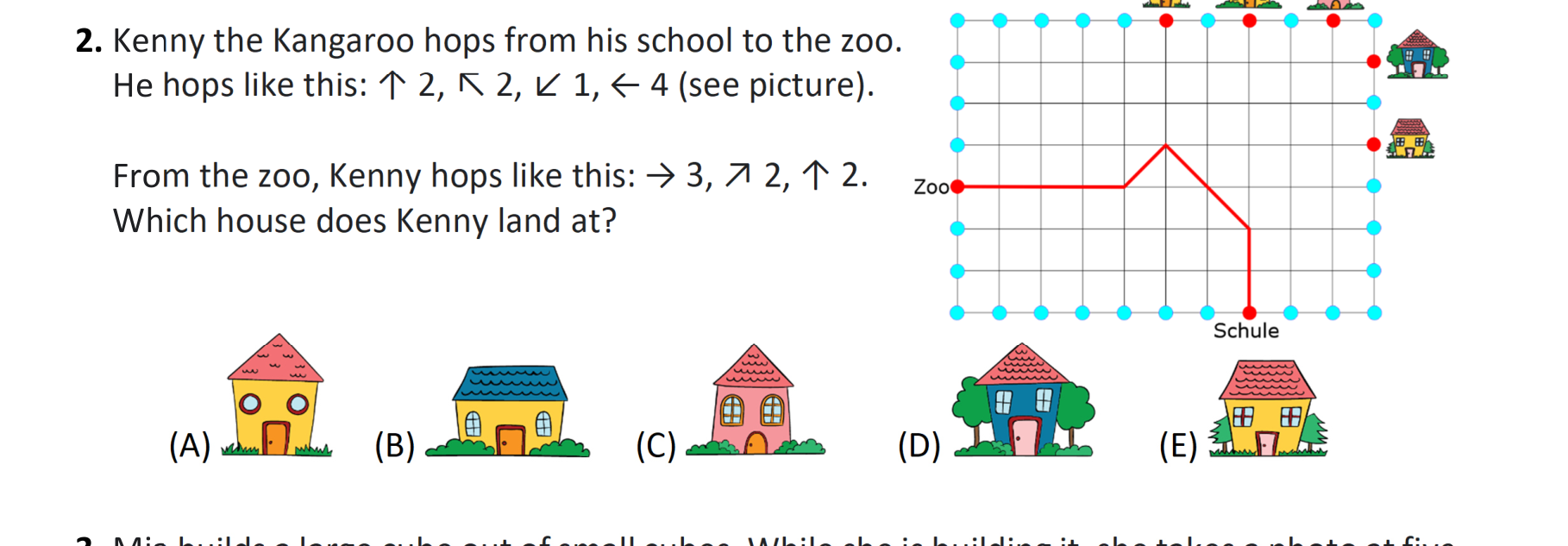
2025 · #2 Kenny the Kangaroo hops from his school to the zoo. He hops like this: up 2, up-left 2, down-left 1, left 4 (see picture). From the zoo,...
Kenny the Kangaroo hops from his school to the zoo. He hops like this: up 2, up-left 2, down-left 1, left 4 (see picture). From the zoo, Kenny hops like this: right 3, up-right 2, up 2. Which house does Kenny land at?
Show answer
Show hints
Still stuck? Show hint 2 →
Show solution
- Begin at the Zoo marker and move right 3 squares.
- Then move diagonally up-right 2 squares, then straight up 2 squares.
- The landing square sits at the house labelled A.
- So Kenny lands at house A.
Fold it in half: do the halves match?
Hold a paper heart and fold it straight down the middle. The two halves land right on top of each other — left side onto right side. They match!
A line where the two halves match like this is called a fold line. Fold on it and one half hides the other exactly — no bit pokes out.
But not every line works! Fold the same heart on a slanted line and the halves do not match — one part sticks out past the other.
So to test a line, ask one simple thing: if I fold on it, does one half land right on top of the other? If yes, it is a fold line.
Some shapes have more than one fold line. A square folds four ways: up-and-down, side-to-side, and along each slanted corner-to-corner line. Try folding a square napkin and see!
What about letters?
Some letters fold and match, some do not. The letter A has an up-and-down fold line (its left and right sides match). The letter B has a side-to-side fold line (its top and bottom match). But the letter F has no fold line — fold it any way and the halves never match. Try a few letters and sort them into ‘folds’ and ‘does not fold’.
THE MOVE: to test a line, fold the shape on it in your head. If one half lands right on top of the other, it is a fold line. If a bit pokes out, it is not.
Do not count a slanted line just because it cuts the shape in two. Cutting in two is not enough — the two halves have to match exactly when you fold. A rectangle's corner-to-corner line splits it, but the halves do not match, so it is not a fold line.
Maria folds a square piece of paper so that the two kangaroos land exactly on top of each other. Along how many of the lines shown is this possible?
Maria folds a square so the two kangaroos land right on top of each other. We count how many of the drawn lines let her do that.
A fold works only when the two halves match after folding — that is a fold line. So we test each drawn line by folding on it in our head.
Fold up-and-down: the left kangaroo lands on the right one. Match! Fold side-to-side: the top kangaroo lands on the bottom one. Match too!
The slanted lines do not match the kangaroos up, so they do not count. That leaves 2 good fold lines — choice C.
A fold works only when the two halves match after folding — that is a fold line. So we test each drawn line by folding on it in our head.
Fold up-and-down: the left kangaroo lands on the right one. Match! That line works. Fold side-to-side: the top kangaroo lands on the bottom one. Match! That line works too.
The slanted lines do not match the kangaroos up, so they do not count. That leaves 2 good fold lines — choice C.
A fold line makes the two halves land on top of each other. Test it by folding in your head: match = yes, poke-out = no.
2024 · #1 Each square below is cut into two pieces by a line. Which square was divided into two pieces that are different in shape? (The answer...
Each square below is cut into two pieces by a line. Which square was divided into two pieces that are different in shape? (The answer choices are the five pictured squares.)

Show answer
Show hints
Still stuck? Show hint 2 →
Still stuck? Show hint 3 →
Show solution
- In each square, picture cutting along the line and laying one piece on top of the other.
- In four of the squares the two pieces stack perfectly — they are the same shape and size.
- In one square the pieces are clearly different: one is bigger or a different shape, so they cannot stack.
- That odd-one-out square is the answer: E.
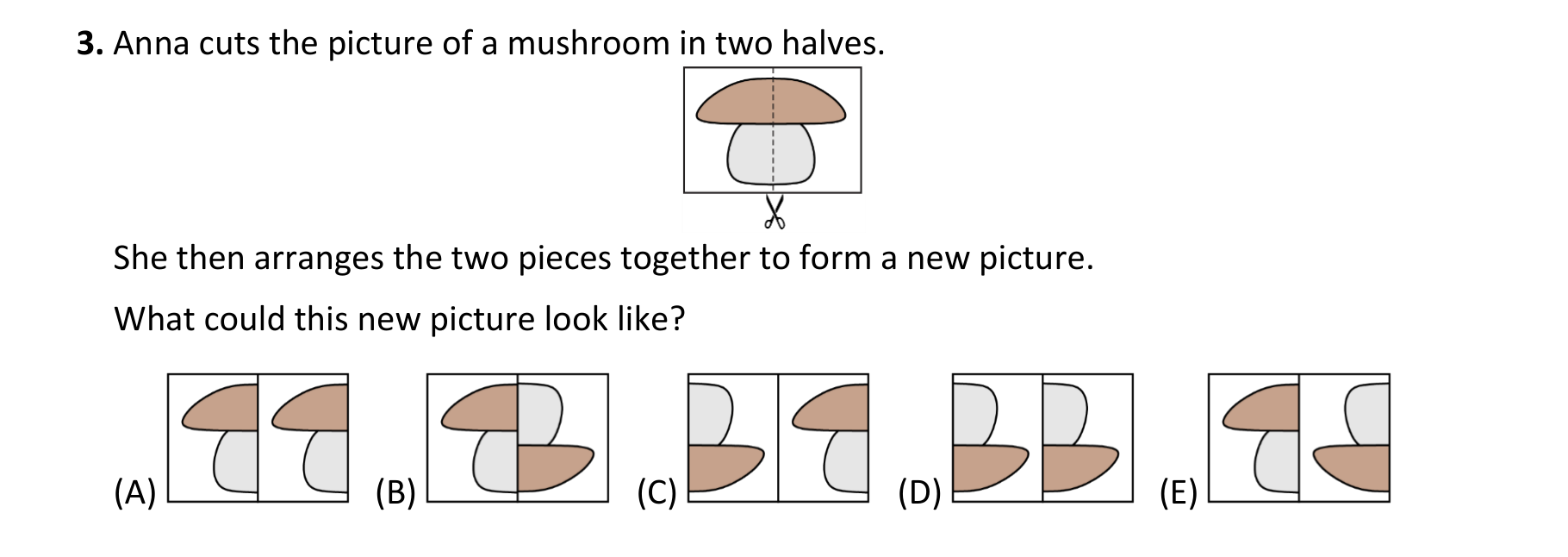
2022 · #3 Anna cuts the picture of a mushroom in two halves (straight down the middle). She then arranges the two pieces together to form a new...
Anna cuts the picture of a mushroom in two halves (straight down the middle). She then arranges the two pieces together to form a new picture. What could this new picture look like?
Show answer
Show hints
Still stuck? Show hint 2 →
Show solution
- Cutting down the middle gives a left half and a right half, each with half a cap and half a stem.
- No matter how Anna turns or slides them, the two pieces together still hold exactly one full cap's worth of brown and one full stem's worth of grey.
- Only picture E is made from exactly those two matching halves, so the answer is E.
Shapes-in-your-head test
Eight puzzles, easy to a little harder. Take your time and picture each one.
2014 · #2 Theresa moves a pencil along the line. She starts at the arrow shown. In which order will she go past the shapes?
Theresa moves a pencil along the line. She starts at the arrow shown. In which order will she go past the shapes?
Show answer
Show hints
Still stuck? Show hint 2 →
Show solution
- Put your finger at the arrow and follow the line without lifting it.
- The first shape the path runs into is the triangle.
- Next it reaches the square, and last the circle.
- So the order is triangle, square, circle — choice A.
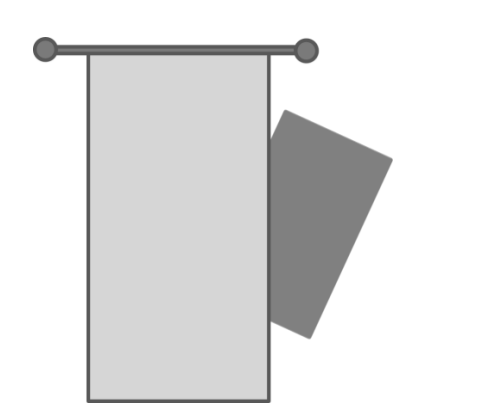
2016 · #7 Part of a rectangle is hidden behind a curtain (see picture). The hidden part is a
Part of a rectangle is hidden behind a curtain (see picture). The hidden part is a
Show answer
Show hints
Still stuck? Show hint 2 →
Show solution
- The curtain hangs over the rectangle and its lower edge slants across one corner.
- The piece left hidden between that slanted edge and the rectangle's corner has three sides.
- So the hidden part is a triangle.
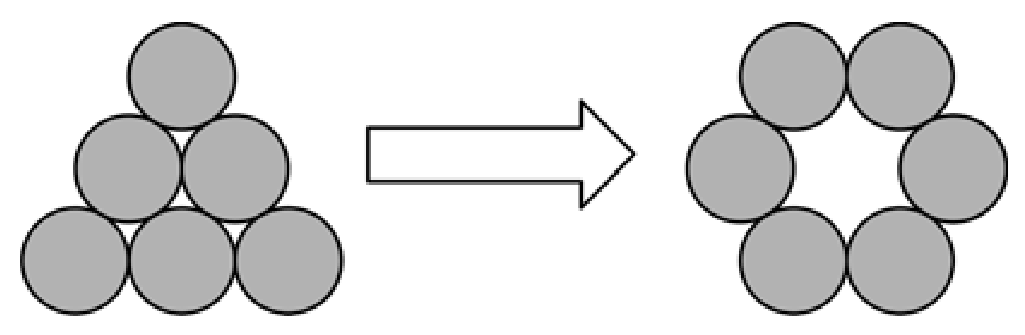
2010 · #5 Six coins make a triangle (see the picture). What is the smallest number of coins that must be moved to make the circle?
Six coins make a triangle (see the picture). What is the smallest number of coins that must be moved to make the circle?
Show answer
Show hints
Still stuck? Show hint 2 →
Show solution
- Lay the target ring of 6 coins over the triangle.
- Four of the coins already sit where the ring needs them; only two are out of place.
- So the smallest number of coins to move is 2.
2018 · #8 Lisa needs exactly 3 pieces to complete her jigsaw. Which of the 4 pieces is left over?
Lisa needs exactly 3 pieces to complete her jigsaw. Which of the 4 pieces is left over?
Show answer
Show hints
Still stuck? Show hint 2 →
Still stuck? Show hint 3 →
Show solution
- The empty hole is a long rectangle with bumps and gaps along its edges.
- Try each piece in the hole — its bumps must meet the hole's gaps, and its gaps must meet the hole's bumps.
- Three pieces fill the hole exactly, but piece A (with bumps sticking out on every side) cannot fit, so it is left over.
2022 · #1 The bee wants to get to the flower. Each arrow shows a move to one neighbouring square. Which path can the bee fly to reach the flower?
The bee wants to get to the flower. Each arrow shows a move to one neighbouring square. Which path can the bee fly to reach the flower?
Show answer
Show hints
Still stuck? Show hint 2 →
Show solution
- The bee must move several squares to the right and several squares down to reach the flower.
- Count the squares: the flower is the same number of steps right and down from the bee.
- Only one arrow sequence keeps the bee on the board and uses exactly those right and down moves.
- That sequence is E.
2015 · #10 Julia folds the paper net pictured on the right into a cube. Which number is on the face that is opposite to the face with the number 3?
Julia folds the paper net pictured on the right into a cube. Which number is on the face that is opposite to the face with the number 3?
Show answer
Show hints
Still stuck? Show hint 2 →
Show solution
- The faces 3, 5 and 6 lie in a straight vertical strip of the net.
- When a strip of three faces is folded, the two ends become opposite faces.
- So 3 and 6 end up on opposite faces of the cube.
- The face opposite 3 carries 6.
2020 · #1 A mushroom grows a little bigger every day. Over five days Maria took a photo of this mushroom, but she put the photos in the wrong...
A mushroom grows a little bigger every day. Over five days Maria took a photo of this mushroom, but she put the photos in the wrong order (see picture). Which order of the photos shows the mushroom growing, from left to right?
Show answer
Show hints
Still stuck? Show hint 2 →
Show solution
- The mushroom grows every day, so the correct order goes from the smallest cap to the biggest, fully opened cap.
- Reading the photo labels from smallest to largest gives the sequence in choice A: 2-5-3-1-4.
2013 · #7 Nathalie wanted to build a large cube out of lots of small cubes, just like in Picture 1. How many cubes are missing from Picture 2 that...
Nathalie wanted to build a large cube out of lots of small cubes, just like in Picture 1. How many cubes are missing from Picture 2 that would be needed to build the large cube?
Show answer
Show hints
Still stuck? Show hint 2 →
Still stuck? Show hint 3 →
Show solution
- A complete large cube is 3 × 3 × 3 = 27 small cubes.
- Counting the cubes in picture 2 layer by layer gives 20 cubes.
- So 27 − 20 = 7 cubes are missing.
Things to remember
SHAPE TRICKS
- A box has 6 flat sides. A net is the box opened up flat. The ends of a strip of three are opposite.
- From the top, tall and short look the same — count floor spots.
- A mirror swaps left and right. A turn does not.
- Turning keeps a shape the same; a mirror flip makes a different one.
- Fill each gap with its piece. The leftover piece is the answer.
- Count blocks floor by floor, and never forget the hidden ones.
- Trace a path with a slow finger — no lifting, no jumping.
- In a pattern, find what changes each step and keep it going.
- A fold line makes the two halves land right on top of each other. If a bit pokes out, it is not a fold line.