About this topic
This is about three friendly things: time, money, and measuring.
You will read a clock and count on to a later time. You will count coins fast. You will say which thing is longer, or heavier, or comes how much later.
We go slow. We count out loud. We draw little pictures and hop along.
Read the Clock, Then Hop
Look at a clock. It has two hands.
The short hand points at the hour. The long hand points at the minutes.
The short red hand points at 3. This clock says 3 o'clock.
Now the fun part. To find a later time, you do not need to do hard math. You hop.
The hop trick
Hop the whole hours first. Then hop the minutes. Watch a story start at 2:00 and last 1 hour and 20 minutes.
Hop the hour: 2:00 to 3:00. Then hop the minutes: 3:00 to 3:20.
So the story ends at 3:20. Hours first, minutes second.
How long is it?
Hopping forward finds a later time. But sometimes you know the start and the end, and you want to know how long it took. That is the same hop, the other way round: you count the hops in the gap.
Cartoons start at 2:00 and end at 4:00. Stand on 2:00 and count up to 4:00: that is 1 hop, 2 hops. So the cartoons are 2 hours long.
From 2:00 to 4:00, count the hops in the gap: 1, 2. That is 2 hours long.
So "how long?" just means count the gap from start to end.
Peek: count up to a tidy o'clock first
If a nap starts at 2:50 and ends at 4:10, do not jump straight. First count up to the next tidy o'clock: 2:50 to 3:00 is 10 minutes. Then hop the whole hour to 4:00. Then the last bit: 4:00 to 4:10 is 10 minutes. So the gap is 10 + 60 + 10 = 1 hour and 20 minutes. Always count up to a tidy o'clock first.
Peek: minutes stop at 60
One hour is 60 minutes. After 60, the hour ticks up by one and the minutes start over at 0. So 50 minutes plus 20 minutes is not 70 on a clock. It is 1 hour and 10 minutes.
THE MOVE: Hop the hours first, then hop the minutes. Land on the o'clock, then count the rest.
Minutes only go up to 60, not 100. The moment you reach 60 minutes, the hour goes up by one and minutes start again at 0.
A 40 minute long lesson began at 11:50. Exactly in the middle of the lesson a bird flew into the classroom. At what time did this happen?
A bird flew in right in the middle of a 40 minute lesson that started at 11:50. When did the bird fly in?
The middle of 40 minutes is half of 40, which is 20. So the bird came 20 minutes after the start.
Now hop. First hop to the next o'clock: 11:50 to 12:00 is 10 minutes. We used 10 of our 20, so 10 minutes are left.
Hop those last 10 minutes from a tidy spot: 12:00 to 12:10.
The bird flew in at 12:10.
I cut 40 in half to get 20. Then I hop to the next o'clock first, because 12:00 is an easy place to stand. Ten minutes get me there, and I count the rest from a tidy spot.
To find a later time, hop the hours, then hop the minutes, and stop at 60.
2011 · #4 Simon awoke one and a half hours ago. In three and a half hours he will catch a train to go to his grandma. How long before his train...
Simon awoke one and a half hours ago. In three and a half hours he will catch a train to go to his grandma. How long before his train leaves did he wake up?
Show answer
Show hints
Still stuck? Show hint 2 →
Show solution
- From waking to now is 1½ hours; from now to the train is 3½ hours.
- So from waking to the train is 1½ + 3½ = 5 hours, answer E.
2019 · #3 Yesterday it was Sunday. Which day will it be tomorrow?
Yesterday it was Sunday. Which day will it be tomorrow?
Show answer
Show hints
Still stuck? Show hint 2 →
Show solution
- Yesterday was Sunday, so today is Monday.
- Tomorrow is the day after Monday, which is Tuesday (D).
2009 · #8 A certain film lasts 90 minutes. It begins at 17:10. During the film there are two advert breaks, one lasting eight minutes and the...
A certain film lasts 90 minutes. It begins at 17:10. During the film there are two advert breaks, one lasting eight minutes and the other five minutes. At what time will the film end?
Show answer
Show hints
Still stuck? Show hint 2 →
Show solution
- The film runs 90 minutes and the breaks add 8 + 5 = 13 minutes.
- Total time on screen and breaks: 90 + 13 = 103 minutes.
- Starting at 17:10, add 103 minutes: 17:10 + 1 h 43 min = 18:53.
- So the film ends at 18:53.
Stack the Coins
Coins help us pay. But a coin is worth more than one.
Look at this pattern. Four coins, each worth 5. Watch what skip-counting does.
Skip-count by 5: 5, 10, 15, 20. Four 5-coins make 20.
See it? You do not add one at a time. You jump by the coin's number. That is skip-counting.
Big coins first
To count fast, start with the biggest coins. To make 20, you could use four 5-coins. Or two 10-coins. Two coins beats four coins.
Same 20, but only two coins. Big coins first means fewer coins.
Peek: fewest coins
To use the fewest coins, grab the biggest coins first. Keep grabbing big ones until the next big one is too much. Then fill the rest with smaller coins.
THE MOVE: Skip-count by the coin, biggest first. A 10-coin is one jump of 10, not one jump of 1.
Do not count every coin as 1. A 10-coin is worth 10. Count what each coin is worth, not how many coins there are.
In a cafe the soup costs €4, the main course €9 and the dessert €5. The three courses ordered together cost €15. How many euros cheaper is this than ordering the same three courses separately?
Three courses cost €4, €9, and €5 on their own. As a deal together they cost €15. How much do you save?
First add the three on their own. Grab the friendly pair: 4 + 5 makes a tidy 9.
Then add the other 9: 9 + 9 = 18. So bought separately they cost €18.
The deal is €15. Take the deal away from the bigger price: 18 − 15 = 3.
You save €3.
First I find the price if you buy each one alone. Then I take away the deal price. What is left over is what you save.
Add up the values to find the total. To save coins, pick the biggest coins first.
2024 · #2 Lizzy has 7 coins of one kind. She buys three fruits at the market, and each fruit has a different price. How much does the most...
Lizzy has 7 coins of one kind. She buys three fruits at the market, and each fruit has a different price. How much does the most expensive fruit cost?
Show answer
Show hints
Still stuck? Show hint 2 →
Show solution
- The three prices are different whole numbers of coins that total 7.
- Make the two cheaper ones as small as possible: 1 and 2 coins.
- Then the most expensive is 7 − 1 − 2 = 4 coins.
- Answer: 4 coins (C).
2021 · #11 Julie and Angela played “kangball”, a ball game. Each goal in their game scores 2 points. Julie scored 5 goals and Angela scored 9...
Julie and Angela played “kangball”, a ball game. Each goal in their game scores 2 points. Julie scored 5 goals and Angela scored 9 goals. How many more points than Julie did Angela score?
Show answer
Show hints
Still stuck? Show hint 2 →
Still stuck? Show hint 3 →
Show solution
- Angela scored 9 − 5 = 4 more goals than Julie.
- Each goal is 2 points, so 4 goals is 4 × 2 = 8 points.
- Angela scored 8 more points.
2017 · #11 Balloons are sold in packages of 5, 10 or 25 pieces each. Marius buys exactly 70 balloons. What is the minimum number of packages he has to buy?
Balloons are sold in packages of 5, 10 or 25 pieces each. Marius buys exactly 70 balloons. What is the minimum number of packages he has to buy?
Show answer
Show hints
Still stuck? Show hint 2 →
Show solution
- Two packs of 25 give 50, leaving 20 balloons to reach 70.
- Make 20 with two packs of 10.
- That is 2 + 2 = 4 packages, and three packages cannot total exactly 70.
- So the minimum is 4.
Quick Check: Clocks & Coins
Two warm-ups. Hop on for time, and stack up for coins.
2019 · #3 Yesterday it was Sunday. Which day will it be tomorrow?
Yesterday it was Sunday. Which day will it be tomorrow?
Show answer
Show hints
Still stuck? Show hint 2 →
Show solution
- Yesterday was Sunday, so today is Monday.
- Tomorrow is the day after Monday, which is Tuesday (D).
2024 · #2 Lizzy has 7 coins of one kind. She buys three fruits at the market, and each fruit has a different price. How much does the most...
Lizzy has 7 coins of one kind. She buys three fruits at the market, and each fruit has a different price. How much does the most expensive fruit cost?
Show answer
Show hints
Still stuck? Show hint 2 →
Show solution
- The three prices are different whole numbers of coins that total 7.
- Make the two cheaper ones as small as possible: 1 and 2 coins.
- Then the most expensive is 7 − 1 − 2 = 4 coins.
- Answer: 4 coins (C).
Line It Up, Tip the Scale
To measure is to find how big a thing is.
We measure length with a ruler. Look at two ribbons lined up at one end.
Line them up at the dotted end. The red one sticks out, so it is longer.
We measure weight with a scale. A balance scale tips down on the heavy side.
The heavy side dips down. The light side lifts up.
The take-away trick
Here is a clever idea for weight. If two things together weigh a known amount, and you know one of them, take it away to find the other.
Peek: fewer steps means longer steps
If two kids walk the same path, the one who takes fewer steps must have longer steps. Big steps cover more ground in one go.
THE MOVE: Whole take away part. To compare, line things up at one end. To find a missing weight, take the part you know away from the whole.
Heavier is not the same as bigger. A small rock can be heavier than a big balloon. Look at what the scale does, not at the size.
Mother kangaroo and her son Max together weigh 60 kg. The mother on her own weighs 52 kg. How heavy is Max?
Mum kangaroo and her son Max together weigh 60 kg. Mum alone weighs 52 kg. How heavy is Max?
Think of 60 as two parts joined together: Mum and Max.
We know Mum is 52. So Max is the leftover part.
Take Mum away from the whole: 60 − 52 = 8.
So Max weighs 8 kg.
The two of them make 60. Mum is one part of it. So Max must be the rest. I take the part I know away from the whole, and what is left is Max.
Compare by lining up at one end. Find a missing part by taking the known part away from the whole.
2010 · #16 On the playground some children measure the length of the playground in strides. Anni takes 15 strides, Betty 17, Denis 12 and Ivo 14....
On the playground some children measure the length of the playground in strides. Anni takes 15 strides, Betty 17, Denis 12 and Ivo 14. Who has the longest stride?
Show answer
Show hints
Still stuck? Show hint 2 →
Show solution
- The playground length is fixed, so the longest stride belongs to whoever takes the fewest steps.
- Denis takes only 12 strides, the fewest of all.
- So Denis has the longest stride.
2013 · #12 Pinocchio’s nose is 9 cm long. Each time he lies, his nose grows by 6 cm. Each time he tells the truth, it shrinks by 2 cm. He tells...
Pinocchio’s nose is 9 cm long. Each time he lies, his nose grows by 6 cm. Each time he tells the truth, it shrinks by 2 cm. He tells three lies and twice tells the truth. How long is Pinocchio’s nose now?
Show answer
Show hints
Still stuck? Show hint 2 →
Still stuck? Show hint 3 →
Show solution
- Three lies add 3 × 6 = 18 cm; two truths take off 2 × 2 = 4 cm.
- 9 + 18 − 4 = 23 cm.
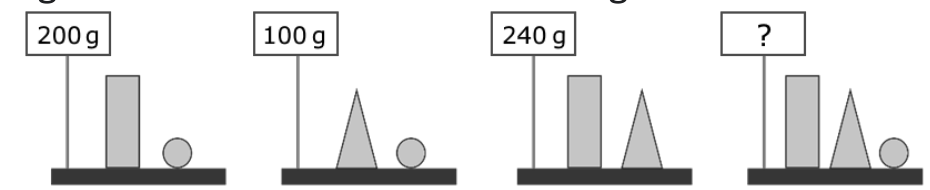
2024 · #18 Lucy weighs building blocks two at a time and reads these scale values: 200 g, 100 g and 240 g (see picture). How much do the three...
Lucy weighs building blocks two at a time and reads these scale values: 200 g, 100 g and 240 g (see picture). How much do the three different building blocks weigh all together?
Show answer
Show hints
Still stuck? Show hint 2 →
Show solution
- The three readings 200, 100, 240 each weigh two blocks, so together they count all three blocks twice.
- Sum: 200 + 100 + 240 = 540 grams.
- Half of that is the weight of the three blocks once: 540 ÷ 2 = 270.
- Answer: 270 g (A).
So Much Per Hop
A rate is a steady deal. The same thing happens, again and again.
Say a koala eats 50 grams of leaves every hour. Watch the pattern grow, one hour at a time.
Each hour adds 50 more. Skip-count: 50, 100, 150, 200.
A rate is skip-counting in disguise. One hop, one helping. Two hops, two helpings.
Half and double
Rates have a sweet pattern. If half a trip takes some time, the whole trip takes double. If you double the steps, you double the time too.
Half the trip is 30 min, so the whole trip is 30 + 30 = 60 min.
Peek: a tricky rate (for big kids)
Sometimes you must first find how many hops there are. A koala only eats when awake. If it sleeps 20 of the 24 hours in a day, it is awake only 24 − 20 = 4 hours. So count 50 four times, not 24 times.
THE MOVE: One hop, one helping. Skip-count the rate. Half the trip means double the time; double the hops means double the amount.
Count the right number of hops. A koala that sleeps does not eat. Find the hops that really happen first, then skip-count those.
Whenever Koko the koala bear is awake, he always eats 50 grams of leaves in one hour. Yesterday Koko slept for 20 hours. How many grams of leaves did he eat yesterday?
Koko the koala eats 50 grams every hour he is awake. Yesterday he slept for 20 hours. How much did he eat?
First, the trap: do not use 24 hours. He only eats while awake.
A day is 24 hours. He slept 20 of them. So awake hours are 24 − 20 = 4.
Now skip-count 50 for each of those 4 awake hours: 50, 100, 150, 200.
Koko ate 200 grams.
The trap is to use 24 hours. But he only eats while awake. So I find the awake hours first, which is 4. Then I do one hop of 50 for each awake hour.
Find how many hops really happen, then skip-count the rate for those hops.
2015 · #9 It takes Jennifer half an hour to cover half of her journey home from school. How long does it take her to cover the whole journey home?
It takes Jennifer half an hour to cover half of her journey home from school. How long does it take her to cover the whole journey home?
Show answer
Show hints
Still stuck? Show hint 2 →
Show solution
- Half the journey takes half an hour = 30 minutes.
- The whole journey is two equal halves, so it takes 30 + 30 = 60 minutes.
- That is 1 hour, choice D.
2016 · #14 Konrad dries mushrooms. From 4 kg of fresh mushrooms he gets 1 kg of dried mushrooms. How many kilograms of mushrooms does he have to...
Konrad dries mushrooms. From 4 kg of fresh mushrooms he gets 1 kg of dried mushrooms. How many kilograms of mushrooms does he have to pick in order to receive 4 kg of dried mushrooms?
Show answer
Show hints
Still stuck? Show hint 2 →
Show solution
- 4 kg fresh gives 1 kg dried.
- For 4 kg dried, he needs 4 times as much fresh: 4 × 4 kg = 16 kg.
- So he must pick 16 kg.
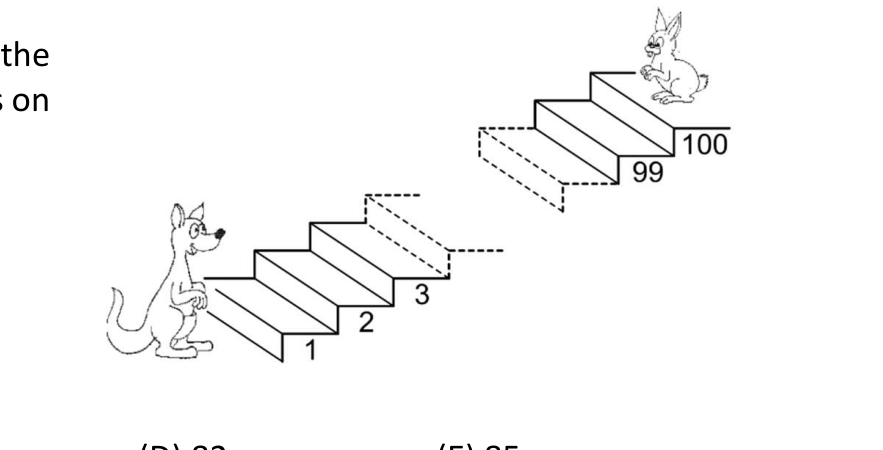
2020 · #15 Whenever the kangaroo goes up seven steps, the rabbit goes down three steps. When the kangaroo is on step number 56, on which step will...
Whenever the kangaroo goes up seven steps, the rabbit goes down three steps. When the kangaroo is on step number 56, on which step will the rabbit be?
Show answer
Show hints
Still stuck? Show hint 2 →
Show solution
- Reaching step 56 means the kangaroo made 56 ÷ 7 = 8 climbs.
- In those same 8 moves the rabbit dropped 8 × 3 = 24 steps from 100, landing on 100 − 24 = 76.
Quick Check: Measuring & Rates
Line things up, and skip-count the steady deal.
2019 · #3 Mother kangaroo and her son Max together weigh 60 kg. The mother on her own weighs 52 kg. How heavy is Max?
Mother kangaroo and her son Max together weigh 60 kg. The mother on her own weighs 52 kg. How heavy is Max?
Show answer
Show hints
Still stuck? Show hint 2 →
Show solution
- Together mother and Max weigh 60 kg.
- The mother alone is 52 kg, so Max is what is left: 60 − 52.
- 60 − 52 = 8, so Max weighs 8 kg.
- The answer is B.
2015 · #9 It takes Jennifer half an hour to cover half of her journey home from school. How long does it take her to cover the whole journey home?
It takes Jennifer half an hour to cover half of her journey home from school. How long does it take her to cover the whole journey home?
Show answer
Show hints
Still stuck? Show hint 2 →
Show solution
- Half the journey takes half an hour = 30 minutes.
- The whole journey is two equal halves, so it takes 30 + 30 = 60 minutes.
- That is 1 hour, choice D.
Ages, Days & Fence Posts
Getting older is a time pattern. Every year, your age goes up by 1.
Six, then one more year is 7, then one more is 8. To grow older, hop forward.
Days and weeks hop too. One week is 7 days. So count weeks by sevens: 7, 14, 21.
The fence-post surprise
Now a sneaky one. Flags stand in a line. Count the flags. Then count the gaps between them.
4 flags, but only 3 gaps. There is always one fewer gap than flags.
So when you measure with gaps, the gaps are one fewer than the posts.
Always the same years apart
Here is a quiet, surprising thing about ages. If your big sister is 3 years older than you, she is older by 3 today, she was older by 3 last year, and she will be older by 3 forever.
Why? Every year, you both hop forward by 1. You both grow the same amount, so the gap between you never changes. The numbers go up together, like two friends climbing the same stairs.
Both rows grew by 3. The sister's row is still 3 blocks longer. You stay 3 years apart.
So if you ever know the gap between two ages, you keep it. The gap is a number that never moves.
Peek: when TWO people get older
If two people both get older, the years add for each one. If 4 years pass for two people, the total of their ages goes up by 4 + 4 = 8, not 4.
THE MOVE: Hop to age up, sevens for weeks, gaps are one fewer. Add the years that pass; count weeks by 7s; remember there is one fewer gap than posts.
When two people both grow older, the total goes up for each one. If 4 years pass for two people, their ages together go up by 8, not 4.
Susanne is 6 years old. Her sister Lisa is 2 years younger. Her brother Max is 2 years older than Susanne. How old are the three siblings altogether?
Susanne is 6. Lisa is 2 years younger. Max is 2 years older. We want all three ages added.
Younger means hop back: Lisa is 6 − 2 = 4.
Older means hop forward: Max is 6 + 2 = 8.
Now add all three: 6 + 4 + 8. Group the friendly pair first: 6 + 4 = 10.
Then 10 + 8 = 18.
I find each child's age one at a time. Younger means take away. Older means add. Then I put all three together, starting with the pair that makes a neat 10.
Younger means hop back, older means hop forward. Then add up the ages you need.
2016 · #2 A kangaroo is 7 weeks and 2 days old. In how many days is it 8 weeks old?
A kangaroo is 7 weeks and 2 days old. In how many days is it 8 weeks old?
Show answer
Show hints
Still stuck? Show hint 2 →
Show solution
- Going from 7 weeks up to 8 weeks is one more full week, which is 7 days.
- The kangaroo has already lived 2 of those days.
- So 7 − 2 = 5 more days until it is 8 weeks old.
2016 · #10 Together, Paul and Josef are 12 years old. How old will they both be together in four years’ time?
Together, Paul and Josef are 12 years old. How old will they both be together in four years’ time?
Show answer
Show hints
Still stuck? Show hint 2 →
Show solution
- Together they are 12 now.
- In four years each is 4 years older, so their combined age rises by 4 + 4 = 8.
- Together they will be 12 + 8 = 20.
2018 · #13 Felix the rabbit has 20 carrots. Every day he eats 2 of them. He has eaten the 12th carrot on a Wednesday. On which day of the week did...
Felix the rabbit has 20 carrots. Every day he eats 2 of them. He has eaten the 12th carrot on a Wednesday. On which day of the week did he start eating the carrots?
Show answer
Show hints
Still stuck? Show hint 2 →
Show solution
- Two carrots each day means: day 1 = carrots 1,2; day 2 = 3,4; day 3 = 5,6; day 4 = 7,8; day 5 = 9,10; day 6 = 11,12.
- So the 12th carrot is eaten on day 6, which is the Wednesday given.
- Count back 5 days from Wednesday: Tue, Mon, Sun, Sat, Friday — that is day 1, answer E.
Time, Money & Measuring Test
Six problems. They start easy and get a little harder. Take your time and count carefully.
2018 · #2 Susanne is 6 years old. Her sister Lisa is 2 years younger. Her brother Max is 2 years older than Susanne. How old are the three...
Susanne is 6 years old. Her sister Lisa is 2 years younger. Her brother Max is 2 years older than Susanne. How old are the three siblings altogether?
Show answer
Show hints
Still stuck? Show hint 2 →
Show solution
- Susanne is 6.
- Lisa is 2 younger: 6 − 2 = 4.
- Max is 2 older: 6 + 2 = 8.
- Total: 6 + 4 + 8 = 18.
2016 · #2 A kangaroo is 7 weeks and 2 days old. In how many days is it 8 weeks old?
A kangaroo is 7 weeks and 2 days old. In how many days is it 8 weeks old?
Show answer
Show hints
Still stuck? Show hint 2 →
Show solution
- Going from 7 weeks up to 8 weeks is one more full week, which is 7 days.
- The kangaroo has already lived 2 of those days.
- So 7 − 2 = 5 more days until it is 8 weeks old.
2010 · #4 In a cafe the soup costs €4, the main course €9 and the dessert €5. The three courses ordered together cost €15. How many euros cheaper...
In a cafe the soup costs €4, the main course €9 and the dessert €5. The three courses ordered together cost €15. How many euros cheaper is this than ordering the same three courses separately?
Show answer
Show hints
Still stuck? Show hint 2 →
Show solution
- Separately the meal costs 4 + 9 + 5 = 18 Euro.
- Together it costs 15 Euro.
- So the saving is 18 − 15 = 3 Euro.
2016 · #10 Together, Paul and Josef are 12 years old. How old will they both be together in four years’ time?
Together, Paul and Josef are 12 years old. How old will they both be together in four years’ time?
Show answer
Show hints
Still stuck? Show hint 2 →
Show solution
- Together they are 12 now.
- In four years each is 4 years older, so their combined age rises by 4 + 4 = 8.
- Together they will be 12 + 8 = 20.
2014 · #4 Whenever Koko the koala bear is awake, he always eats 50 grams of leaves in one hour. Yesterday Koko slept for 20 hours. How many grams...
Whenever Koko the koala bear is awake, he always eats 50 grams of leaves in one hour. Yesterday Koko slept for 20 hours. How many grams of leaves did he eat yesterday?
Show answer
Show hints
Still stuck? Show hint 2 →
Still stuck? Show hint 3 →
Show solution
- A day is 24 hours and Koko slept 20 of them, so he was awake 24 − 20 = 4 hours.
- Each awake hour he eats 50 grams, so count by fifties for the 4 hours: 50, 100, 150, 200.
- That is 200 grams in all.
- Answer: 200 grams.
2009 · #8 A certain film lasts 90 minutes. It begins at 17:10. During the film there are two advert breaks, one lasting eight minutes and the...
A certain film lasts 90 minutes. It begins at 17:10. During the film there are two advert breaks, one lasting eight minutes and the other five minutes. At what time will the film end?
Show answer
Show hints
Still stuck? Show hint 2 →
Show solution
- The film runs 90 minutes and the breaks add 8 + 5 = 13 minutes.
- Total time on screen and breaks: 90 + 13 = 103 minutes.
- Starting at 17:10, add 103 minutes: 17:10 + 1 h 43 min = 18:53.
- So the film ends at 18:53.
Quick reference
- 1 hour = 60 minutes.
- 1 week = 7 days.
- Skip-count coins by 5s, 10s, and 25s; big coins first.
- Heavy side goes down. Light side goes up.
- One hop, one helping — that is a rate.
- Gaps are one fewer than posts.
- "How long?" means count the hops in the gap.
- Two people age together, so the gap between their ages never changes.