In Kangaroo Town the unit of distance is the ‘hop’ instead of the kilometre. Kangaroo Klaus needs 12 minutes to cover one hop. How many hops can he cover in 12 hours?
Show answer
Answer: A — 60
Show hints
Hint 1 of 2
First find how many minutes are in 12 hours.
Still stuck? Show hint 2 →
Hint 2 of 2
Each hop costs 12 minutes, so divide the total minutes by 12.
Show solution
Approach: convert to a common time unit then divide
12 hours = 12 × 60 = 720 minutes.
Each hop takes 12 minutes, so he covers \(720 \div 12 = 60\) hops, which is (A).
Carin is going to paint the walls in her room green. The green paint is too dark, so she mixes it with white paint. She tries different mixtures. Which of the following mixtures will give the darkest green colour?
Show answer
Answer: E — They will all be equally dark
Show hints
Hint 1 of 2
The darkness comes from how much of the whole bucket is green, not from the raw number of parts.
Still stuck? Show hint 2 →
Hint 2 of 2
Look for a pattern: in every mixture, how many parts are white for each part of green?
Show solution
Approach: spot that every mixture has the same green share
In each mixture there are exactly 3 parts of white for every 1 part of green, so the green is always 1 out of every 4 parts.
As fractions: \(\frac{1}{4}\), \(\frac{2}{8}\), \(\frac{3}{12}\), \(\frac{4}{16}\) all equal \(\frac{1}{4}\).
Same green share means same darkness, so the answer is E (they are all equally dark).
When Julia goes from home to school, she can walk half the way and take the bus for the other half. If she walks the whole way instead, she spends 45 minutes more. How much less time does it take her to go to school if she takes the bus the whole way?
Show answer
Answer: B — 45 minutes
Show hints
Hint 1 of 2
Let the full walk take W minutes and the full bus ride take B minutes; write the mixed trip as half of each.
Still stuck? Show hint 2 →
Hint 2 of 2
Compare 'walk only' with the half-and-half trip to find W − B, then compare 'bus only' with the mix.
Show solution
Approach: set up the half-and-half relation
Mixed trip = W/2 + B/2; walking only = W. Walking is 45 min more: W − (W/2 + B/2) = 45, so (W − B)/2 = 45.
The bus saves over the mixed trip by (W/2 + B/2) − B = (W − B)/2.
That is the same (W − B)/2 = 45 minutes.
So the bus-only trip takes 45 minutes less, choice B.
A model railway goes round in circles at a constant speed and needs exactly 1 minute and 11 seconds for one circuit. How long does it need for six circuits?
Show answer
Answer: B — 7 minutes 6 seconds
Show hints
Hint 1 of 2
One circuit takes 71 seconds; what do six take?
Still stuck? Show hint 2 →
Hint 2 of 2
Multiply 71 s by 6, then convert back to minutes and seconds.
Show solution
Approach: convert to seconds, multiply, convert back
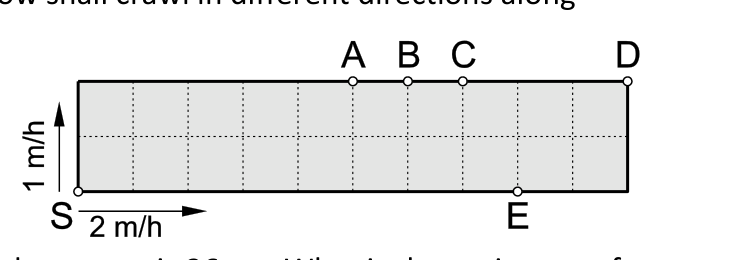
A garden is split into equally sized square-shaped lots. A fast snail and a slow snail crawl in different directions along the outside edge of the garden. Both start at the corner S. The slow snail crawls 1 m in one hour and the fast one crawls 2 m in one hour. At which marked point will the two snails meet for the first time?
Show answer
Answer: B — B
Show hints
Hint 1 of 2
The two snails together cover the whole boundary before they meet, so add their speeds.
Still stuck? Show hint 2 →
Hint 2 of 2
Find how far the faster snail has gone when their combined distance equals the perimeter, then step that far around from S.
Show solution
Approach: combined speed reaches the perimeter; locate the meeting point
Going opposite ways around the edge, the snails meet when the distances they have walked add up to the full perimeter.
Their combined speed is 1 + 2 = 3 m per hour, so the fast snail covers two-thirds of the boundary and the slow one a third.
Marking off the fast snail's two-thirds of the boundary from S lands exactly at point B.
Anna, Beate and Cindy buy a bag of 30 biscuits together. They get 10 biscuits each. But Anna has paid 80 cents, Beate 50 cents and Cindy 20 cents. How many more biscuits should Anna have got, if they had shared them in proportion with the amount they had each paid?
Show answer
Answer: E — 6
Show hints
Hint 1 of 2
Split the 30 biscuits in the same ratio as the money paid: 80 : 50 : 20.
Still stuck? Show hint 2 →
Hint 2 of 2
Simplify 80 : 50 : 20 to 8 : 5 : 2 and find Anna's fair share, then subtract the 10 she got.
Show solution
Approach: share in proportion to money paid
The payments 80 : 50 : 20 simplify to 8 : 5 : 2, which is 15 equal parts.
30 biscuits over 15 parts means 2 biscuits per part.
Anna's fair share = 8 × 2 = 16 biscuits.
She already received 10, so she should have got 16 − 10 = 6 more.
The drive from A-village to B-town via C-house takes 130 minutes. The drive from A-village to C-house takes 35 minutes. How many minutes does a drive from C-house to B-town take?
Show answer
Answer: A — 95
Show hints
Hint 1 of 2
The whole trip splits into the first leg plus the part you want.
Still stuck? Show hint 2 →
Hint 2 of 2
Subtract the A-to-C time from the total A-to-B time.
Show solution
Approach: subtract the known leg from the total
The full drive A to B via C takes 130 minutes.
The first leg A to C takes 35 minutes.
So the remaining leg C to B takes 130 - 35 = 95 minutes.
Whenever Koko the koala bear is awake, he always eats 50 grams of leaves in one hour. Yesterday Koko slept for 20 hours. How many grams of leaves did he eat yesterday?
Show answer
Answer: D — 200 grams
Show hints
Hint 1 of 3
Koko only eats when he is awake, so first work out how many hours he was awake.
Still stuck? Show hint 2 →
Hint 2 of 3
A whole day is 24 hours; take away the hours he slept.
Still stuck? Show hint 3 →
Hint 3 of 3
For each awake hour add another 50 grams of leaves.
Show solution
Approach: find the awake hours, then add 50 grams for each one
A day is 24 hours and Koko slept 20 of them, so he was awake 24 − 20 = 4 hours.
Each awake hour he eats 50 grams, so count by fifties for the 4 hours: 50, 100, 150, 200.
In Kangaroo City there are m men, f women and k children, with m : f = 2 : 3 and f : k = 8 : 1. In what ratio is the number of adults (men and women) to the number of children?
Show answer
Answer: E — 40 : 3
Show hints
Hint 1 of 2
Scale the two ratios so the women count matches in both.
Still stuck? Show hint 2 →
Hint 2 of 2
Make f the same number, then read off adults vs children.
Show solution
Approach: line up the shared term (women)
m : f = 2 : 3 and f : k = 8 : 1. Scale the first so f = 24: m : f = 16 : 24.
Tom and Laura stand directly opposite each other around a circular well. At the same moment they both begin to run clockwise around the well. Tom's speed is \(\frac{9}{8}\) of Laura's speed. How many full laps of the well will Laura run before Tom catches up with her for the first time?
Show answer
Answer: A — 4
Show hints
Hint 1 of 2
They start half a lap apart; Tom must close that gap running only a little faster.
Still stuck? Show hint 2 →
Hint 2 of 2
Work with the speed difference and how long it takes to make up half a lap.
Show solution
Approach: relative speed to close the gap
Starting opposite means Tom is half a lap behind Laura.
Tom gains on Laura at rate (9/8 − 1) = 1/8 of Laura's speed.
To make up 1/2 lap at 1/8-lap-per-Laura-lap, Laura must run (1/2)÷(1/8) = 4 laps.
Five swimmers from a school are training for a relay race. The five participants swim the same distance, one after the other, without stopping. The coach stops the intermediate time after each swimmer. The first swimmer takes 2 minutes and 8 seconds. The stopwatches show the total time after the first, second, third, fourth and fifth swimmer (see picture). Which swimmer swam the distance the fastest?
Show answer
Answer: D — the fourth
Show hints
Hint 1 of 2
Each stopwatch shows the total time after that many swimmers, so subtract to get each leg.
Still stuck? Show hint 2 →
Hint 2 of 2
All swam the same distance, so the fastest is the one with the shortest individual leg.
Show solution
Approach: difference of consecutive total times
The watches show running totals: 2:08, 4:07, 6:10, 8:05, 10:03.
Subtract each total from the one before to get each swimmer’s own time: 128 s, 119 s, 123 s, 115 s, 118 s.
Same distance means fastest = shortest time, and 115 s is the smallest.
Anurag lives 1 km from his school and sets off at the same time every day. Walking, he travels at 4 km/h; cycling, he travels at 15 km/h. When he walks, he arrives 5 minutes before school starts. How many minutes before school starts does he arrive if he cycles?
Show answer
Answer: E — 16
Show hints
Hint 1 of 2
Find how long the 1 km walk takes and how long the 1 km ride takes.
Still stuck? Show hint 2 →
Hint 2 of 2
Cycling saves the time difference, so add that saving to the 5 minutes he already had to spare.
Show solution
Approach: compare travel times and the fixed start moment
Walking 1 km at 4 km/h takes 15 minutes; cycling 1 km at 15 km/h takes 4 minutes.
He leaves at the same moment, so cycling gets him there 15 − 4 = 11 minutes earlier than walking.
Walking he is 5 minutes early, so cycling he is \(5 + 11 = 16\) minutes early, which is (E).
Uli can buy exactly 12 packages of jelly babies or exactly 20 chocolate bars with her pocket money. Uli buys 9 packages of jelly babies. How many chocolate bars can she buy with the remaining money?
Show answer
Answer: C — 5
Show hints
Hint 1 of 2
Think of her whole pocket money as one amount split into 12 jelly-baby shares or 20 chocolate shares.
Still stuck? Show hint 2 →
Hint 2 of 2
Buying 9 of the 12 jelly packages uses 9/12 = 3/4 of the money, so a quarter is left.
Show solution
Approach: convert the leftover fraction of money into chocolate bars
Her money buys 12 jelly packages, so 9 packages cost 9/12 = 3/4 of it.
That leaves 1/4 of her money.
Her money buys 20 chocolate bars, so 1/4 buys 20 × 1/4 = 5 bars.
Two candles of equal length are lit at the same time. One candle will burn down completely in 4 hours, the other in 5 hours. Both burn at a constant rate. How many hours do they have to burn until one candle is exactly 3 times as long as the other?
Show answer
Answer: A — 4011
Show hints
Hint 1 of 2
Write each candle's remaining length as a fraction of time, then set one equal to three times the other.
Still stuck? Show hint 2 →
Hint 2 of 2
Solve (1 − t/5) = 3(1 − t/4) for the time t in hours.
Show solution
Approach: equation for remaining lengths
After t hours the slow candle has fraction 1 − t/5 left, the fast one 1 − t/4.
Set the longer equal to 3 times the shorter: 1 − t/5 = 3(1 − t/4).
This gives t · (3/4 − 1/5) = 2, i.e. t · 11/20 = 2, so t = 40/11 hours.
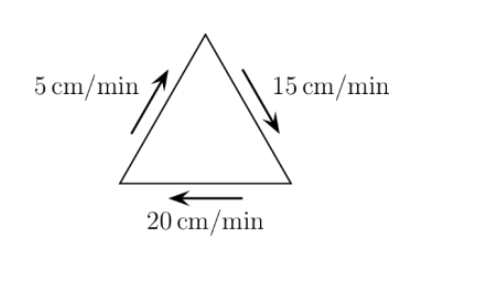
An ant walks along the sides of an equilateral triangle (see diagram). Its speed is 5 cm/min along the first side, 15 cm/min along the second and 20 cm/min along the third. What is the average speed, in cm/min, at which the ant walks once around the whole triangle?
Show answer
Answer: C — 18019
Show hints
Hint 1 of 2
Average speed is total distance divided by total time, not the average of the three speeds.
Still stuck? Show hint 2 →
Hint 2 of 2
Let each side be length L; add the three times L/5, L/15, L/20 and divide 3L by that.
Show solution
Approach: average speed = total distance / total time
Let each side have length L; the times on the sides are L/5, L/15 and L/20.
Total time = L(1/5 + 1/15 + 1/20) = L(12+4+3)/60 = 19L/60.
The gap between two shelves in Monika’s kitchen is 36 cm. A stack of 8 identical glasses is 42 cm high, and a stack of 2 such glasses is 18 cm high. What is the largest number of glasses in one stack that still fits between the shelves?
Show answer
Answer: D — 6
Show hints
Hint 1 of 2
A stack's height grows by the same amount for each extra glass; find that per-glass increase.
Still stuck? Show hint 2 →
Hint 2 of 2
Get the height of one glass, then find the largest count whose stack height stays at or below 36 cm.
Show solution
Approach: linear height model for the stack
From 2 glasses (18 cm) to 8 glasses (42 cm), 6 extra glasses add 24 cm, so each extra glass adds 4 cm.
One glass is 18 - 4 = 14 cm, and n glasses reach 14 + 4(n-1) = 10 + 4n cm.
Need 10 + 4n <= 36, so n <= 6.5; the biggest stack is 6 glasses, the answer is D.
A rabbit and a hedgehog enter a race against each other. The circular racecourse is 550 m long. The starting line and the finish line are the same. The speed of the rabbit is a constant 10 m/s, the speed of the hedgehog is a constant 1 m/s. They start at the same time, but the hedgehog tries to cheat by going in the opposite direction. When the two meet, the hedgehog turns around immediately and follows the rabbit. How many seconds after the rabbit does the hedgehog reach the finish line?
Show answer
Answer: A — 45
Show hints
Hint 1 of 2
Find when the two meet (closing speed) and where the hedgehog is then.
Still stuck? Show hint 2 →
Hint 2 of 2
After turning, the hedgehog still has to cover the rest of the loop to the finish.
Show solution
Approach: relative speed for the meeting, then finish the loop
The rabbit finishes the 550 m loop in 550/10 = 55 s.
Moving toward each other they close 550 m at 10+1 = 11 m/s, meeting at 50 s; the hedgehog has gone 50 m the wrong way.
It turns and must still cover 50 m forward to the start/finish, taking 50 s more, so it finishes at 100 s.
There are two clocks in my office. One gains one minute every hour; the other loses two minutes every hour. Yesterday I set them both to the correct time. When I checked today, one read 11:00 and the other read 12:00. At what time did I set them yesterday?
Show answer
Answer: C — 15:40
Show hints
Hint 1 of 2
Each hour the two clocks drift apart by a fixed amount; how fast does the gap between them grow?
Still stuck? Show hint 2 →
Hint 2 of 2
The clocks now read 60 minutes apart; divide by the hourly drift to find the elapsed time, then step back.
Show solution
Approach: use the growing gap between the clocks
One clock gains 1 min/hour and the other loses 2 min/hour, so they separate by 3 minutes each hour.
They are now 60 minutes apart (11:00 vs 12:00), which takes 60 / 3 = 20 hours.
The true time lies between them, and stepping back gives a setting of 15:40, so the answer is C.
Maurice asked the canteen chef for the recipe for his pancakes. The recipe makes 100 pancakes and uses 25 eggs, 4 litres of milk, 5 kg of flour and 1 kg of butter. Maurice has 6 eggs, 400 g flour, 0.5 litres of milk and 200 g butter. What is the largest number of pancakes he can make using this recipe?
Show answer
Answer: B — 8
Show hints
Hint 1 of 2
The recipe makes 100 pancakes; for each ingredient work out how many pancakes Maurice's amount allows.
Still stuck? Show hint 2 →
Hint 2 of 2
The ingredient that runs out first sets the limit — take the smallest of the four.
Show solution
Approach: find the limiting ingredient
Per 100 pancakes: 25 eggs, 4 L milk, 5 kg (5000 g) flour, 1 kg (1000 g) butter.
Roberto and Maria leave at the same time from the same point of a long circular track, he on foot and she by bike. Maria completes a lap 24 minutes before Roberto and waits for him while having an ice cream. When he reaches this point, Maria leaves on her bike in the opposite direction and Roberto continues walking without stopping in the same direction. They then meet 5 minutes later. Assuming the speeds are kept constant, how long does it take for Roberto to do a lap of the track?
Show answer
Answer: A — 30 min
Show hints
Hint 1 of 2
Let Roberto’s lap take T minutes; Maria’s lap takes T−24.
Still stuck? Show hint 2 →
Hint 2 of 2
When they move in opposite directions and meet in 5 minutes, together they cover one full lap.
Show solution
Approach: set up a lap-time equation from the opposite-direction meeting
Roberto’s lap = T, Maria’s lap = T−24.
Meeting in 5 min going opposite ways: 5(1/T + 1/(T−24)) = 1.
This gives T² − 34T + 120 = 0, so T = 30 (rejecting T = 4).
Julius has two cylinder-shaped candles of different heights and diameters. The first candle burns down in 6 hours, the second in 8 hours. They both burn down evenly. He lights both candles at the same time, and after three hours they are both equally tall. What was the ratio of their original heights?
Show answer
Answer: C — 5 : 4
Show hints
Hint 1 of 2
After 3 hours each candle has burned a fraction of its own height.
Still stuck? Show hint 2 →
Hint 2 of 2
Set the two leftover heights equal and compare the originals.
Show solution
Approach: equal leftover heights give the ratio
In 3 hours the 6-hour candle burns half its height, leaving 1/2; the 8-hour candle burns 3/8, leaving 5/8.
Simon runs along the edge round a 50 m long rectangular swimming pool, while at the same time Jan swims lengths in the pool. Simon runs three times as fast as Jan swims. While Jan swims 6 lengths, Simon manages 5 rounds around the pool. How wide is the swimming pool?
Show answer
Answer: B — 40 m
Show hints
Hint 1 of 2
In the same time, compare how far each travels using the 3-to-1 speed ratio.
Still stuck? Show hint 2 →
Hint 2 of 2
Find the pool's perimeter, then solve for the unknown width from 2(length + width).
Show solution
Approach: equal time, speed ratio gives the perimeter
Jan swims 6 lengths = 6 · 50 = 300 m; in the same time Simon (3 times as fast) covers 900 m in 5 rounds.
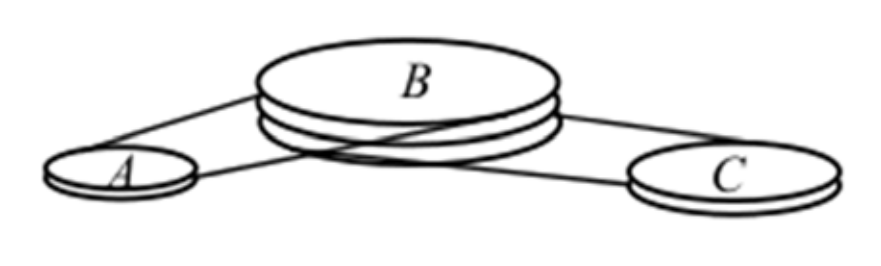
A belt system is made up of wheels A, B and C, which rotate without sliding. B rotates 4 times around, while A turns 5 times around, and B rotates 6 times around, while C turns 7 times around. The circumference of C is 30 cm. How big is the circumference of A?
Show answer
Answer: B — 28 cm
Show hints
Hint 1 of 2
Wheels joined by a belt move the same length of belt, so turns × circumference is equal.
Still stuck? Show hint 2 →
Hint 2 of 2
Chain the A–B relation to the B–C relation.
Show solution
Approach: equal belt length means revolutions are inversely proportional to circumference
Wheels joined by a belt cover the same belt length, so each wheel's turns × circumference is the same on the link.
For B and C: 6 × (circumference of B) = 7 × 30, so the circumference of B is 35 cm.
For A and B: 5 × (circumference of A) = 4 × 35, so the circumference of A is 28 cm, choice B.
Every three minutes a bus leaves the airport to drive to the city centre. A car leaves the airport at the same time as a bus and travels the same route to the city centre. Every bus takes 60 minutes for the journey from the airport to the city centre; the car takes only 35 minutes. How many buses does the car overtake on its way to the city centre? (The bus that starts at the same time as the car does not count.)
Show answer
Answer: A — 8
Show hints
Hint 1 of 2
Send the car and a bus from the airport together and find when the car draws level with each earlier bus.
Still stuck? Show hint 2 →
Hint 2 of 2
A bus counts only if the car catches it before either reaches the city.
Show solution
Approach: catch-up time for each earlier bus
Let the car leave at time 0; a bus that left 3k minutes earlier is caught when the car has run for 4.2k minutes.
This catch must happen before the bus arrives: 4.2k + 3k ≤ 60 gives k ≤ 8.
So the car overtakes buses for k = 1..8, that is 8 buses.
Max has a one-hour piano lesson twice a week; Hanna has a one-hour lesson only every second week. The piano lessons run over a certain number of weeks. How many weeks is this, if during this time Max has 15 more hours of lessons than Hanna?
Show answer
Answer: E — 10 weeks
Show hints
Hint 1 of 2
Work out how many extra hours Max gets over Hanna in a single week.
Still stuck? Show hint 2 →
Hint 2 of 2
Divide the 15-hour gap by the weekly gap to get the number of weeks.
Show solution
Approach: find the weekly difference, then divide
Max has 2 hours each week; Hanna has 1 hour every two weeks, i.e. 0.5 hours per week on average.
So Max gains 2 − 0.5 = 1.5 extra hours every week.
To build a 15-hour lead takes 15 ÷ 1.5 = 10 weeks.
On the Kangaroo planet each kangoo-year has 20 kangoo-months. Each kangoo-month has 6 kangoo-weeks. How many kangoo-weeks are in a quarter of a kangoo-year?
Show answer
Answer: B — 30
Show hints
Hint 1 of 3
First find how many kangoo-weeks fill a whole kangoo-year.
Still stuck? Show hint 2 →
Hint 2 of 3
Every one of the 20 months holds 6 weeks, so count by sixes (or multiply).
Still stuck? Show hint 3 →
Hint 3 of 3
A quarter means splitting that whole year into 4 equal parts and taking one.
Show solution
Approach: find the weeks in a whole year, then split into four equal parts
A year has 20 months and each month has 6 weeks, so a year is 20 × 6 = 120 kangoo-weeks.
A quarter is one of four equal pieces, so share 120 into 4 parts: 120 ÷ 4 = 30.
The king travels with his messengers at 5 km/h from his castle to his summer residence. Every hour he sends one messenger back to the castle at 10 km/h. What is the difference in arrival times between two messengers who arrive at the castle one after the other?
Show answer
Answer: D — 90 min
Show hints
Hint 1 of 2
Work out when the first two messengers each set off and how far from the castle they start.
Still stuck? Show hint 2 →
Hint 2 of 2
Each messenger travels back at 10 km/h; find its arrival time, then subtract two consecutive arrivals.
Show solution
Approach: find each messenger's start distance and return time
After 1 hour the king is 5 km out; that messenger rides back 5 km at 10 km/h, taking 0.5 h, so it arrives 1 + 0.5 = 1.5 h after departure.
After 2 hours the king is 10 km out; that messenger rides back 10 km at 10 km/h, taking 1 h, so it arrives 2 + 1 = 3 h after departure.
The gap between these two arrivals is 3 − 1.5 = 1.5 h = 90 min (and every later pair gives the same 90 minutes).
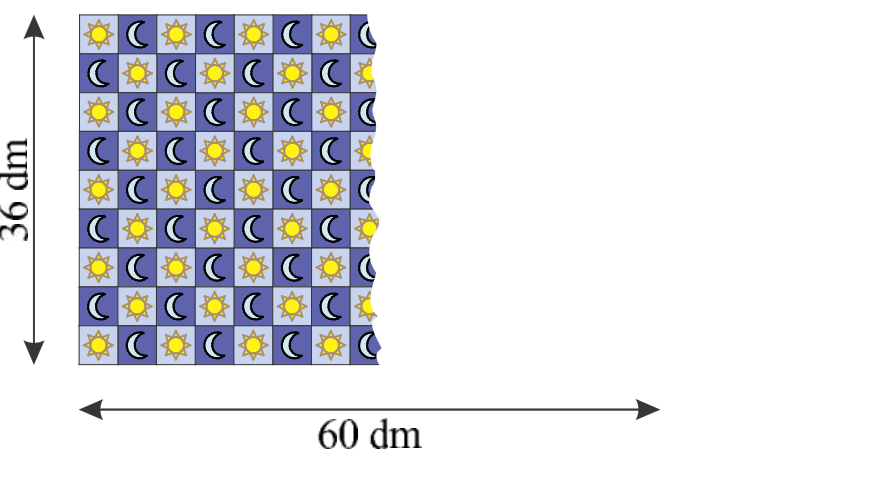
Peter has bought a rug that is 36 dm wide and 60 dm long. The rug is covered in squares that each contain either a sun or a moon, as shown in the picture. There are exactly nine squares along the width of the rug. The full length of the rug cannot be seen. How many moons would you see if you could see the entire rug?
Show answer
Answer: B — 67
Show hints
Hint 1 of 3
If 9 squares fit across the 36 dm width, work out how wide one square is.
Still stuck? Show hint 2 →
Hint 2 of 3
Use that square size to find how many squares fit along the 60 dm length.
Still stuck? Show hint 3 →
Hint 3 of 3
Multiply rows by columns for the total squares, then the sun/moon pattern splits them almost in half.
Show solution
Approach: find the grid size, then count one colour
36 dm ÷ 9 = 4 dm per square, so the length 60 dm holds 60 ÷ 4 = 15 squares.
The rug is 9 × 15 = 135 squares in a checkerboard of suns and moons.
The moons fall on the smaller of the two colour groups, giving 67 moons.
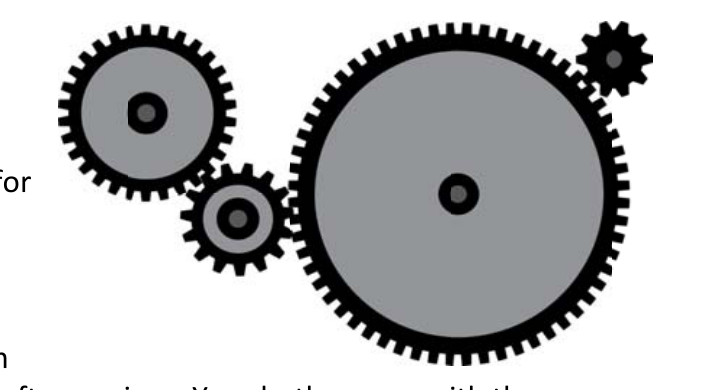
Four cogs are connected to each other as shown in the picture. The first has 30 teeth, the second 15, the third 60 and the fourth 10. How many turns will the last cog make for each full turn of the first cog?
Show answer
Answer: A — 3
Show hints
Hint 1 of 2
Connected gears pass the same number of teeth; the in-between gears do not change the first-to-last result.
Still stuck? Show hint 2 →
Hint 2 of 2
Compare only the first gear's teeth with the last gear's teeth.
Show solution
Approach: teeth passed are equal; compare first and last
One full turn of the first gear moves 30 teeth along the chain of gears.
Those same 30 teeth pass the last gear, which has only 10 teeth.
So the last gear turns 30 / 10 = 3 times (the middle gears do not matter).
Three turtles are competing in a 10 km race. Each of them moves at a constant speed. When the first turtle finishes the competition, the second has completed 14 of the distance and the third has completed 15 of the distance. How far is the third turtle from the finish line when the second turtle finishes the race?
Show answer
Answer: B — 2 km
Show hints
Hint 1 of 2
The turtles move at steady speeds, so the distance each has covered tells you their speed ratio.
Still stuck? Show hint 2 →
Hint 2 of 2
When the 2nd turtle finishes, its distance has grown by the same factor as the 3rd turtle’s.
Show solution
Approach: scale the third turtle’s distance by the same factor
When the 1st finishes 10 km, the 2nd has done 1/4 of 10 = 2.5 km and the 3rd has done 1/5 of 10 = 2 km.
For the 2nd turtle to reach 10 km, time must be multiplied by 10 ÷ 2.5 = 4.
In that same time the 3rd turtle goes 2 × 4 = 8 km.
So the 3rd turtle is 10 − 8 = 2 km from the finish.
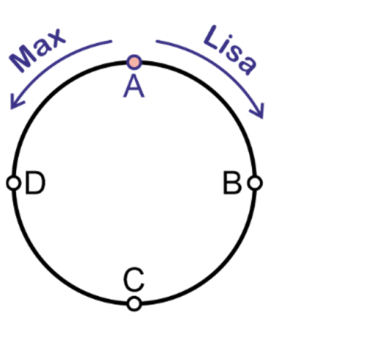
Max draws a large circle in the sand and Lisa adds the letters A, B, C and D. Starting together from point A, Lisa runs clockwise and Max runs anti-clockwise around the circle (see picture). They meet for the first time at B, then at C, then at D, and then again at A. How many times has Max run around the circle by then?
Show answer
Answer: C — 3 times
Show hints
Hint 1 of 2
Each time they meet, together they have covered one more full circle.
Still stuck? Show hint 2 →
Hint 2 of 2
Find what fraction of the circle Max covers before the first meeting, then scale up to the total laps.
Show solution
Approach: use the constant speed ratio across the meetings
Going opposite ways, between meetings the two together cover one whole circle.
They first meet at B after Max has gone three quarters of the way around (A to D to C to B), so Max is 3 times faster.
From the start until they meet again at A, together they cover 4 circles.
Max therefore covers 3 of those 4 circles, so Max ran around 3 times - option C.
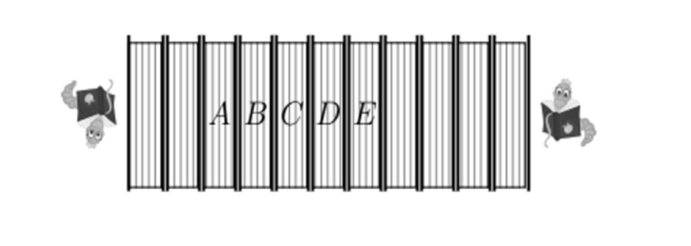
The two bookworms Linki and Rechti eat their way through a row of books. Linki starts from the left and Rechti from the right, both at the same time. Linki eats through a book cover in 3 days and through all the pages of a book in 2 days. Rechti eats through a book cover in 1 day and through all the pages of a book in 2 days. In which book (see illustration) do the two meet?
Show answer
Answer: B — B
Show hints
Hint 1 of 2
Give each worm a 'days to chew through' cost for a cover and for a set of pages, then send them toward each other.
Still stuck? Show hint 2 →
Hint 2 of 2
Add up the days each worm spends, layer by layer, until their totals show them reaching the same book.
Show solution
Approach: accumulate the days each worm needs until they meet
Linki (from the left) needs 3 days per cover and 2 days per book of pages; Rechti (from the right) needs 1 day per cover and 2 days per book of pages.
After 13 days Linki has chewed through book A entirely and reached the pages of book B \((3+2+3+3+2)\); in those same 13 days Rechti has chewed through E, D and C and into book B \((1+2+1+1+2+1+1+2+1+1)\).
Logic & Word ProblemsRatios, Rates & Proportionsratiocasework
A box of fruit contains twice as many apples as pears. Christy and Lily divided them up so that Christy had twice as many pieces of fruit as Lily. Which one of the following statements is always true?
Show answer
Answer: E — Christy took as many pears as Lily got apples.
Show hints
Hint 1 of 2
Let there be p pears and 2p apples, total 3p; Christy ends with 2p pieces and Lily with p.
Still stuck? Show hint 2 →
Hint 2 of 2
Test each statement against every possible split — only one holds in all cases.
Show solution
Approach: check each claim over all valid splits
Pears = p, apples = 2p, total 3p; Christy has 2p pieces, Lily has p.
If Christy takes a apples she takes 2p−a pears; Lily then gets the remaining 2p−a apples.
So Christy's pears always equal Lily's apples; the other options can fail.
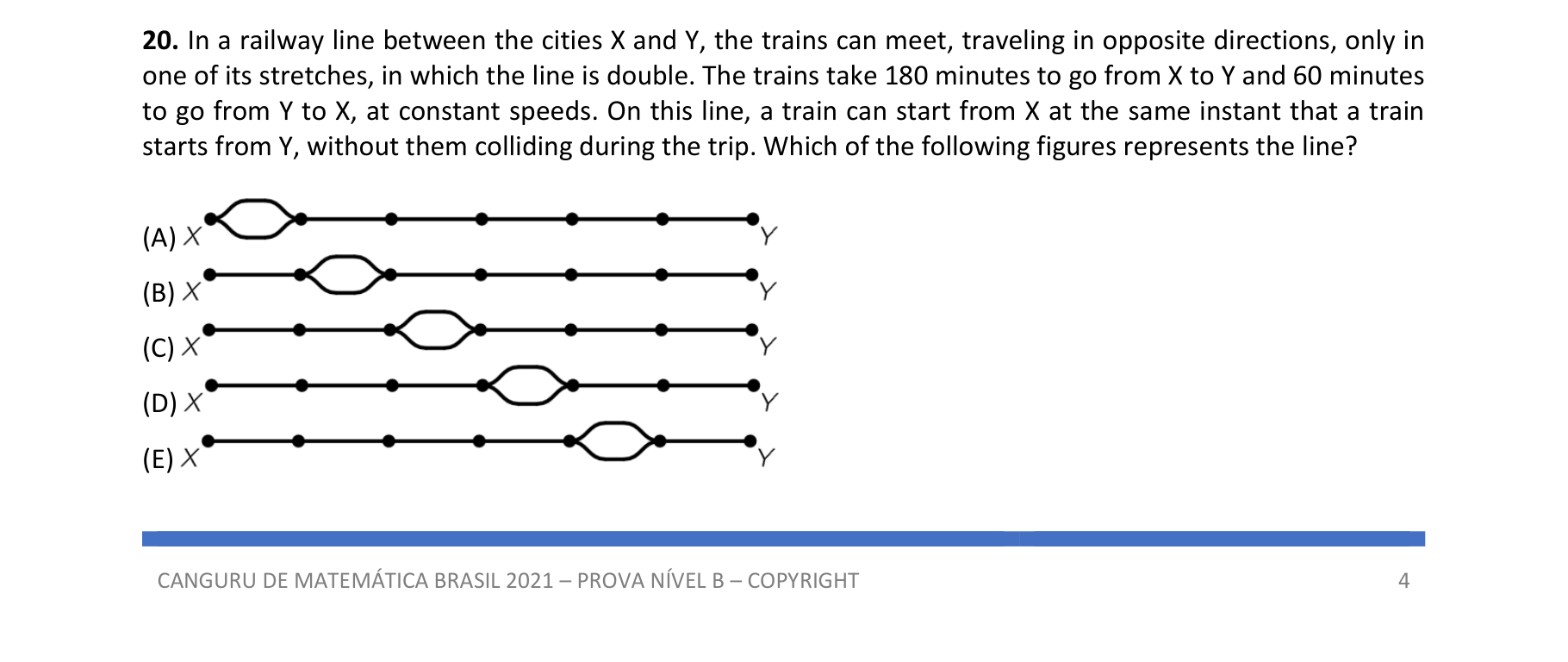
In a railway line between the cities X and Y, the trains can meet, traveling in opposite directions, only in one of its stretches, in which the line is double. The trains take 180 minutes to go from X to Y and 60 minutes to go from Y to X, at constant speeds. On this line, a train can start from X at the same instant that a train starts from Y, without them colliding during the trip. Which of the following figures represents the line?
Show answer
Answer: B
Show hints
Hint 1 of 2
The trains start together; X→Y takes 180 min and Y→X takes 60 min, so the Y-train is three times faster.
Still stuck? Show hint 2 →
Hint 2 of 2
They must cross exactly inside the doubled stretch — locate where they meet along the line.
Show solution
Approach: find the meeting point and place the double stretch there
The Y-train (60 min) is three times as fast as the X-train (180 min), so after the same time it has covered three times the distance.
They meet at the point three-quarters of the way from X to Y.
The double (passing) section must contain that meeting point, which matches figure B.
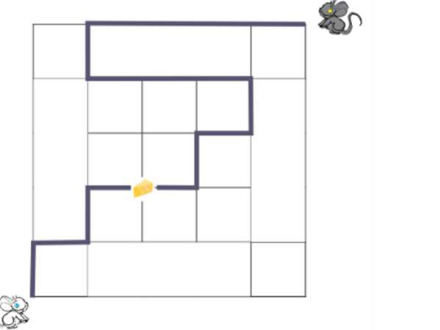
Two little mice, one white and one dark, leave at the same time toward the cheese along the different paths shown (the little squares are all equal). They reach the cheese at the same moment. If the dark mouse runs 4.5 metres per second, how many metres per second does the white mouse run?
Show answer
Answer: B — 1.5
Show hints
Hint 1 of 2
Same start, same finish, same time - so speeds are in the same ratio as the path lengths.
Still stuck? Show hint 2 →
Hint 2 of 2
Count the unit edges each mouse travels; the white mouse's speed scales 4.5 by (white length / dark length).
Show solution
Approach: speeds are proportional to path lengths over equal time
Both mice take the same time, so speed is proportional to distance.
Counting the grid edges, the white mouse's path is one third the length of the dark mouse's path.
Hence its speed is one third of 4.5 m/s, namely 4.5 x (1/3) = 1.5 m/s.
Ana planned to walk an average of 5 km per day in March. In the first 10 days she walked an average of 4.4 km per day, and in the next 6 days she walked an average of 3.5 km per day. What average daily distance must she walk on the remaining days in order to fulfill her plan?
Show answer
Answer: C — 6 km
Show hints
Hint 1 of 2
March has 31 days; turn the planned average into a total distance she must cover.
Still stuck? Show hint 2 →
Hint 2 of 2
Subtract what she has already walked, then divide by the days that remain.
Show solution
Approach: work with totals over the month
A 5 km average over 31 days means a target total of 5 × 31 = 155 km.
First 10 days: 10 × 4.4 = 44 km; next 6 days: 6 × 3.5 = 21 km; so 65 km done in 16 days.
Remaining distance 155 − 65 = 90 km over the last 15 days is 90 ÷ 15 = 6 km/day.
Many model railways use the H0-scale 1:87. For his railway, Benjamin owns a 2 cm high model of his brother in H0-scale. How tall is his brother in reality?
Show answer
Answer: A — 1.74 m
Show hints
Hint 1 of 2
The scale 1:87 means every real centimetre is shrunk 87 times in the model.
Still stuck? Show hint 2 →
Hint 2 of 2
Multiply the model height by 87 to undo the shrinking, then convert to metres.
Show solution
Approach: scale up by the ratio
The model is 2 cm tall and the scale is 1:87, so the real height is 2 x 87 = 174 cm.
Konrad dries mushrooms. From 4 kg of fresh mushrooms he gets 1 kg of dried mushrooms. How many kilograms of mushrooms does he have to pick in order to receive 4 kg of dried mushrooms?
Show answer
Answer: B — 16 kg
Show hints
Hint 1 of 2
Every 4 kg of fresh mushrooms shrinks to 1 kg dried.
Still stuck? Show hint 2 →
Hint 2 of 2
To get 4 kg dried, scale that 4-to-1 relationship up four times.
Show solution
Approach: scale the fresh-to-dried ratio
4 kg fresh gives 1 kg dried.
For 4 kg dried, he needs 4 times as much fresh: 4 × 4 kg = 16 kg.
A cyclist covers a distance of 5 m in one second. The wheels of his bike each have a circumference of 125 cm. How many complete turns does each wheel make in 5 seconds?
Show answer
Answer: D — 20
Show hints
Hint 1 of 2
First find how far the bike travels in 5 seconds, then how far one wheel turn moves it.
Still stuck? Show hint 2 →
Hint 2 of 2
One full turn moves the bike one circumference; divide the distance by the circumference (watch the units).
Show solution
Approach: distance over circumference
In 5 seconds the bike covers 5 * 5 = 25 m = 2500 cm.
Each full wheel turn moves it forward one circumference, 125 cm.
Anna walks a distance of 8 km at a speed of 4 km/h. Then she runs for a while at 8 km/h. For how many minutes must she run so that her overall average speed is 5 km/h?
Show answer
Answer: E — 40 min
Show hints
Hint 1 of 2
Average speed is total distance over total time, not the average of the speeds.
Still stuck? Show hint 2 →
Hint 2 of 2
Write the running distance as an unknown and set the overall average to 5 km/h.
Show solution
Approach: set total distance / total time = 5
Walking 8 km at 4 km/h takes 2 h. Let the run be d km at 8 km/h, taking d/8 h.
Require (8 + d)/(2 + d/8) = 5; solving gives d = 16/3 km.
At an airport there is a “rolling pavement” which is 500 m long and transports people with a speed of 4 km/h. Anna and Peter step onto the rolling pavement at the same time. While Peter is standing still, Anna continues to walk with a speed of 6 km/h. How big is Anna’s head start on Peter when she leaves the rolling pavement after 500 m?
Show answer
Answer: E — 300 m
Show hints
Hint 1 of 2
Add Anna's walking speed to the belt's speed to get her ground speed.
Still stuck? Show hint 2 →
Hint 2 of 2
Find how long Anna takes for 500 m, then see how far Peter (moving with the belt) gets in that time.
Show solution
Approach: distance = speed × time
Anna's ground speed is 4 + 6 = 10 km/h; Peter just rides the belt at 4 km/h.
Anna covers 500 m = 0.5 km in 0.5 ÷ 10 = 0.05 h.
In 0.05 h Peter travels 4 × 0.05 = 0.2 km = 200 m, so Anna's lead is 500 − 200 = 300 m.
In order to sew together three short strips of cloth to get one long strip, Cathy needs 18 minutes. How much time does she need to sew together a really long piece consisting of six short strips?
Show answer
Answer: D — 45 minutes
Show hints
Hint 1 of 2
Joining strips needs one fewer seam than the number of strips.
Still stuck? Show hint 2 →
Hint 2 of 2
Find the time per seam from the three-strip case, then count seams for six strips.
Show solution
Approach: count seams, scale by time per seam
Three strips need 2 seams and take 18 min, so each seam takes 9 min.
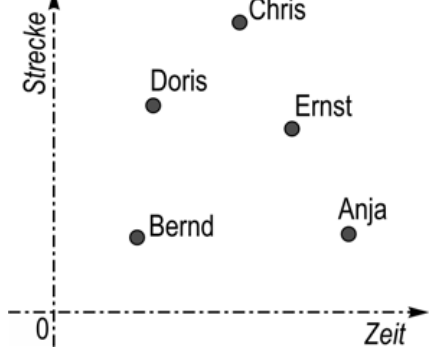
Five students take part in a run. Their results are recorded in the graph opposite, showing the time taken (Zeit) and the distance covered (Strecke). Who had the greatest average speed?
Show answer
Answer: D — Doris
Show hints
Hint 1 of 2
Average speed is distance divided by time, the steepness of the line from the origin to that point.
Still stuck? Show hint 2 →
Hint 2 of 2
The fastest runner is the point making the steepest line up from 0.
Show solution
Approach: steepest distance-over-time point
Speed is distance divided by time, the slope from the origin to each marked point.
The point that is high up (large distance) yet far left (small time) has the steepest slope.
A bridge is being built across a river that is 120 m wide. One quarter of the bridge continues onto the land on the left bank, and another quarter continues onto the land on the right bank. How long is the bridge?
Show answer
Answer: D — 240 m
Show hints
Hint 1 of 2
A quarter on each bank means half the bridge is over the water.
Still stuck? Show hint 2 →
Hint 2 of 2
If the river part is half the bridge and equals 120 m, scale up.
Show solution
Approach: part-to-whole
One quarter is on the left land and one quarter on the right land, so half the bridge is over the river.
That river half is 120 m.
So the whole bridge is 2 × 120 = 240 m — answer D.
Julia and her little sister Paula start a bike ride together. Julia cycles at a constant speed of 18 km/h and Paula at a constant speed of 12 km/h. They cycle along the same route. After 20 minutes, Julia is tired and turns around. When she meets Paula, she also turns around and they both cycle home at their respective speeds. How many minutes does Paula arrive later than Julia?
Show answer
Answer: C — 8
Show hints
Hint 1 of 2
Find where Julia (turning at 20 min) meets Paula, then send each home at her own speed.
Still stuck? Show hint 2 →
Hint 2 of 2
They meet 4 min after Julia turns; from there compare each rider's time home.
Show solution
Approach: meeting point then separate trips home
In 20 min Julia rides 6 km and turns; Paula has ridden 4 km. Closing 2 km at 30 km/h takes 4 min, meeting at 4.8 km.
Julia home: 24 + 4.8/18·60 = 40 min. Paula home: 24 + 4.8/12·60 = 48 min.
Olga walked in the park. For half of the time she walked at 2 km/h. For half of the distance she walked at 3 km/h. For the rest of the time she walked at 4 km/h. For what fraction of the time did she walk at 4 km/h?
Show answer
Answer: A — \(\frac{1}{14}\)
Show hints
Hint 1 of 2
Name the total time T and total distance S, then write the distance covered in each phase.
Still stuck? Show hint 2 →
Hint 2 of 2
The three phases must account for all of S, which gives one equation linking S and T.
Show solution
Approach: write each phase, force the distances to add to S, then read off the time share
In the first half of the time (time \(\tfrac{T}{2}\)) at 2 km/h she covers \(2\cdot\tfrac{T}{2}=T\); the 3 km/h stretch covers half the distance \(\tfrac{S}{2}\); the leftover time \(\tfrac{T}{2}-\tfrac{S}{6}\) at 4 km/h covers \(4(\tfrac{T}{2}-\tfrac{S}{6})\).
Adding all three distances to \(S\) gives \(S=T+\tfrac{S}{2}+(2T-\tfrac{2S}{3})\), which solves to \(S=\tfrac{18T}{7}\).
Then the 4 km/h time is \(\tfrac{T}{2}-\tfrac{S}{6}=\tfrac{T}{2}-\tfrac{3T}{7}=\tfrac{T}{14}\), so its share of the total time is \(\frac{1}{14}\), answer A.
Anne drives from point A to point B and then immediately back to A. Benni drives from point B to point A and then immediately back to B. They drive on the same road, start at the same time, and both drive at constant speed. Anne’s speed is three times as high as Benni’s speed. They meet for the first time 15 minutes after they start. How long after the start will they meet for the second time?
Show answer
Answer: C — 30 min
Show hints
Hint 1 of 2
At the first meeting the two together have covered the whole road once, fixing the road length in their speeds.
Still stuck? Show hint 2 →
Hint 2 of 2
Track who turns around when; the second meeting comes after Anne (the faster one) catches Benni from behind.
Show solution
Approach: track positions through the turnarounds to the second meeting
With speeds 3v and v meeting head-on after 15 min, the road length is 4v·15 = 60v.
Anne reaches the far end at 20 min and turns back; Benni is still heading the same way.
Anne then closes the 20v gap at relative speed 2v, taking 10 more min, so they meet at 30 min.
When Matilda’s smartphone is fully charged it has a battery life of 32 hours if she phones continuously, 20 hours if she surfs the internet continuously, and 80 hours if she does not use it at all. Matilda boards a train with a half-full battery. During her time on board she spends the same amount of time each on phoning, surfing the internet, and not using the phone at all. Just when she arrives at her destination the battery is empty. How many hours did the train ride take?
Show answer
Answer: D — 16
Show hints
Hint 1 of 2
Convert each usage into a fraction of the battery drained per hour.
Still stuck? Show hint 2 →
Hint 2 of 2
With equal time on each activity, set the total drain equal to half a battery.
Show solution
Approach: add the drain rates over equal time shares
Drain rates are 1/32, 1/20, 1/80 of the battery per hour.
Over a ride of length T with T/3 on each: (T/3)(1/32+1/20+1/80) = 1/2.
The bracket is 15/160 = 3/32, so (T/3)(3/32) = T/32 = 1/2.
By bike it takes Marc 20 minutes to go from home to school and back; on foot the same round trip takes 60 minutes. He rides and walks at constant speeds. Yesterday Marc biked to Eva’s house (on the way to school), left the bike there, and walked the rest of the way to school. Coming home he first walked to Eva’s house, then biked the rest of the way. The whole journey took 52 minutes. What fraction of the journey did he cover by bike?
Show answer
Answer: B — 1⁄5
Show hints
Hint 1 of 2
One leg (home to school) takes 10 min by bike and 30 min on foot; the bike part is the same length each way.
Still stuck? Show hint 2 →
Hint 2 of 2
Let the bike part be a fraction \(f\) of one leg; he bikes it twice and walks the rest twice, totalling 52 min.
Show solution
Approach: mix bike and walking times over the route
A round trip is two legs; by bike one leg takes 10 min, on foot one leg takes 30 min.
Let the bike portion be a fraction \(f\) of one leg. He bikes that fraction on both legs and walks the rest on both legs, so the time is \(2(10f) + 2(30(1-f)) = 60 - 40f = 52\).
Then \(40f = 8\), so \(f = \tfrac{1}{5}\), and the bike distance is \(\tfrac{1}{5}\) of the whole journey, so the answer is B.
Jonas was driving his car and saw the following information on the car display: speed 90 km/h, distance travelled 116.0 km, and time 21h00min. Jonas kept driving at the same speed, and that same night he noticed that the four-digit sequence showing the distance travelled was the same four-digit sequence showing the time. At what time did this happen?
Show answer
Answer: D — 22h10min
Show hints
Hint 1 of 2
At 90 km/h he gains 90 km each hour (1.5 km per minute); update both the distance and the clock together.
Still stuck? Show hint 2 →
Hint 2 of 2
Find the moment when the four digits of the distance match the four digits of the time.
Show solution
Approach: advance distance and time together
At 90 km/h the distance climbs by 1.5 km per minute from 116.0 km at 21h00.
After 70 minutes (at 22h10) the distance is 116 + 90·(70/60) = 221.0 km.
The distance digits 2–2–1–0 match the time 22h10 exactly.
Two points are marked on a circular disc that rotates about its centre. The outer point is 3 cm further away from the centre than the inner point, and it moves 2.5 times as fast as the inner point. How big is the distance between the outer point and the centre of the circular disc?
Show answer
Answer: E — 5 cm
Show hints
Hint 1 of 2
On a spinning disc, speed is proportional to distance from the centre.
Still stuck? Show hint 2 →
Hint 2 of 2
If the outer radius is r and the inner is r − 3, then r/(r − 3) = 2.5.
Show solution
Approach: speed proportional to radius
Speed ∝ radius, so (outer radius)/(inner radius) = 2.5.
With inner = r − 3 and outer = r: r = 2.5(r − 3) ⇒ 1.5r = 7.5 ⇒ inner = 2.
Ria and Flora compare their savings and find that they are in the ratio 5 : 3. Then Ria buys a tablet for 160 €. The ratio of their savings now changes to 3 : 5. How much money did Ria have before she bought the tablet?
Show answer
Answer: C — 250 €
Show hints
Hint 1 of 2
Write both savings using the 5 : 3 ratio with one unknown.
Still stuck? Show hint 2 →
Hint 2 of 2
Subtract 160 from Ria's and set the new ratio to 3 : 5.
Show solution
Approach: set the changed ratio equal to 3 : 5
Let savings be 5x (Ria) and 3x (Flora).
After Ria spends 160: (5x − 160) : 3x = 3 : 5, so 5(5x − 160) = 9x.
That gives 25x − 800 = 9x, 16x = 800, x = 50, so Ria had 5x = 250 Euros.
Two runners are training at the same time on a 720 m long, round running track. They run with constant speed in opposite directions. The first runner needs four minutes for one lap, the second five minutes. How many metres does the second runner run between two consecutive meetings of the two runners?
Show answer
Answer: E — 320
Show hints
Hint 1 of 2
Running opposite ways, the two runners' speeds add when finding how fast the gap to the next meeting closes.
Still stuck? Show hint 2 →
Hint 2 of 2
Find the time between meetings, then multiply by the slower runner's speed.
Show solution
Approach: closing speed gives the meeting interval
A motorboat drives in the middle of a stream. Downstream it needs four hours to get from X to Y. In order to drive back from Y to X it needs six hours. Tree trunks are also floating on the stream. How many hours does it take for a tree trunk to float in the middle of the stream from X to Y?
Show answer
Answer: E — 24
Show hints
Hint 1 of 2
Let the boat speed and current speed combine downstream and oppose upstream.
Still stuck? Show hint 2 →
Hint 2 of 2
The tree floats at the current's speed alone; find that from the two trip times.
Show solution
Approach: relative speeds
Downstream speed is D/4 and upstream is D/6 (D the distance).
Subtracting, twice the current is D/4 − D/6 = D/12, so the current is D/24.
David cycles from Edinburgh to his aunty, who lives outside Edinburgh. He wants to arrive at exactly 15:00. After 23 of his planned travel time he had covered 34 of the way. He then cycled more slowly and arrived exactly on time. In what ratio are the average speeds of the two sections of his journey?
Show answer
Answer: C — 3 : 2
Show hints
Hint 1 of 2
Take the planned time as 1 and the distance as 1; the first part used 2/3 of the time for 3/4 of the distance.
Still stuck? Show hint 2 →
Hint 2 of 2
Speed = distance ÷ time for each part, then compare the two speeds.
Show solution
Approach: compute each part's speed as distance over time
Let total time = 1 and total distance = 1. First part: distance 3/4 in time 2/3, so speed = (3/4)/(2/3) = 9/8.
Second part: the remaining 1/4 of distance in the remaining 1/3 of time, so speed = (1/4)/(1/3) = 3/4.
A car starts at point A and drives on a straight road at 50 km/h. Every hour after that, another car leaves point A with a speed 1 km/h faster than the one before. The last car leaves A 50 hours after the first car and drives at 100 km/h. What is the speed of the car that is leading 100 hours after the start of the first car?
Show answer
Answer: C — 75 km/h
Show hints
Hint 1 of 2
The car leaving at hour k has speed 50 + k and, by 100 hours, has driven for 100 − k hours.
Still stuck? Show hint 2 →
Hint 2 of 2
Maximise the distance (50 + k)(100 − k) over k from 0 to 50.
Show solution
Approach: maximise distance travelled at t = 100
The car leaving at hour k (speed 50 + k) has travelled (50 + k)(100 − k) by t = 100.
This product is largest at k = 25, giving 75 × 75 = 5625.
It takes 8 seconds for train G to pass by a milestone. Shortly afterwards the train meets train H. It takes 9 seconds for the trains to pass each other. Train H then takes 12 seconds to pass by the milestone. What can be deduced about the length of the trains?
Show answer
Answer: A — G is twice as long as H.
Show hints
Hint 1 of 2
Passing a milestone takes (own length)/(own speed); passing each other uses the combined length and speeds.
Still stuck? Show hint 2 →
Hint 2 of 2
Write the three timings and combine them to compare the lengths.
Show solution
Approach: translate each timing into length = speed × time and combine
Let G have length Lg, speed vg, so Lg = 8·vg; H has Lh = 12·vh.
The trains pass each other in 9 s: Lg + Lh = 9(vg + vh), i.e. 8vg + 12vh = 9vg + 9vh, giving vg = 3vh.
Then Lg = 8vg = 24vh and Lh = 12vh, so Lg = 2·Lh: train G is twice as long as H (A).
Two runners each run at constant speed around a racetrack. Both start at the same time at the same point. A is faster than B, takes 3 minutes to cover one lap, and overtakes B for the first time after 8 minutes. How long does B take to cover one lap?
Show answer
Answer: D — 4 min 48 sec
Show hints
Hint 1 of 2
‘First overtake’ means A has run exactly one extra full lap compared with B.
Still stuck? Show hint 2 →
Hint 2 of 2
Set A’s laps minus B’s laps equal to 1 at the 8-minute mark and solve for B’s lap time.
Show solution
Approach: first overtaking = exactly one lap ahead
In 8 minutes A completes 8/3 laps; B completes 8/T laps for lap time T.
First overtaking means 8/3 − 8/T = 1, so 8/T = 5/3 and T = 24/5 minutes.